I wanted to learn to knit for years before I finally got the chance. It was on my ‘things to do after graduate school’ list. However, I didn’t have to wait that long because in my last year of graduate school a new student offered to teach a group of us to knit. Before the lesson, she instructed me to go out and buy a big pair of knitting needles and a chunky skein of yarn. Later, I would learn that the chunky yarn knits up faster, which is encouraging for new knitters who spend the first few lessons staring at a strange little tangle of knots hanging from a stick. I can’t remember how many times we met (just a few, I think), and, in those sessions, she taught me to knit!
So, I’ve been knitting. In the past few years, I’ve knitted all manner of squares and rectangles and even branched out to a pretty terrible-looking hat (more on hats later). For Christmas, I made a blanket for my nephew, which turned out to be bigger than I originally intended (he’ll grow into it, right?) The blanket was fun through. It was simple, and it didn’t take a lot of concentration—it was something I could do while watching a show or in a meeting. I’ve decided to tackle a few more “baby blanket” projects, and now that I’m a little more confident, I’ve decided to start working more with textures and borders. My first post-holiday project has been a baby blanket for my cousin’s son’s first birthday. Since he’s a year old now, I wanted to make a blanket that was a little bigger than the patterns I was seeing online for newborn baby blankets.
Below is a description of the pattern I created (which is not in typical knitting pattern speak). If you try it out or alter it, please let me know what you think!
The Materials:
I used four skeins of “Loops & Threads Country Loom” in a color called “driftwood.” I chose this color because it has a natural green tone to it that I hope will complement the baby’s current bedding.

Loops & Threads Country Loom in Driftwood; image from Michaels
The Pattern:
Row 1-7: I cast on seventy stitches across. Many of the patterns called for 50-60 stitches across for a 32 inch width. Since my blanket is for a one-year old, I went a little bigger, and I’m glad I did because it was none too wide. Back to the pattern: I knit stitched for seven rows. (See notes below for what I would do differently.)
Row 8: I knit stitched seven stitches, marked it, then purl stitched 56 stitches, marked it again, and then knit stitched seven stitches.
Row 9: I knit stitched seven stitches, marked it, then knit stitched 56 stitches, marked it again, and then knit stitched seven stitches.
Row 10-?: I did a regular stitch for the first and last seven stitches, and then I alternated knit stitch and purl stitch until I had almost finished four skeins of yarn. I was aiming for about 36 inches long, but mine ended up being about 45 inches long—which looked about right.
Last 7 rows: I did a regular knit stitch for the last seven rows and then cast off.
Notes: I created this pattern myself, and I really liked the way it turned out. However, if I had to do it all over, I would probably knit ten rows instead of seven before beginning to alternate the knit/purl stitches in the middle of the blanket because the resulting boarder around the edge of the blanket is not quite as long as the border around the sides of the blanket. I was, however, happy with the length of sides of the border, which was the seven stitches that I marked off on either side of the blanket.
The Final Product:
The final product was a bordered baby blanket about 32×45 inches. I should’ve taken better pictures, but I shipped it off too soon! Just trust me that the actual color is a little better than in this photo. Also, the border doesn’t show up very well–though it is a subtle border. Here it is:
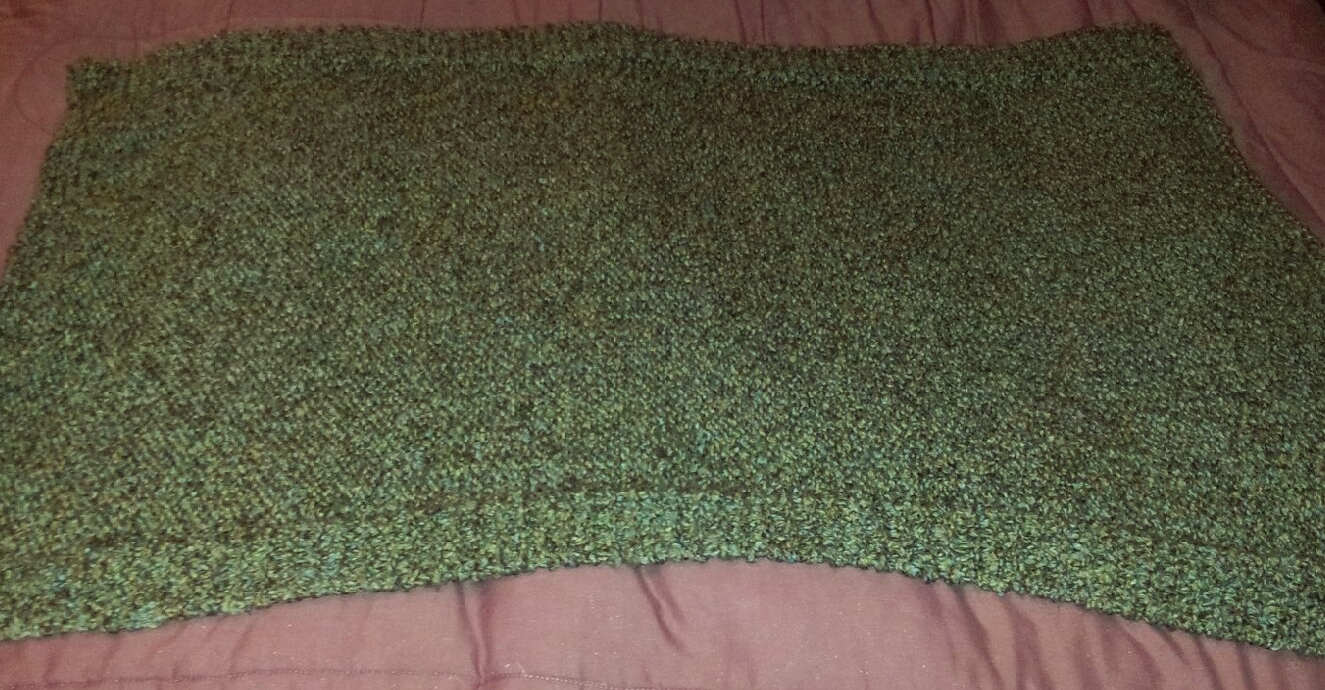
baby blanket with Loops & Threads Country Loom in Driftwood

 SHEREWIN