Monthly Archives: August 2025

The Goodbye Kit by Daneen Bergland

I keep seeing people posting about the “Sealey Challenge,” which is to make a point to read books of poetry during the month of August. I figured it was a good time to clear some poetry off of my tbr pile.

I found The Goodbye Kit by Daneen Berhland to be a completely clean and readable book of poetry, with beautiful imagery, some funs turns of language, and relatable themes throughout.

How Should a Person Be? by Sheila Heti

I have a quick follow up after yesterday’s post because I just also recently finished How Should a Person Be? by Sheila Heti.

Lately, I’ve had a hard time telling if some main characters are intentionally or unintentionally insufferable, and this is one of those instances where I couldn’t always tell. The main character is supposed to be insufferable to a degree, sure, but to this degree? I’m not so sure.

That said, with books like these, I’m always glad they get published. I’m glad this was published. For most, this is worth the read. However, if you are feeling a bit on the sensitive side, maybe skip this one (for now). There is a wandering, an aimlessness, and unknowing that may be comforting, but there is also deep friendship and closeness, which I could imagine may feel alienating to some. There is also some short sections of depravity that may be better left unread by some.

For the average reader, acquainted with and able to stomach what I’ve mentioned above, do read this unique book.

Women We Buried, Women We Burned by Rachel Louise Snyder

I can’t remember how Women We Buried, Women We Burned by Rachel Louise Snyder got on my reading list, but about half way through the book, I realized I was vaguely familiar with Snyder’s work from NPR. I could recall some of difficult human rights stories she reported on, especially surrounding women’s rights abroad.

In that regard, this books nearly reads like two books. First, there is the story of Snyder’s traumatic and tumultuous childhood. Then, there is her life and journey to motherhood, and finally there is the story with Barb at the end. To me these all feel like a cohesive whole.

This is an important book, with a main character that grapples with tough cultural questions, chief among them have to do with women having a right to understand and have control of their own bodies. The painful stories she recounts illustrate these issues and bring to light the ways in which social controls take away basic bodily autonomy.

At times I thought some of the details were strangely specific, without being clear as to why, the book too lengthy. By the end, I was convinced that most of it was necessary. The books is a beautiful and important book. Next, I’d like to see her write more about the middle part, about her life abroad, about motherhood and marriage. About relationships. I hope she does.

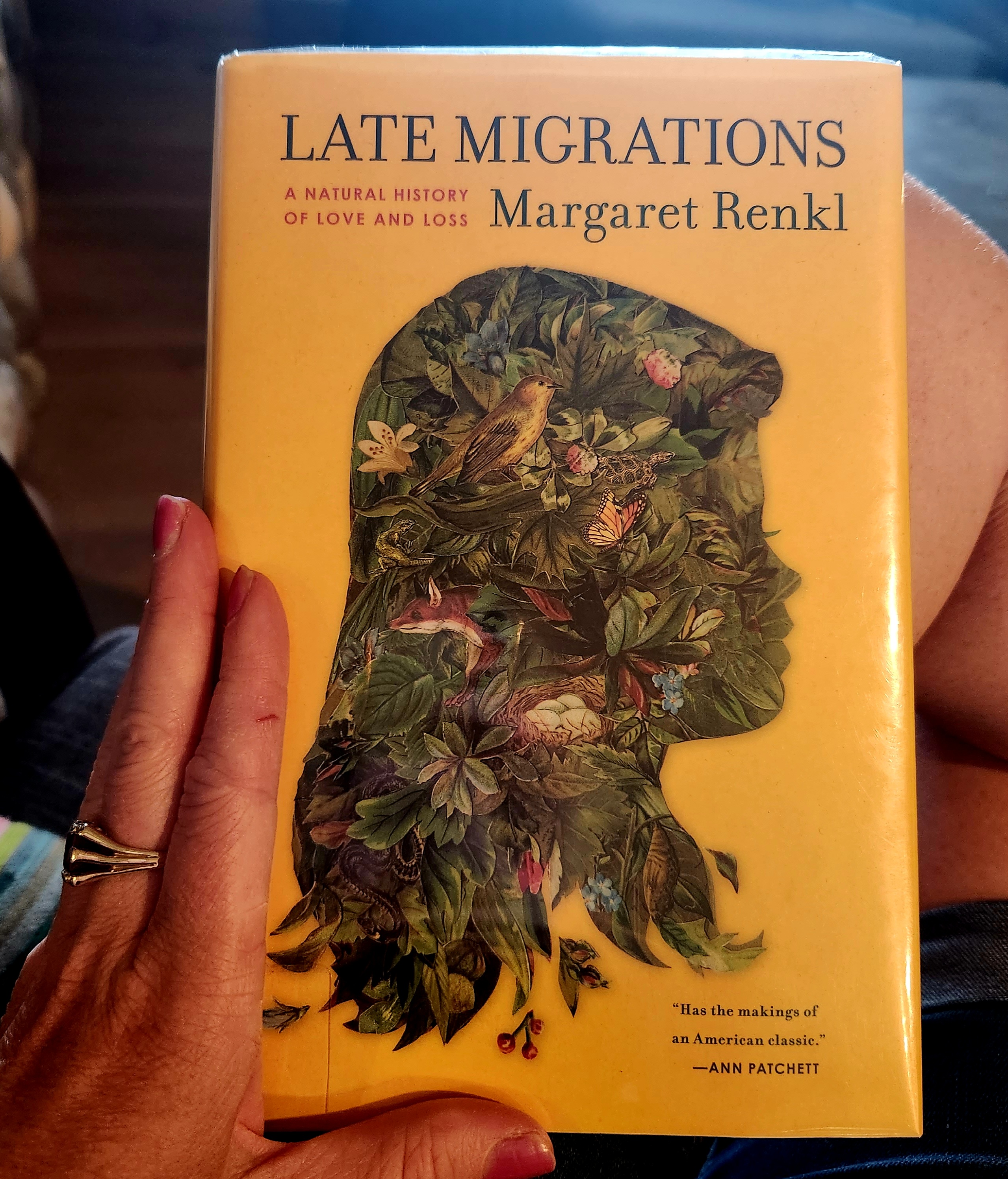
Late Migrations: A Natural History of Love and Loss by Margaret Renkl

I read somewhere that Wendell Berry (and I mostly like Wendell Berry!) was one of Margaret Renkl’s influences, and I could definitely see that as I read, especially in the attention to and elevation of the natural world.

Late Migrations: A Natural History of Love and Loss is a beautifully written book that does so many important things: it captures the lifespan intimate family relationships, the landscapes that hold them, and the socio cultural aspects of these southern spaces as well.

It is also very clear that Renkl is a trained poet, as this makes the prose beautiful to read. I always love it when writers are able to produce unconventional structures in books AND also get published. Overall–a bittersweet, but life affirming book.

The Best American Short Stories 2024

My creative writing classes keeps me reading The Best American Short Stories each year, but looking back through my notes, it appears that I don’t typically write about it, which is a shame! This year’s story collection was edited by Lauren Groff, who I have been reading and enjoying lately. (Though honestly I typically don’t have a sense of an editor’s taste from one year to the next.)

This year’s collection was epic and stunning as always. In my opinion, these anthologies are the single best way to get a sense of contemporary writing, although the works remain fairly conservative in their form and approach. These are all typical short stories.

One of the most memorable stories this year had abuse in it. As I think back over the years, I now realize that some of the stories that stand out the most have featured some type of abuse. Not because they are better stories, but because they can be so traumatizing to the reader. I don’t like it and seem to get increasingly sensitive to it with each passing year. I even think the series may need to start integrating trigger warnings. Maybe literary fiction more broadly needs to integrate trigger warnings. And, yet, as I write this, I am aware that the trigger warning significantly changes the reading experience. I don’t have the answers. I think this work should exist. It lends insight into the human condition. Even still, at this point I can’t help but think that the subtler works are the greater works.