Category Archives: enlightenment

i do rush home

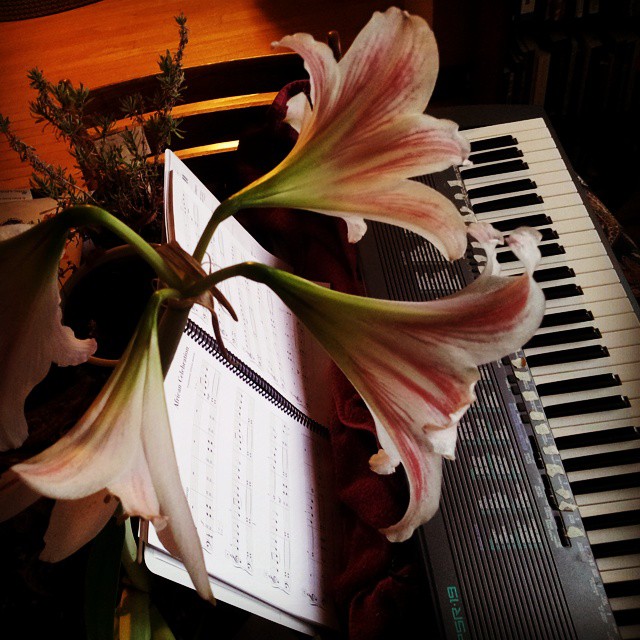
I rush home to play the piano. (Well, keyboard.) I listen to songs on the radio and try to figure them out while driving. I fill out all of the exercises in my lesson book just for the joy of it.

My mom’s pretty competent at the piano, but has always wanted to play the violin. She started taking lessons this summer and absolutely loved it. I, on the other hand, have always wanted to play the piano. I took lessons when I was very young, but they were short-lived.

This summer, my mom inspired me with her violin lessons. She kept saying things like, “I just love it,” and “It’s so great.” It’s probably the English major in me, but I’m always prompting her to explain what she means. “What’s great about it?” She couldn’t quite explain. Now, neither can I.

I found a teacher who lives nearby and signed up for lessons this fall. I immediately loved it and, like my mom, find myself sort of inarticulate about it: “It’s the best thing ever,” and “It’s just so great.” At first I really loved the forced meditation. Music requires your entire brain, and when I’m concentrating, there is no room for chatter. There is no room for anything else, and it is divine.

One of the things I miss from my last relationship is music. I miss singing (though I am shy!) and I miss hearing the new song and the song that’s dedicated to me. So, I’ve tried to create that for myself. I’ve been surprised by how quickly I’ve been able to move through the lesson book and how satisfying it is to play.

I’ve always felt drawn the to piano. I have always wanted to be able to play. I love the sound of the piano. I’m also really fast at typing (and I think that actually helps.)

I don’t know what else to say. See how rambling and incoherent I am about it? Other than just “YES! I am doing it! And it is so great!”

morning scene

morning scene

Birth, Breath, and Death: Meditations on Motherhood, Chaplaincy, and Life as a Doula by Amy Wright Glenn

Since I began the doula certification process through DONA International, I have had to read myriad required books on labor and the work of being a labor companion. My favorite book by far has been Ina May Gaskin’s Ina May’s Guide to Childbirth. I pretty much love everything she does, but that book was has been the best so far.

image from Amazon

image from Amazon

As I’ve completed the required reading for the doula certification, I’ve been able to branch out and read some related works that are not on the list. While I’ve browsed through a few other titles, Birth, Breath, and Death: Meditations on Motherhood, Chaplaincy, and Life as a Doula by Amy Wright Glenn has been the standout. It’s a really interesting book that (perhaps controversially) makes the connection between doula work and chaplaincy.

Let me get my criticisms out of the way first (because that’s always the worst part). Organization. This book has an organization problem. It appears to be a mash up of personal reflection (that is wonderful!) and what reads like long excerpts from a recycled academic paper on spirituality, love, philosophy (which is fine, but less wonderful). I sometimes found myself wanting her to get back to her stories, lovely insights, and self-reflection.

Glenn’s experience and her perspective is absolutely rich. It felt like an indulgence, and I wanted more. Since I began this work, I have often thought of the close connection between doula work and chaplaincy—although I haven’t thought chaplaincy was the right word—it makes me think of religion. Like yoga, doula work is more than spirituality. It also deals with the emotional and very much the physical. In fact, I imagine that chaplaincy work would do well to take a lead from the female-centric way that doulas have of guiding new life on to Earth (no big deal).

At a recent doula gathering, a new friend, still very emotional, shared that her father had recently passed away. As doulas, we discussed the way that doulas might facilitate a more peaceful, less medicalized passing, just like we are often asking questions and making plans in advance to help facilitating a more peaceful, empowered, and oftentimes a less medicalized birth.

It appears that Glenn has made that connection between birth and death in her own life’s work. A highlight of her book is her birth story. It’s one of the best I’ve ever read (though I have read [and witnessed!] many beautiful birth stories). Like all births, Glenn’s labor is unpredictable, and she is skilled at reflecting and sharing insights from the experience. More generally, I loved her insights on motherhood. I wanted to know even more about her thoughts on her own mother. I loved reading about the way she loves her son and the hesitations she had at becoming a mother in the first place.

If you find deep complexity in doula work, motherhood, childhood, life, and death, you’ll like this book. You might have to forgive it for lacking some of the polish (and organization) of other books, but if you’re like me, that forgiveness will be easy for the insight she offers.

Let’s Explore Diabetes with Owls by David Sedaris

I recently finished another book by David Sedaris, Let’s Explore Diabetes with Owls. As with all of his books, this one was well worth the read. I found myself having deep feelings of gratitude for the author as I laughed, and was moved by, his prose.

Let's Explore Diabetes with Owls

image from NPR

My favorite stories are the ones where he pokes fun at himself. I love the stories of his childhood. “Loggerheads” is wonderfully cringe-worthy and funny and sad. I love the stories of his early adulthood. For me, “Stand Still” covered the well-worn territory of parental expectations, masculinity vs. humanism, and adulthood vs. pettiness. I love the stories of his life now. His story “Rubbish” tackles the fine line between being a good human and the deep relationship with neuroses that such an endeavor might inspire.

Though I’m on board with his politics, the overtly political pieces were funny, yes, but less engaging on all counts.  Still, it’s funny. And smart. And absolutely worth reading. Framed differently, perhaps in first person and expertly woven with his own life, they might be even better.

As I mentioned earlier, I had a strong feeling of gratitude as I read. I frequently hear stories of people “thanking” their favorite  artists for their work. Sedaris is one whom I want to thank, and this sense of gratitude was with me throughout the entire book.

When Women Were Birds by TTW

When Women Were Birds, the latest book from Terry Tempest Williams (TTW), is a wonderful, painful, poetic, and intensely personal meditation on Williams’ life: her femininity, her spirituality, her relationship with her mother, and more. Her work resonates with me because, like TTW, my family has been affected by cancer–cancer that was likely caused by exposure to radiation. “Clan of the One-Breasted Women” was the first beautiful thing I’d ever read that spoke directly to that experience.

Grandma on her wedding day

My own grandmother died after a painful, decade-long battle with cancer at the age of 54. I gasped as I read that TTW’s mother also died of cancer at 54–an age that becomes painfully young the older I get. My grandmother’s youngest sister was also afflicted with cancer and did not survive childhood. Her siblings, who lived to adulthood, got cancer too. The doctor said the type of cancer indicated that the kids “must have gotten into something.” Indeed, they lived along a river in Northeast Oregon, with an air stream that carried plutonium from Hanford, Washington. Though it was over 100 miles away, the pollution seeped into the atmosphere and even caused green snow one winter. Locals were unaware of it’s toxic nature.

Williams reminds us that silence and secrecy have long plagued the female experience. But within a family, women also navigate the most beautiful and painful experiences together: the loneliness and intimacy of marriage, the pain and power of childbirth, the joy of children, the suffering of disease; death. TTW navigates this territory with raw honesty and vulnerability. In addition to her connection to the women in her family, she reveals her own unique path, her own choices.

Like Williams, I have often felt that I have very few role models. I am a woman who has chosen a somewhat unconventional life. I tend to give less energy to relationships (although, at times, my love for Z has been completely consuming), and I currently have no children. I have not always understood my path, but it is one that has clearly deviated from my peers. My friends from high school have careers, yes, but they have also invested their energy profoundly into their husbands and their children in ways that I have not.

My nearest role models are women in my field, colleagues and former teachers. Even still, I’ve yet to meet one whose relationship to her partner and to her children, or lack thereof, has really reflected my own choices and relationships. This is a theme that TTW explores in When Women Were Birds. In the early years of her marriage, her inclination not to have children (at least not right away) made her different from her peers. And yet, like me, she does not seem to reject or disidentify with her femininity or her capacity and potential as a mother.

In a world where these stories seem too few and far between, her admissions are brave. It is this bravery that allows her to share her fear in enduring a hemangioma in her brain. For a writer, a woman whose world is in her thoughts and creativity, I cannot imagine the trauma, fear, and doubt involved in recovering from such an injury. But she does recover–though changed, perhaps–and the eloquence and insight in her book is a testament to that.

I first discovered TTW sometime during my undergraduate degree. I was struck by the accuracy with which she addressed the themes that most interested me in my own life. She feels like a kindred spirit, and I think that’s the sign of a great artist: she shares her secrets with the reader, and the reader has the same secrets, and then everyone is united in realizing how much we are the same.

After finishing the book, I remembered a bird feeder that was still boxed up in the basement from my recent move. I brought it upstairs, dusted it off, and filled it with fresh sunflower seeds. It now hangs on my front porch, waiting for birds.