Category Archives: family

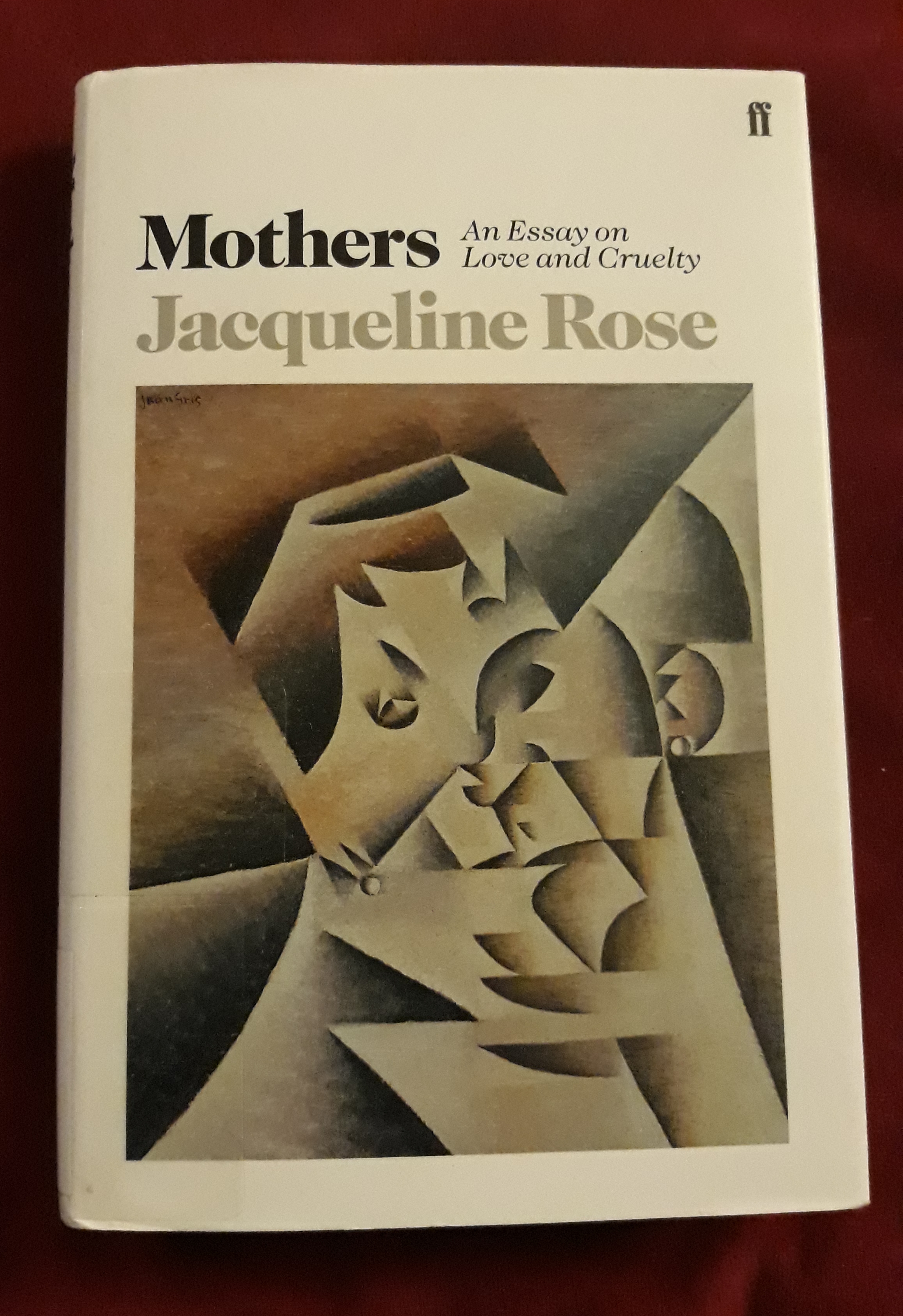
Mothers: An Essay on Love and Cruelty by Jacqueline Rose

I started reading this book after a friend challenged me to mini book club. I thought it would be an interesting take on motherhood, perhaps essays, although the title calls itself an essay, singular, which reads, in hindsight, as pretentious as it is by no means an essay, and is, at the very least, essaysss. This books is basically theory, with some fairly dense analysis and criticism, but also some accessible hot takes and also slow burning takes mixed in.

The perks of this book are in some of the one liners, which I’ll share below. Her literary knowledge of mothers is vast and deep and fascinating. I found myself wanting to read all of the literary works she mentions, something that would take me years. I always (and will continue to) return to de Beauvoir and Rich.

The drawback of the book is only that it was more academic than I was hoping, something that might be reconciled by a more accurate title. I did not always understand the connection between mothering and immigration, although that connection is made frequently throughout the book. This was especially true for me in the first chapter. I found myself arguing—aren’t immigrant mothers the most sympathetic of all immigrants? This point felt underdeveloped to me throughout the book. Also, I felt that, based on my own experience, the dogged connection between breastfeeding and eroticism was a stretch and over-developed.

Even still, I appreciated the vulnerability and honesty throughout the entire book. It’s really like no other and tells a story of matrescence that is important, but rarely told. For me, motherhood has required me to be an almost entirely different person. Giving up such a huge sense of self is the sacrifice that seems too great and also unnecessary. Nothing could prepare me for how much I would change, would be forced to change in order to survive, and how that change felt inevitable, and necessary, and okay, and part of my life’s path and development, but also, in many ways, a jarring loss.

Overall, if you’re doing scholarship in motherhood, this is a must read. I may even be able to use some gems in my own scholarship, which is often, just adjacent, although I haven’t isolated any yet.

Here are a few lines/questions worth returning to:

“[W]hat are mothers being asked to carry, what forms of failure and injustice are they made accountable for, above all, in the modern Western world?” (37).

(Indeed, I have found the motherhood to be too demanding, asking too much, and unnecessarily so. With a better social network, motherhood could be vastly improved for (most) women.)

“We talk of a mother’s suffocating love. But the one in danger of being smothered by love might not be the infant but, under the weight of such a demand, the mother” (81).

(See above.)

“For several yars she has tried in vain to adapt to his point of view, to her mother-in-law’s exacting standards and ‘to all the unintelligible ritual with which they barricaded themselves against the alarming business of living’” (99).
(I just thought this was a profoundly accurate description of how I perceive some people to be doing life. (I have been wrong in my interpretations of this though.))

“[T]he child’s demands drive the mother to insane perfection; the inconsiderate child underscores the radical neglect of her own life” (187).
(I don’t think it can be helped.)

“‘[H]is implanting himself inside me; unreasonably and totally destroying the me I was’” (206).

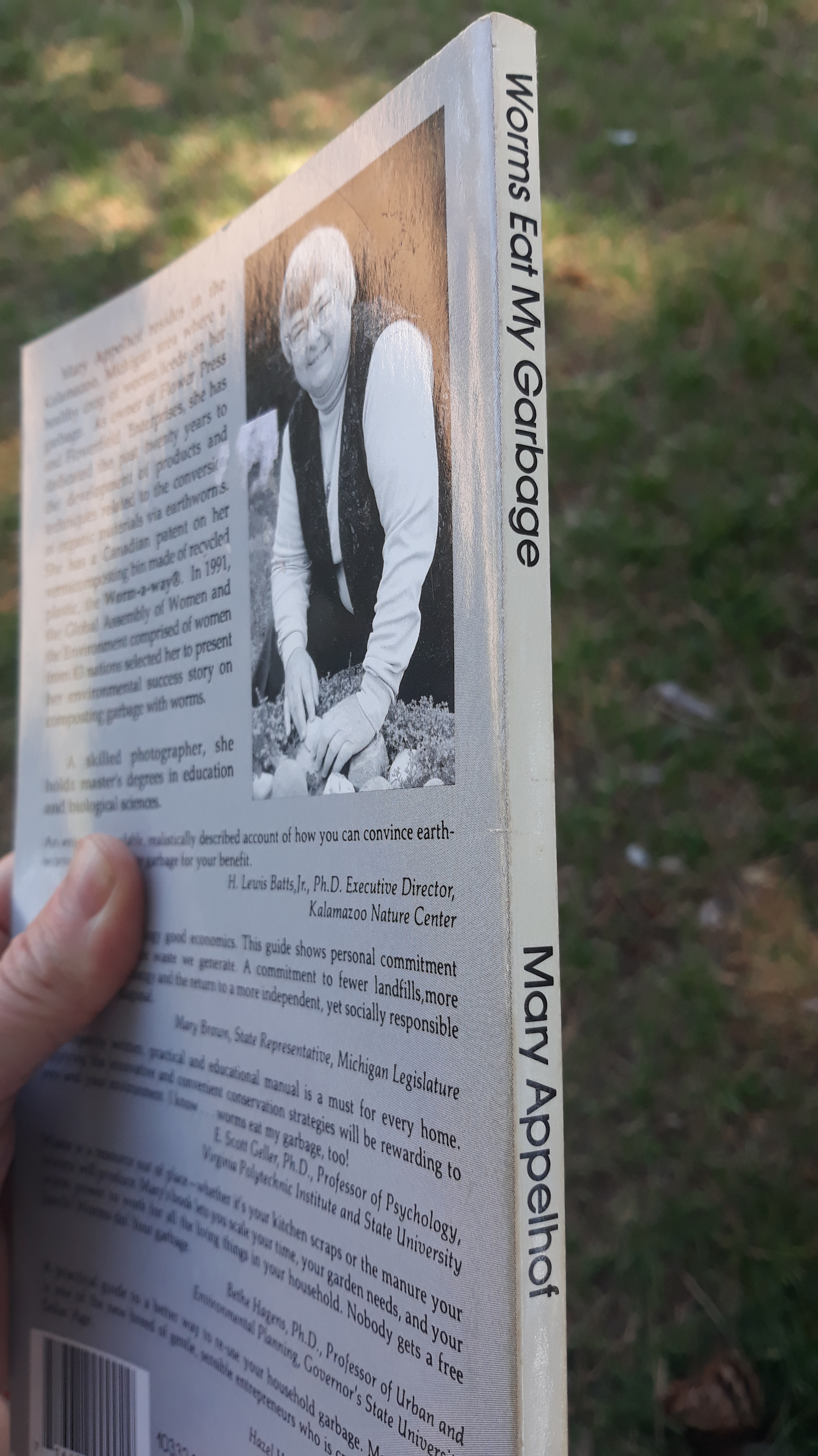
Worms Eat My Garbage by Mary Appelhof

my own little free library copy!

Worms Eat My Garbage by Mary Appelhof was a Little Free Library find and a quick read. I was first introduced to the idea of composing with worms from a professor in grad school. It’s an intriguing idea, and since this version of the book was published in 1982, it’s easier than ever thanks to YouTube and relatively affordable worm containers and systems. Back in 1982, they were building their own boxes, for example.

My take away is that it’s a great idea and is especially suitable for people who do a lot of cooking and eat a lot of vegetables and are not squeamish about worms. I, on the other hand, am a little afraid of worms, and, while it hate to admit it, I do think a lot of the garbage my household produces is…junk food. And, evidently junk food is salt and spicy and might mess up the ph of the soil. Reading this book does make me want to figure out a good composting system for my home. That’s my takeaway.

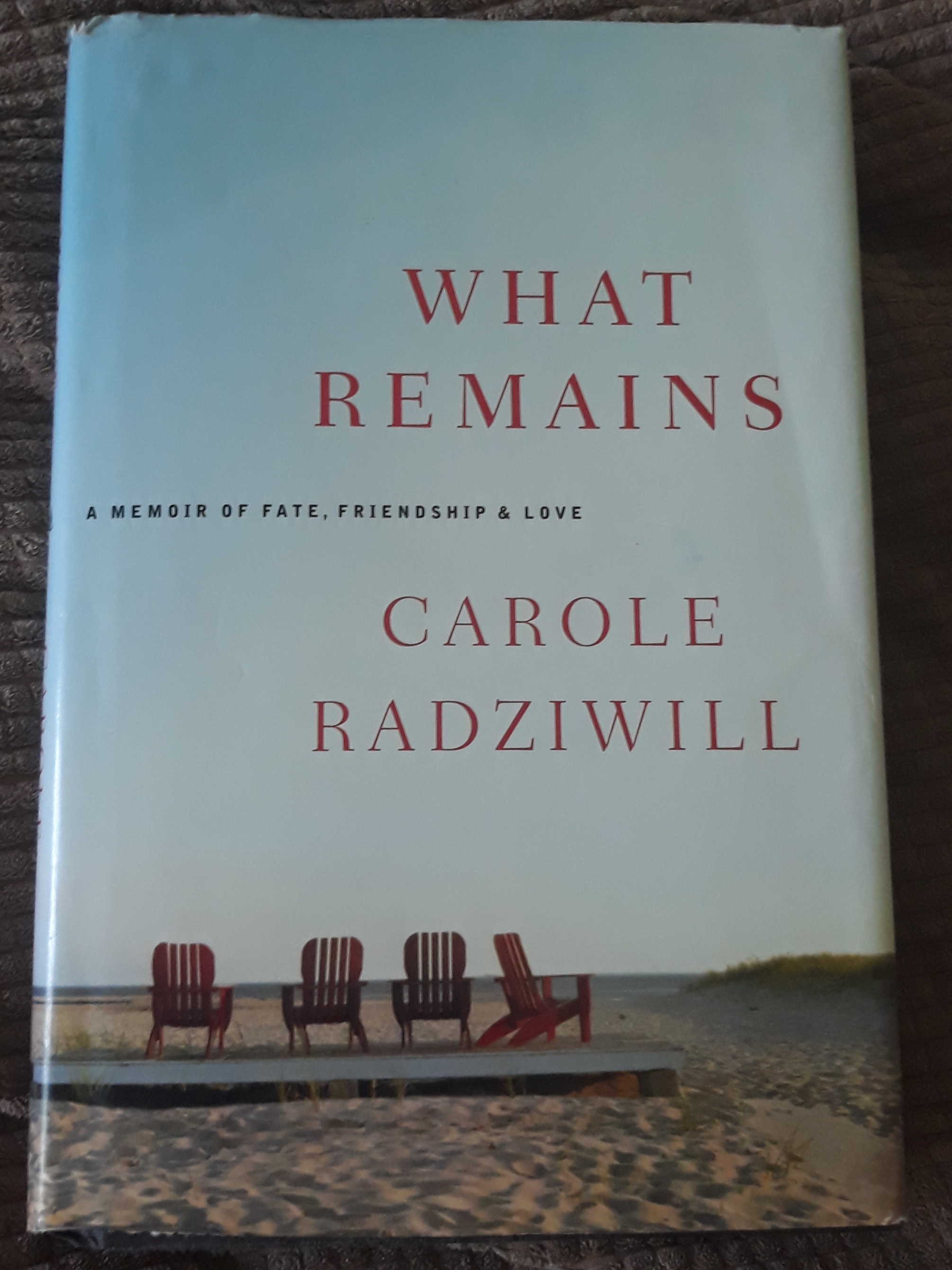
What Remains by Carole Radziwill

What a beautiful book! What Remains by Carole Radziwill is a completely unique book, taking the reader locations you’ve never been—could never go—but also to fully human and universally recognizable places.

It’s no secret that the Real Housewives series are a guilty pleasure, and I always found Carole to be a fun, tell-it-like-it-is, type of “character,” so I thought this book might be decent, but it’s better than that!

A Memoir of Fate, Friendship, and Love

The book takes the reader to the poor gravel roads and streams of New York state, to the haphazard suburbs, to a chaotic, but close family life, to the rush of a bold new career in a city, to war zones, to falling in love (without cliché), and forging deep friendships with “America’s royalty.” Readers see that we all ache, love, suffer, and feel the joy of the sun on our skin and the wind in our hair universally. The life she lives once she’s seriously dating and married to her husband Anthony is (emotionally) much like other everyday relationships, except with better food, clothing, apartments, travel, and lovely places to stay. The reader might be surprised to find that this group of “elites” are thoughtful, frugal, playful, stressed, sometimes uncertain. Aren’t we all?

Radziwill has lived an extraordinary life, and so while this is a memoir, and a genre with which readers might be familiar, it’s is so completely unique in the extraordinary events and circumstances she’s survived. She loses her three closest people in the span of three weeks. Maybe she has survivor’s guilt, but I hope she doesn’t. I hope she is exploring what to do with this big, bold, beautiful life she gets to live. While there is a tight and lovely metaphor about fortune threaded throughout, which works on several levels, the reader leaves the book thinking, “Anything is possible. Anything can happen. Now, what am I going to do with this big bold, beautiful life?”

I read every word and, almost to prove a point, she thanks her bff and sister-in-law, Teresa, who–get this–is from my very own La Grande, Oregon! I am reminded that it truly is a very teeny tiny microscopic world, and anything is possible.

Dog Flowers by Danielle Geller

For whatever reason, I’ve been reading a disproportionate number of memoirs by Native American women. I’ve also been loving them. The most recent is Dog Flowers by Danielle Geller. The book is troubling and straightforward. It seemed to be divided into two distinct sections, although it’s not formatted as such. I found myself wanting to read two separate books: one about childhood through the death of her mother and another about life after that death. (I don’t think it’s a spoiler to mention the death here because the reader knows about it from early on.)

Most children with parents who are addicts and homeless don’t go on to write beautiful books, so in that regard this novel is unique and offers a perspective that’s rarely told.

One of the main takeaways for me is the way that dysfunctional families impact their members constantly. The always immediate need for housing, medical help, mental health support, food, emotional support, and on and on, just never seems to end, and it impacts every aspect of one’s life. It’s something I’ll understand in a new way in my interactions with others who may be experiencing this same constant and continual drain from their own dysfunctional families.

This book is heavy and hard, but important. Oh, and there’s weaving! I hope the next book has more weaving.

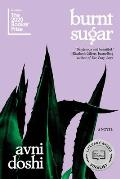
Burnt Sugar by Avni Doshi

In the precious time between when the term begins and when the grading comes flooding in, I read Burnt Sugar by Avni Doshi. It’s an interesting and heavy book. I was really interested in the unique relationship that is depicted between daughter and mother. The lines of reality are blurred throughout, making the point that reality is fragile and based on a corroborated story shared by people.

I was interested in the setting, which felt foreign to me, but also familiar as so much of the daily tasks of living, eating, and interacting with others are shared across borders.

This book was heavier than what I need right now, but the reading was good, and I need that even more.

Here are some lines that I liked:

“My mother knew marriages were generally unhappy, but she was young and had not fully metabolized the idea that this would be her reality. She still believed she was special, exceptional and had thoughts that no one else did” (44).

“I tell her I am not sure what to do, that maybe I’ve lost my imagination./ She says she never thought my work required much imagination, that it was copying an image over and over again./ I explain that I mean another kind of imagination, the kind that invents a world where my work matters” (174).

“Is the sensation of receiving a kiss less pleasurable than that of giving it?” (212).

Iep Jāltok: Poems from a Marshallese Daughter by Kathy Jetñil-Kijiner

Iep Jāltok: Poems from a Marshallese Daughter is a beautiful book of poetry by Kathy Jetñil-Kijiner. I don’t usually read a lot of poetry, but this one drew me in and held me there.

The place where I work has a relatively large population of Micronesian students. In fact, a summer program for work put this book on my radar, and I’m so glad it did. I find myself wanting to learn more about this population. From the book I read about the indigenous connection to place, language, racism, climate change, climate refugees, refugees from US nuclear testing, food, love, religion, womanhood, family, and more.

I found myself searching for plane tickets. Just how far away are the Marshall Islands?

How We Fight for Our Lives by Saeed Jones

I read How We Fight for Our Lives by Saeed Jones because it was sitting there, and I’m glad I did. It’s a quick (but not necessarily easy) read. I was immediately drawn into the narrative. He shares what feels like a really authentic account of what it’s like to grow up Black and gay and how and why that felt like a death sentence to him.how we fight for our lives

The confusion, innocence, curiosity, and angst of childhood felt really authentic to me—though his experience seemed even more exacerbated by his firm knowledge that he was *different*. Later, the sex is explicit, and there’s a lot of it, and at times I wondered if it was gratuitous, but in the big pictures, it really did serve an important purpose in the story. And anyway, it’s about a young gay man, so yeah, there’s going to be some sex.

About two thirds or three quarters of the way through the book, when many authors lose their steam, attention to detail, and sentence-level care, this book picks up, ending powerfully as the author’s relationship with his mother contextualizes and heals and, although imperfect, a clear love story emerges that feels true and healing and heartwarming.

The ending is surprisingly, as it becomes clear that this author has achieved the sense of self that he’d been searching for—in some unlikely ways and places that simultaneously feel familiar. I too have suddenly and unexpectedly wept with strangers.

The book made me much more reflective of my own education, especially my undergraduate degree, an experience that, for me, has inexplicably evaded much analysis or meaning making from me. This book also made my world much smaller. I identified with this man in that I too went to a state school on a scholarship, and although it wasn’t the fancy private school to which I had received a partial scholarship, it offered an important education still the same.

Because the book was not too demanding of my time, I googled some of people listed in the acknowledgements section. I read Sarah Schulman as an undergrad! I didn’t realize Roxanne Gay has a PhD in Rhet/Comp like I do! I didn’t realize it was from Michigan Tech, a sister school with my own PhD program that often exchanges “talent.” Not only did the book’s journey resonate with me, I also had the sudden sense that these people were actually my people. This felt like…my circle.

This is a story of a gay black man, but the journey to reconcile the love and harm inflicted by one’s family, the journey of navigating the first years of adulthood (college) and settling into one’s authentic identity amid wildly conflicting pressures, the community we find, the family we choose is the stuff of life and something with which every reader can identify.

planting the placenta

Today I finally planted the placentas that I saved from both of my hospital births. I kept them in case I was struggling postpartum and wanted to have them encapsulated. Fortunately, I never ended up needing to use them postpartum. So, I stored them in the freezer with a plan to bury them. I learned that once you have them, there’s no turning back. I moved across two states with a placenta in a cooler on ice. I started to have my doubts about keeping them, but what else could I do?

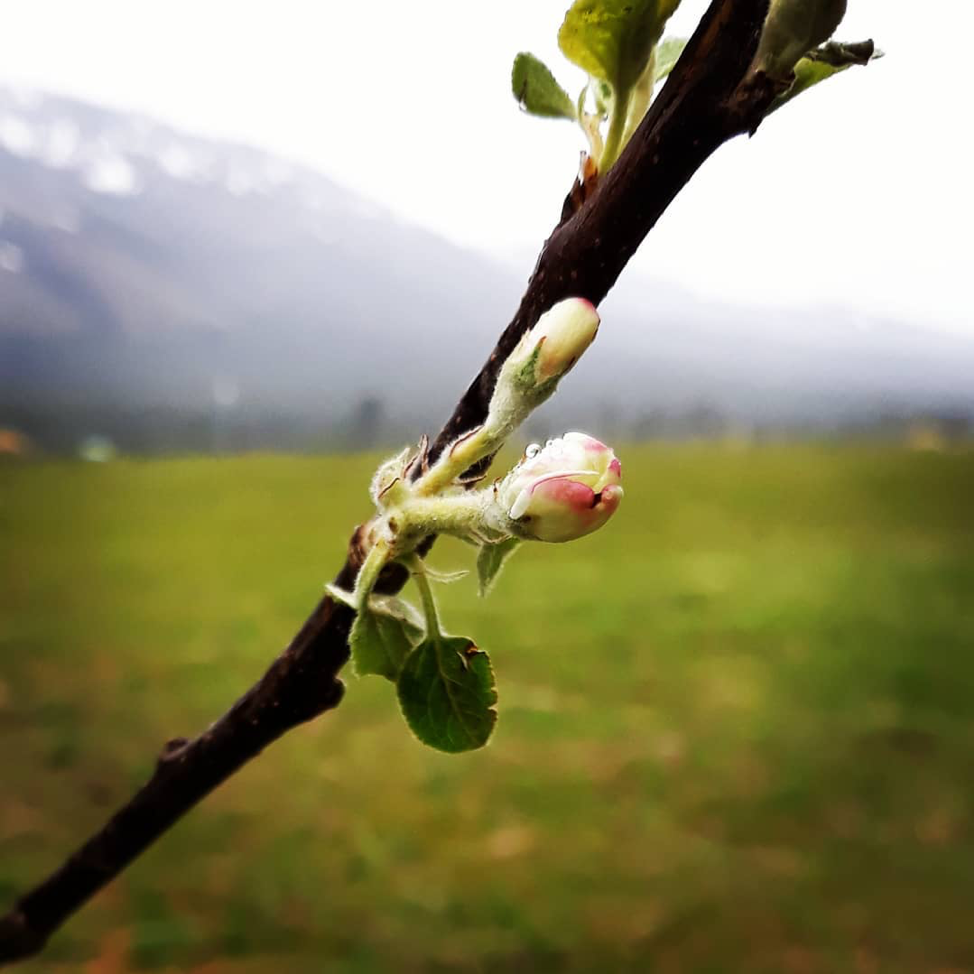
Finally, it is springtime, and I am settled, and I am planting my first orchard: apples, pears, apricot, and peach. It is time.

appleblossom

a new fruit tree for the orchard

To begin, it felt like a chore. Get trees. Remember to get the placentas out of the deep freeze so that I can plant trees tomorrow. Dig holes. Do it all quickly before the babies wake up from their naps.

I’m so glad I did it though. It was a beautiful and surprisingly introspective process. When I opened the containers, they were so fresh, like I had just given birth. Everything slowed down. The memories of my pregnancy, of growing and birthing these beautiful babies came flooding back as I prepared the placentas that connected us in every way. It was bittersweet to let them go. To put them in the earth felt like letting go of the most physical connection I have with my boys. It’s something I’ll never get back.

I hope I’ll remember. I hope sometimes when I am in the orchard, I’ll slow down, and I’ll remember the absolute miracle of life and the life changing gift this experience of motherhood has been to me.

How fitting that today is also Earth Day. Happy Day!

A’s birth story

91099257_10222563971474455_2803633970837716992_o

A was born at 7:44pm on December 5th, 2019. He was due on December 1st, although an early ultrasound read a Nov. 30th due date, I rounded “late” to give myself more time. I did the same last year with L. Given a family history of long gestations and big birth weight babies, I wanted to avoid induction pressure as much as possible, while still being relatively accurate and medically responsible. I was in labor with L on his due date—not late at all! However, during this pregnancy, I was bombarded with so many stories of people barely making it the hospital with their second babies and stories of early babies that, despite knowing better, I began to think that I might have a quick, early labor with this baby too. But first, let me back up.

I found out I was pregnant around the middle/end of March 2019. (A few days before, I had submitted an application for my dream job in Oregon.) I was still nursing 8 month old L around the clock and had not yet start my period. So, my only indication of pregnancy was implantation cramping, which happens during a very specific window of time after conception, and, in my body, is a very specific feeling that I’ve only felt twice. Thinking of it now, I cannot draw up the memory of the feeling. But, I know it when I feel it. I noted the date, told T I thought I might be pregnant, and loaded L in the car and made the drive from Driggs, ID to my home in Utah. Around that time, I had also just received word that Grandpa H was dying of kidney failure. Mom met me in Utah, and we began a week of tender visits with Grandpa as his kidneys failed, and then he passed away. Privately, I began taking pregnancy tests and saw that first faint line get darker with each test. I told both T and my mom. Although this pregnancy was a surprise and came to me much faster than my first pregnancy, I felt strongly that this was a precious miracle baby, and I was grateful for the timing. Questions about if and when to have a second child were suddenly no longer a concern. This was how it would happen. This was the answer.

Shortly thereafter, in mid-April, we made our first trip to Louisiana with L. The trip went well, but I felt that first trimester exhaustion and had an upset stomach the entire time—something I never felt with my first pregnancy. When we returned, I had my first prenatal appointment, where the due date was confirmed, and we did prenatal testing to find out, “It’s a boy!” Around this time, I also learned that I was a finalist for the job in Oregon. So, once again, I packed up L, and we made the long trek to Oregon. I felt great the day of the job interview, but it was taxing. I continued to struggle with first trimester exhaustion, upset stomach, and also scheduled nursing sessions with L throughout the day.

Shortly after returning from Oregon, in early June, I was offered the job. I accepted, and by mid-June, I made arrangements to put my house in Utah on the market, with a goal to sell it within a month. That process required cleaning and trips to Utah and packing up my life (once again). My mom came for another visit, which coincided with my uncle Roger’s sculpture reveal at This is the Place Park in Utah. Mom helped me pack, then T came to Utah at the end of July to help finish packing and load my belongings into storage pods, which would be shipped to Oregon. During this time, I was also house shopping in Oregon, via video walkthroughs with the realtor and my mom’s visits to properties. I made a few offers, until finally finding the home I would buy at a great location.

I spent the rest of the summer enjoying my time in Idaho with L, taking long walks in the stroller with him and generally enjoying the slower pace that life there affords. In mid-August, I found childcare in Oregon and moved in with my mom temporarily while I began working at my new job. I also saw the house that I was in the process of buying for the first time. Buying the house ended up having several unforeseen setbacks, and the one month I was supposed to stay with my mom turned into three months. I had repairs and updates completed, and I moved in during my third trimester, only a month or so before A was born, with the help of my mom and T and other family members.

I mention all of this to indicate the intensity of this entire pregnancy. While staying with my mom, L and I shared a small bedroom. He began daycare for the first time, he caught every cold imaginable, and so did I. Antibiotics were even required at one point, and while I was sick, I had regular, painful contractions that made me wonder if my baby would arrive early. T was also supposed to arrive and stay about a month before the due date. However, work obligations kept him away several weeks longer than anticipated.

In the final weeks of pregnancy, I felt huge. I was huge, gaining 65 pounds this time. By far the most difficult part was caring for L while pregnant. Tasks like lifting him, changing him, getting him in and out of the car seat, and putting him in this crib sometimes felt impossible. I held him not on my lap, but beside me now—a emotional transition as I began to feel what it would be like to not be able to fully baby my first baby as much as I had in the previous year and a half.

My due date came and went. At the 38 week mark, I began nesting and became much more motivated to finish unpacking the house. The few weeks previously were spent moving and unpacking too, but I was tired and less motivated. In the last few weeks of pregnancy, I’d finished enough of the interior of the house to feel satisfied and ready for baby.

The due date came and went. I felt uncomfortable at night, tossing and turning, but never went in to labor. At 36 weeks, I was dilated 2-3 cm. At 40 weeks, I was dilated to 4cm. One night, near my due date, I had a wave of hormonal nausea and a painful contraction, followed by another painful contraction. I told T that I felt certain I was in labor, and I tried to sleep. I awoke the next morning. Contractions had faded away. I wasn’t in labor after all.

At around 2:20am on Thursday, December 5th, I woke up feeling uncomfortable. I was struggling with the bedsheets and felt a pop or a shifting in my uterus. Steady, painful contractions started right away. After about an hour, T and I made our way to the hospital, while Mom stayed home with L. I arrived around 4am and was at 4-5cm. About an hour later, I asked for an epidural and the anesthesiologist arrived around 6am. Contractions were not regular (between 3-7 minutes) and never established a regular pattern, which is what happened last time too. I couldn’t talk during the contractions and had to moan and close my eyes and sway to get through them. The anesthesiologist encouraged me to get the epidural then based on my pain level. However, the epidural was not so easy. This time, the anesthesiologist was unable to easily place the epidural. This was not a problem last time, but this time they thought it might be cause of mild scoliosis, which was the first I’d ever heard of it. I did get a severe headache last time, which doctors thought might’ve been the beginnings of postpartum preeclampsia, but the anesthesiologist felt certain that it was a spinal headache. My last epidural did leave my legs completely paralyzed for the duration of the epidural, so I guess that’s not normal.

After three attempts, a second anesthesiologist was brought in. She was tried a fourth time, and then was able to place it the fifth time. (She said it would be her last attempt.) I was so, so grateful that it was finally successful! Especially since I ended up having another very long, slow labor, just like last time. It was definitely not the fast second baby that so many had warned me of. My mom showed up at the hospital around 9am, after getting L ready and taking him to daycare, where he would spend the night, since baby arrived at 7:44pm, which was after L’s bedtime, and the following day. It felt hard to have L spending the night away for the first time, but it was our only option, and at least he was familiar with the daycare.

After the epidural was set, I waited and rested. There was talk of breaking my water (more) because it might have already broken a little. There was talk of Pitocin, which I eventually got, because my labor stalled out again once I had the epidural. After a long day, with little progress, the obgyn came to the hospital after a full day in the clinic and had me labor in hands and knees (more like child’s pose) since I had so much more sensation and mobility with my legs with this epidural. Then, she was going to break my water, but baby had shifted, and she didn’t feel comfortable doing it. After laboring awhile longer, she broke my water. A short time later, I was complete and able to start pushing. Although I had spoken to the obgyn about it, and the birth team, and put it in my birth plan, I was cued to curl around my baby and do purple pushing. Personally, I hate this method of pushing. I feel no leverage in the lithotomy position, and it feels like a frustrating and an unproductive waste of energy. I tried pushing in this way again, at the insistence of everyone in the room, but felt nothing but lack of oxygen and straining in my face and neck.

The obgyn suggested the squat bar, since I had so much mobility in my legs. This pushing felt very productive. After one push, I felt baby’s head move down significantly. I told everyone that the push felt productive. I was then made to lie back after the contraction. Lying back felt unnecessary and bad because baby’s head was descending so much now. With the second contraction, I got up on the squat bar and pushed the baby’s head out. At that point, the medical staff started yelling at me to stop and to lay back. Again, this did not feel good. I could tell that something was wrong, and they began to break down the bed and prepare for delivery. Since this was expected to be such a big baby, I guess they thought that pushing would take awhile. In the meantime, I wasn’t sure what was wrong. I wasn’t too worried, but I was hyper focused. I thought maybe the baby was a surprise breach. Once they were ready, they began yelling at me to push again. Afraid of what was going on, I pushed with all of my might. I knew I was tearing. I knew it was going too fast. I knew that if I could go slower and ease my baby down, it would be better, but I felt I had no other choice but to listen and push because my baby might be in danger. Within just a push or two, trying with all of my might to get the baby out, my baby slipped out of my body and into this world.

I said I wish I’d been allowed to stay in the squatting position. The obgyn said she couldn’t deliver a baby upside down. I said, you might’ve surprised yourself. The obgyn said the urgency was that the umbilical cord was wrapped around the baby’s neck. However, later my mom told me that the urgency was that the umbilical cord actually came out first, which can also be dangerous. Despite some lingering bad feelings about the pushing and delivery, the mood in the room was pleasant and celebratory. I would have guessed the baby was having breathing problems because he didn’t seem to cry or breath as much as L did when he was born. However, L was the one that needed oxygen, while this baby was fine. It just goes to show that I’m not a baby doctor, and mother’s intuition is not always right. This baby’s face was quite swollen. His hair was dark. He looked very different than his brother did at birth. He weighed 9 lbs 10.2 oz and was 21.5 inches long. He felt so tiny in my arms. It was hard to believe he was actually slightly bigger at birth than his brother was. How are they ever this small? It’s impossible to remember, until a new baby is placed in your arms again.

I held him, and within the first few hours, he began to nurse. As is common with big babies, he had low blood sugar and needed to be supplemented with small amounts of formula. I felt that the hospital’s standard for blood sugar, hydration, and bilirubin was impossibly high and that most babies probably have to get formula while there, which makes me feel sad for all of the breastfeeding mamas in there. Since this was my second baby, I felt less stressed about formula derailing breastfeeding. But, it was a stressor nonetheless.

L came to meet his brother the next evening. He was sweet and curious. We left the hospital the following day, without a name. Going into labor, we had a few top contender names picked out, but after 48 hours, none of them seemed right. After a few days at home, and a lot of work, and deliberation on our part, we finally found his name.

This baby came to me easily, naturally, and without any effort. I knew my body in birth better, so as labor unfolded, it felt familiar. Breastfeeding, sleeping, holding, even moving my own body was easier and more familiar the second time around. I didn’t yet know him, but he smelled and felt perfect in my arms, and I loved spending hours with him snuggled up against my belly while he slept—easy love.
2019: year in review

Last year I said that 2018 was the best year of my life. 2019 might’ve topped it. In early 2019, I had a six month old baby. I was still up every two hours or so throughout the night with him. I was on a very strict, allergy-free diet and was therefore wire thin. I was finding my stride as a mother, but I was still very tired. I was living almost entirely in Idaho, enjoying a cozy winter inside while the snow fell outside. I took my baby on walks on days that weren’t too cold, and I read the same baby books to him over and over again.

157765732854840741034

In March three things happened. I applied for my dream job in my home state. Then, I felt the twinge of implantation that is unlike any other feeling I’ve ever felt before. I couldn’t describe it now, but I knew it when I felt it because I also felt it when I became pregnant with L. The other thing that happened was I received news that Grandpa was dying. Mom and I both drove to Utah to spend time with him in his final says. I quietly took pregnancy tests and watched the thin pink line darken each day.

In April, we made the trek to Louisiana to introduce L to his extended family. It was a lot of work, and I was exhausted from early pregnancy, but I ate two muffulettas and other delicious foods and felt sick to my stomach a lot. We also attended a friend’s wedding. Then, I flew back on my own with L. The flight was only between Dallas and SLC, but it was exhausting. I had to nurse him while sitting next to a (very considerate) older man and was constantly diligent, feeding L, entertaining him, and praying he would take a nap. He was so much smaller then!

In May I had my first prenatal appointment to confirm my pregnancy and determine my due date—Dec. 1st. I also drove with L to Oregon to interview as a finalist for that dream job I mentioned earlier. There, I interviewed around my nursing schedule, feeding L between meetings and a teaching demo. The interview went well, but I was still quite tired from nursing a baby and also being in the first trimester with my second.

By the end of the month, I was offered the job. Normally I make pro/con lists for any big decision, but this time it didn’t seem like I was making a decision. I just put my house in Utah up for sale and made plans to move. My house sold quickly, and I made an offer on a small house in Oregon with a few acres, sight unseen. Meanwhile, I spent a long summer in Idaho, still taking my baby on long walks and reading books to him. By now, life with L was much easier. He was doing great, and I was getting more sleep.

In August, I moved to Oregon and made plans to stay with my mom for about a month. That month turned into three months. I lived in an house that was not baby proofed, sharing a room with my one year old, who was a loud, fussy sleeper, while I slept on a loud, squeaky mattress. During that time, L started to go to daycare for the first time, which meant I was hauling my increasingly heavy pregnant body up early every morning, getting my baby to daycare, and then driving to work. Near the end of my pregnancy, this routine became increasingly impossible. Getting L in and out of his car seat was particularly hard.

After my new home closed, I waited a few more weeks for new wood flooring to go in. I updated light fixtures and added a shower the a bathroom. Then, I orchestrated two sets of movers and U-Hauls, and I moved into the home that I imagine I could live in for a very long time.

At last, I moved into my new home with only a few weeks left before my new baby would arrive. On December 5th, I welcomed my second son (that story is forthcoming). I spent the final weeks of 2019 enjoying my new baby, my angel, and adjusting to a wonderful new life with a newborn and a toddler.