Category Archives: family

Spare by Prince Harry

After watching some of the recent interviews with Harry and Meghan, my curiosity was piqued to read Spare by Prince Harry. For those who have been following along, this is a great book. Fans of Princess Diana will appreciate it too. The book effectively captures his tone. It offers the kind of inside look that audiences never get access to. Prince Harry bravely takes up vulnerable and taboo topics in the book. He openly admits to his bad behavior. He openly admits to his anxiety and depression.

Where this book is a triumph is in its ability to show the royals as real, fallible, human people. Of course logically we know this, but due to tabloids, celebrities often get distilled down to products for consumption rather than treated as real people. I appreciated that about the book.

Strangely, I sort of identified with some aspects of Prince Harry’s experience. He writes about visiting the site of his mother’s death years later and mentions that its the first time he’d been to Paris, but I assumed he would have traveled to all of the world’s major cities frequently. His visit was in close proximity to my own first visit to Paris. But for me, it was more understandable. I was raised in a rural location without a lot of firsthand experience with the outside world. I could read about it, but I’d never actually, for example, walked the streets of Paris. It’s great, but it’s also a somewhat isolated experience. Prince Harry’s experience seems somewhat similar. While school and studies take up a big part of his life, another big part of his life seems to have been safely sitting alone in castles.

It’s clear that Prince Harry is traumatized by the loss of his mother at the hands of paparazzi. It’s clear that the trauma informs his own reaction to the paparazzi today, and that’s made even more evident in his drive to protect his new family. While others may say that he should ignore it, or that by recounting these baseless stories in his book, he’s just giving them more air time. There’s no accounting for a broken heart and how it will make you feel and what it will make you do.

I am sympathetic to Prince Harry, but I don’t see eye to eye with him on everything. I don’t need to. In fact, challenging the audience in these areas is probably part of what makes him so compelling. I am more sympathetic to the circumstances of the other members of the royal family. I think they’re in both a really privileged situation and a really limiting one as well. As is made clear in Spare, the royals are, again, real people with all of their own strengths and challenges, living within a limited, but also very privileged world.

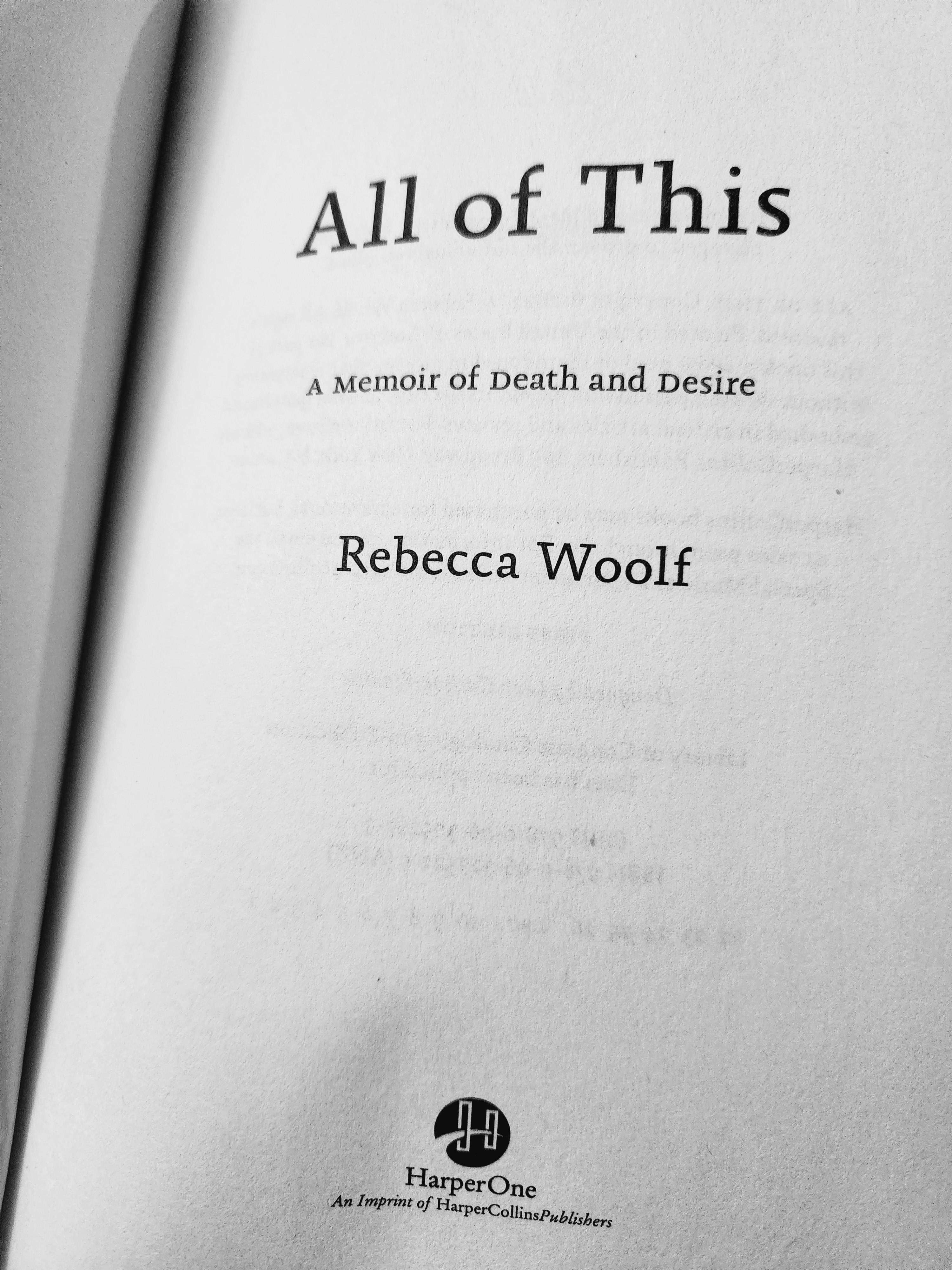
All of This: A Memoir of Death and Desire by Rebecca Woolf

First, here are my unsolicited blurbs for this book:
“Please option this for a film asap.”
“Woolf is a modern day Nora Ephron.” (Possibly influenced by the fact that I just finished Heartburn, but still!)
“This book is the true LA Story.”

After following her work online for years (as one of the thousands of people whose fingers hold her up in this cosmic game of light as a feather, stiff as a board), I have been eagerly awaiting my chance to read All of This: A Memoir of Death and Desire by Rebecca Woolf.

The first half+ of this book is a gripping narrative. Later, the book becomes less plot driven and slows, and I think that’s because the “after” is not/could not be a linear trajectory.

Woolf wrestles with what it means to be a feminist, or to become a feminist, and puts a magnifying glass to some of the common dynamics of life, relationships, particularly heterosexual relationships that are, to say the least, problematic. I was with her for these points because I also wrestle with many of the same questions. I differ though. Unlike Woolf, I was less tied down in my early adult life, and more so now, even though still not very “tied down” by comparison, and that is by design. I had my children later, but a decade ago, I was also reading about her life online. To be reading this book now, as I have little ones of my own feels very full circle, which she would enjoy.

Here are some lines I loved or identified with and/or that gave me pause:

First, as a fan of her writing, I loved seeing her include her numbered lists with numbers that get longer and insaner each time.

“I will not shrink myself nor prioritize people’s pleasure over my own.” Simple, true. It can be hard to recognize when it’s happening.

“Then the 2016 election happened.” This changed me forever too, and I am still not over it.

“WHAT IF IT DID NOT TURN OUT TO BE CHILL?” Just, lol, yes, this is what it is like to be a parent, mother, woman in life.

“I soon realize that it’s a lot faster for me to pack four lunches on my own.” This is just simply true and a lot of people don’t know it.

“My daughters. They are only mine now.”

“The bravest women I know are not widows. They are divorced.”

“And there is nothing I can do but let it go and drive him home. This is the moment I became a single mother.”

My Brilliant Friend by Elena Ferrante

I discovered Elena Ferrante from Mothers by Jacqueline Rose, which I read recently. I started with Ferrante’s My Brilliant Friend, the first in a long series, and I loved it! The writing is excellent. The content is thought-provoking, and it also has the long sense of story found in easier, longer reads–not a common combination. Although it is long, I flew through it.

While I highly recommend the book, I will warn that I found the conclusion to be somewhat disappointing. I wanted a strong wrap up for this particular book, but instead found myself needing to read more of the series in order to get that. It will probably require reading all four books.

I ended the book somewhat exhausted and unwilling to continue with the series. Maybe I’ll return to them someday. They’re certainly worth it, but, and I can’t believe I’m writing this, I really don’t have the energy to give them at this point in my life.

I’m glad these books are out there. Sometimes I just need a good book, a good story, and I now know I can turn to Ferrante to get that.

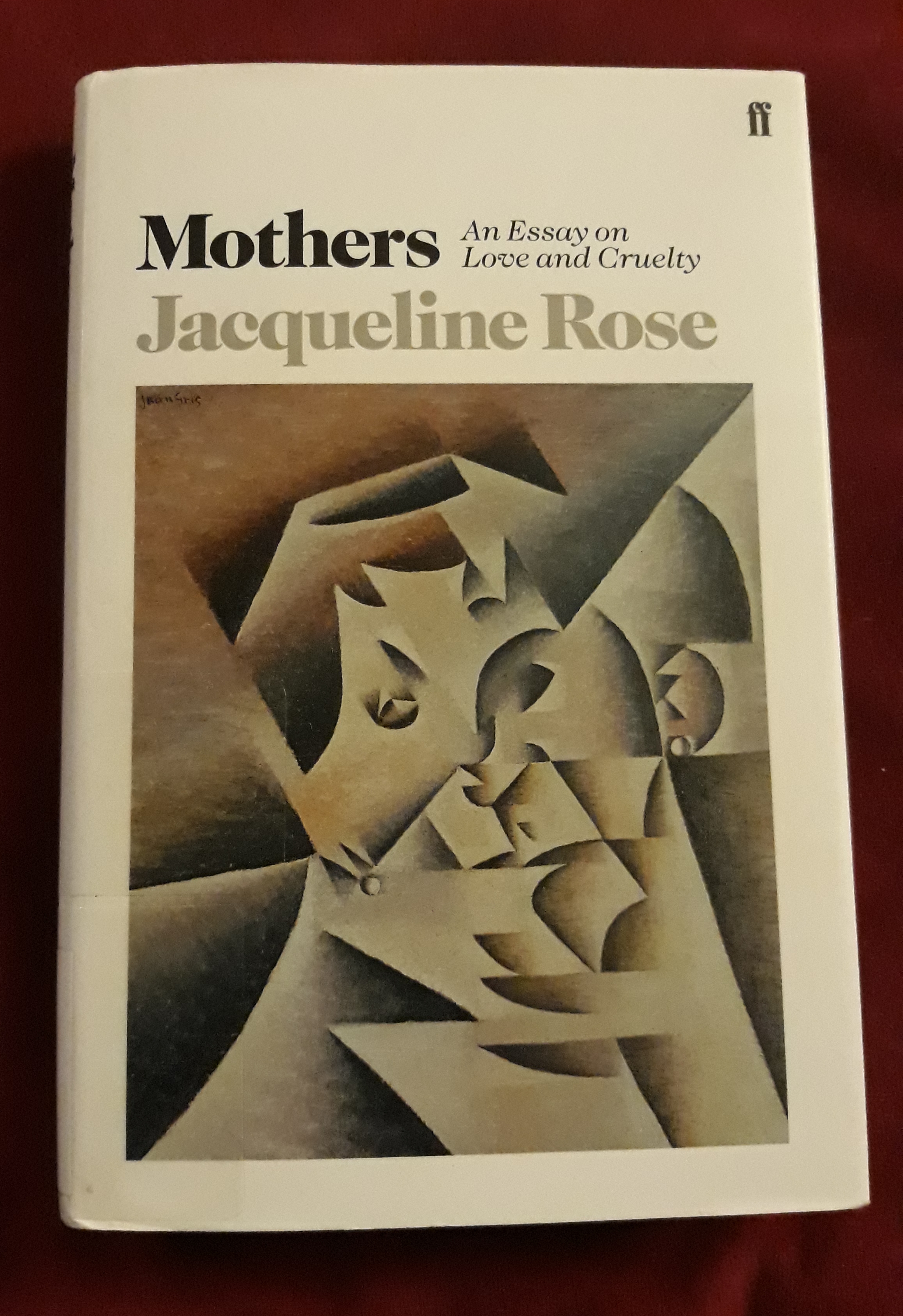
I am also inexplicably obsessed with the cover art:

Mothers: An Essay on Love and Cruelty by Jacqueline Rose

I started reading this book after a friend challenged me to mini book club. I thought it would be an interesting take on motherhood, perhaps essays, although the title calls itself an essay, singular, which reads, in hindsight, as pretentious as it is by no means an essay, and is, at the very least, essaysss. This books is basically theory, with some fairly dense analysis and criticism, but also some accessible hot takes and also slow burning takes mixed in.

The perks of this book are in some of the one liners, which I’ll share below. Her literary knowledge of mothers is vast and deep and fascinating. I found myself wanting to read all of the literary works she mentions, something that would take me years. I always (and will continue to) return to de Beauvoir and Rich.

The drawback of the book is only that it was more academic than I was hoping, something that might be reconciled by a more accurate title. I did not always understand the connection between mothering and immigration, although that connection is made frequently throughout the book. This was especially true for me in the first chapter. I found myself arguing—aren’t immigrant mothers the most sympathetic of all immigrants? This point felt underdeveloped to me throughout the book. Also, I felt that, based on my own experience, the dogged connection between breastfeeding and eroticism was a stretch and over-developed.

Even still, I appreciated the vulnerability and honesty throughout the entire book. It’s really like no other and tells a story of matrescence that is important, but rarely told. For me, motherhood has required me to be an almost entirely different person. Giving up such a huge sense of self is the sacrifice that seems too great and also unnecessary. Nothing could prepare me for how much I would change, would be forced to change in order to survive, and how that change felt inevitable, and necessary, and okay, and part of my life’s path and development, but also, in many ways, a jarring loss.

Overall, if you’re doing scholarship in motherhood, this is a must read. I may even be able to use some gems in my own scholarship, which is often, just adjacent, although I haven’t isolated any yet.

Here are a few lines/questions worth returning to:

“[W]hat are mothers being asked to carry, what forms of failure and injustice are they made accountable for, above all, in the modern Western world?” (37).

(Indeed, I have found the motherhood to be too demanding, asking too much, and unnecessarily so. With a better social network, motherhood could be vastly improved for (most) women.)

“We talk of a mother’s suffocating love. But the one in danger of being smothered by love might not be the infant but, under the weight of such a demand, the mother” (81).

(See above.)

“For several yars she has tried in vain to adapt to his point of view, to her mother-in-law’s exacting standards and ‘to all the unintelligible ritual with which they barricaded themselves against the alarming business of living’” (99).
(I just thought this was a profoundly accurate description of how I perceive some people to be doing life. (I have been wrong in my interpretations of this though.))

“[T]he child’s demands drive the mother to insane perfection; the inconsiderate child underscores the radical neglect of her own life” (187).
(I don’t think it can be helped.)

“‘[H]is implanting himself inside me; unreasonably and totally destroying the me I was’” (206).

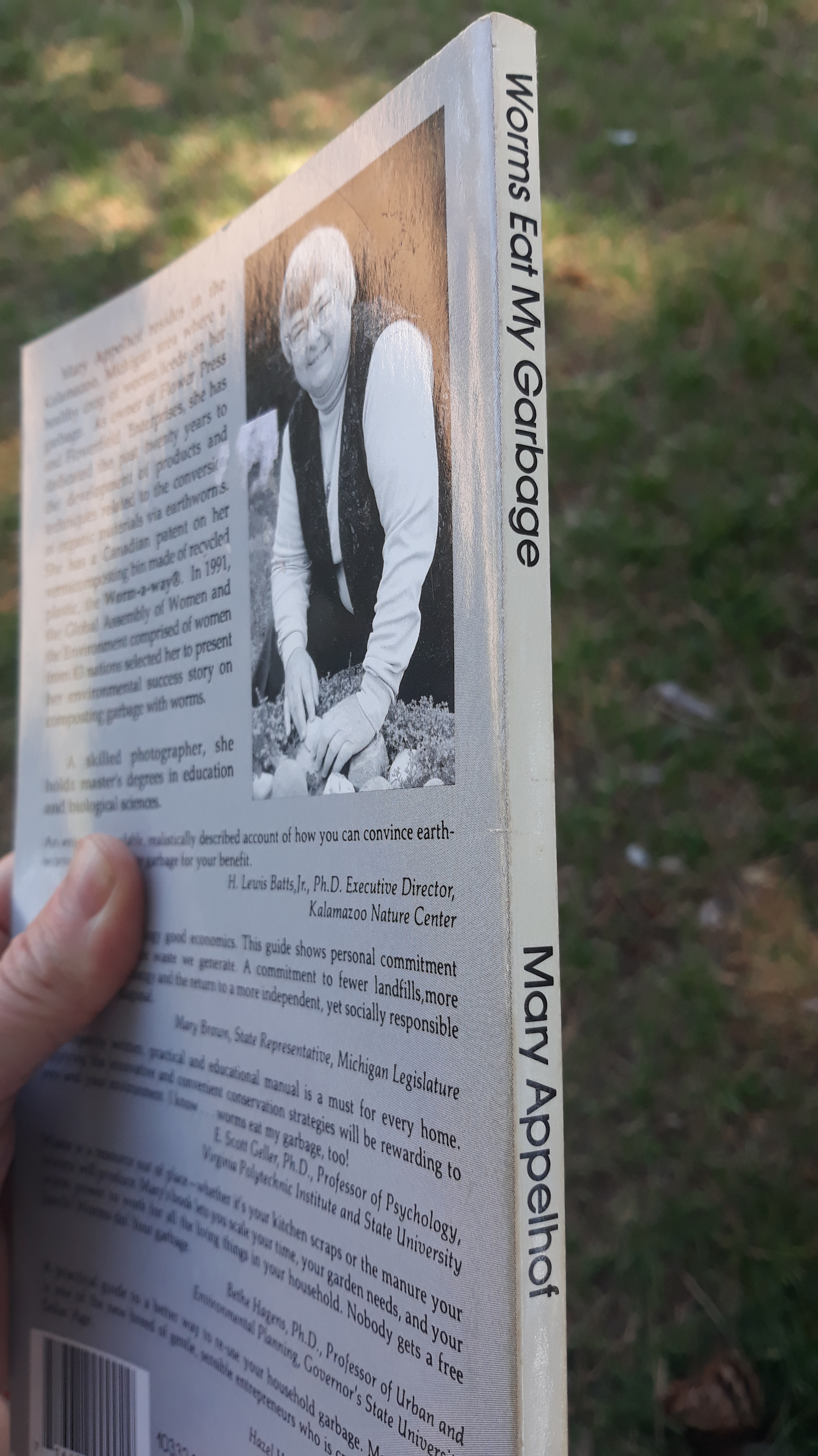
Worms Eat My Garbage by Mary Appelhof

my own little free library copy!

Worms Eat My Garbage by Mary Appelhof was a Little Free Library find and a quick read. I was first introduced to the idea of composing with worms from a professor in grad school. It’s an intriguing idea, and since this version of the book was published in 1982, it’s easier than ever thanks to YouTube and relatively affordable worm containers and systems. Back in 1982, they were building their own boxes, for example.

My take away is that it’s a great idea and is especially suitable for people who do a lot of cooking and eat a lot of vegetables and are not squeamish about worms. I, on the other hand, am a little afraid of worms, and, while it hate to admit it, I do think a lot of the garbage my household produces is…junk food. And, evidently junk food is salt and spicy and might mess up the ph of the soil. Reading this book does make me want to figure out a good composting system for my home. That’s my takeaway.

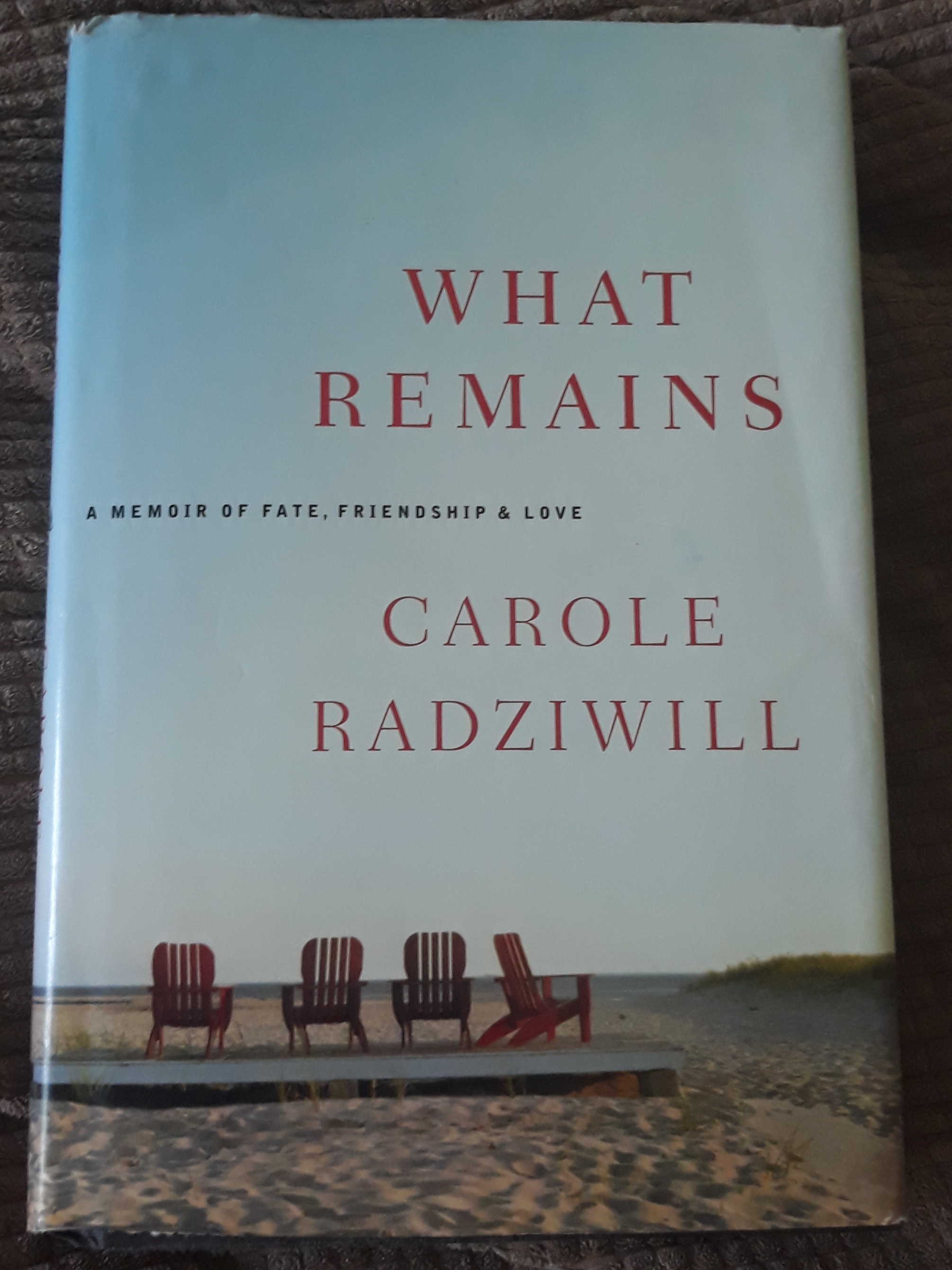
What Remains by Carole Radziwill

What a beautiful book! What Remains by Carole Radziwill is a completely unique book, taking the reader locations you’ve never been—could never go—but also to fully human and universally recognizable places.

It’s no secret that the Real Housewives series are a guilty pleasure, and I always found Carole to be a fun, tell-it-like-it-is, type of “character,” so I thought this book might be decent, but it’s better than that!

A Memoir of Fate, Friendship, and Love

The book takes the reader to the poor gravel roads and streams of New York state, to the haphazard suburbs, to a chaotic, but close family life, to the rush of a bold new career in a city, to war zones, to falling in love (without cliché), and forging deep friendships with “America’s royalty.” Readers see that we all ache, love, suffer, and feel the joy of the sun on our skin and the wind in our hair universally. The life she lives once she’s seriously dating and married to her husband Anthony is (emotionally) much like other everyday relationships, except with better food, clothing, apartments, travel, and lovely places to stay. The reader might be surprised to find that this group of “elites” are thoughtful, frugal, playful, stressed, sometimes uncertain. Aren’t we all?

Radziwill has lived an extraordinary life, and so while this is a memoir, and a genre with which readers might be familiar, it’s is so completely unique in the extraordinary events and circumstances she’s survived. She loses her three closest people in the span of three weeks. Maybe she has survivor’s guilt, but I hope she doesn’t. I hope she is exploring what to do with this big, bold, beautiful life she gets to live. While there is a tight and lovely metaphor about fortune threaded throughout, which works on several levels, the reader leaves the book thinking, “Anything is possible. Anything can happen. Now, what am I going to do with this big bold, beautiful life?”

I read every word and, almost to prove a point, she thanks her bff and sister-in-law, Teresa, who–get this–is from my very own La Grande, Oregon! I am reminded that it truly is a very teeny tiny microscopic world, and anything is possible.

Dog Flowers by Danielle Geller

For whatever reason, I’ve been reading a disproportionate number of memoirs by Native American women. I’ve also been loving them. The most recent is Dog Flowers by Danielle Geller. The book is troubling and straightforward. It seemed to be divided into two distinct sections, although it’s not formatted as such. I found myself wanting to read two separate books: one about childhood through the death of her mother and another about life after that death. (I don’t think it’s a spoiler to mention the death here because the reader knows about it from early on.)

Most children with parents who are addicts and homeless don’t go on to write beautiful books, so in that regard this novel is unique and offers a perspective that’s rarely told.

One of the main takeaways for me is the way that dysfunctional families impact their members constantly. The always immediate need for housing, medical help, mental health support, food, emotional support, and on and on, just never seems to end, and it impacts every aspect of one’s life. It’s something I’ll understand in a new way in my interactions with others who may be experiencing this same constant and continual drain from their own dysfunctional families.

This book is heavy and hard, but important. Oh, and there’s weaving! I hope the next book has more weaving.

Burnt Sugar by Avni Doshi

In the precious time between when the term begins and when the grading comes flooding in, I read Burnt Sugar by Avni Doshi. It’s an interesting and heavy book. I was really interested in the unique relationship that is depicted between daughter and mother. The lines of reality are blurred throughout, making the point that reality is fragile and based on a corroborated story shared by people.

I was interested in the setting, which felt foreign to me, but also familiar as so much of the daily tasks of living, eating, and interacting with others are shared across borders.

This book was heavier than what I need right now, but the reading was good, and I need that even more.

Here are some lines that I liked:

“My mother knew marriages were generally unhappy, but she was young and had not fully metabolized the idea that this would be her reality. She still believed she was special, exceptional and had thoughts that no one else did” (44).

“I tell her I am not sure what to do, that maybe I’ve lost my imagination./ She says she never thought my work required much imagination, that it was copying an image over and over again./ I explain that I mean another kind of imagination, the kind that invents a world where my work matters” (174).

“Is the sensation of receiving a kiss less pleasurable than that of giving it?” (212).

Iep Jāltok: Poems from a Marshallese Daughter by Kathy Jetñil-Kijiner

Iep Jāltok: Poems from a Marshallese Daughter is a beautiful book of poetry by Kathy Jetñil-Kijiner. I don’t usually read a lot of poetry, but this one drew me in and held me there.

The place where I work has a relatively large population of Micronesian students. In fact, a summer program for work put this book on my radar, and I’m so glad it did. I find myself wanting to learn more about this population. From the book I read about the indigenous connection to place, language, racism, climate change, climate refugees, refugees from US nuclear testing, food, love, religion, womanhood, family, and more.

I found myself searching for plane tickets. Just how far away are the Marshall Islands?

How We Fight for Our Lives by Saeed Jones

I read How We Fight for Our Lives by Saeed Jones because it was sitting there, and I’m glad I did. It’s a quick (but not necessarily easy) read. I was immediately drawn into the narrative. He shares what feels like a really authentic account of what it’s like to grow up Black and gay and how and why that felt like a death sentence to him.how we fight for our lives

The confusion, innocence, curiosity, and angst of childhood felt really authentic to me—though his experience seemed even more exacerbated by his firm knowledge that he was *different*. Later, the sex is explicit, and there’s a lot of it, and at times I wondered if it was gratuitous, but in the big pictures, it really did serve an important purpose in the story. And anyway, it’s about a young gay man, so yeah, there’s going to be some sex.

About two thirds or three quarters of the way through the book, when many authors lose their steam, attention to detail, and sentence-level care, this book picks up, ending powerfully as the author’s relationship with his mother contextualizes and heals and, although imperfect, a clear love story emerges that feels true and healing and heartwarming.

The ending is surprisingly, as it becomes clear that this author has achieved the sense of self that he’d been searching for—in some unlikely ways and places that simultaneously feel familiar. I too have suddenly and unexpectedly wept with strangers.

The book made me much more reflective of my own education, especially my undergraduate degree, an experience that, for me, has inexplicably evaded much analysis or meaning making from me. This book also made my world much smaller. I identified with this man in that I too went to a state school on a scholarship, and although it wasn’t the fancy private school to which I had received a partial scholarship, it offered an important education still the same.

Because the book was not too demanding of my time, I googled some of people listed in the acknowledgements section. I read Sarah Schulman as an undergrad! I didn’t realize Roxanne Gay has a PhD in Rhet/Comp like I do! I didn’t realize it was from Michigan Tech, a sister school with my own PhD program that often exchanges “talent.” Not only did the book’s journey resonate with me, I also had the sudden sense that these people were actually my people. This felt like…my circle.

This is a story of a gay black man, but the journey to reconcile the love and harm inflicted by one’s family, the journey of navigating the first years of adulthood (college) and settling into one’s authentic identity amid wildly conflicting pressures, the community we find, the family we choose is the stuff of life and something with which every reader can identify.