Category Archives: love

Be Free Where You Are by Thich Nhat Hanh

I’m supposed to be gearing up for a spiritual year according to sundry esoteric readings and such. I entertain these mostly for fun, but when the idea reappeared to me in multiple venues, I thought, okay, I’m listening. I’m not particularly excited by the prospect of a spiritual year, but recognize that it’s a part of being. And, there’s no time like the present.

So, the other day on a friend’s table, I saw a copy of Thich Nhat Hanh’s Be Free Where You Are, which is a little pocket-sized book based on a lecture he have to a group of prisoners a few decades ago. “Take it,” she said. So, I slipped it into my purse and read it the other night. It is a very quick read. I read half of it, then decided to read the rest of it, and then read the Q&A after that—all in one sitting. I chose to read and reread a few key sections  slowly to try to really absorb his potential meanings.

Thich Nhat Hanh’s been on my radar after a respected mentor mentioned that his work had valid philosophical and scholarly potential. After reading this short book, I can’t say that I agree. Of course, it’s way too soon to make a definitive statement either way. But, he spoke about things like being in your heart and being positive, and while I can make a lot of assumptions about what that might mean, I’m not sure that means much. Or, maybe it means everything. The book is full of these kinds of assertions, and I can only hope that his longer works offer more depth.

Thich Nhat Hanh said that understanding is crucial for forgiveness.

He said to think about each bite of food and where it came from with gratitude.

He said to meditate always, while walking and washing dishes. While inhaling and exhaling. He encourages his audience to be present. Describing this, he wrote, “Here I am.” I read it a few times:  “Here I am.” I walked over to my full-length bedroom mirror and tore away the tens of sticky notes upon which I had scribbled affirmations in permanent marker, affirmations that I had written months earlier as they occurred to me. I threw the tiny stack of words into the recycling, got out a new sticky note and wrote, “Here I am.” I placed it alone on the mirror. Here I am.

I thought about an eye-gazing meditation I did recently that was either good or meaningless, and I thought, “Here I am. Here I am.”

The First Bad Man by Miranda July

An autographed copy of Miranda July’s The First Bad Man arrived in a cardboard box propped against my front door. I did not order it. I was coming back from yoga. It was any old day, and my mind very slowly bended around the idea that someone had bought something for me. I brought it inside and carefully opened it. Inside was a note from Z and the book. I immediately read the first few paragraphs, smiled to myself, and set it aside for later.

I’ve been reading a lot lately and savored this one, reading it slowly over the course of a few weeks. There are so many lines in the first few chapters that made me laugh, or made me reach for a pencil to draw a thin gray line under a phrase or beside a passage. Miranda July is an artist who makes me feel not alone in this world. It is absolutely novel how she can capture all the strange little quips and quirks that brains do.

July also writes about really disgusting, gross-out, putrid sorts of things, and the sheer quantity of that mid-way through The First Bad Man started to get me down. The suffocation the main character creates for herself, her home, her kitchen, her frying pan, her throat condition, the containers of urine, the breast punching—it all got to be too much, and I didn’t want to spend any more time in the book. But, of course, I did and in the last few chapters, I started underlining things again, and smiling as I read, and once again, felt that I was not alone in the world.

When I read a particularly delightful passage, I found myself turning to the title page and running my finger over her indecipherable magic marker signature. Who was this woman? Is she like me? Or, is she commenting on what it’s like to be me?

Meru directed by Jimmy Chin, et al

This year at Sundance, I had the opportunity to see Meru, a documentary film about Conrad Anker, Jimmy Chin, and Renan Ozturk’s summit of Mount Meru, or the “Shark Fin” in the Himalayas. I was a little worried that I might spend most of my time averting my gaze from the vertigo-inducing shots of men hanging by a rope over 20,000 foot drops. While there were plenty of those shots, there are also a lot of beautiful scenes that did not invoke a need to cover my eyes. The cinematography is absolutely beautiful and unforgiving throughout.

image from Meru trailer

image from Meru trailer

At about the mid-point, viewers get a lot of backstory on these three climbers. Each of them overcomes absolutely unbelievable obstacles. (Well, maybe not so unbelievable given that they are elite climbers.) I went in worried that this would be one of these films when men (yes, men) do these insane things that make no sense and risk their lives and everyone’s lives, and for what? But I enjoyed and admired these men throughout the film.

They each brought such unique personalities to the screen. Conrad is the hardened old-timer with tons of experience. He’s got a remarkable record for safety, but he’s got a thin exterior might be pushing too hard at this point in his career. There is evidence that Jimmy is aggressive and unstoppable in his pursuit of success, but he’s so quiet and understated about it. Renan has a natural, physical ability, but he’s got a spooked look in his eyes—maybe it’s the fear of being a newcomer or maybe he’s haunted by what’s to come.

Watching the film, I was proud to be in the same species as these guys. It makes me think about the things we’re driven to do. The things we obsess over until we absolutely must do them. Some of us know what we have to do, and it usually means logging countless hours alone with one’s self. This is why, though I recognize my need for relationships, I trust solitude. Important things happen there, and etching out that time and being willing to spend that time alone is key. For some people, that great thing is having a child.

During this film, though it is very masculine, I was reminded of doula work. Like the men climbing Meru, women in labor are inexplicably driven, but they reach their breaking point, they’re brought to the brink, and then beyond to the place where their skin starts to break—just like the climbers. They continue on as the animal body takes over and the higher intelligence and the spirituality are all forced to work together. All three are required, which is one of the lessons, I think. I always say, “What doesn’t kill you makes you stronger, or it weakens you badly.” However, in this film, what doesn’t kill them actually does make them stronger. Cliché as it may sound, the film reminded me of our greatness as human beings. I feel newly inspired to pursue the things I must do in this life, for more quiet focus to better understand what those things are, and a deeper commitment to the solitude they require.

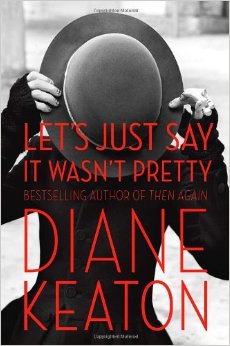
Let’s Just Say It Wasn’t Pretty by Diane Keaton

I read Let’s Just Say It Wasn’t Pretty by Diane Keaton because I remembered liking her Then Again awhile back. Also, more importantly, Diane Keaton has done things a little differently, and I’m always looking to read about women who are doing things a little differently because I do things a little differently too.

image from amazon.com

image from amazon.com

It’s an odd book, and much more stream of consciousness than I remember of Then Again. And, so I was glad to read something entirely different. It was insightful to be privy to Diane Keaton’s mind, which was, just like her, brilliant, annoying, confusing, legendary.

I mean, you can tell that a frenzied editor tried to assemble her bedside journal scribblings, but that’s okay. It never needed to be a perfect to begin with.

She writes about beauty. It’s mostly about beauty. The introduction is so promising, and there are only glimpses (though worth it!) of this promise throughout. She writes about the process of discovering beauty as a young girl, and hearing the opinions of others, she and writes “Don’t tell me what beauty is before I know if for myself.” I think that line is so important. The most honest, provocative moments are when we fall in love with something beautiful before we realize or understand if it meets a shared social standard of beauty: our mothers, the fabric on grandmother’s old chair, a tiny glass figurine weighted just right. Of course, soon enough, we are told what beauty is, and all is lost, and we can never again really know how much we’ve mixed up our own sense of beauty with society’s standards. C’est la vie.

Later, of Picasso’s depiction of Marie- Thérèse, Keaton writes that Picasso paints her, “through loving her, living with her, and seeing her as both ugly and magnificent. Because of his sculptures, Marie- Thérèse emerged as a symbol of unsightly, frightening, even hideous but also, I have to say, complete beauty” (xix). I can think of nothing more romantic than the thought of two people loving each other and timelessly fascinated with the ugly and the magnificent in the other—the unsightly, the frightening, the hideous, and the beauty.

Keaton is a romantic and appears to be unlucky in love, but has also had some luck in love. Her questions of love and beauty were really nice to think through with her, even if just for a couple hundred pages.

i do rush home

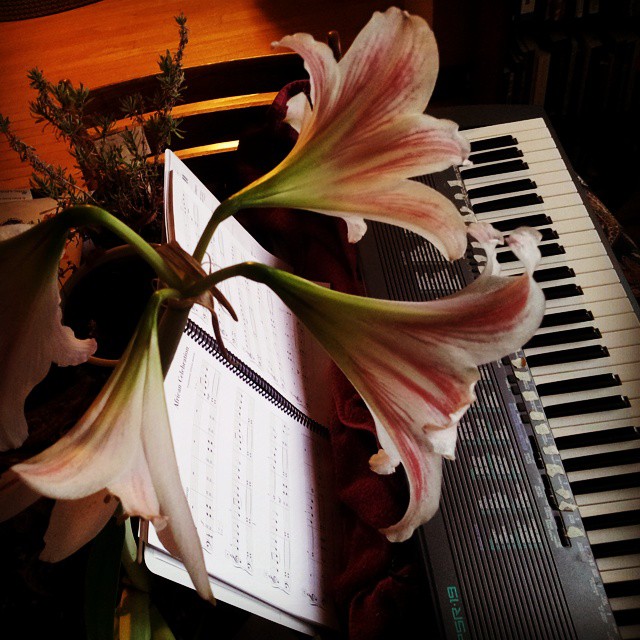
I rush home to play the piano. (Well, keyboard.) I listen to songs on the radio and try to figure them out while driving. I fill out all of the exercises in my lesson book just for the joy of it.

My mom’s pretty competent at the piano, but has always wanted to play the violin. She started taking lessons this summer and absolutely loved it. I, on the other hand, have always wanted to play the piano. I took lessons when I was very young, but they were short-lived.

This summer, my mom inspired me with her violin lessons. She kept saying things like, “I just love it,” and “It’s so great.” It’s probably the English major in me, but I’m always prompting her to explain what she means. “What’s great about it?” She couldn’t quite explain. Now, neither can I.

I found a teacher who lives nearby and signed up for lessons this fall. I immediately loved it and, like my mom, find myself sort of inarticulate about it: “It’s the best thing ever,” and “It’s just so great.” At first I really loved the forced meditation. Music requires your entire brain, and when I’m concentrating, there is no room for chatter. There is no room for anything else, and it is divine.

One of the things I miss from my last relationship is music. I miss singing (though I am shy!) and I miss hearing the new song and the song that’s dedicated to me. So, I’ve tried to create that for myself. I’ve been surprised by how quickly I’ve been able to move through the lesson book and how satisfying it is to play.

I’ve always felt drawn the to piano. I have always wanted to be able to play. I love the sound of the piano. I’m also really fast at typing (and I think that actually helps.)

I don’t know what else to say. See how rambling and incoherent I am about it? Other than just “YES! I am doing it! And it is so great!”

morning scene

morning scene

The Room Lit by Roses by Carole Maso

Carole Maso is one of the few authors who I will read over and over again. Her work has a quality that just gives and gives each time I read it. Oddly, I haven’t even come close to reading all of her work. With the short time before work for the semester really starts in earnest, I decided to grab a few books to frantically and recklessly read before I got down to business. That has involved forsaking some exercise and sunlight to read while lounging in air-conditioned spaces–sometimes with a popsicle.

I grabbed a few new books from the New York Times Bestseller list along with Carole Maso’s The Room Lit by Roses. I began reading it after working a long shift as a doula. My wrist was sore (still not recovered from a bike wreck two months ago) and my body weary. I tossed by hospital clothes in the hamper and showered the hospital germs away and propped myself up in bed with pillows on my cool white feather down comforter (enter also swamp cooler and popsicle).

I was done thinking about childbirth and labor when I cracked the spine and for the first time realized the rest of the book’s title: A Journal of Pregnancy and Birth. The universe clearly wants me to examine the issue more closely, so “here we go again,” I thought. I scarcely could put it down until it was finished about 24 hours later with the strong impulse to turn around and read it again, which I will not do right now.

Years ago, I read The American Woman in the Chinese Hat and read it again to prepare for my trip to France. I assume I’ll return to The Room Lit by Roses if I become pregnant or want to write more extensively on the topic. For now, I’m glad it exists and I’m glad I can return to it. What I love about Maso’s work is how real and raw and open she is. The ultimate sacrifice, I get the feeling that she splays herself open for us, dear reader, and for art and probably for world peace. Carole Maso is one of those authors for whom I am incredibly grateful.

Sometimes a line or two will be entirely dumb and petty and ugly, which works to magnify the stuff that is brilliant and important and beautiful. As I read her work, I find myself saying yes! That’s how it is. That’s how I feel! She wrote, “Always knew I wanted to have the experience of pregnancy.” I swear I say those exact words. The rest of it, the child, the life, that’s the part I’m not always sure about. But pregnancy and labor, yes. It’s such a bizarre and most intense human experience that is felt only a few times, or once, or never, so of course I’d like to have that. Maso puts into words how absolutely terrible and wonderful and necessary the experience can be, and I clung to each word.

Birth, Breath, and Death: Meditations on Motherhood, Chaplaincy, and Life as a Doula by Amy Wright Glenn

Since I began the doula certification process through DONA International, I have had to read myriad required books on labor and the work of being a labor companion. My favorite book by far has been Ina May Gaskin’s Ina May’s Guide to Childbirth. I pretty much love everything she does, but that book was has been the best so far.

image from Amazon

image from Amazon

As I’ve completed the required reading for the doula certification, I’ve been able to branch out and read some related works that are not on the list. While I’ve browsed through a few other titles, Birth, Breath, and Death: Meditations on Motherhood, Chaplaincy, and Life as a Doula by Amy Wright Glenn has been the standout. It’s a really interesting book that (perhaps controversially) makes the connection between doula work and chaplaincy.

Let me get my criticisms out of the way first (because that’s always the worst part). Organization. This book has an organization problem. It appears to be a mash up of personal reflection (that is wonderful!) and what reads like long excerpts from a recycled academic paper on spirituality, love, philosophy (which is fine, but less wonderful). I sometimes found myself wanting her to get back to her stories, lovely insights, and self-reflection.

Glenn’s experience and her perspective is absolutely rich. It felt like an indulgence, and I wanted more. Since I began this work, I have often thought of the close connection between doula work and chaplaincy—although I haven’t thought chaplaincy was the right word—it makes me think of religion. Like yoga, doula work is more than spirituality. It also deals with the emotional and very much the physical. In fact, I imagine that chaplaincy work would do well to take a lead from the female-centric way that doulas have of guiding new life on to Earth (no big deal).

At a recent doula gathering, a new friend, still very emotional, shared that her father had recently passed away. As doulas, we discussed the way that doulas might facilitate a more peaceful, less medicalized passing, just like we are often asking questions and making plans in advance to help facilitating a more peaceful, empowered, and oftentimes a less medicalized birth.

It appears that Glenn has made that connection between birth and death in her own life’s work. A highlight of her book is her birth story. It’s one of the best I’ve ever read (though I have read [and witnessed!] many beautiful birth stories). Like all births, Glenn’s labor is unpredictable, and she is skilled at reflecting and sharing insights from the experience. More generally, I loved her insights on motherhood. I wanted to know even more about her thoughts on her own mother. I loved reading about the way she loves her son and the hesitations she had at becoming a mother in the first place.

If you find deep complexity in doula work, motherhood, childhood, life, and death, you’ll like this book. You might have to forgive it for lacking some of the polish (and organization) of other books, but if you’re like me, that forgiveness will be easy for the insight she offers.

Let’s Explore Diabetes with Owls by David Sedaris

I recently finished another book by David Sedaris, Let’s Explore Diabetes with Owls. As with all of his books, this one was well worth the read. I found myself having deep feelings of gratitude for the author as I laughed, and was moved by, his prose.

Let's Explore Diabetes with Owls

image from NPR

My favorite stories are the ones where he pokes fun at himself. I love the stories of his childhood. “Loggerheads” is wonderfully cringe-worthy and funny and sad. I love the stories of his early adulthood. For me, “Stand Still” covered the well-worn territory of parental expectations, masculinity vs. humanism, and adulthood vs. pettiness. I love the stories of his life now. His story “Rubbish” tackles the fine line between being a good human and the deep relationship with neuroses that such an endeavor might inspire.

Though I’m on board with his politics, the overtly political pieces were funny, yes, but less engaging on all counts.  Still, it’s funny. And smart. And absolutely worth reading. Framed differently, perhaps in first person and expertly woven with his own life, they might be even better.

As I mentioned earlier, I had a strong feeling of gratitude as I read. I frequently hear stories of people “thanking” their favorite  artists for their work. Sedaris is one whom I want to thank, and this sense of gratitude was with me throughout the entire book.

back home

I’m going to be making more trips home to Oregon this summer than I originally anticipated. I’ve been travelings so much, especially to exhausting places like Las Vegas, that I’ve spent the last day just unwinding at home. It’s been great. But, my summer travels are not over yet. Soon enough, I’ll repack my bags and head to Oregon. Which is beautiful, and hard, and emotional, and puts me in a tailspin, but in a good way, and in a bad way. That’s just life, I suppose.

my beautiful home in Oregon

my beautiful homeland