Category Archives: love

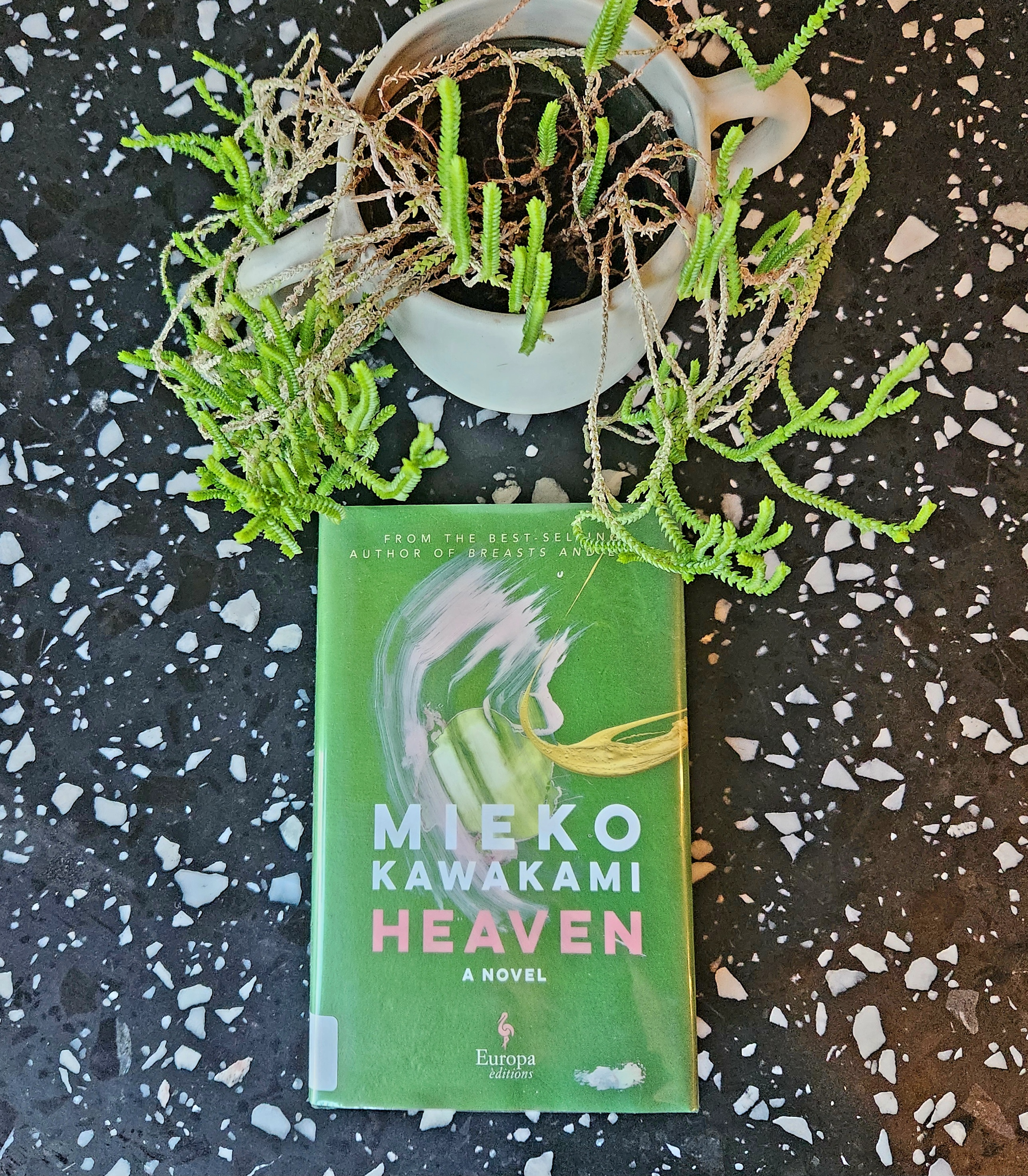
Breasts and Eggs by Mieko Kawakami

Breasts and Eggs by Mieko Kawakami delves into a modern, urban female experience. The main character navigates the big questions women must face and the relationships they must navigate. Kawakami leads the reader through these issues without defaulting to any oversimplifications. The opposite, actually. Each question and relationship is as complex as real life. This book feels almost memoiristic, as I imagined Kawakami as the main character. (I’m prone to doing this though.)

The main character, Natsu, comes from poverty and brings herself out of that slowly as a novelist (the most unlikely of stories!). This character’s life leads her away from her family roots (in a sense) and complicates her relationships with her now very small extended family, not that these relationships are ever uncomplicated.

Her past (experiences with poverty and loss) also complicate her relationships and her abilities to be in a romantic relationship and to create a family of her own.

The book is strange. Natsu is confused. There is tragedy and there is triumph. It is nuanced, and that is true of the human experience, and in this case, it’s focused especially on the female experience.

I read that Breasts and Eggs was once published as a novella and then was expanded into a longer novel, which is the version I read. Through most of the book, I found myself wishing that this was two separate books, but then again, I love a good, short, digestible read. However, now that I’ve reached the conclusion, I do think extending it into one long book is defensible.

Lucy by the Sea by Elizabeth Strout

For the first half of this book, I felt myself impatient with the main character, Lucy. I am so hungry for a female lead who is not so passive, who knows her own mind. However, the writing was good enough that I suspected this all too common characterization of female leads was going somewhere meaningful, and I was right. I also grew to appreciate the spare writing style and the diary-entry style that she uses to develop a consistent sense of voice and theme throughout.

Elizabeth Strout’s Lucy by the Sea is a great book worth reading. Although this history seems so very recent, Strout’s book helps me recall just what the early days of the pandemic were like and the politics surrounding that time.

Even more interesting to me were her characters and the subtle insights she develops through the book to help the reader see just how they came to think and act like they do. None of this life gets wrapped up in a pretty bow, and Strout’s work reflects that not uncomplicated reality.

Their Eyes Were Watching God by Zora Neale Hurston

A literary classic, Their Eyes Were Watching God by Zora Neale Hurston is, indeed, an epic work of staggering genius. I thought I had read this book in college, but realized I hadn’t once I got started. Perhaps I only read an excerpt. While I have read several books with plenty of AAVE (African American Vernacular English), especially Alice Walker, I think this book had more dialogue and more AAVE than anything I’d ever read before. Much like reading Shakespeare, the text was challenging to get in to, but once I found my pace, the language became rich and beautiful–full of great humor and the depths of human emotional experience.

There’s not much more that I can say about this book that hasn’t already been said. It fell out of preference for several decades, but was revived in the 1970s by Alice Walker and has been a canonical text in Literature classes ever since. Much has been written about it, and rightly so.

The Sun in a Compass by Caroline Van Hemert

What a gorgeous book. Caroline is a friend from grad school, and so this book has been on my radar since it came out. However, it’s publication coincided with the birth of my son, and so I’ve been delayed in reading it. I’m so glad the time has finally arrived!

This story is undeniably epic. Reading it will reacquaint you with your adventuresome spirit, no matter how modest. At the very least, you will want to get outside and go for a hike. Information about birds and migration is artfully interspersed throughout. The uniqueness of the land and animals is overlaid with insights about climate change, and it’s impact.

Caroline’s book is the antidote to the seemingly cool, unemotional adventure teams that appear to work solely from complex datasets. And mostly male. She is fully human, full of life’s most pressing questions, full of fears and doubts, and also gumption and bravery. She brings readers intimately into the complex experience of a 4,000 mile human powered trek. We learn that just like the choices we make in life, sometimes there isn’t a well established path forward, and the answer is found in weighing options, wrestling with the odds, and searching one’s own preferences.

This Is the Story of a Happy Marriage by Ann Patchett

What can I say? I thought this was a novel going in, so immediately it defied expectations. This Is the Story of a Happy Marriage is a book of *essays* by Ann Patchett. Before reading this book, my knowledge of Patchett was only vaguely that she’s a well-known female author. (I’m putting “female” in there for political reasons.)

These essays are good and follow the style of, some of the women I’ve read lately: Anne Lamott, Jane Smiley, Nora Ephron, etc. There’s an easiness and confidence in their voice and tone and especially in Patchett’s. Lamott perhaps is more questioning. Smiley a bit more interested in story, and so forth, but these women all seem very much a part of second wave feminism, confidently taking up spaces and stories.

I don’t fully relate to this confident and in control tone, but sometimes I do. These stories are worth reading. The writing is solid. Patchett marks an important time for female writers and perfectly captures a moment (okay, many decades) of women gaining and stage and gathering their voices.

It’s a great title too, am I right?

A Thousand Acres by Jane Smiley

Ok, wow, this book might be a little too on the nose. I definitely identified with certain aspects of it. Overall, A Thousand Acres by Jane Smiley is a good book, written by a objectively talented writer.

I read some short stories by Smiley in undergrad, but I hadn’t ever returned, until now. This book is about a farming family and the challenges they face as they try to navigate what to do with the land as the patriarch ages, an incredibly complicated and tough challenge. Smiley does an amazing job of navigating people’s natural fears, jealousies, ambitions, trauma, heartache, and more, with nuance. In fact, I found myself reading her bio, wondering if she had a rural background. Her understanding of, for example, how women cook food just felt so very rural midwestern and real. However, it appears that she grew up in the suburbs, which is baffling because she knows this world so well. According to her bibliography, she’s written other rural texts too. Maybe she has grandparents who were farmers.

I do have a critique of the book, and it’s one I would like to ask her about. [Spoiler ahead] In the book, a pretty shocking level of abuse is revealed. While I think this is valid subject matter, the abuse is so stunning that it reaches the point of distraction, from the narrative, from some other purposes, etc. I believe it was Hemingway who advised that an author should start the story after the beloved character dies, and I wondered what this book might be like, better perhaps, if this abuse remained an undercurrent that the author never fully revealed. The sexism and mind games alone were enough to warrant the characters’ complex emotional landscape. I just think it might’ve been more interesting to leave out the more overt stories of abuse, letting it subtly infuse the scene, without letting it completely taking over, and letting the more nuanced, but no less interesting dramas, have more emphasis throughout.

Olivia: A Novel by Dorothy Strachey

In one of her books, Elena Ferrante references Olivia, a novel published anonymously by Dorothy Strachey in 1949, and so I read it next. It is a slow short novel that burns brightly at the very end. I wondered why it’s not a more well-known book, but I think the subject matter and age difference between “Olivia” and her teacher are key reasons. At times it felt like somewhat of a reverse Lolita. Interestingly, this novel was written several years prior.

In the end, while I don’t necessarily recommend it as your typical light read, I do think the book has literary merit on the grounds that it seems to capture a Freudian influence and understanding of the world. Many books and authors were doing something similar at the time, and it, no doubt, had an impact on art today.

Spare by Prince Harry

After watching some of the recent interviews with Harry and Meghan, my curiosity was piqued to read Spare by Prince Harry. For those who have been following along, this is a great book. Fans of Princess Diana will appreciate it too. The book effectively captures his tone. It offers the kind of inside look that audiences never get access to. Prince Harry bravely takes up vulnerable and taboo topics in the book. He openly admits to his bad behavior. He openly admits to his anxiety and depression.

Where this book is a triumph is in its ability to show the royals as real, fallible, human people. Of course logically we know this, but due to tabloids, celebrities often get distilled down to products for consumption rather than treated as real people. I appreciated that about the book.

Strangely, I sort of identified with some aspects of Prince Harry’s experience. He writes about visiting the site of his mother’s death years later and mentions that its the first time he’d been to Paris, but I assumed he would have traveled to all of the world’s major cities frequently. His visit was in close proximity to my own first visit to Paris. But for me, it was more understandable. I was raised in a rural location without a lot of firsthand experience with the outside world. I could read about it, but I’d never actually, for example, walked the streets of Paris. It’s great, but it’s also a somewhat isolated experience. Prince Harry’s experience seems somewhat similar. While school and studies take up a big part of his life, another big part of his life seems to have been safely sitting alone in castles.

It’s clear that Prince Harry is traumatized by the loss of his mother at the hands of paparazzi. It’s clear that the trauma informs his own reaction to the paparazzi today, and that’s made even more evident in his drive to protect his new family. While others may say that he should ignore it, or that by recounting these baseless stories in his book, he’s just giving them more air time. There’s no accounting for a broken heart and how it will make you feel and what it will make you do.

I am sympathetic to Prince Harry, but I don’t see eye to eye with him on everything. I don’t need to. In fact, challenging the audience in these areas is probably part of what makes him so compelling. I am more sympathetic to the circumstances of the other members of the royal family. I think they’re in both a really privileged situation and a really limiting one as well. As is made clear in Spare, the royals are, again, real people with all of their own strengths and challenges, living within a limited, but also very privileged world.

My Body by Emily Ratajkowski

My Body by Emily Ratajkowski is a unique book–part expose on the seedy world of modeling, fashion, Hollywood, and fame, and part memoir, with deep personal introspection. In the book, Ratajkowski, whom I was vaguely aware of as a model, but now a fan and follower on Instagram, shares the story of her rise to fame, known for her perfect body. But, she’s also critic of the abuse she suffers at the hands of both the industry and the larger culture. She’s a critic of herself too, acknowledging stories when she was too naive, too confused, too scared, or too complacent to do better. It’s a complicated book that sends readers on a trajectory of introspection about women’s bodies, while also offering a look into an elite (and also surprisingly not glamorous in so many ways) world that few get to experience. I hope she’ll write more, especially about motherhood. This book is worth the read!

Why Be Happy When You Could Be Normal by Jeanette Winterson

What can I say about Why Be Happy When You Could Be Normal by Jeanette Winterson? She has an incredible life story to draw from and she does so in writing that understands all of the conventions of good writing. She writes about the horrors and abuse that kids face with little to no place to go to escape and how severely this is amplified for queer kids, and I think she started telling this story before many narratives like this existed. That’s important.

In many ways this book felt like the same book she’s written before. This one is about her mother “Mrs. Winterson,” and about herself. I found myself wanting it to be more about her biological mother, whom she journey’s to find in this book. However, I suppose it makes sense that it’s more about her adoptive mother, about whom she’s spent a lifetime thinking, and much less time processing a biological mother.

It’s a book worth reading. Just like the title, the book is shocking, profound, makes no sense, and is kind of funny.