Category Archives: reading

Wild Fermentation by Sandor Ellix Katz

I recently became re-inspired to ferment something. This happened once, a few years ago, when I tried and failed to make a crock of sauerkraut. I love homemade sauerkraut (my Mom can make it effortlessly). It’s supposed to be the easiest thing to ferment in the history of fermentation (maybe with the exception of fruit ciders). This time around, as I was reading about sauerkraut, I realized what I did wrong the first time: I kept the crock too cold. Last time, I put it directly into the basement to forget about for a few months. My basement isn’t freezing cold, but I guess it stays pretty cool–too cool for adequate fermentation. Months later, it was just a salty muck, and I threw it out.

This time around, as I was studying fermentation, I read accounts of Germans keeping crocks of sauerkraut by the stove. People said they kept crocks in their kitchens, etc., where it was warmer, and then placed them in a cooler location once the sauerkraut reached it’s idea flavor. So, I tried again.

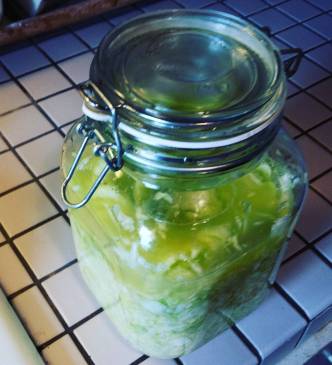
This time, I kept the container (I’m using a glass jar) in the kitchen, and within a day, it was a frothy and bubbly. Recipes said it could be ready in as few as three days, and it’s true! Within three days, I had sauerkraut. I fully intend to keep it in the kitchen until the flavor it just right. When it’s good, I’ll refrigerate it for easy access.

12466332_10208708906706495_6203632713933855765_o

second attempt at sauerkraut

While researching fermentation, one book kept reappearing and that was Wild Fermentation by Sandor Ellix Katz. So, I got a (very well used loved) copy from the library and read it in one day. The author’s enthusiasm for fermentation is contagious. I like fermentation as much as the next guy, but this book pumped me up even more. The first few chapters provide some good history and context for fermentation. There’s also some nice philosophical musing throughout regarding the divine and omnipresent nature of microscopic organisms like yeast.

The recipes in the book are artfully crafted. I intended to skim through the recipe section (which is the body of the book), but I ended up reading most of the recipes anyway. The book sold me on the value of regularly consuming fermented food and the value of fermenting that food myself. (I didn’t really have to be persuaded.) Here are a few foods with recipes from the book that seem good and completely doable: sauerkraut, honey wine, yogurt, cheese, kefir, buttermilk (and it’s pancakes), sourdough bread, rye bread, cider, apple cider vinegar, horseradish sauce, and yes, even kombucha.

I’m from Oregon, and I know it’s a cliché that everyone in the Pacific Northwest is always fermenting everything, but it’s true! I grew up with a mother who pickled and fermented foods regularly. It’s the way of my people.

Modern Romance by Aziz Ansari

Oddly (or appropriately) enough, an ex-boyfriend recommended Modern Romance by Aziz Ansari. I like his work from Parks and Recreation, so I finally got around to reading it over the Christmas break. This is probably a useful read for anyone who didn’t settle down in their early twenties–which, at this point, is most of us. In my early twenties, I was getting all the degrees, forging deep friendships, and yes, “dating,” as well as staying in a few serious relationships. Mostly, I was writing and making art. I was not pursuing marriage.

image from amazon.com

I do not look back on the dating eras with any fondness. So, it was validating to read Ansari’s take on modern dating. In his book, he uses a very soft social science approach and couples it with his good humor. Pairing stand up with social science and commentary is actually pretty amusing, if not hard hitting. Oh, and when you’re reading it, feel free to skim through large swatches of some of the repetitive stuff through the middle.

Ansari’s parents are Indian and, like most Indian couples, have an arranged marriage. Like many people in arranged marriages, they report being very happy. Of course, on the contrary, in the US, we’re all looking for soul mates and have relatively low levels of happiness in marriage. Ansari’s exposure to both US and Indian cultural attitudes toward marriage gives him an interesting perspective.

Here are some of the main take aways from the book: technology has expanded our options for coupling, which means we have the potential to find a better match, but it also means we’re paralyzed by options; we’re not great at intellectualizing what we actually want in a partner (i.e. we think we know what we want, but we’re often wrong); the vast majority of men and women pretty much dislike dating and just want the relationship.

This last one was a surprise to me. I mean, I hate dating, sure. But, I would hate dating. I’m an introvert, which means I don’t love going out all the time. I don’t *love* people, which means I don’t particularly love meeting new people. I’m very sensitive, which means the sizing up, and the texting, and the strangers, and the whole process tends to be a bit too soul-violating for my constitution. And so in the end, when it comes to dating, I’m very much just like, “Forget it. Everyone please fuck off.”

But then, eventually, you find your person who gets it and gets you, and it’s all worth it. Until then, it sucks, and it surprised me that most other people also think it sucks. Before reading this book, I thought most people were out there playing the field, meeting new people, and having a great time doing the things I typically don’t enjoy doing. Evidently, most other people don’t enjoy it either.

Here are a few gems from the book:

On previous generations: “People were marrying neighbors who lived on the same street, in the same neighborhood, and even in the same building” (14).

Things have changed: “Until they got married…women were pretty much stuck at home under fairly strict adult supervision and lacked basic adult autonomy…For women in this era, it seemed that marriage was the easiest way of acquiring the basic freedoms of adulthood” (18).

On the prevalence of FOMI (fear of missing out): “…what I see at bars today, which is usually a bunch of people staring at their phones trying to find someone or something more exciting than where they are” (27).

On the influence of technology: “That’s the thing about the internet: It doesn’t simply help us find the best thing out there; it has helped to produce the idea [emphasis mine] that there is a best thing and, if we search hard enough, we can find it” (125).

This and most other social interactions: “I started to despise the bar scene. I had experienced every single version of these nights. I knew all the possible outcomes, and I knew the probabilities of those outcomes” (210).

On passionate vs. companionate love: “Passionate love always spikes early, then fades away, while companionate love is less intense but grows over time…It is love, just less intense and more stable. There is still passion, but it’s balanced with trust, stability, and an understanding of each other’s flaws” (215).

This basically sums it up: “We want a lifelong wingman/wingwoman who completes us and can handle the truth, to mix metaphors from three different Tom Cruise movies” (239).

Single, Carefree, Mellow by Katherine Heiny

I subscribe to Vogue, and I do so for the fabric and the writing. I’ve read a few great books based on their recommendations. Unfortunately, Single, Carefree, Mellow is not one of their great recommendations, and it serves as a reminder that, while Vogue has some great writers on their staff, the book mentions in Vogue probably have less to do with their keen eye, and more to do with commercial demands.

image from amazon.com

I sympathize though because Single, Carefree, Mellow is probably what would happened if I set out to write a popular, commercial, plot-driven novel about single women. In fact, I’m sure it’s much better than anything I could muster. Still, it’s bad.

First, the writing: much of the description does nothing to move the plot forward or deepen meaning or character. It seems to only serve the purpose of “my writing teacher said good writing has lots of description so I’ll add some here.”

Next, the themes: these characters are weirdly detached and casual about cheating, destroying marriages, and are either morally corrupt *in uninteresting ways* or disconnected from their real wants and desires *in uninteresting ways*.

To be fair, lately I have been really sensitive to moral corruption. The last few years have been so tumultuous for me that I have craved security, stability, and people who are who they say they are–people who are straightforward about their motives. As a result, my tolerance for books and shows that delve into vapid characters, driven by quick and easy gratification, is at it’s lowest.

The Orgy by Muriel Rukeyser

It took me months to finish The Orgy: An Irish Journey of Passion and Transformation by Muriel Rukeyser, and I have to start by saying this: for a book with “orgy” in the title, there is actually very little sex. If you read the book, you’ll think that was funny because this is not a sexy book. This is capital “L” Literature. You know–a thinking piece.

image from books.google.com

A well-respected friend recommended it to me, and I tried and tried, and it never really took off, and that’s because it’s not a book that “takes off.” It’s poetry. I mean, it’s prose, but it’s basically poetry in terms of accessibility, sound, rhythm, and so forth. (Rukeyser explains here.)

For several months, both The Orgy and Thich Nhất Hanh’s How to Love* lie prone in my living room . I’d forget about them, and visitors would come over and raise their eyebrows at the display. Now I find it amusing, but at the time, I remember feeling embarrassed. The titles convey two really different messages. And, in hindsight, not entirely unrelated to my summer. (There were no orgies! Sheesh!)

As for Rukeyser, the book was meaningful in the sentences, but not so much the big picture. The book is about the author’s (semi-autobiographical) journey to the Puck Fair for one of the last pagan festivals of it’s kind. That kind of premise holds so much intrigue for me. I was hopeful for deep description and weird plot points and characters. But nope. It’s not really that kind of book.

Instead, we are gifted with subtle sentence level gems and an overall sense, but nothing concrete, as is the way of good capital “L” Literature, and that’s fine. It’s fine. IT’S JUST THAT I THINK WE WERE ALL EXPECTING A BIT MORE IN THE ORGY DEPARTMENT.

Here are a few lines for continued consideration:

On walking through shit: “I thought, joy and release is it! and put my foot down slowly, gained an inch, and slipped” (69).

“[T]he book compared peace with monogamy” (91).

On the infant cry: “It is the most profound and powerful force in nature” (102).

“Though they may kill, killing is not their aim…” (103).

“verbal arabesques” (114).

“Nicholas began to relax; it was as if he remembered his whole life, and unwound” (115).

*Thich Nhất Hanh’s critically acclaimed, and I really liked his Be Free Where You Are, and wrote about it here, but he’s phoning it in on How to Love, so there will be no blog post on that one.

My Body Is a Book of Rules by Elissa Washuta

image from amazon.com

image from amazon.com

For those of you who miss the bygone days of the grad school creative writing workshop, My Body is a Book of Rules by Elissa Washuta is going to be your jam. It fostered in me nostalgia for those rapid cycling days of pushing myself to the psychological and intellectual limits to produce the wildest new thing imaginable only to discover it’d already been done, and better, and then I was back to the drawing board, and I did this on repeat for a couple of years until maybe (maayyybee) I really did create a few new things.

Washuta’s book has the messy feel of a creative writing workshop. In many of the sections, you can almost imagine the writing prompts to which she’s responding. Readers unfamiliar with this kind of (independent?) prose could very well be put off by this book. And to be fair, even as far as independent presses go, this book has some clunky, first effort moments. As a reader, I was okay with these moments because I was just so glad to be reading something new and different and good and incredibly personal and raw. Maybe too raw.

It’s difficult to write about one’s own mental illness without seeming off-puttingly self-indulgent, and Washuta is aware of this problem and bravely soldiers on. Her themes are so smart—a beautifully nuanced commentary on interactions between race, gender, government, and society. It’s weird. Life’s weird.

Interestingly, both Lena Dunham and Washuta published their books last year and both sometimes use a footnote method, where they break down a piece of text (such as their online dating profile or food journal) with footnotes. The footnotes are so great and so real. It feels very intimate. The only downside (and it’s a big one for me) is that you’ll get vertigo from going back and forth between the original text and the footnotes.

Here are some words I loved:

First, the title: My Body is  Book of Rules is genius.
Next, a chapter title that she should’ve saved for the title of her next novel: “Faster Than Your Heart Can Beat.”

Her descriptions of bipolar:

“…decreased social judgement” (12).

“…a window left open to let the murderers in” (13).

Commentary on Cosmo’s “sex tips”:

“…definitely don’t forget his sack” (18).

Her literary criticism:

She nails her analysis of Catcher in the Rye (a book with which I was previously enamored) like I’ve never seen before when she writes that it “Talks about what’s wrong when that’s not really what’s wrong” (63).

Her insights on life:

“Hope is the thing that comes before the very fucking scary thing” (135).

“do it because you want to, so badly, because you can’t not” (176).

“I am enough” (177).

“Nowadays, when someone else wants to reach me, they get a perpetual busy signal while I whisper sweet nothings to myself late into the night” (177).

“Perfection is hard to stomach” (183).

Outline: A Novel by Rachel Cusk

image from amazon.com

image from amazon.com

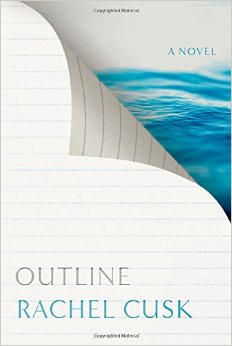
Outline by Rachel Cusk was something different. I haven’t read popular fiction in quite a long time, and I was worried when, in the beginning, the main character becomes engaged in a conversation with her “neighbor” on a flight to Athens. Through his line of questioning, we learn a little about the protagonist, which felt like a plot point contrived solely for the purpose of giving the reader information about the main character.

However, I liked the book and found the brilliance in that, as the protagonist meets several different characters, there are interesting and universal insights to be gained about human nature. For the most part, the characters themselves are very self-aware and analytical, sharing meaningful insights with the protagonist. Though, like all people, their assessment is not always accurate. Cusk presents these quirks and character flaws in entirely novel ways, but they resonate as true and important glimpses into the human psyche.

Interestingly, as the protagonist meets the various characters, Cusk’s voice or tone remains consistent throughout. So, there is little sense of the individuality of these characters. In many ways, the novel reads like an outline, a sketch, of the characters and ideas that Cusk is presenting.

The last character to enter the novel speaks about a troubling condition she’s gained, which she calls “summing up.” It prohibits her writing because just as she really gets in to writing a play, she finds the meaning creeping into her brain, words like “tension,” “mother-in-law,” or “meaninglessness.” Once she finds the significance of her work, she loses interest. In the summing up concept, the reader sees the ways in which Cusk has both avoided and indulged a summing up of the various characters and meanings in her own novel.

This section was also meaning to me because I’ve been stricken by the same sense of summing up since my early 20s. I was probably 21 when I realized, with a start, that every story is the same with few uninteresting variations. This is why I have a hard time with popular fiction. I have a longstanding joke, which is likely only amusing to me, that is called “I saw it the first time when it was called…,” wherein I liken every new book or movie to a book or movie that came before and grumpily deduce that it will offer nothing new.

Furthermore, I see the same patterns play out not just in movies, but in real people in real lives. I rarely think anyone is ever having a unique experience, and the result of that is, I suppose, a somewhat jaded view of the world. I’ve never known anyone else to sum things up quite like I do, and so to see it portrayed in a novel was strangely validating.

Here are a few ideas from the novel that I think render further discussion:

  • “The bump in the road hadn’t only upset his marriage; it caused him to veer off on to a different road altogether, a road that was but a long, directionless detour, a road he had no real business being on and that sometimes he still felt himself to be travelling even to this day” (15).
  • “The memory of suffering had no effect whatever on what they elected to do: on the contrary, it compelled them to repeat it” (18).
  • “We are all addicted to it, he said…the story of improvement, to the extent that it has commandeered our deepest sense of reality” (99).
  • “I had friends in Athens I could have called. But I didn’t call them: the feeling of invisibility was too powerful” (248).

Yes Please by Amy Poehler

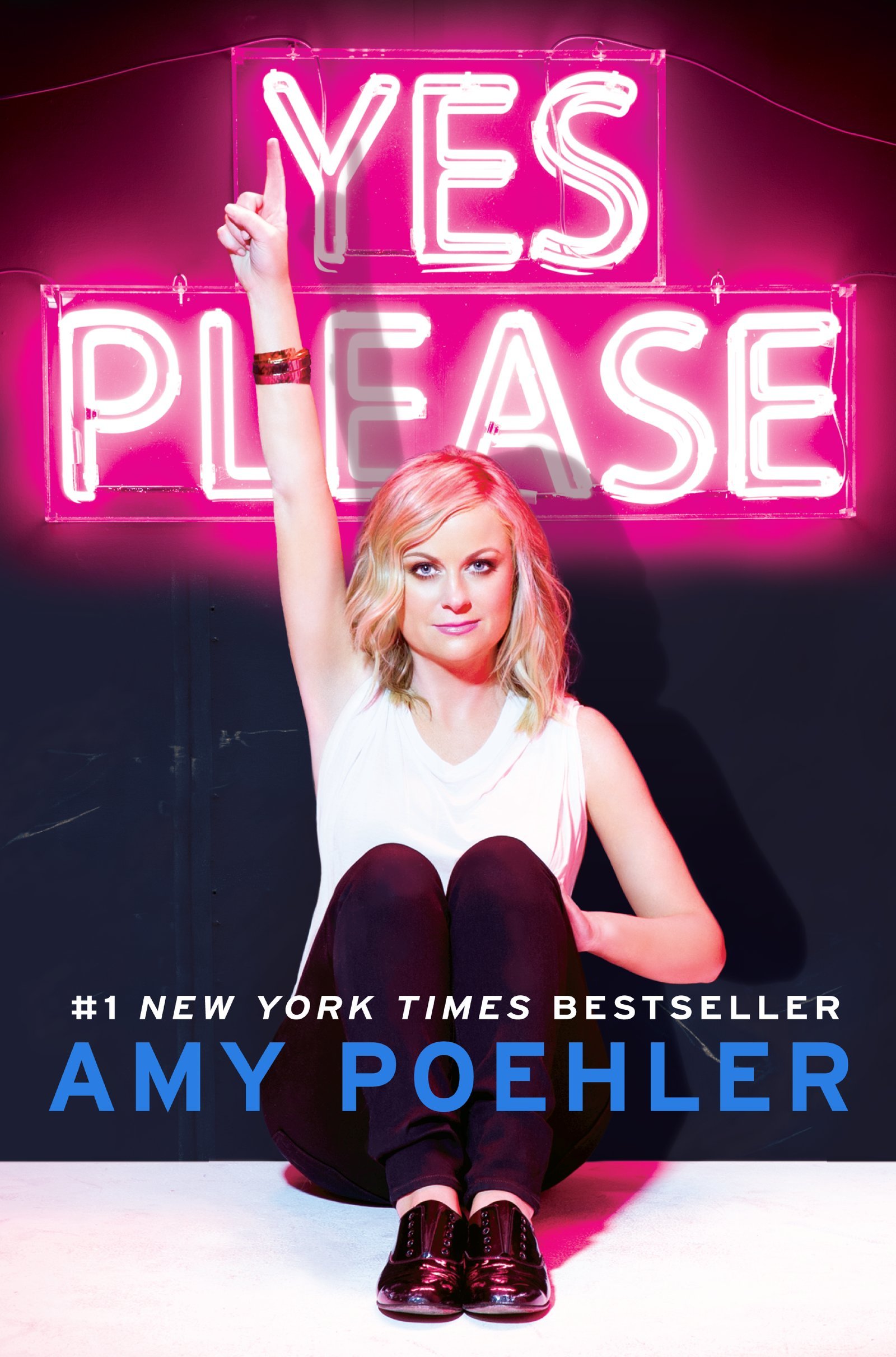
After reading books like Tina Fey’s Bossypants, Mindy Kaling’s Is Everyone Hanging Out Without Me?, and Chelsea Handler’s Are You There, Vodka? It’s Me, Chelsea, I was excited to read this latest one by a comedian. I’m a die hard fan of Saturday Night Live. I tend to love the work that comes from their alums–probably because they know all the good writers. Of her SNL bits, I mostly loved the ensemble skits she was in. Leslie Knope, the character she’s gone on to play in Parks and Recreation, is just great. When it comes to Amy Poehler, I like her, but I think she’s best in collaborative efforts.

Her book was not a favorite. If you’re a die hard fan and will read anything related to SNL, then read it. Otherwise, it’s okay to skip this one. There are funny moments, there are insightful moments, there’s biographical information, and there’s behind the scenes stuff from her work in comedy. But, there’s also a difficult self consciousness that doesn’t always work. Throughout, she complains about how hard and terrible it is to write a book, and those feelings begin to wear off on the reader. The book is repetitive in some ways that don’t seem intentional. The book’s organization is baffling. More importantly, the pages are thick and weird and glossy. What is probably supposed to be “good quality” comes off as too slick, and it makes the book too heavy. It will hurt your wrists while you are reading it in bed.

image from amazon.com

image from amazon.com

Here are a few lines for further discussion:

  • “Make sure he’s grateful to be with you” (202). This wisdom is via Poehler’s mother. It’s simple, but it resonated with me. I’ve had a few relationships for which I am (and was) very grateful. Like, look around at the sun shining and birds chirping and thank my lucky stars kind of grateful every day. With other people, not so much. Your level of gratitude for the other person says a lot.
  • “Hairspray was king, and the eighties silhouette…was big hair, giant shoulder pads, chunky earrings, thick belts, and form-fitting stretch pants. My silhouette was an upside-down triangle. Add in my round potato face and hearty eyebrows and you’ve got yourself a grade-A boner killer” (207-08). See, there were plenty of lolz! (Also, I want to reintroduce “grade-A boner killer” into more of my conversations.)
  • “And I count myself very lucky. That is what “very lucky” feels like. Oof” (235). These sentences ended a long paragraph on the various violences Poehler has endured–muggings, physical and sexual harassment, sexual violence–but never rape. She makes a powerful point here.
  • “‘Smile’ doesn’t really work either. Telling me to relax or smile when I’m angry is like bringing a birthday cake into an ape sanctuary. You’re just asking to get your nose and genitals bit off” (236). I like this for two reasons. One, being told to “smile” is a weird thing that men say to women. To be on the receiving end of this kind of command feels icky. Two, I love making jokes about ape violence despite the fact that it rarely draws laughs. I’m glad to see Poehler going for it here.
  • “[I]f you do start crying in an argument and someone asks why, you can always say, “I’m just crying because of how wrong you are” (237). This one made me laugh, and I hope I have the wherewithall to use it sometime.

**Edit: There’s also this place where she tells a story of having a casting director ask her to share her most embarrassing story. Poehler refused and didn’t get the job. Then, she told the reader that you don’t have to tell people your most embarrassing story when they ask. I liked that.

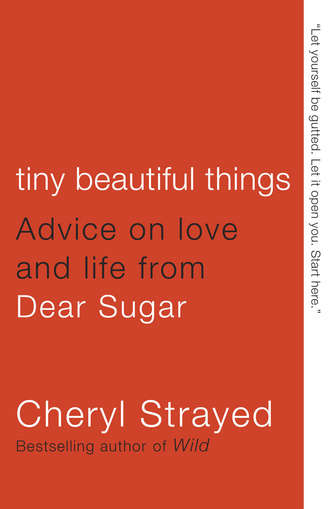
Tiny Beautiful Things: Advice on Love and Life From Dear Sugar by Cheryl Strayed

I ordered Tiny Beautiful Things and my mom was visiting when I got it. So, she read it first and kept saying out loud, “You need to read this.” She even marked a few passages for me. I watched the movie adaptation of Wild about a month earlier, but could never get into the book. Tiny Beautiful Things was not hard to get into. It takes right off.

I started reading it after my mom went home. I’m not sure if there was one catalyst, or just all the things, but I was an emotional wreck during the few weeks it took me to read the book. I sent frantic texts to my long-suffering bff, and I droned on and on to my dear, long-suffering mother, and I even sobbed a little on the phone with Z, who either suffers most or least of all.

I read and quietly sobbed the duration of a long, cross-country flight. People on either side of my armrests humanely ignored me. The flight attendant retrieved a fistful of tissues for me. Clearly, I’m going through some stuff, and I think it was the potent cocktail of heartache, family, fear, love, effort, HUMANITY!, and Tiny Beautiful Things that created a big emotional purge.

Here are two quotes that meant something to me:

  • On partnering: “This is called intimacy. This is called fuck yes. When people do this with us, it’s an honor” (197).
  • On doing crazy things for love: “Love is our essential nutrient. Without it, life has little meaning. It’s the best thing we have to give and the most valuable thing we receive. Its’ worthy of all the hulabaloo” (219).

Is the book any good? I think it is good. It might be good like wine and ice cream are good: indulgent. I think there’s some useful stuff there. Cheryl Strayed turns herself inside out, revealing her most intimate and painful stories, and in doing so, we readers see the universality of our most painful and humiliating experiences, but also the universality of love, passion, of falling in love. In this book of advice, Strayed convinced me again that the heady passion between two people is rare and real and beautiful and possible and sacred, and I so, so need to believe that right now.

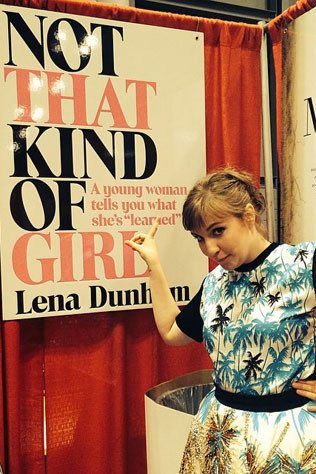
Not That Kind of Girl by Lena Dunham

I have a [smart] friend who thinks Lena Dunham’s work is bad, irresponsible. We go rounds on this because I love her and think that he’s too caught up on having morally good, heroic main characters. He says I’m missing the point. Dunham’s work is shrouded in controversy, but if you’re a fan of her show Girls, you’ll definitely like Not That Kind of Girl. In fact, if you just sort of like her show, you’ll still like her book. Lena Dunham’s work is so incredibly personal and vulnerable and embarrassing and painful, and human. I identify with her so much.

First, I am fascinated with the way she deals with first/early sexual experience. It is the most honest depiction of the kinds of sexual experiences people have in their late teens and early twenties. It can be weird, awkward, and embarrassing. People are unsure about what to do where and for how long. There are strange acts that exist solely because porn tells us that’s what people do for pleasure, even if very few people are doing that thing for pleasure. I actually think this is unavoidable for the most part because there are very few activities that are comparable to coupled sex. In the process, mistakes are made and confusion abounds. Young women are in a constant negotiation with owning and expressing their sexuality, while simultaneously figuring out where the media pressures and social expectations end and where their own pleasure and desire begins. [By the way, I think this is true for men, too, but I don’t read much about it.] So, that’s important.

She’s also balancing art and social commentary, which can be weird and bad, but she does it well. One could easily assume that her work is this off the cuff confessional style, and it is, but there is also real artistry in her work. She has a deep familiarity with language and a knack for creative expression through  her writing. My expectation is that she will continue to write books, and they will be revolutionary, yes, and will only improve from a literary perspective.

Now, let me address the whole scuttlebutt over childhood sexual abuse when the book first came out. I assumed that it would be honest and artfully done, and even be good in that it would help us to think more critically about childhood sexuality. I wanted to read it first before forming my opinion, and after reading it, I thought it was good and important, and did the thing of making us think openly about childhood sexuality. The story is weird, and a bit uncomfortable, but true and not abuse, in my opinion. You can bet that Dunham thinks about consent and abuse because they are major themes in her work.

While I am highly invested in the topic of female sexuality, obviously, Dunham covers other ideas that resonate with me so strongly. Like, there are people who love people, and people who can’t stand to be alone, and people who are curious about other people [I might fall into that last category], but usually I have, as Dunham states, “the nagging sense that my true friends are waiting for me” (xiii). I have met some of my true friends, and when we meet, and recognize each other, there is much rejoicing! I love these people. They are my forever friends and lovers. But, they number so few I can count them on my hands, and I often feel lonely or out of place, wishing that I could be with one of my people when I’m tired of being alone. Lena Dunham—she gets me.

image from vogue.com

image from vogue.com

Here are some quotes I highlighted:

  • “There is nothing gutsier to me than a person announcing that their story is one that deserves to be told, especially if that person is a woman” (xvi).
  • “He was nervous, and, in a nod toward gender equality, neither of us came” (7).
  • “This was the time in life before I learned it wasn’t considered appropriate by society at large to like yourself” (34).
  • She quotes Joan Didion: “There is a common superstition that “self-respect” is a kind of charm against snakes, something that keeps those who have it locked in some unblighted Eden, out of strange beds, ambivalent conversations, and trouble in general. It does not at all. It has nothing to do with the face of things, but concerns instead a separate peace, a private reconciliation” (38).
  • A list from a relationship…”One very unnecessary pregnancy test” (54).
  • “Wherever you go, there you are” (69). An old favorite.
  • “After several interactions in which he questioned my authority and pretended not to hear me speaking, it was clear he was my type” (71).
  • “I had broken up with him on my seventh try, and one try didn’t even count because all I could muster was “I love you” (76).
  • On meeting her love: “Look, there is my friend” (76).
  • “…desire is the enemy of contentment” (143).
  • “You will find,” she says, “that there’s a certain grace to having your heart broken” (144).
  • “…you’ll see that later and be very, very proud” (262).

And so many others.

Be Free Where You Are by Thich Nhat Hanh

I’m supposed to be gearing up for a spiritual year according to sundry esoteric readings and such. I entertain these mostly for fun, but when the idea reappeared to me in multiple venues, I thought, okay, I’m listening. I’m not particularly excited by the prospect of a spiritual year, but recognize that it’s a part of being. And, there’s no time like the present.

So, the other day on a friend’s table, I saw a copy of Thich Nhat Hanh’s Be Free Where You Are, which is a little pocket-sized book based on a lecture he have to a group of prisoners a few decades ago. “Take it,” she said. So, I slipped it into my purse and read it the other night. It is a very quick read. I read half of it, then decided to read the rest of it, and then read the Q&A after that—all in one sitting. I chose to read and reread a few key sections  slowly to try to really absorb his potential meanings.

Thich Nhat Hanh’s been on my radar after a respected mentor mentioned that his work had valid philosophical and scholarly potential. After reading this short book, I can’t say that I agree. Of course, it’s way too soon to make a definitive statement either way. But, he spoke about things like being in your heart and being positive, and while I can make a lot of assumptions about what that might mean, I’m not sure that means much. Or, maybe it means everything. The book is full of these kinds of assertions, and I can only hope that his longer works offer more depth.

Thich Nhat Hanh said that understanding is crucial for forgiveness.

He said to think about each bite of food and where it came from with gratitude.

He said to meditate always, while walking and washing dishes. While inhaling and exhaling. He encourages his audience to be present. Describing this, he wrote, “Here I am.” I read it a few times:  “Here I am.” I walked over to my full-length bedroom mirror and tore away the tens of sticky notes upon which I had scribbled affirmations in permanent marker, affirmations that I had written months earlier as they occurred to me. I threw the tiny stack of words into the recycling, got out a new sticky note and wrote, “Here I am.” I placed it alone on the mirror. Here I am.

I thought about an eye-gazing meditation I did recently that was either good or meaningless, and I thought, “Here I am. Here I am.”