Category Archives: writing

Crazy Brave by Joy Harjo

I read this book almost entirely while lying in bed, while falling in love. Joy Harjo’s a fixture in poetry and literature. Before now, I’d only ever read a poem or two here and there, but I’d never really gotten into her work…that is until I read her memoir, Crazy Brave. It was one of those books that I started reading in a bookstore, and then read a chapter or two from the library, and then finally bought my own damn copy and finished it at home…while lying in bed. I love this book.

image from amazon.com

Harjo is mostly known for her poetry. I don’t enjoy reading a lot of poetry, and so that’s why I haven’t been very familiar with her work. After reading and loving Crazy Brave, I read She Had Some Horses, which is also beautiful, and I love it, and it’s poetry. It’s a collection I see myself returning to.

As for Crazy Brave, what I love about the book is how she captures a creative, feminine life experience that I (mostly) really relate to. It’s soulful. It captures pain, and specifically women’s pain, in a profound way. It shows us another way. It does so in poetic prose–she’s a poet after all.

This is from the back cover of She Had Some Horses, but I think it pertains to all Harjo’s work: “If you want to remember what you never listened to & what you didn’t know you knew, or wanted to know, open this sound & forget to fear. A woman is appearing in the horizon light.” ~ Meridel Le Sueur.

And then I saw her picture and remembered that maybe I met her. Or maybe I heard her read once. She is familiar to me. Her name. Her face. Her work. And yet I only really found her work now, when of course I needed it most.

I was captured throughout the entire book, but  by the end, I was a little lost: WHAT DOES IT ALL MEAN?! I wondered about the title: crazy brave. Now I think I can say that the larger message was, for me personally, a message to women to be brave, an admonition that it will be crazy, and you will be crazy, and you will be brave, and that is life.

Part of this is about surrendering to the flow of the river, instead of fighting against it, using the strength of the current to pursue yourself, but also acknowledge or accept that the river will be violent, and it will wound you deeply, and it might kill you, and it might lull you to sleep, and part of this we can control, and part of it we cannot control, and this is the wisdom we gain from being in the river. I am reminded of the time I went underwater in the Colorado River, the immense crushing noise turned warm and quiet and then I emerged. Part of this book is about acknowledging fear, working around it, using it, but not being controlled by it. I left the book thinking I should do what I must do before the river does it for me, even as the river does it for me.

Some of the words I loved:

“Yet everyone wanted the same thing: land, peace, a place to make a home, cook, fall in love, make children and music” (19).

“Because music is a language that live sin the spiritual realms, we can hear it, we can notate it and create it, but we cannot hold it in our hands” (19).

“In the end, we must each tend to our own gulfs of sadness, though others can assist us with kindness, food, good words, and music. Our human tendency is to fill these holes with distractions like shopping and fast romance, or with drugs and alcohol” (23).

“Water people can easily get lost. And they may not comprehend that they are lost. They succumb easily to the spirits of alcohol and drugs. They will always search for a vision that cannot be found on earth” (25).

“They continue to live as if the story never happened” (43).

“Our  heartbeats are numbered. We have only so many allotted. When we use them up, we die (52).

“All of these plant medicines, like whiskey, tequila, and tobacco, are potent healers. There’s a reason they’re called spirits. You must use them very carefully. They open you up. If you abuse them, they can tear holes in your protective, spiritual covering” (77).

“I noticed a marked change in the quality of light when we made it to New Mexico” (83).

“Each scar was evidence that we wanted to live” (90).

“I told Lupita I wanted to paint, to be an artist. She told me that what she wanted was someone to love her” (102).

“I was given the option of being sterilized” (121).

“I believe that if you do not answer the noise and urgency of your gifts, they will turn on you” (135).

“We were in that amazed state of awe at finding each other in all the millions and billions of people in the world” (143).

“Her intent made a fine unwavering line that connected my heart to hers” (146).

Why Not Me? by Mindy Kaling

As you know, one of my favorite genres is a memoir from a female comedy writer. It’s like hanging out with a really funny best girlfriend all weekend. Is it weird that I artificially fabricate this experience through reading? Maybe. I don’t care. I read Mindy Kaling’s first book, Is Everyone Hanging Out Without Me? during a frantic “pleasure reading” phase I went through between the time I submitted my dissertation and the time I graduated.

This time, I am realizing (perhaps late) that Kaling writes, plays, (and maybe is?) just one character. But, like Jack Nicholson and James Franco (maybe I’ve only seen his stoner films?), nobody cares because it’s such a good character. The Office’s Kelly Kapoor, The Mindy Project’s Mindy Lahiri, and the identity Kaling develops in both of her books are all basically the same person. She’s a myopic, worst/best basic bitch kind of person, and it’s hilarious. She’s always simultaneously doing great commentary on gender and femininity. She describes the persona best: “Mindy is…a combination of Carrie Bradshaw and Eric Cartman” (75).

image from books.google.com

Here’s the take away of Why Not Me: First, you will want to eat McDonalds. And yes, there is some filler content. All of these books have filler. Like, okay, I’ll read a script that’s not going anywhere and a commencement speech that you gave. And, yes, the book was probably written by a ghost writer (but that ghost writer does a great job maintaining Kaling’s voice throughout!) And regardless, Kaling writes some grade-A jokes for these books, and even inspires her reader a bit toward the end. I was thinking, “Hey, yeah, why not me?!” Then, laced up my running shoes and achieved my dreams.

Here are some of the lines I loved:

Real Talk

  • “I’m skrilla flush with that dollah-dollah-bill-y’all” (4). This is the single best description of me on payday.
  • “[T]he gulf between a friend and a best friend is enormous and profound” (27).
  • On breakups: “So, the only decent way for him to have broken up with you is to not break up with you and stay with you forever” (39).
  • “As someone who enjoys secrets, exclusivity, and elitism…” (40).
  • People don’t say “Give me your honest opinion” because they want an honest opinion. They say it because it’s rude to say “Please tell me I’m amazing” (125).
  • “[R]ecycling makes America look poor” (139).
  • “[H]ard work must be rewarded with soul-replenishing gossip” (139).
  • “I have a terrible habit of impulsively sending text messages that reveal my true feelings” (140-41).

On Body Image

  • “One of the great things about women’s magazines is that they accept that drinking water and sitting quietly will make your breasts huge and lips plump up to the size of two bratwursts” (10).
  • “I cannot imagine a life more boring and a more time-consuming obsession than being preoccupied with watching what I eat” (194).
  • “But my secret is: even though I wish I could be thin, I don’t wish for it I don’t wish for it with all my heart. with all my heart. Because my is reserved for way more important things” (202).

I want to say some more about the body image stuff. So, I can work to get the sick body, the one with that weird vein between your lower ab and hipbone, but it does require me to think about what I’m eating and get regular exercise. It takes time and mental energy–time and mental energy I’m not always willing to give. Take graduate school, for example. I knew I would take four years and focus my energy on learning. And, so I didn’t think much about what I ate, and I taught and practiced yoga several times a week. I gained weight. I felt fine. This lasted four years.

Now, I can focus more time and energy on my body. Most people I know who pour 100% into looking good look great, but aren’t very interesting to talk to. Additionally, I simply have the kind of brain that requires me to spend time thinking about the meaninglessness of life and experiencing existential angst. I simply can’t/don’t want to transfer that energy into diet and exercise. I liked when Kaling wrote, “I don’t wish for it I don’t wish for it with all my heart. with all my heart” (202), and I think that’s a healthy approach. Anyway, I certainly haven’t found a balance, and I sort of don’t think a balance is possible (for women), and that sucks…is the way I’m going to end this post.

Trumbo by Jay Roach

At this point I’ll watch Bryan Cranston do anything, which is why I went when I had a chance to see him in Trumbo, directed by Jay Roach. Diane Lane is always exquisite, and Louis CK’s in it too!

image from imdb.com

This film felt long. It’s about two hours and fifteen minutes. It took me awhile to warm up to the characters. I’m a big Louis CK fan, but it took me awhile to buy him in a dramatic role. (He gets there, don’t worry.) Though the whole film felt somewhat rigid at first, it does warm up and pick up so that it is not dragging at the end. While I left the film feeling satisfied, I still think it could’ve been edited more aggressively.

Politically, the “red scare,” and McCarthyism is a fascinating and disturbing (and ongoing?) part of US history. It doesn’t take much to engage me on the topic. Yet, I had a hard time getting into this film. That said, it is worth watching. Because it picks up. Because it’s beautiful. Because it rises to something interesting and important.

Now, let me break it down. First, the smoke. These people are smoking constantly, and the cinematographer is having some fun with it. There are these glorious shots of white smoke swirly slowly and intricately around people’s faces. There’s a smoke shot toward the end that is absolutely over the top. Thick white smoke swirls through each grain of thick, gray mustache hair, and it’s both repulsive and lovely and artful.

And on that note, I’ll also talk about Bryan Cranston’s physicality—something I think he’s understood for his entire acting career. (I first noticed it in his Malcolm in the Middle days). He, more than anyone, knows the power of an ordinary middle-aged man wearing tighty whiteys, and he’s not afraid to use it.

Finally, the design. This was L.A. in the 1940s and 1950s. Every couch, every glass of water, and every earring is on point. I was busy watching the design elements while I waited for characters to develop and the plot to pick up, and that was more than enough to keep me satisfied.

Single, Carefree, Mellow by Katherine Heiny

I subscribe to Vogue, and I do so for the fabric and the writing. I’ve read a few great books based on their recommendations. Unfortunately, Single, Carefree, Mellow is not one of their great recommendations, and it serves as a reminder that, while Vogue has some great writers on their staff, the book mentions in Vogue probably have less to do with their keen eye, and more to do with commercial demands.

image from amazon.com

I sympathize though because Single, Carefree, Mellow is probably what would happened if I set out to write a popular, commercial, plot-driven novel about single women. In fact, I’m sure it’s much better than anything I could muster. Still, it’s bad.

First, the writing: much of the description does nothing to move the plot forward or deepen meaning or character. It seems to only serve the purpose of “my writing teacher said good writing has lots of description so I’ll add some here.”

Next, the themes: these characters are weirdly detached and casual about cheating, destroying marriages, and are either morally corrupt *in uninteresting ways* or disconnected from their real wants and desires *in uninteresting ways*.

To be fair, lately I have been really sensitive to moral corruption. The last few years have been so tumultuous for me that I have craved security, stability, and people who are who they say they are–people who are straightforward about their motives. As a result, my tolerance for books and shows that delve into vapid characters, driven by quick and easy gratification, is at it’s lowest.

The Orgy by Muriel Rukeyser

It took me months to finish The Orgy: An Irish Journey of Passion and Transformation by Muriel Rukeyser, and I have to start by saying this: for a book with “orgy” in the title, there is actually very little sex. If you read the book, you’ll think that was funny because this is not a sexy book. This is capital “L” Literature. You know–a thinking piece.

image from books.google.com

A well-respected friend recommended it to me, and I tried and tried, and it never really took off, and that’s because it’s not a book that “takes off.” It’s poetry. I mean, it’s prose, but it’s basically poetry in terms of accessibility, sound, rhythm, and so forth. (Rukeyser explains here.)

For several months, both The Orgy and Thich Nhất Hanh’s How to Love* lie prone in my living room . I’d forget about them, and visitors would come over and raise their eyebrows at the display. Now I find it amusing, but at the time, I remember feeling embarrassed. The titles convey two really different messages. And, in hindsight, not entirely unrelated to my summer. (There were no orgies! Sheesh!)

As for Rukeyser, the book was meaningful in the sentences, but not so much the big picture. The book is about the author’s (semi-autobiographical) journey to the Puck Fair for one of the last pagan festivals of it’s kind. That kind of premise holds so much intrigue for me. I was hopeful for deep description and weird plot points and characters. But nope. It’s not really that kind of book.

Instead, we are gifted with subtle sentence level gems and an overall sense, but nothing concrete, as is the way of good capital “L” Literature, and that’s fine. It’s fine. IT’S JUST THAT I THINK WE WERE ALL EXPECTING A BIT MORE IN THE ORGY DEPARTMENT.

Here are a few lines for continued consideration:

On walking through shit: “I thought, joy and release is it! and put my foot down slowly, gained an inch, and slipped” (69).

“[T]he book compared peace with monogamy” (91).

On the infant cry: “It is the most profound and powerful force in nature” (102).

“Though they may kill, killing is not their aim…” (103).

“verbal arabesques” (114).

“Nicholas began to relax; it was as if he remembered his whole life, and unwound” (115).

*Thich Nhất Hanh’s critically acclaimed, and I really liked his Be Free Where You Are, and wrote about it here, but he’s phoning it in on How to Love, so there will be no blog post on that one.

My Body Is a Book of Rules by Elissa Washuta

image from amazon.com

image from amazon.com

For those of you who miss the bygone days of the grad school creative writing workshop, My Body is a Book of Rules by Elissa Washuta is going to be your jam. It fostered in me nostalgia for those rapid cycling days of pushing myself to the psychological and intellectual limits to produce the wildest new thing imaginable only to discover it’d already been done, and better, and then I was back to the drawing board, and I did this on repeat for a couple of years until maybe (maayyybee) I really did create a few new things.

Washuta’s book has the messy feel of a creative writing workshop. In many of the sections, you can almost imagine the writing prompts to which she’s responding. Readers unfamiliar with this kind of (independent?) prose could very well be put off by this book. And to be fair, even as far as independent presses go, this book has some clunky, first effort moments. As a reader, I was okay with these moments because I was just so glad to be reading something new and different and good and incredibly personal and raw. Maybe too raw.

It’s difficult to write about one’s own mental illness without seeming off-puttingly self-indulgent, and Washuta is aware of this problem and bravely soldiers on. Her themes are so smart—a beautifully nuanced commentary on interactions between race, gender, government, and society. It’s weird. Life’s weird.

Interestingly, both Lena Dunham and Washuta published their books last year and both sometimes use a footnote method, where they break down a piece of text (such as their online dating profile or food journal) with footnotes. The footnotes are so great and so real. It feels very intimate. The only downside (and it’s a big one for me) is that you’ll get vertigo from going back and forth between the original text and the footnotes.

Here are some words I loved:

First, the title: My Body is  Book of Rules is genius.
Next, a chapter title that she should’ve saved for the title of her next novel: “Faster Than Your Heart Can Beat.”

Her descriptions of bipolar:

“…decreased social judgement” (12).

“…a window left open to let the murderers in” (13).

Commentary on Cosmo’s “sex tips”:

“…definitely don’t forget his sack” (18).

Her literary criticism:

She nails her analysis of Catcher in the Rye (a book with which I was previously enamored) like I’ve never seen before when she writes that it “Talks about what’s wrong when that’s not really what’s wrong” (63).

Her insights on life:

“Hope is the thing that comes before the very fucking scary thing” (135).

“do it because you want to, so badly, because you can’t not” (176).

“I am enough” (177).

“Nowadays, when someone else wants to reach me, they get a perpetual busy signal while I whisper sweet nothings to myself late into the night” (177).

“Perfection is hard to stomach” (183).

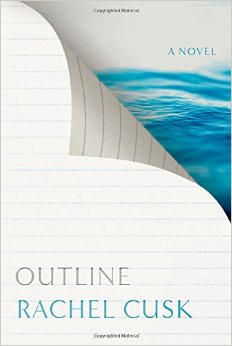
Outline: A Novel by Rachel Cusk

image from amazon.com

image from amazon.com

Outline by Rachel Cusk was something different. I haven’t read popular fiction in quite a long time, and I was worried when, in the beginning, the main character becomes engaged in a conversation with her “neighbor” on a flight to Athens. Through his line of questioning, we learn a little about the protagonist, which felt like a plot point contrived solely for the purpose of giving the reader information about the main character.

However, I liked the book and found the brilliance in that, as the protagonist meets several different characters, there are interesting and universal insights to be gained about human nature. For the most part, the characters themselves are very self-aware and analytical, sharing meaningful insights with the protagonist. Though, like all people, their assessment is not always accurate. Cusk presents these quirks and character flaws in entirely novel ways, but they resonate as true and important glimpses into the human psyche.

Interestingly, as the protagonist meets the various characters, Cusk’s voice or tone remains consistent throughout. So, there is little sense of the individuality of these characters. In many ways, the novel reads like an outline, a sketch, of the characters and ideas that Cusk is presenting.

The last character to enter the novel speaks about a troubling condition she’s gained, which she calls “summing up.” It prohibits her writing because just as she really gets in to writing a play, she finds the meaning creeping into her brain, words like “tension,” “mother-in-law,” or “meaninglessness.” Once she finds the significance of her work, she loses interest. In the summing up concept, the reader sees the ways in which Cusk has both avoided and indulged a summing up of the various characters and meanings in her own novel.

This section was also meaning to me because I’ve been stricken by the same sense of summing up since my early 20s. I was probably 21 when I realized, with a start, that every story is the same with few uninteresting variations. This is why I have a hard time with popular fiction. I have a longstanding joke, which is likely only amusing to me, that is called “I saw it the first time when it was called…,” wherein I liken every new book or movie to a book or movie that came before and grumpily deduce that it will offer nothing new.

Furthermore, I see the same patterns play out not just in movies, but in real people in real lives. I rarely think anyone is ever having a unique experience, and the result of that is, I suppose, a somewhat jaded view of the world. I’ve never known anyone else to sum things up quite like I do, and so to see it portrayed in a novel was strangely validating.

Here are a few ideas from the novel that I think render further discussion:

  • “The bump in the road hadn’t only upset his marriage; it caused him to veer off on to a different road altogether, a road that was but a long, directionless detour, a road he had no real business being on and that sometimes he still felt himself to be travelling even to this day” (15).
  • “The memory of suffering had no effect whatever on what they elected to do: on the contrary, it compelled them to repeat it” (18).
  • “We are all addicted to it, he said…the story of improvement, to the extent that it has commandeered our deepest sense of reality” (99).
  • “I had friends in Athens I could have called. But I didn’t call them: the feeling of invisibility was too powerful” (248).

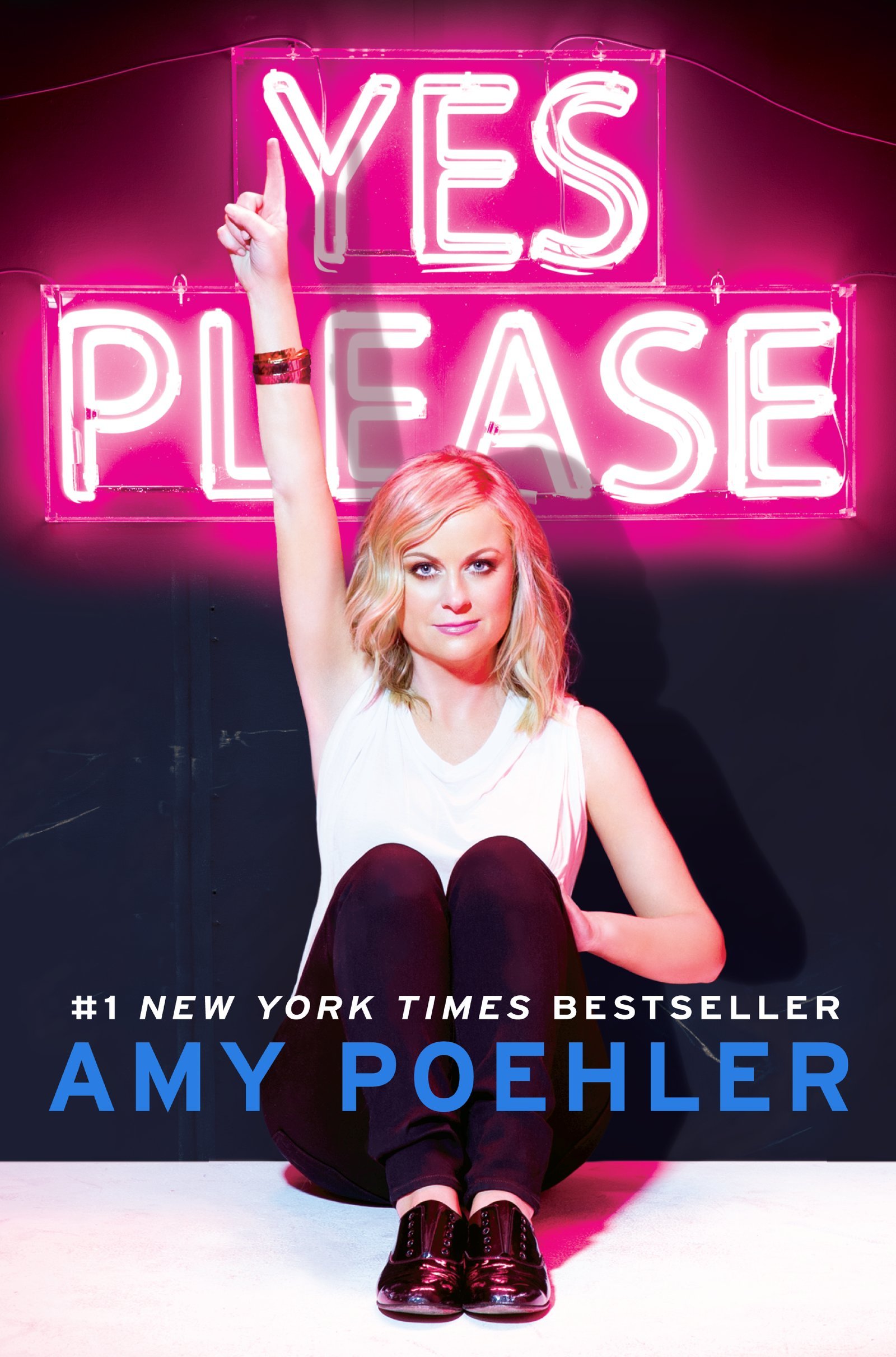
Yes Please by Amy Poehler

After reading books like Tina Fey’s Bossypants, Mindy Kaling’s Is Everyone Hanging Out Without Me?, and Chelsea Handler’s Are You There, Vodka? It’s Me, Chelsea, I was excited to read this latest one by a comedian. I’m a die hard fan of Saturday Night Live. I tend to love the work that comes from their alums–probably because they know all the good writers. Of her SNL bits, I mostly loved the ensemble skits she was in. Leslie Knope, the character she’s gone on to play in Parks and Recreation, is just great. When it comes to Amy Poehler, I like her, but I think she’s best in collaborative efforts.

Her book was not a favorite. If you’re a die hard fan and will read anything related to SNL, then read it. Otherwise, it’s okay to skip this one. There are funny moments, there are insightful moments, there’s biographical information, and there’s behind the scenes stuff from her work in comedy. But, there’s also a difficult self consciousness that doesn’t always work. Throughout, she complains about how hard and terrible it is to write a book, and those feelings begin to wear off on the reader. The book is repetitive in some ways that don’t seem intentional. The book’s organization is baffling. More importantly, the pages are thick and weird and glossy. What is probably supposed to be “good quality” comes off as too slick, and it makes the book too heavy. It will hurt your wrists while you are reading it in bed.

image from amazon.com

image from amazon.com

Here are a few lines for further discussion:

  • “Make sure he’s grateful to be with you” (202). This wisdom is via Poehler’s mother. It’s simple, but it resonated with me. I’ve had a few relationships for which I am (and was) very grateful. Like, look around at the sun shining and birds chirping and thank my lucky stars kind of grateful every day. With other people, not so much. Your level of gratitude for the other person says a lot.
  • “Hairspray was king, and the eighties silhouette…was big hair, giant shoulder pads, chunky earrings, thick belts, and form-fitting stretch pants. My silhouette was an upside-down triangle. Add in my round potato face and hearty eyebrows and you’ve got yourself a grade-A boner killer” (207-08). See, there were plenty of lolz! (Also, I want to reintroduce “grade-A boner killer” into more of my conversations.)
  • “And I count myself very lucky. That is what “very lucky” feels like. Oof” (235). These sentences ended a long paragraph on the various violences Poehler has endured–muggings, physical and sexual harassment, sexual violence–but never rape. She makes a powerful point here.
  • “‘Smile’ doesn’t really work either. Telling me to relax or smile when I’m angry is like bringing a birthday cake into an ape sanctuary. You’re just asking to get your nose and genitals bit off” (236). I like this for two reasons. One, being told to “smile” is a weird thing that men say to women. To be on the receiving end of this kind of command feels icky. Two, I love making jokes about ape violence despite the fact that it rarely draws laughs. I’m glad to see Poehler going for it here.
  • “[I]f you do start crying in an argument and someone asks why, you can always say, “I’m just crying because of how wrong you are” (237). This one made me laugh, and I hope I have the wherewithall to use it sometime.

**Edit: There’s also this place where she tells a story of having a casting director ask her to share her most embarrassing story. Poehler refused and didn’t get the job. Then, she told the reader that you don’t have to tell people your most embarrassing story when they ask. I liked that.

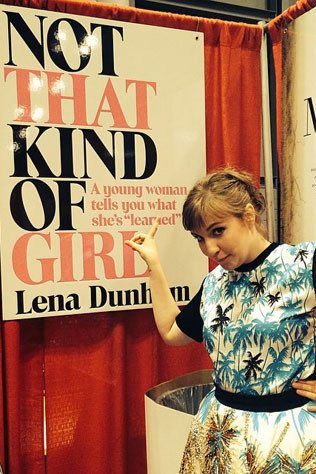
Not That Kind of Girl by Lena Dunham

I have a [smart] friend who thinks Lena Dunham’s work is bad, irresponsible. We go rounds on this because I love her and think that he’s too caught up on having morally good, heroic main characters. He says I’m missing the point. Dunham’s work is shrouded in controversy, but if you’re a fan of her show Girls, you’ll definitely like Not That Kind of Girl. In fact, if you just sort of like her show, you’ll still like her book. Lena Dunham’s work is so incredibly personal and vulnerable and embarrassing and painful, and human. I identify with her so much.

First, I am fascinated with the way she deals with first/early sexual experience. It is the most honest depiction of the kinds of sexual experiences people have in their late teens and early twenties. It can be weird, awkward, and embarrassing. People are unsure about what to do where and for how long. There are strange acts that exist solely because porn tells us that’s what people do for pleasure, even if very few people are doing that thing for pleasure. I actually think this is unavoidable for the most part because there are very few activities that are comparable to coupled sex. In the process, mistakes are made and confusion abounds. Young women are in a constant negotiation with owning and expressing their sexuality, while simultaneously figuring out where the media pressures and social expectations end and where their own pleasure and desire begins. [By the way, I think this is true for men, too, but I don’t read much about it.] So, that’s important.

She’s also balancing art and social commentary, which can be weird and bad, but she does it well. One could easily assume that her work is this off the cuff confessional style, and it is, but there is also real artistry in her work. She has a deep familiarity with language and a knack for creative expression through  her writing. My expectation is that she will continue to write books, and they will be revolutionary, yes, and will only improve from a literary perspective.

Now, let me address the whole scuttlebutt over childhood sexual abuse when the book first came out. I assumed that it would be honest and artfully done, and even be good in that it would help us to think more critically about childhood sexuality. I wanted to read it first before forming my opinion, and after reading it, I thought it was good and important, and did the thing of making us think openly about childhood sexuality. The story is weird, and a bit uncomfortable, but true and not abuse, in my opinion. You can bet that Dunham thinks about consent and abuse because they are major themes in her work.

While I am highly invested in the topic of female sexuality, obviously, Dunham covers other ideas that resonate with me so strongly. Like, there are people who love people, and people who can’t stand to be alone, and people who are curious about other people [I might fall into that last category], but usually I have, as Dunham states, “the nagging sense that my true friends are waiting for me” (xiii). I have met some of my true friends, and when we meet, and recognize each other, there is much rejoicing! I love these people. They are my forever friends and lovers. But, they number so few I can count them on my hands, and I often feel lonely or out of place, wishing that I could be with one of my people when I’m tired of being alone. Lena Dunham—she gets me.

image from vogue.com

image from vogue.com

Here are some quotes I highlighted:

  • “There is nothing gutsier to me than a person announcing that their story is one that deserves to be told, especially if that person is a woman” (xvi).
  • “He was nervous, and, in a nod toward gender equality, neither of us came” (7).
  • “This was the time in life before I learned it wasn’t considered appropriate by society at large to like yourself” (34).
  • She quotes Joan Didion: “There is a common superstition that “self-respect” is a kind of charm against snakes, something that keeps those who have it locked in some unblighted Eden, out of strange beds, ambivalent conversations, and trouble in general. It does not at all. It has nothing to do with the face of things, but concerns instead a separate peace, a private reconciliation” (38).
  • A list from a relationship…”One very unnecessary pregnancy test” (54).
  • “Wherever you go, there you are” (69). An old favorite.
  • “After several interactions in which he questioned my authority and pretended not to hear me speaking, it was clear he was my type” (71).
  • “I had broken up with him on my seventh try, and one try didn’t even count because all I could muster was “I love you” (76).
  • On meeting her love: “Look, there is my friend” (76).
  • “…desire is the enemy of contentment” (143).
  • “You will find,” she says, “that there’s a certain grace to having your heart broken” (144).
  • “…you’ll see that later and be very, very proud” (262).

And so many others.

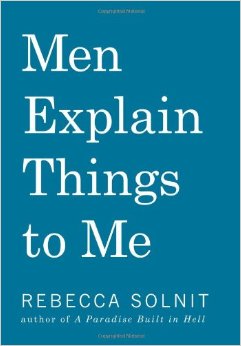
Men Explain Things to Me by Rebecca Solnit

I just finished Men Explain Things to Me by Rebecca Solnit over the course of a few evenings. It’s a *heavy* read, but it’s composed of short, manageable essays. The first most noticeable thing about this book is that it is not funny. There is absolutely nothing funny or lighthearted about it, and that was a surprise. The title is sort of funny, and alludes to “mansplaining,” which is terrible and indicative of larger social issues surrounding gender, but it’s also sort of funny. The title is not a good indication of the book.

image from amazon.com

image from amazon.com

Solnit is unrelenting in her depiction of the “longest war,” a war on women. Reading it was overwhelming—a reminder of the violence and disdain lobbed at women by our society. The statistics were staggering. Having heterosexual relationships with men seemed increasingly fraught for both genders. I was left wondering how we navigate these weird power dynamics in our most personal relationships. I felt overwhelmed by the violence. I felt overwhelmed by the reminders of the constraints I face each day as a woman.

For example, each day before dark, I try to accomplish all tasks that require me to walk any distance alone or through a parking lot. Every day, I, mostly subconsciously at this point, plan my day with safety in mind. When I overtly think about these habits, it makes me sad that I live in such a violent world, and it makes me sad that safety has to be such an underlying factor in my daily decisions. Surely this has unknown negative effects. Solnit writes, “My feminism waxed and waned, but the lack of freedom to move through the city for women hit me hard and personally at the end of my teens, when I came under constant attack in my urban environment and hardly anyway seemed to think that is was a civil rights issue” (128). Solnit argues for an emphasis on turning the lens on men and why they are so frequently the perpetrators of violence, opposed to giving women the sole responsibility of preventing violence. This “Top 10 Tip to Avoid Rape” meme has made the rounds and points out the profound role that men (obviously) play in “rape culture.”

image found here

image found here.

Like Solnit, I wonder why these problems are not viewed as a deeper crisis and as a civil rights issue. In recent years, I have felt a real personal fear as politicians have made absolutely horrifying, and often scientifically inaccurate, claims about women’s bodies. As the Hobby Lobbys and various right wingers argue about what I can and cannot do with my own body, for the first time, it has felt very personal and very stifling.

Of course, the reaction to these issues is often, yes, but “not all men.” And, Solnit carefully dedicates sections of each chapter, writing “not all men, but…” This is unfortunate. We can’t just talk about this issue without spending a lot of time reassuring men and women that not all men are bad. In so many ways it seems like this reassurance is also indicative of the problem. It’s a problem that we literally can’t even talk about women’s issues without spending a good deal of time reassuring men and talking about men and turning the focus, even just briefly, back to men. On the other hand, they’re half the population, and they’re our partners, fathers, brothers, and friends, and so it makes sense that we can’t talk about women without spending some time also talking about men.

The book isn’t entirely matched thematically, and she delves into some literacy criticism, as a way to address the larger social problems that she unpacks earlier in the book. She wrote of a criticism that “does not put the critic against the text” (101). In her exchange with Susan Sontag, Solnit writes that “you don’t know if your actions are futile; that you don’t have the memory of the future” (93). This is in response to Sontag’s assertion that resistance is required, even if it is futile, and maybe it is always futile.

On Woolf, Solnit writes of a botanist that had “a knack for finding new species by getting lost in the jungle, by going beyond what he knew and how he know it, by letting experience be larger than his knowledge, by choosing reality rather than the plan” (96), and I love this idea so much. For living life, for finding new ideas, for creating art. I am such a planner and a researcher, and I love the idea of this kind of purposeful method (which, yes, requires planning and research). I love the idea of using this method as a means of discovery, rather than following what is known: “a compass by which to get lost” (106).

Of measurement and discovery, Solnit also writes about “the tyranny of the quantifiable,” which is “the way what can be measured almost always takes precedence over what cannot” (104-105). This has been a frustration for me lately. Working in bureaucracies, and within high education, too often means a singular focus on the quantifiable, on the assessable. When other ways of being or knowing are scoffed at as being dangerous, even life-threatening, we are limited by what we can do as dreamers, thinkers, creators, and teachers.

This book reads up so quickly and so powerfully that there’s really no reason not to read it. Afterward, you can spend some time thinking through what it all means for gender, relationships, and the way men and women exist in the world. I think I’ll even pick up her other book, Wanderlust because it is about walking and maybe other things too.