Tag Archives: book club

Let’s Just Say It Wasn’t Pretty by Diane Keaton

I read Let’s Just Say It Wasn’t Pretty by Diane Keaton because I remembered liking her Then Again awhile back. Also, more importantly, Diane Keaton has done things a little differently, and I’m always looking to read about women who are doing things a little differently because I do things a little differently too.
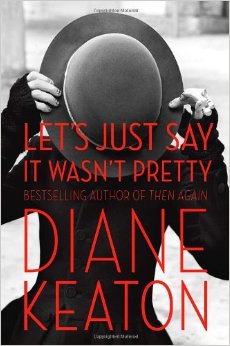
image from amazon.com

image from amazon.com

It’s an odd book, and much more stream of consciousness than I remember of Then Again. And, so I was glad to read something entirely different. It was insightful to be privy to Diane Keaton’s mind, which was, just like her, brilliant, annoying, confusing, legendary.

I mean, you can tell that a frenzied editor tried to assemble her bedside journal scribblings, but that’s okay. It never needed to be a perfect to begin with.

She writes about beauty. It’s mostly about beauty. The introduction is so promising, and there are only glimpses (though worth it!) of this promise throughout. She writes about the process of discovering beauty as a young girl, and hearing the opinions of others, she and writes “Don’t tell me what beauty is before I know if for myself.” I think that line is so important. The most honest, provocative moments are when we fall in love with something beautiful before we realize or understand if it meets a shared social standard of beauty: our mothers, the fabric on grandmother’s old chair, a tiny glass figurine weighted just right. Of course, soon enough, we are told what beauty is, and all is lost, and we can never again really know how much we’ve mixed up our own sense of beauty with society’s standards. C’est la vie.

Later, of Picasso’s depiction of Marie- Thérèse, Keaton writes that Picasso paints her, “through loving her, living with her, and seeing her as both ugly and magnificent. Because of his sculptures, Marie- Thérèse emerged as a symbol of unsightly, frightening, even hideous but also, I have to say, complete beauty” (xix). I can think of nothing more romantic than the thought of two people loving each other and timelessly fascinated with the ugly and the magnificent in the other—the unsightly, the frightening, the hideous, and the beauty.

Keaton is a romantic and appears to be unlucky in love, but has also had some luck in love. Her questions of love and beauty were really nice to think through with her, even if just for a couple hundred pages.

Tenth of December by George Saunders

I recently finished a collection of short stories by George Saunders called Tenth of December. I’ve never read Saunders before and didn’t intend to, but I saw the title in a favorite new and used bookstore and had to pick it up. I’ve always loved the bookstore. It used to be called Earth ‘N Book in La Grande, Oregon. Years ago, it changed hands, and I felt that it wasn’t quite what it used to be. However, I popped my head in on a recent visit to Oregon, and it drew me in—just like a good new and used bookstore (is there any other kind?) always does.

image from usatoday.com

image from usatoday.com

I scanned the new releases, and that’s when the title caught my attention: Tenth of December. You see, that’s a significant date for me. That’s the date that My Love was born. (Though for years I had it in my head that his birthday was on the seventh.) I picked it up and read some praise on the back cover. There was a conversation at the end with David Sedaris—a favorite! I decided to get it as a gift for Z, who would be visiting me in Oregon on his way through. (He is currently on a bike trek from Utah through the Northwest.) So, I bought the book, along with another great book called This is Not My Hat for my nephew. (That book encouraged a good four-year old-appropriate conversation on the ethics of stealing. Z pointed out that it also taught dramatic irony.)

Tenth of December starts with a short story called “Victory Lap,” which is absolutely stunning. It is hilarious and traumatic—something Saunders does very well. He also has a distinct and innovative voice, but doesn’t seem like he’s trying too hard—which means he was probably trying very, very hard. I know that seems so very nonspecific, so I’ll try to elaborate. Saunders does this thing where he integrates these informal aspects of text-speak and typing. So, for example, the “ha ha has” we get when we’re chatting or texting are integrated into his work in a profound and poetic, but (of course) understated way. There are a few good authors who are absolutely genius with their ability to make the colloquial profound (Raymond Carver is among them), and Saunders does that too. But, what’s most interesting, I think, is the way he integrates a really modern colloquial that is clearly influenced by the way changing and omnipresent technology evolves our language.

“Victory Lap” was probably my favorite piece. I also really appreciated “Puppy.” In my opinion, a few pieces were too dark and/or difficult for their payoff, but I am particularly sensitive to such things. As you, dear readers, may recall, I am making an effort to read mostly female authors for the time being. It’s difficult to describe why exactly, but suffice it to say that for my current creative endeavors, I want to have the voices of women in my head.

Despite that current constraint, I picked up and read Tenth of December as quickly as I could. When Z arrived in Oregon, I kept reading it for several days, trying to finish in case he wanted to take it with him on his bike trek. Though it was an emotional rollercoaster, I’m glad I read it. I’m also glad I’ve given it as a gift. I won’t mind that it is in someone else’s care for awhile.

The Favored Daughter: One Woman’s Fight to Lead Afghanistan Into the Future by Fawzia Koofi

I just finished reading The Favored Daughter: One Woman’s Fight to Lead Afghanistan Into the Future by Fawzia Koofi. It was a fascinating glimpse into the life of a Middle Eastern woman and a reminder of how quickly a dictatorship can destroy people’s lives, especially women.

The Favored Daughter

image from NPR

Several years ago, I also read Inside the Kingdom: My Life in Saudi Arabia by Carmen Bin Laden, and it was also spellbinding. The books are both from the perspective of educated women from the Middle East. I love getting their perspective because that experience is so vastly different than my own and also because it is represented so infrequently in literature. On one hand, these women are very similar to me in that we are all highly educated. On the other hand, I have much more relative freedom here in the US than many women in the Middle East. A highly educated woman living in an incredibly conservative patriarchal society is fascinating.

What I loved most was Koofi’s description of her childhood, growing up in the remote mountains of Afghanistan to a politician father in a polygamous family. It illustrated the bygone days when rampant spousal abuse and deadly sexism prevailed. The book provides a lens to a culture that is very different from my own. The passages about her childhood and early womanhood are lovely and interesting. It seemed that the love and unusual attention her mother gave her, even though she was “only” a girl, inspired her to a different life than one lived by most women in Afghanistan.

It is no spoiler than Koofi goes on to have a political career and that is where the book falters a bit. The last few chapters become a bit repetitive and have a distinctly political. The book ends in a tone that is political and not always in a good way. Not at that her points aren’t valid. They are! And, she is incredibly inspiring and her work as one of the few female politicians is no doubt incredibly important. All of that is gripping and exciting—but it’s not as exciting as the personal view she takes of her life in the first two-thirds of the book. By the end, she sounds like a politician who is on the campaign trail—a politician who might one day become the president of Afghanistan.