Tag Archives: memoir

I’ll Tell You in Person by Chloe Caldwell

I read I’ll Tell You in Person by Chloe Caldwell right before reading her other more well-known and previous book entitled Women. The book reads as a memoir and Caldwell as the main character is unhinged and insufferable, but recognizable, and this seems intentional and is the interesting thing about this book.

Caldwell’s depictions of coming of age in the 90s and early aughts is detailed and nostalgic, and this part will resonate with most readers who have lived through that era.

There’s something to say about privilege/social class and mental illness, but I’m not sure what except maybe just that people with support networks can experience drug addiction and depression more safely than those in more precarious situations.

I found myself wishing I’d read the book 20 years ago, but it was published in 2016.

Dear Girls by Ali Wong

A friend gave me this book, and, as you know, I like a comedian’s memoir. Dear Girls by Ali Wong is that great blend of comedy and memoir, with some important social commentary about race and gender sprinkled in throughout.

Some readers may think it doesn’t age well since the author and her husband divorced shortly after the release of this book, and the book covers their relationship extensively, but this book is still worthwhile and captures a moment and a sentiment worth capturing.

Paris: A Memoir by Paris Hilton

As you know, I love a good celebrity memoir, and Paris: A Memoir by Paris Hilton did not disappoint. I’m actually surprised this book hasn’t been more widely advertised or talked about in my media streams because the book is quite interesting, and I think everyone who has watched the Paris juggernaut over past decades will find this book to be of interest.

Most interestingly, Paris relays the horrifying treatment facilities she was put in as a child (in great detail) and her tumultuous teen (and adult) years. She contextualizes it all with her ADHD/neurodiversity, and honestly, as a reader, this context made it all make sense for me. It was also interesting to see the focus and vision she’s had for her career from very early on.

In the end, I think this book will truly be a gift to teens with ADHD and to people who aspire toward greatness. I would have liked to see more “how I built this”-style insights and more insights into social class, access, and fame, but she does touch on all of these to some extent.

She is entering a new era now–marriage and motherhood–and in the future I’ll definitely read another memoir from her that goes more into depth on these subjects as well.

From Here to the Great Unknown by Lisa Marie Presley and Riley Keough

For the last decade or so, I’ve had a heightened interest in Elvis. What a legend! I love his staying power. I love his unique voice. I love the performance of it all. I especially love this song that totally melts my face.

So when I found out that Riley Keough and Lisa Marie Presley had written a memoir, I could not wait to read it. I was really hoping that Lisa Marie would have narrated her part, but it was read by Riley and Julia Roberts, and that was good too. Julia Roberts has a subtle Southern accent that really piques the imagination. There are also a few excerpts from Lisa Marie, and that is very satisfying.

Overall, From Here to the Great Unknown is an excellent book. Lisa Marie’s life was incredibly intense and full of tragedy, and the book portrays much of that in extreme detail. I learned new things. The descriptions of Graceland were incredible that I felt like I was there. Now I really want to visit Graceland!

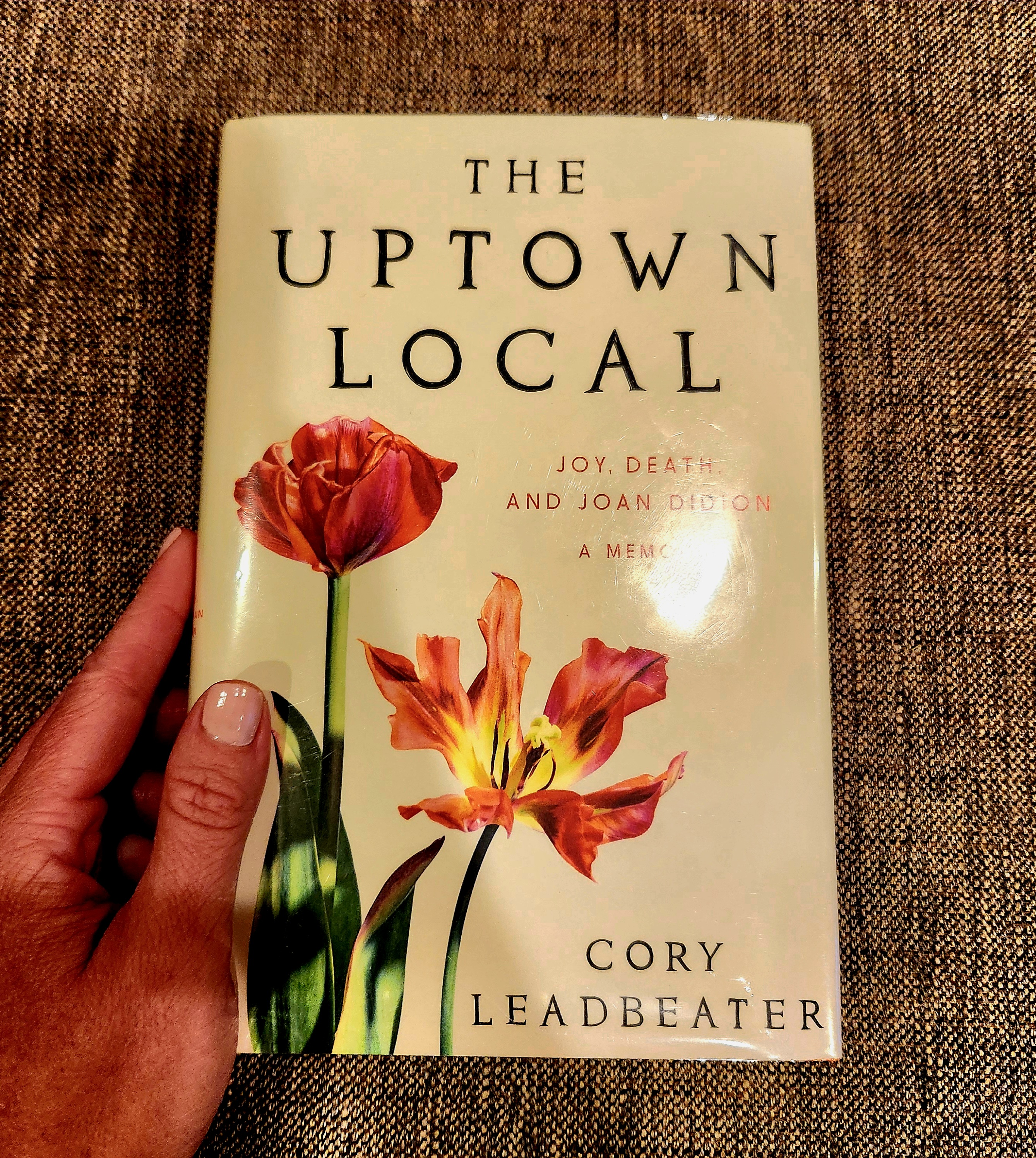
The Uptown Local by Cory Leadbeater

After reading Joan Didion’s Blue Nights, I picked up Cory Leadbeater’s The Uptown Local at the library because it is about his life working as Didion’s assistant, and my interest in Didion had been renewed. This is a memoir, and Leadbeater has quite a lot to share about his own life and creative process, as well as what it meant to him to work so closely with Didion.

This book is honest and insightful, and very self aware. Readers will get some Didion fixes, but more than that, it offers insight into what it might’ve been like to be her assistant in her final years. And, I’m sure many readers and writers probably have fantasized about just such a job. I have.

Leadbeater portrays their dynamic as a kind of mother son relationship. In fact, Didion refers to herself a “mommy” in her book inscription to him. Leadbeater seems to wear his troubles on his sleeve, and Didion seems to not shy away from them. She seems to fully embrace and welcome him, even despite (or because?) of his challenges. Even when her more aristocratic friends disregard him, Didion is stalwart. I wonder if she saw her own daughter in Leadbeater. Some of their troubles seemed the same, from what I can gather, which is very little.

In the end, both Didion and Leadbeater both offer insights on relationships, art appreciation, poetry, and how to live a meaningful life–something we could all probably use.

The Woman in Me by Britney Spears

I continue to be impressed by the work of the ghostwriters behind some of the memoirs produced by key famous people recently. These writers effectively capture the famous figure’s voice, add genuine insight to their lives, and seemingly work under impossible deadlines, and that was the case with Britney Spears’ book The Woman in Me. The first half of the book is really interesting and insightful. Readers will likely learn things about Spears’ childhood that were previously unknown. The context helps add insight to the performer’s experiences later on.

What I appreciate about some of these ghostwritten books written about famous people is insight into the individual’s character and experiences, and what that says about humanity and culture. In the case of Britney, it’s really tragic just how she was used by everyone and what that says about our culture. The book lends some insight into that dynamic in ways that just don’t get captured in popular media (try as they may).

If the first half of the book is good, the last half or third of the book drags on a bit. The conservatorship seems like a thirteen-year fog, and that’s what readers feel too. There were relationships, but they lacked much depth and development (both in the book and perhaps in real life).

I wanted the conclusion to really sing with mind blowing insights into the human spirit, but that’s not real, I suppose. Instead, readers get the sense that Britney is still just surviving in many ways. Adding the context of her recent divorce, which is not mentioned in the book, readers can see that Britney is still figuring it out. It’s not perfect, or pretty, but she is alive, and that is worth celebrating.

(It is also true what they say about Michelle Williams–she really did a phenomenal job with the audio book.)

Spare by Prince Harry

After watching some of the recent interviews with Harry and Meghan, my curiosity was piqued to read Spare by Prince Harry. For those who have been following along, this is a great book. Fans of Princess Diana will appreciate it too. The book effectively captures his tone. It offers the kind of inside look that audiences never get access to. Prince Harry bravely takes up vulnerable and taboo topics in the book. He openly admits to his bad behavior. He openly admits to his anxiety and depression.

Where this book is a triumph is in its ability to show the royals as real, fallible, human people. Of course logically we know this, but due to tabloids, celebrities often get distilled down to products for consumption rather than treated as real people. I appreciated that about the book.

Strangely, I sort of identified with some aspects of Prince Harry’s experience. He writes about visiting the site of his mother’s death years later and mentions that its the first time he’d been to Paris, but I assumed he would have traveled to all of the world’s major cities frequently. His visit was in close proximity to my own first visit to Paris. But for me, it was more understandable. I was raised in a rural location without a lot of firsthand experience with the outside world. I could read about it, but I’d never actually, for example, walked the streets of Paris. It’s great, but it’s also a somewhat isolated experience. Prince Harry’s experience seems somewhat similar. While school and studies take up a big part of his life, another big part of his life seems to have been safely sitting alone in castles.

It’s clear that Prince Harry is traumatized by the loss of his mother at the hands of paparazzi. It’s clear that the trauma informs his own reaction to the paparazzi today, and that’s made even more evident in his drive to protect his new family. While others may say that he should ignore it, or that by recounting these baseless stories in his book, he’s just giving them more air time. There’s no accounting for a broken heart and how it will make you feel and what it will make you do.

I am sympathetic to Prince Harry, but I don’t see eye to eye with him on everything. I don’t need to. In fact, challenging the audience in these areas is probably part of what makes him so compelling. I am more sympathetic to the circumstances of the other members of the royal family. I think they’re in both a really privileged situation and a really limiting one as well. As is made clear in Spare, the royals are, again, real people with all of their own strengths and challenges, living within a limited, but also very privileged world.

Dog Flowers by Danielle Geller

For whatever reason, I’ve been reading a disproportionate number of memoirs by Native American women. I’ve also been loving them. The most recent is Dog Flowers by Danielle Geller. The book is troubling and straightforward. It seemed to be divided into two distinct sections, although it’s not formatted as such. I found myself wanting to read two separate books: one about childhood through the death of her mother and another about life after that death. (I don’t think it’s a spoiler to mention the death here because the reader knows about it from early on.)

Most children with parents who are addicts and homeless don’t go on to write beautiful books, so in that regard this novel is unique and offers a perspective that’s rarely told.

One of the main takeaways for me is the way that dysfunctional families impact their members constantly. The always immediate need for housing, medical help, mental health support, food, emotional support, and on and on, just never seems to end, and it impacts every aspect of one’s life. It’s something I’ll understand in a new way in my interactions with others who may be experiencing this same constant and continual drain from their own dysfunctional families.

This book is heavy and hard, but important. Oh, and there’s weaving! I hope the next book has more weaving.

How We Fight for Our Lives by Saeed Jones

I read How We Fight for Our Lives by Saeed Jones because it was sitting there, and I’m glad I did. It’s a quick (but not necessarily easy) read. I was immediately drawn into the narrative. He shares what feels like a really authentic account of what it’s like to grow up Black and gay and how and why that felt like a death sentence to him.how we fight for our lives

The confusion, innocence, curiosity, and angst of childhood felt really authentic to me—though his experience seemed even more exacerbated by his firm knowledge that he was *different*. Later, the sex is explicit, and there’s a lot of it, and at times I wondered if it was gratuitous, but in the big pictures, it really did serve an important purpose in the story. And anyway, it’s about a young gay man, so yeah, there’s going to be some sex.

About two thirds or three quarters of the way through the book, when many authors lose their steam, attention to detail, and sentence-level care, this book picks up, ending powerfully as the author’s relationship with his mother contextualizes and heals and, although imperfect, a clear love story emerges that feels true and healing and heartwarming.

The ending is surprisingly, as it becomes clear that this author has achieved the sense of self that he’d been searching for—in some unlikely ways and places that simultaneously feel familiar. I too have suddenly and unexpectedly wept with strangers.

The book made me much more reflective of my own education, especially my undergraduate degree, an experience that, for me, has inexplicably evaded much analysis or meaning making from me. This book also made my world much smaller. I identified with this man in that I too went to a state school on a scholarship, and although it wasn’t the fancy private school to which I had received a partial scholarship, it offered an important education still the same.

Because the book was not too demanding of my time, I googled some of people listed in the acknowledgements section. I read Sarah Schulman as an undergrad! I didn’t realize Roxanne Gay has a PhD in Rhet/Comp like I do! I didn’t realize it was from Michigan Tech, a sister school with my own PhD program that often exchanges “talent.” Not only did the book’s journey resonate with me, I also had the sudden sense that these people were actually my people. This felt like…my circle.

This is a story of a gay black man, but the journey to reconcile the love and harm inflicted by one’s family, the journey of navigating the first years of adulthood (college) and settling into one’s authentic identity amid wildly conflicting pressures, the community we find, the family we choose is the stuff of life and something with which every reader can identify.

Crazy Brave by Joy Harjo

I read this book almost entirely while lying in bed, while falling in love. Joy Harjo’s a fixture in poetry and literature. Before now, I’d only ever read a poem or two here and there, but I’d never really gotten into her work…that is until I read her memoir, Crazy Brave. It was one of those books that I started reading in a bookstore, and then read a chapter or two from the library, and then finally bought my own damn copy and finished it at home…while lying in bed. I love this book.

image from amazon.com

Harjo is mostly known for her poetry. I don’t enjoy reading a lot of poetry, and so that’s why I haven’t been very familiar with her work. After reading and loving Crazy Brave, I read She Had Some Horses, which is also beautiful, and I love it, and it’s poetry. It’s a collection I see myself returning to.

As for Crazy Brave, what I love about the book is how she captures a creative, feminine life experience that I (mostly) really relate to. It’s soulful. It captures pain, and specifically women’s pain, in a profound way. It shows us another way. It does so in poetic prose–she’s a poet after all.

This is from the back cover of She Had Some Horses, but I think it pertains to all Harjo’s work: “If you want to remember what you never listened to & what you didn’t know you knew, or wanted to know, open this sound & forget to fear. A woman is appearing in the horizon light.” ~ Meridel Le Sueur.

And then I saw her picture and remembered that maybe I met her. Or maybe I heard her read once. She is familiar to me. Her name. Her face. Her work. And yet I only really found her work now, when of course I needed it most.

I was captured throughout the entire book, but  by the end, I was a little lost: WHAT DOES IT ALL MEAN?! I wondered about the title: crazy brave. Now I think I can say that the larger message was, for me personally, a message to women to be brave, an admonition that it will be crazy, and you will be crazy, and you will be brave, and that is life.

Part of this is about surrendering to the flow of the river, instead of fighting against it, using the strength of the current to pursue yourself, but also acknowledge or accept that the river will be violent, and it will wound you deeply, and it might kill you, and it might lull you to sleep, and part of this we can control, and part of it we cannot control, and this is the wisdom we gain from being in the river. I am reminded of the time I went underwater in the Colorado River, the immense crushing noise turned warm and quiet and then I emerged. Part of this book is about acknowledging fear, working around it, using it, but not being controlled by it. I left the book thinking I should do what I must do before the river does it for me, even as the river does it for me.

Some of the words I loved:

“Yet everyone wanted the same thing: land, peace, a place to make a home, cook, fall in love, make children and music” (19).

“Because music is a language that live sin the spiritual realms, we can hear it, we can notate it and create it, but we cannot hold it in our hands” (19).

“In the end, we must each tend to our own gulfs of sadness, though others can assist us with kindness, food, good words, and music. Our human tendency is to fill these holes with distractions like shopping and fast romance, or with drugs and alcohol” (23).

“Water people can easily get lost. And they may not comprehend that they are lost. They succumb easily to the spirits of alcohol and drugs. They will always search for a vision that cannot be found on earth” (25).

“They continue to live as if the story never happened” (43).

“Our  heartbeats are numbered. We have only so many allotted. When we use them up, we die (52).

“All of these plant medicines, like whiskey, tequila, and tobacco, are potent healers. There’s a reason they’re called spirits. You must use them very carefully. They open you up. If you abuse them, they can tear holes in your protective, spiritual covering” (77).

“I noticed a marked change in the quality of light when we made it to New Mexico” (83).

“Each scar was evidence that we wanted to live” (90).

“I told Lupita I wanted to paint, to be an artist. She told me that what she wanted was someone to love her” (102).

“I was given the option of being sterilized” (121).

“I believe that if you do not answer the noise and urgency of your gifts, they will turn on you” (135).

“We were in that amazed state of awe at finding each other in all the millions and billions of people in the world” (143).

“Her intent made a fine unwavering line that connected my heart to hers” (146).