Tag Archives: spirituality

Anatomy of the Spirit by Caroline Myss

Next up in my series in the self-help genre was Anatomy of the Spirit by Caroline Myss. I have read, or skimmed (or was supposed to read?) Myss in the past–I can’t quite remember–but either way, this book was familiar. In it, Myss compares the Eastern concept of the seven chakras to the Catholic concept of the seven sacraments.
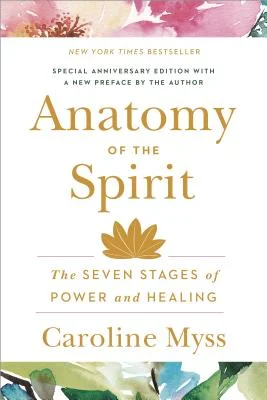
Peronally, I am much more familiar with the chakras than I am with the seven sacratments. But, based on my limited understanding, I thought the comparison was often clunky, especially in regards to the first three chakras and first of the seven sacraments. Sure, both are seven, and sure, seven is considered a sacred number across many traditions, but beyond that, the comparisons often felt like a stretch.

Myss, like many of the gurus in The Wisdom of Sundays, has to hedged her integration of an Eastern tradition into her practice or theory. I find this kind of hedging to be kind of sad and frustrating. On one hand, it can dumb down the content, and on the other hand, I am just baffled and disappointed about what this says about society’s ability to hold on to complex and/or competing ideas. Still, I suppose these baby steps are necessary. Either way, while I was sometimes weary of Myss’s use of Christianity as a foundation for the philosophies in ways that did not feel productive, I still found a lot of wisdom in her words. There are many nuggets of truth to be had here.

The Wisdom of Sundays by Oprah Winfrey

Next in the line up for self-help was more from Oprah: The Wisdom of Sundays. Similarly to The Path Made Clear, this book included excerpts and insights from Oprah’s interviewees.

As one might imagine from the title (Sundays), this book was heavy influenced by religion, mostly Christianity. However, I think other readers have something to gain from it because the interviewees (and Oprah) frequently refer to a sense of spirituality that will resonate with most audiences.

Interestingly, most of the interviewees shared a narrative of a big transformation, some moment, a stroke of insight, a miracle occurring, which is such a part of the Christian tradition (and probably others) that I had a hard time taking it seriously as anything other than a trope. I wanted to hear more about the gurus who gained enlightenment after a slow and steady path. These are the stories that feel most realistic to me.

That said, I have also had big, transformational moments in my life too. Haven’t we all? And there is a lot to learn from those moments too, and they are certainly more entertaining to read about.

The Path Made Clear by Oprah Winfrey

For years, my yoga practice and author’s like Eckhart Tolle helped me to connect to my spiritual self. For whatever reason, these practices and readings have felt like necessary touchstones, reminders to help me stay on track with my authentic self and my unique spiritual path, reminders I have a hard time remembering on my own.

For whatever reason, these spiritual feelings, and my interest and curiosity in them, completely left me once I had children (although it seems like the opposite would be true). The only sense I can make of it now is that I was so deeply in my spiritual self as I transformed into a mother that I was unable to stand outside and observe, analyze, or even connect to the experience in a thinking way. I could not think it. I could only feel it, and I did feel it deeply! I have felt so profoundly grounded and assured since the transformation. Since becoming a mother, I am undeniable a new version of myself.

As the years pass, and I gain some distance from the initial experience of becoming a mother, and as I have more time for thinking and reflect than I did in the early days, I find myself having capacity for and appreciating the small *thinking* spiritual reminders that come my way.

Oprah Winfrey’s The Path Made Clear is just such a book, carefully curated with some of the great spiritual insights available to us. It is not too deep or too complicated, and it is not too long, but the insights shared from many of Oprah’s friends and peers are worth reading, even if they are just serving as familiar reminders.

Braiding Sweetgrass by Robin Wall Kimmerer

Braiding Sweetgrass: Indigenous Wisdom, Scientific Knowledge and the Teachings of Plants by Robin Wall Kimmerer (link below) is just a lovely book. When I first heard about it, I knew I wanted to read it. (If you follow me on Instagram, you know this too.) An immersion into plants, poetry, and botany? Yes please!

The second section is my favorite: “Tending Sweetgrass.” This section is more about plants as they relate to humans, relationships, parenting, and home. In this section, she delves into her sense of belonging (or lack thereof) in the different regions she’s lived in. I identified with this section deeply as someone who hasn’t always been able to live in regions that feel like “home” to me.

The author uses metaphor and parable, and it’s beautifully done, but these sections were less powerful to me. Instead, I gained the most from the sections that seem most connected to her own lived experience. I also loved some of the deep descriptions of the kind of spiritual nature of sitting alone in a patch of wild strawberries, harvesting wild nuts, and the life cycle of the salamander (an animal that I’ve encountered in life and in dreams recently).

Parts of this book are dense, and I found myself skipping through. The end is a beautiful, poetic, and urgent , warning, plea, defense against the rampant destruction of Mother Earth. Sometimes I have a hard time reading this kind of difficult material, but she does it so artfully that I was able to understand it in a new way.

If you love plants, animals, people, and Mother Earth, you’ll want to read this book.

Lines I loved:

“[B]ecoming indigenous to a place means living as if your children’s future mattered, to take care of the land as if our lives, both material and spiritual, depend on it (9).

“Plants know how to make food and medicine from light and water, and then they give it away” (10).

“[R]estoring habitat, no matter how well intentioned, produces casualties” (92).

“Being a good mother includes the caretaking of water” (94).

“You can smell it before you see it, a sweetgrass meadow on a summer day” (156).