Category Archives: art

Not That Kind of Girl by Lena Dunham

I have a [smart] friend who thinks Lena Dunham’s work is bad, irresponsible. We go rounds on this because I love her and think that he’s too caught up on having morally good, heroic main characters. He says I’m missing the point. Dunham’s work is shrouded in controversy, but if you’re a fan of her show Girls, you’ll definitely like Not That Kind of Girl. In fact, if you just sort of like her show, you’ll still like her book. Lena Dunham’s work is so incredibly personal and vulnerable and embarrassing and painful, and human. I identify with her so much.

First, I am fascinated with the way she deals with first/early sexual experience. It is the most honest depiction of the kinds of sexual experiences people have in their late teens and early twenties. It can be weird, awkward, and embarrassing. People are unsure about what to do where and for how long. There are strange acts that exist solely because porn tells us that’s what people do for pleasure, even if very few people are doing that thing for pleasure. I actually think this is unavoidable for the most part because there are very few activities that are comparable to coupled sex. In the process, mistakes are made and confusion abounds. Young women are in a constant negotiation with owning and expressing their sexuality, while simultaneously figuring out where the media pressures and social expectations end and where their own pleasure and desire begins. [By the way, I think this is true for men, too, but I don’t read much about it.] So, that’s important.

She’s also balancing art and social commentary, which can be weird and bad, but she does it well. One could easily assume that her work is this off the cuff confessional style, and it is, but there is also real artistry in her work. She has a deep familiarity with language and a knack for creative expression through  her writing. My expectation is that she will continue to write books, and they will be revolutionary, yes, and will only improve from a literary perspective.

Now, let me address the whole scuttlebutt over childhood sexual abuse when the book first came out. I assumed that it would be honest and artfully done, and even be good in that it would help us to think more critically about childhood sexuality. I wanted to read it first before forming my opinion, and after reading it, I thought it was good and important, and did the thing of making us think openly about childhood sexuality. The story is weird, and a bit uncomfortable, but true and not abuse, in my opinion. You can bet that Dunham thinks about consent and abuse because they are major themes in her work.

While I am highly invested in the topic of female sexuality, obviously, Dunham covers other ideas that resonate with me so strongly. Like, there are people who love people, and people who can’t stand to be alone, and people who are curious about other people [I might fall into that last category], but usually I have, as Dunham states, “the nagging sense that my true friends are waiting for me” (xiii). I have met some of my true friends, and when we meet, and recognize each other, there is much rejoicing! I love these people. They are my forever friends and lovers. But, they number so few I can count them on my hands, and I often feel lonely or out of place, wishing that I could be with one of my people when I’m tired of being alone. Lena Dunham—she gets me.
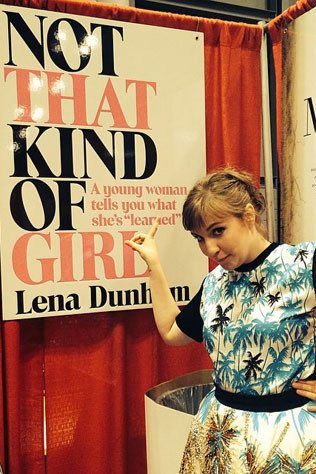
image from vogue.com

image from vogue.com

Here are some quotes I highlighted:

  • “There is nothing gutsier to me than a person announcing that their story is one that deserves to be told, especially if that person is a woman” (xvi).
  • “He was nervous, and, in a nod toward gender equality, neither of us came” (7).
  • “This was the time in life before I learned it wasn’t considered appropriate by society at large to like yourself” (34).
  • She quotes Joan Didion: “There is a common superstition that “self-respect” is a kind of charm against snakes, something that keeps those who have it locked in some unblighted Eden, out of strange beds, ambivalent conversations, and trouble in general. It does not at all. It has nothing to do with the face of things, but concerns instead a separate peace, a private reconciliation” (38).
  • A list from a relationship…”One very unnecessary pregnancy test” (54).
  • “Wherever you go, there you are” (69). An old favorite.
  • “After several interactions in which he questioned my authority and pretended not to hear me speaking, it was clear he was my type” (71).
  • “I had broken up with him on my seventh try, and one try didn’t even count because all I could muster was “I love you” (76).
  • On meeting her love: “Look, there is my friend” (76).
  • “…desire is the enemy of contentment” (143).
  • “You will find,” she says, “that there’s a certain grace to having your heart broken” (144).
  • “…you’ll see that later and be very, very proud” (262).

And so many others.
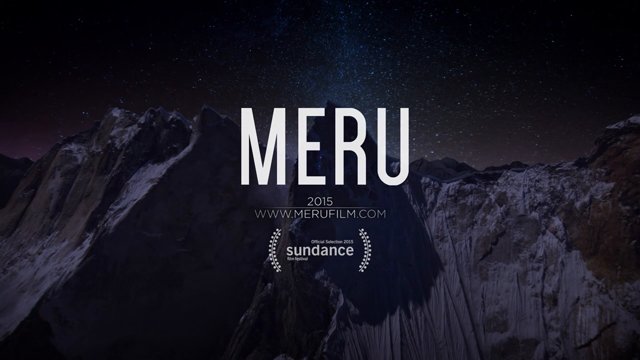
Meru directed by Jimmy Chin, et al

This year at Sundance, I had the opportunity to see Meru, a documentary film about Conrad Anker, Jimmy Chin, and Renan Ozturk’s summit of Mount Meru, or the “Shark Fin” in the Himalayas. I was a little worried that I might spend most of my time averting my gaze from the vertigo-inducing shots of men hanging by a rope over 20,000 foot drops. While there were plenty of those shots, there are also a lot of beautiful scenes that did not invoke a need to cover my eyes. The cinematography is absolutely beautiful and unforgiving throughout.

image from Meru trailer

image from Meru trailer

At about the mid-point, viewers get a lot of backstory on these three climbers. Each of them overcomes absolutely unbelievable obstacles. (Well, maybe not so unbelievable given that they are elite climbers.) I went in worried that this would be one of these films when men (yes, men) do these insane things that make no sense and risk their lives and everyone’s lives, and for what? But I enjoyed and admired these men throughout the film.

They each brought such unique personalities to the screen. Conrad is the hardened old-timer with tons of experience. He’s got a remarkable record for safety, but he’s got a thin exterior might be pushing too hard at this point in his career. There is evidence that Jimmy is aggressive and unstoppable in his pursuit of success, but he’s so quiet and understated about it. Renan has a natural, physical ability, but he’s got a spooked look in his eyes—maybe it’s the fear of being a newcomer or maybe he’s haunted by what’s to come.

Watching the film, I was proud to be in the same species as these guys. It makes me think about the things we’re driven to do. The things we obsess over until we absolutely must do them. Some of us know what we have to do, and it usually means logging countless hours alone with one’s self. This is why, though I recognize my need for relationships, I trust solitude. Important things happen there, and etching out that time and being willing to spend that time alone is key. For some people, that great thing is having a child.

During this film, though it is very masculine, I was reminded of doula work. Like the men climbing Meru, women in labor are inexplicably driven, but they reach their breaking point, they’re brought to the brink, and then beyond to the place where their skin starts to break—just like the climbers. They continue on as the animal body takes over and the higher intelligence and the spirituality are all forced to work together. All three are required, which is one of the lessons, I think. I always say, “What doesn’t kill you makes you stronger, or it weakens you badly.” However, in this film, what doesn’t kill them actually does make them stronger. Cliché as it may sound, the film reminded me of our greatness as human beings. I feel newly inspired to pursue the things I must do in this life, for more quiet focus to better understand what those things are, and a deeper commitment to the solitude they require.

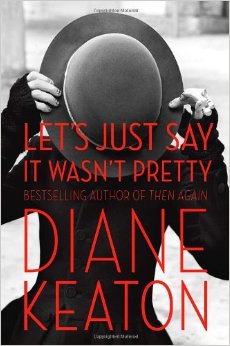
Let’s Just Say It Wasn’t Pretty by Diane Keaton

I read Let’s Just Say It Wasn’t Pretty by Diane Keaton because I remembered liking her Then Again awhile back. Also, more importantly, Diane Keaton has done things a little differently, and I’m always looking to read about women who are doing things a little differently because I do things a little differently too.

image from amazon.com

image from amazon.com

It’s an odd book, and much more stream of consciousness than I remember of Then Again. And, so I was glad to read something entirely different. It was insightful to be privy to Diane Keaton’s mind, which was, just like her, brilliant, annoying, confusing, legendary.

I mean, you can tell that a frenzied editor tried to assemble her bedside journal scribblings, but that’s okay. It never needed to be a perfect to begin with.

She writes about beauty. It’s mostly about beauty. The introduction is so promising, and there are only glimpses (though worth it!) of this promise throughout. She writes about the process of discovering beauty as a young girl, and hearing the opinions of others, she and writes “Don’t tell me what beauty is before I know if for myself.” I think that line is so important. The most honest, provocative moments are when we fall in love with something beautiful before we realize or understand if it meets a shared social standard of beauty: our mothers, the fabric on grandmother’s old chair, a tiny glass figurine weighted just right. Of course, soon enough, we are told what beauty is, and all is lost, and we can never again really know how much we’ve mixed up our own sense of beauty with society’s standards. C’est la vie.

Later, of Picasso’s depiction of Marie- Thérèse, Keaton writes that Picasso paints her, “through loving her, living with her, and seeing her as both ugly and magnificent. Because of his sculptures, Marie- Thérèse emerged as a symbol of unsightly, frightening, even hideous but also, I have to say, complete beauty” (xix). I can think of nothing more romantic than the thought of two people loving each other and timelessly fascinated with the ugly and the magnificent in the other—the unsightly, the frightening, the hideous, and the beauty.

Keaton is a romantic and appears to be unlucky in love, but has also had some luck in love. Her questions of love and beauty were really nice to think through with her, even if just for a couple hundred pages.

Whiplash by Damien Chazelle

I enjoyed watching Whiplash over the weekend. This is a movie that will take you up to the edge and over the waterfall, if you know what I mean. While I enjoyed watching it more than I enjoyed Birdman, I think Birdman will have the edge during awards season. Here’s why: Whiplash takes a close look at just a few ideas, whereas (despite my criticisms of the film) Birdman takes a nuanced look at a lot of ideas and characters.

Still, Whiplash is a joy to watch. Some say the movie is about teaching method, but I think the movie is about the music, talent, and art overcoming the process. And, this is evidenced in the way the film ends–paying homage to the music. The audience loses sight of the drama and the personal dynamics as the final performance plays out. And I loved that.

I also really loved the relationship that Miles Teller’s character Andrew had with his father Paul Reiser. It was a minor aspect of the movie, but this was a highlight of the film for me. If the film had followed a more predictable narrative, the relationship between father and son would’ve been strained. The father would have either pushed the son too hard, or would have disapproved of the son’s pursuits all together. Instead, the film portrays a gentle, loving, and supportive relationship between father and son, and it results in a tenderness that I would love to see more of between two men on screen.

There are a few really predictable aspects of the film, the most noteworthy being that Andrew very predictably sabotages his personal relationships for the sake of his success.

There are a few uncharacteristic scenes as well. The character Andrew is a strong combination of deeply insecure, appearing to second guess himself at every turn, coupled with brief explosions of self-assuredness that are usually at the expense of this peers.

There is an amusing scene where Andrew is having dinner with his father and extended family. It is clear that the family does not really understand or value what Andrew is doing, and Andrew broods silently before schooling them all. It’s amusing, but isn’t really indicative of the character throughout the rest of the film.

Overall, I think the film might’ve been more powerful if Andrew was more aggressive, funny, fast-talking, and confident throughout the film, and only the teacher, Fletcher, played by J.K. Simmons, was able to destroy that confidence. Anyway, it would’ve given Fletcher’s character more convincing power throughout.

Despite all that, I enjoyed the film, the music, watching the process. The whole thing inspired me to practice piano. Maybe that’s all.

i do rush home

I rush home to play the piano. (Well, keyboard.) I listen to songs on the radio and try to figure them out while driving. I fill out all of the exercises in my lesson book just for the joy of it.

My mom’s pretty competent at the piano, but has always wanted to play the violin. She started taking lessons this summer and absolutely loved it. I, on the other hand, have always wanted to play the piano. I took lessons when I was very young, but they were short-lived.

This summer, my mom inspired me with her violin lessons. She kept saying things like, “I just love it,” and “It’s so great.” It’s probably the English major in me, but I’m always prompting her to explain what she means. “What’s great about it?” She couldn’t quite explain. Now, neither can I.

I found a teacher who lives nearby and signed up for lessons this fall. I immediately loved it and, like my mom, find myself sort of inarticulate about it: “It’s the best thing ever,” and “It’s just so great.” At first I really loved the forced meditation. Music requires your entire brain, and when I’m concentrating, there is no room for chatter. There is no room for anything else, and it is divine.

One of the things I miss from my last relationship is music. I miss singing (though I am shy!) and I miss hearing the new song and the song that’s dedicated to me. So, I’ve tried to create that for myself. I’ve been surprised by how quickly I’ve been able to move through the lesson book and how satisfying it is to play.

I’ve always felt drawn the to piano. I have always wanted to be able to play. I love the sound of the piano. I’m also really fast at typing (and I think that actually helps.)

I don’t know what else to say. See how rambling and incoherent I am about it? Other than just “YES! I am doing it! And it is so great!”

morning scene

morning scene

Coeur De Lion by Ariana Reines

One of those things went around Facebook asking people to list the top ten most influential books they’ve ever read, and several writer-friends mentioned Coeur De Lion by Ariana Reines. So, I got it, and read it in a few hours late one morning (which, coupled with a cup of tea, felt amazingly indulgent, by the way).

image from amazon.com

image from amazon.com

The book is erotic and smart, and gives the impression of effortlessness. Like when the untrained eye looks at a piece of abstract expressionism and says, “hey, I could do that!” In so many ways, it feels like the emotional frenzied jotting down of ideas that happens thoughtlessly in a bedside journal. But there is such an attention to sound, such perfection throughout, it is clear the effortlessness is no accident. Here, for example: “She has curly hair like me, but in this jpeg it looks like she puts more emollients in hers.” While it may sound very conversational, the sound and rhythm are just beyond.

Here are a few other lines I liked in the order that they appear:

“She is sexually terrifying. Her elegance
And intelligence dignify the insanity so
Much I forget not to be charmed”

“The melancholic
Loses the object of desire while the object
Is still there.”
(Reines paraphrasing Zizek paraphrasing Freud)

“It’s been so easy for you
To disengage yourself from your
Behavior, as though you really
Were conjectural, as though
Your desire really were as limitless
And general as the fucking internet.”

That last one was worth the wait, wasn’t it? Anyway, go now. Read the book.

The Room Lit by Roses by Carole Maso

Carole Maso is one of the few authors who I will read over and over again. Her work has a quality that just gives and gives each time I read it. Oddly, I haven’t even come close to reading all of her work. With the short time before work for the semester really starts in earnest, I decided to grab a few books to frantically and recklessly read before I got down to business. That has involved forsaking some exercise and sunlight to read while lounging in air-conditioned spaces–sometimes with a popsicle.

I grabbed a few new books from the New York Times Bestseller list along with Carole Maso’s The Room Lit by Roses. I began reading it after working a long shift as a doula. My wrist was sore (still not recovered from a bike wreck two months ago) and my body weary. I tossed by hospital clothes in the hamper and showered the hospital germs away and propped myself up in bed with pillows on my cool white feather down comforter (enter also swamp cooler and popsicle).

I was done thinking about childbirth and labor when I cracked the spine and for the first time realized the rest of the book’s title: A Journal of Pregnancy and Birth. The universe clearly wants me to examine the issue more closely, so “here we go again,” I thought. I scarcely could put it down until it was finished about 24 hours later with the strong impulse to turn around and read it again, which I will not do right now.

Years ago, I read The American Woman in the Chinese Hat and read it again to prepare for my trip to France. I assume I’ll return to The Room Lit by Roses if I become pregnant or want to write more extensively on the topic. For now, I’m glad it exists and I’m glad I can return to it. What I love about Maso’s work is how real and raw and open she is. The ultimate sacrifice, I get the feeling that she splays herself open for us, dear reader, and for art and probably for world peace. Carole Maso is one of those authors for whom I am incredibly grateful.

Sometimes a line or two will be entirely dumb and petty and ugly, which works to magnify the stuff that is brilliant and important and beautiful. As I read her work, I find myself saying yes! That’s how it is. That’s how I feel! She wrote, “Always knew I wanted to have the experience of pregnancy.” I swear I say those exact words. The rest of it, the child, the life, that’s the part I’m not always sure about. But pregnancy and labor, yes. It’s such a bizarre and most intense human experience that is felt only a few times, or once, or never, so of course I’d like to have that. Maso puts into words how absolutely terrible and wonderful and necessary the experience can be, and I clung to each word.

The Orchardist by Amanda Coplin

Let me start this way: it’s been a very, very long time since I read a book like Amanda Coplin’s The Orchardist. This kind of plot-driven book felt like a throwback to my junior high and high school days when I picked through the slim reading selection in my small town library in rural Eastern Oregon. The Orchardist is such a great title too! However, as a reader, I was hoping to learn more about the workings of an orchard.

book cover from NPR

In addition to the landscape, The Orchardist is driven by characters too, though. Like in the reading forays of my youth, Coplin’s characters are often completely transparent, irrational, and occasionally infuriating. I wonder if Coplin was ever irritated with her Talmadge character like the reader would be at times.

The following could be considered somewhat of a ******spoiler******:

Much of Talmadge’s behavior can be forgiven because of his traumatic upbringing and the loss of his sister. What cannot be forgiven of Talmadge, nor of Coplin, is the violence enacted upon Jane as she is giving birth. Jane is a woman who has endured incredible abuse. In her deepest moment of vulnerability, when she is in labor, the midwife, Caroline Middey, and Talmadge are both complacent in her violation as they ignore her desire to be left to labor alone. Instead, they struggle with her even as she is on the brink of exhaustion. Talmadge violently grips and presses her thighs until the child is born. Jane indicates over and over that she wants to be left alone physically, but the well-meaning Talmadge and the trustworthy midwife do not abide. When Jane takes irreversible action soon after, the reader knows she wasn’t kidding about wanting to be left alone.

Each character in the novel possessed a combined inability to reach out, communicate, and move beyond the confines of their past and their current circumstances. There is no real character transformation in this book. The product of the story is Angelene, and this character’s welfare is completely unknown by the end of the book. As a reader, I was left wondering what became of Angelene.

In her debut novel, Coplin is a master of creating a gripping plot. However, the first page of the book is a long physical description of the main character that will make you want to put the book down. Those descriptions continue throughout without the book, without adding much if anything to the reader’s understanding of the plot or the characters. That said, Coplin will, no doubt, have a long career as a novelist, and hopefully she’ll learn to rein in those long descriptions.

Even with the long descriptive flourishes, the book will hold your attention and curiosity after the first few pages. In fact, I couldn’t put it down. Beyond her long-winded descriptions, her writing is effortless and entertaining. Some of the character’s insights are truly enlightening. If she writes a sequel about her character Angelene, I will read it. In fact, I’m quite curious to see what Amanda Coplin will write next.

When Women Were Birds by TTW

When Women Were Birds, the latest book from Terry Tempest Williams (TTW), is a wonderful, painful, poetic, and intensely personal meditation on Williams’ life: her femininity, her spirituality, her relationship with her mother, and more. Her work resonates with me because, like TTW, my family has been affected by cancer–cancer that was likely caused by exposure to radiation. “Clan of the One-Breasted Women” was the first beautiful thing I’d ever read that spoke directly to that experience.

Grandma on her wedding day

My own grandmother died after a painful, decade-long battle with cancer at the age of 54. I gasped as I read that TTW’s mother also died of cancer at 54–an age that becomes painfully young the older I get. My grandmother’s youngest sister was also afflicted with cancer and did not survive childhood. Her siblings, who lived to adulthood, got cancer too. The doctor said the type of cancer indicated that the kids “must have gotten into something.” Indeed, they lived along a river in Northeast Oregon, with an air stream that carried plutonium from Hanford, Washington. Though it was over 100 miles away, the pollution seeped into the atmosphere and even caused green snow one winter. Locals were unaware of it’s toxic nature.

Williams reminds us that silence and secrecy have long plagued the female experience. But within a family, women also navigate the most beautiful and painful experiences together: the loneliness and intimacy of marriage, the pain and power of childbirth, the joy of children, the suffering of disease; death. TTW navigates this territory with raw honesty and vulnerability. In addition to her connection to the women in her family, she reveals her own unique path, her own choices.

Like Williams, I have often felt that I have very few role models. I am a woman who has chosen a somewhat unconventional life. I tend to give less energy to relationships (although, at times, my love for Z has been completely consuming), and I currently have no children. I have not always understood my path, but it is one that has clearly deviated from my peers. My friends from high school have careers, yes, but they have also invested their energy profoundly into their husbands and their children in ways that I have not.

My nearest role models are women in my field, colleagues and former teachers. Even still, I’ve yet to meet one whose relationship to her partner and to her children, or lack thereof, has really reflected my own choices and relationships. This is a theme that TTW explores in When Women Were Birds. In the early years of her marriage, her inclination not to have children (at least not right away) made her different from her peers. And yet, like me, she does not seem to reject or disidentify with her femininity or her capacity and potential as a mother.

In a world where these stories seem too few and far between, her admissions are brave. It is this bravery that allows her to share her fear in enduring a hemangioma in her brain. For a writer, a woman whose world is in her thoughts and creativity, I cannot imagine the trauma, fear, and doubt involved in recovering from such an injury. But she does recover–though changed, perhaps–and the eloquence and insight in her book is a testament to that.

I first discovered TTW sometime during my undergraduate degree. I was struck by the accuracy with which she addressed the themes that most interested me in my own life. She feels like a kindred spirit, and I think that’s the sign of a great artist: she shares her secrets with the reader, and the reader has the same secrets, and then everyone is united in realizing how much we are the same.

After finishing the book, I remembered a bird feeder that was still boxed up in the basement from my recent move. I brought it upstairs, dusted it off, and filled it with fresh sunflower seeds. It now hangs on my front porch, waiting for birds.