Category Archives: books

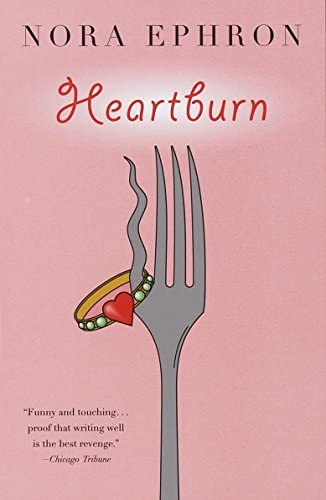
Heartburn by Nora Ephron

I had to set aside Heartburn by Nora Ephron shortly after I started because, after reading some of the other seemingly deeper, more “artful” books, I found the content to be a little too silly or irreverent. When I returned to it though, I was ready, and it is an excellent book.

Published in 1983, it really captures an interesting period of time (aren’t they all?) for women. The book is simultaneously feminist and sexist. There is truly some insightful feminist though. There’s also some internalized, unselfconscious sexism too though. There are definitely some dated jokes that would not fly today. The book perfectly captures the culture of the 1980s, especially When Harry Met Sally, which I should watch again (have I ever seen it in it’s entirety?), which is a film that was also written by Ephron. For example, I could easily image Diane Keaton playing the read role.

I loved the portrayal of motherhood in this novel. Probably due in no small part to the amount of wealth and therefore help that these characters have, motherhood in the early ’80s seems lovely, enriching, rewarding, sometimes hard. These women have time to also be themselves and explore their interests (frivolous though they may seem). I think this is next to impossible in motherhood today, where women are expected to/have few other options than to do so much, everything, constantly, every second, for their children.

Still, though it may at times seem frivolous, Ephron packs a surprising amount of insights about the human condition into every single sentence. It’s a good book. There is some really good humor in it too, and I don’t say that lightly.

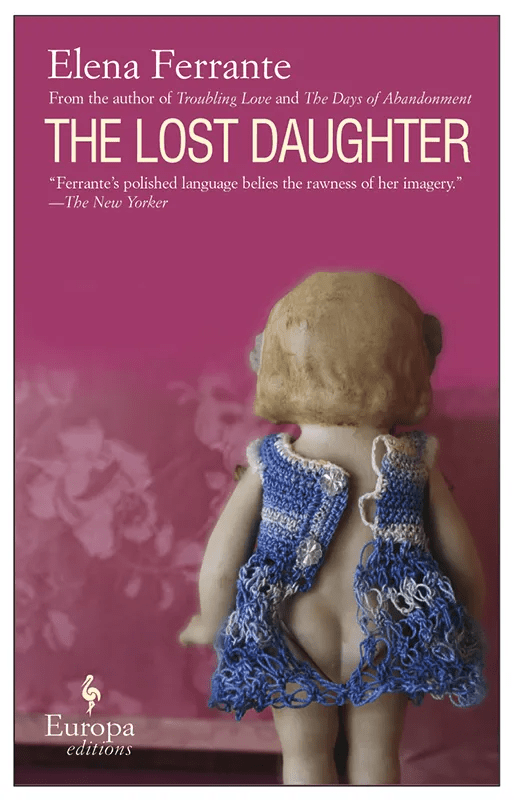
The Lost Daughter by Elena Ferrante

I read Elena Ferrante’s The Lost Daughter immediately after finishing My Brilliant Friend. This is another excellent, although perhaps more literary, piece than the first book of the Neopalitan Quartet series.

The Lost Daughter, also referenced in the Mother’s book, is about the darker side of motherhood, in a way that I found entirely relatable. Too often, critical books on motherhood are too critical, too negative–children are too exhausting, it’s not worth it, end of story. However, I truly appreciate Ferrante’s more nuanced approach. In The Lost Daughter, she turns a magnifying glass on the difficulties, violences, and burden of motherhood, the complete selfless turning over of the self that is required of the job, an ask that is far too demanding and made worse by societal constructs around motherhood and a general lack of support.

However, instead of dismissing the mothering journey altogether, as too exhausting, too violent, Ferrante acknowledges the duality of the role, the positive life changing aspects of it–the more complicated relationship it can foster in the self in regards to love, compassion, nurturance, service, and ambition. The little girl in The Lost Daughter is depicted as both angelic and beautiful from a distance, but up close is whiny, snot-nosed, crusty-eyed, and clawing, swatting, and pinching at adults around her. This is the reality of living with and loving a child. They are, each and every one of them all at once both transcendently perfect and also demanding, selfish, and incidentally cruel. To be a mother is to live within this duality constantly throughout the day. It’s complicated and beautiful and ugly too.

My Brilliant Friend by Elena Ferrante

I discovered Elena Ferrante from Mothers by Jacqueline Rose, which I read recently. I started with Ferrante’s My Brilliant Friend, the first in a long series, and I loved it! The writing is excellent. The content is thought-provoking, and it also has the long sense of story found in easier, longer reads–not a common combination. Although it is long, I flew through it.

While I highly recommend the book, I will warn that I found the conclusion to be somewhat disappointing. I wanted a strong wrap up for this particular book, but instead found myself needing to read more of the series in order to get that. It will probably require reading all four books.

I ended the book somewhat exhausted and unwilling to continue with the series. Maybe I’ll return to them someday. They’re certainly worth it, but, and I can’t believe I’m writing this, I really don’t have the energy to give them at this point in my life.

I’m glad these books are out there. Sometimes I just need a good book, a good story, and I now know I can turn to Ferrante to get that.

I am also inexplicably obsessed with the cover art:

2022 Reading List!

Once again, I read over twice as many books as I read last year. Most of this happened hurriedly during rare breaks. My absolute favorite was A Lover’s Discourse. As usual, I also read several books for work, but only included the few that were really meaningful or entertaining to me. Mom jeans are back in fashion (or at least I am still embracing them), and so I’ve also been reading and enjoying scholarship from the early 1980s as well. I’ve also included a few children’s books that I thought had literary merit, although I also read well over 2,000 children’s books this year, many of which were repeats.

A Short History of the World According to Sheep by Sally Coulthard

The Lais of Marie de France

Tales the Textiles Tell in the Lais of Marie De France: Weaving As a Signifying System by Gloria Thomas Gilmore-Hunt

The House on Mango Street by Sandra Cisneros

Turns of Thought: Teaching Composition as Reflexive Inquiry by Donna Qualley

Wintering: The Power of Rest and Retreat in Difficult Times by Katherine May

Burnt Sugar by Avni Doshi

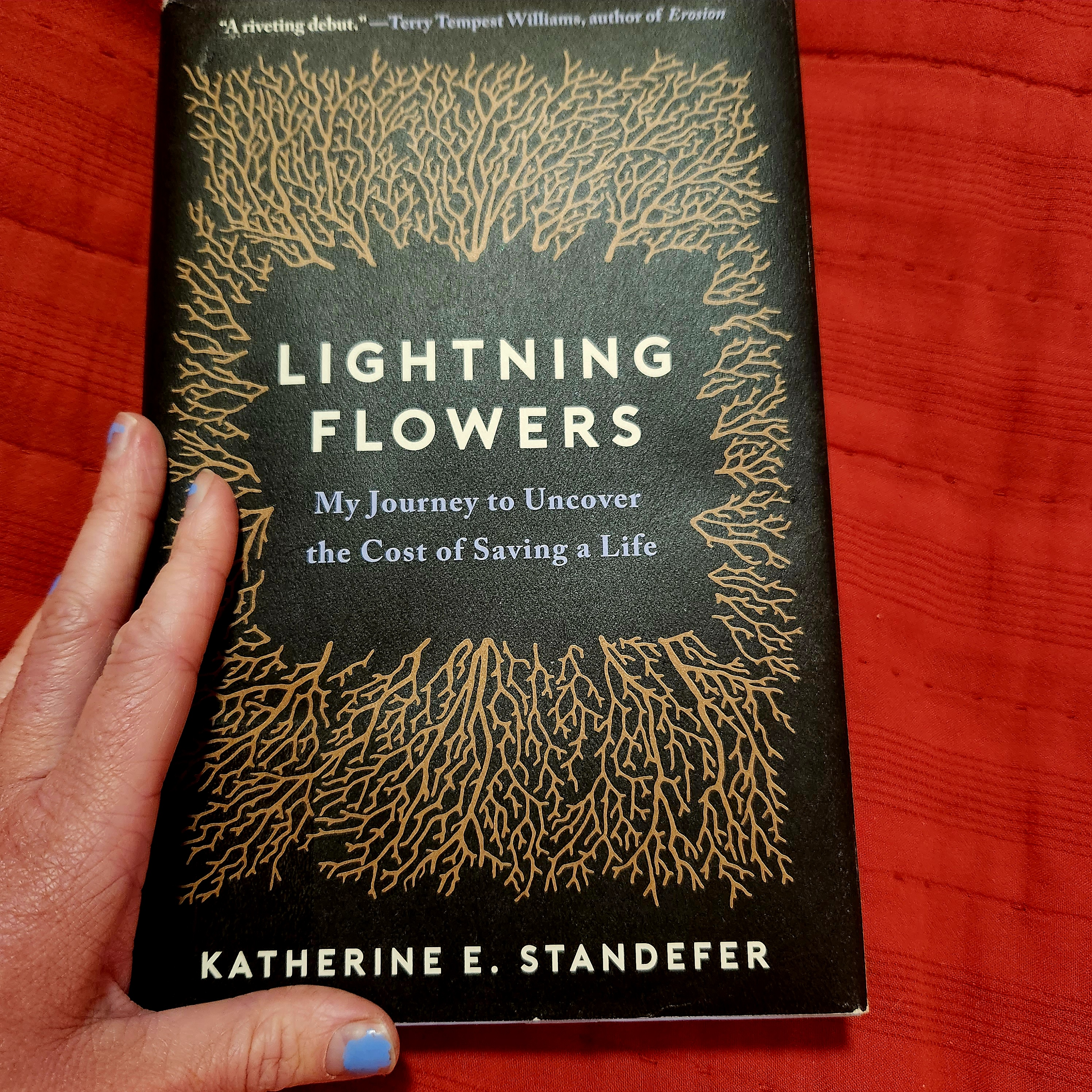
Dog Flowers by Danielle Geller

A Lover’s Discourse by Xiaolu Guo

What Remains by Carole Radziwill

James and the Giant Peach by Roald Dahl

Worms Eat My Garbage by Mary Appelhof

Orwell’s Roses by Rebecca Solnit

Journey to the Center of the Earth by Jules Verne

Walking: One Step at a Time by Erling Kagge

The Peaceable Classroom by Mary Rose O’Reilley

Mothers: An Essay on Love and Cruelty by Jacqueline Rose And others…

Walking: One Step at a Time by Erling Kagge

I found Walking: One Step at a Time by Erling Kagge on a list of pleasant books that help readers reconnect with nature. This was, indeed, a short and pleasant book. It lacks a plot and any overt organization, which, I have to admit bothered me a little. It bothered me in that I think it would have been improved by making overt organizational themes known throughout. The lack of (overt) organization could be considered a Scandinavian-style of prose writing, which has its benefits of course. I just thought this book was an exception. There are some great tidbits and great short narratives worth reading.

Journey to the Center of the Earth by Jules Verne

This summer the boys and I read an abridged version of Journey to the Center of the Earth by Jules Verne, written in 1864. I have to admit that this story was quite entertaining!

L is interested in the concept of Earth (as well as outer space), so I think he was interested in it because it was about the earth. A was not deeply interested, but did pick up on the fact that there was hot lava (!), which is a game we love to play.

I was interested in which aspects of the story were intentionally fantastical and which aspects were a result of changing beliefs and scientific information. What they thought about Earth 150+ years ago was dramatically different from what we now believe and understand.

The book had me asking questions like which is the deepest cave, and where is the deepest bore hole in the world. I also learned, from the Wikipedia page, that this book represents an early version of the idea of time travel, a literary concept that would be deeply expanded in the decades to follow (reaching it’s fulcrum, imho, in 1985 with the film Back to the Future). All in all it was a cool book, one that was gripping and suspenseful, but also interesting in both its literary and geological explorations.

Orwell’s Roses by Rebecca Solnit

True to form, my “breezy summer beach read” was neither breezy nor read on a beach. Instead, I read Rebecca Solnit’s 2021 book, Orwell’s Roses. Solnit is an incredibly prolific author, and I like her work, but it is heavy and deep, and I rarely feel up to the task. However, at the beginning of the summer, this copy caught my eye at the local library, so I checked it out and read it whenever grading was complete and babies were asleep.

Here’s the copy that I read.

This book is about Orwell. Politics. The roses that he grew at his cottage. His interest in gardening and the natural world, and the hope that can be found there. Writ large, the book is about labor and freedom and politics and all of the themes of Orwell’s own writing, reflecting on labor and illness in Orwell’s time and also today. Solnit draws links between political strife that Orwell wrote about and the political strife of today.

As you know from my Instagram, I am interested in plants and gardening, especially flowers. I love the idea of growing food in whatever piece of earth one might inhabit. I like my own sheep, chickens, and flowers. I love to take a close look at a plant and watch it as it changes throughout the seasons and over the years. Evidently, Orwell and I have that in common. Unlike Orwell (and Solnit), however, I am less insightful and imaginative when it comes to politics, so I appreciated Solnit’s ability to meld the two together in ways that helped me learn and see these subjects all in a new light.

When I start reading Solnit, I think “This is mostly boring and only a little interesting,” and those thoughts are interspersed with with absolutely lovely prose and engaging content, and I love that about her writing. Reading Solnit is like the good feeling I have after I eat my vegetables and get my exercise. When it comes to nonfiction, Solnit is the realest deal. She also gives me permission to go on long tangents, and take up words and space, because it is meaningful to me, and trust that it will be meaningful to others as well.

Worms Eat My Garbage by Mary Appelhof

my own little free library copy!

Worms Eat My Garbage by Mary Appelhof was a Little Free Library find and a quick read. I was first introduced to the idea of composing with worms from a professor in grad school. It’s an intriguing idea, and since this version of the book was published in 1982, it’s easier than ever thanks to YouTube and relatively affordable worm containers and systems. Back in 1982, they were building their own boxes, for example.

My take away is that it’s a great idea and is especially suitable for people who do a lot of cooking and eat a lot of vegetables and are not squeamish about worms. I, on the other hand, am a little afraid of worms, and, while it hate to admit it, I do think a lot of the garbage my household produces is…junk food. And, evidently junk food is salt and spicy and might mess up the ph of the soil. Reading this book does make me want to figure out a good composting system for my home. That’s my takeaway.

James and the Giant Peach by Roald Dahl

I found a copy of James and the Giant Peach by Roald Dahl in a Little Free Library and read it to the boys this summer. While there’s no doubt that Dahl is an excellent writer with great control on the sentence level and wonderful descriptions, I was struck by the antiquated fatphobic language and some other negativity in the book that you don’t see in new children’s publications and that, honestly, I do not miss. The plot is fine, but I found myself hoping for some deeper meaning and purpose in the adventure, some deeper symbolism in it all. I found very little. Instead, Dahl takes readers on a simple, uncomplicated adventure, but one with plenty of antics, wordplay, and vivid description. It’s worth the read for those alone. I also see that there’s a 2010 movie, so maybe we’ll check that out this summer too.

Our “used” copy, now even more tattered.

Reader, as you know by now, James and the Giant Peach is “not my genre,” but it is a classic, and I’m glad we read it. I might try it again in a few years when the boys are older and have a better understanding, but likely there will be many other favorites old and new to read. The littlest one lost interest several times this time around. However, it is the longest book we’ve read so far, and, overall, the boys tolerated it well. I am hopeful for our journey into longer (still illustrated) chapter books. Reading books to the boys is one of my greatest daily joys in parenting. It’s something we all truly enjoy and can share, and I look forward to reading many more classics together!

What Remains by Carole Radziwill

What a beautiful book! What Remains by Carole Radziwill is a completely unique book, taking the reader locations you’ve never been—could never go—but also to fully human and universally recognizable places.

It’s no secret that the Real Housewives series are a guilty pleasure, and I always found Carole to be a fun, tell-it-like-it-is, type of “character,” so I thought this book might be decent, but it’s better than that!

A Memoir of Fate, Friendship, and Love

The book takes the reader to the poor gravel roads and streams of New York state, to the haphazard suburbs, to a chaotic, but close family life, to the rush of a bold new career in a city, to war zones, to falling in love (without cliché), and forging deep friendships with “America’s royalty.” Readers see that we all ache, love, suffer, and feel the joy of the sun on our skin and the wind in our hair universally. The life she lives once she’s seriously dating and married to her husband Anthony is (emotionally) much like other everyday relationships, except with better food, clothing, apartments, travel, and lovely places to stay. The reader might be surprised to find that this group of “elites” are thoughtful, frugal, playful, stressed, sometimes uncertain. Aren’t we all?

Radziwill has lived an extraordinary life, and so while this is a memoir, and a genre with which readers might be familiar, it’s is so completely unique in the extraordinary events and circumstances she’s survived. She loses her three closest people in the span of three weeks. Maybe she has survivor’s guilt, but I hope she doesn’t. I hope she is exploring what to do with this big, bold, beautiful life she gets to live. While there is a tight and lovely metaphor about fortune threaded throughout, which works on several levels, the reader leaves the book thinking, “Anything is possible. Anything can happen. Now, what am I going to do with this big bold, beautiful life?”

I read every word and, almost to prove a point, she thanks her bff and sister-in-law, Teresa, who–get this–is from my very own La Grande, Oregon! I am reminded that it truly is a very teeny tiny microscopic world, and anything is possible.