Category Archives: existence

A Lotus Grows in the Mud by Goldie Hawn

I can’t remember where exactly, but Goldie Hawn’s book, A Lotus Grows in the Mud was recommended to me while I was reading some respectable piece of literature, and so I ordered it and set it aside for a month or so. I finally got the chance to read it over spring break, and it was surprisingly delightful–thanks in no small part, I’m sure, to “co-author” Wendy Holden.

Lotus Grows In The Mud

image from powells.com

Hawn has led a fascinating life, and her book really tries to get at some of the wisdom she’s gained in this life. And, you know what? Some of that wisdom was pretty darn inspiring and insightful.

Here’s what impressed me–Hawn follows her purpose, even when it is not obvious, even when she has doubt, even when others criticize her and roadblocks threaten her faith.

When I think about my purpose in life, I often have doubt and uncertainty. However, the predominant narrative one hears about one’s path is that it is easy and clear. But, that hasn’t been the case for me. I was an English major because I liked reading, but that seemed incidental. Now, I’ve made an entire career out this. I love practicing yoga because it is good for me, but a lot of times I phone it in, or have to talk myself into going, and sometimes I don’t go at all. I’m never the most flexible, most enlightened, or coolest person in the class. Still, I trained to teach yoga, and I’ve been teaching it since 2008. Most days when I enter into that classroom to teach, it feels really, really *right*. Same goes for the garden, for writing, for my friendships, for My Love.

So, I loved the message of her book. She was brave. She did hard things. It made me feel like I could be brave. I could do hard things–all while making a living and having Kurt Russell unexpectedly waltz in and save me in the final hour and then stay for the remainder of my decades. Yeah, I’ll have what she’s having.

In perfect timing, just as I finish this book, I see that Hawn is teaming up with Amy Schumer in a new film called Snatched. It looks lovely and hilarious, and I can’t wait to see it. I love seeing mother/daughter duos (that’s in the book too).

Bluets by Maggie Nelson

I needed to read something artistic, and so I finally read Bluets by Maggie Nelson. I read it quickly. (It did not need to be read slowly.) It seemed like I’d read this book before. It reminded me of Coeur de Lion by Ariana Reines, but not as beautiful as that in terms of the sentence. It was beautiful, though, and smart–one of the best books I’ve read in the genre. I had little patience for the sexual aspects of the book. That’s me though. Lately, those inclusions seem cheap. I used to “get it.” Adding the sexual gave writing that perfect blend of raw and mystery. Anymore I only want to think about birds and botany.

Bluets - Maggie Nelson

image from wavepoetry.com


Lines I liked:

“My Thought has though itself through and reached a Pure Idea. What the rest of me has suffered during the at long agony, is in describable” (Mallarmé 2-3).

“Now I like to remember the question alone, as it reminds me that my mind is essentially a sieve, that I am mortal” (62).

“…the blue of the sky depends on the darkness of empty space behind it” (62).

“For some, the emptiness itself is God; for others, the space must stay empty” (86).

“…ask not what has been real and what has been false, but what has been bitter, and what has been sweet” (86).

“As a rule we find pleasure much less pleasurable, pain much more more painful that we expected” (87).

“She is too busy asking, in this changed form, what makes a livable life, and how she can live it” (88).

“Imagine someone saying, “Our fundamental situation is joyful.” Now imagine believing it…Or forget belief: imagine feeling, even if for a moment, that it were true” (89).

“When I was alive, I aimed to be a student not of longing, but of light” (95).

Words/concepts that inspired further study:

  • the male satin bowerbird
  • International Klein Blue
  • samsara
  • the jacaranda tree
  • the Tuareg
  • The Oblivion Seekers

The Last Supper: A Summer in Italy by Rachel Cusk

Since I read Outline by Rachel Cusk, I’ve wanted to read her earlier book The Last Supper: A Summer in Italy. I finally got the chance to finish it this winter. Cusk’s genius is in her observations. She has some of the most shockingly astute and artfully articulated insights on the human condition that I have ever read. She also has a vast vocabulary, which she integrates beautifully into her writing: inchoate, lachrymose, acolyte, obeisance, balustrades.

Image result for The Last Supper: A Summer in Italy by Rachel Cusk

image from goodreads.com

The book comments on foreign travel, staying, getting sick of a place, hating and loving a place, connecting, awkwardness, presence, living in the experience, and art, and an eye, and the moments between people that capture the feeling or meaning in art.

Two thirds of the way through, I’ll admit that I wanted a bit less description of some of the art (though I can see that it was necessary). I wanted more of the human interactions, the mistakes, the moving, the descriptions of the land, the houses, the people. This wasn’t a joyful read, but it was quiet and thoughtful, which is what I needed.

Just a few lines:
“In this it is the artist who is God. And it is a strange kind of proof we seek from him, we who are so troubled by our own morality, who know we will all eat a last supper of our own” (53).

“Now our violence is diffuse, generalized: it has been broken down until it covers everything in a fine film, like dust” (148).

I, Rigoberta Menchú: An Indian Woman in Guatemala translated by Ann Wright and edited by Elisabeth Burgos-Debray

I first learned about Rigoberta Menchú when I was getting my undergraduate minor in Spanish. I think I might’ve even read excerpts back then, but I was a few pages into this book when I realized I had definitely never read I, Rigoberta Menchú: An Indian Woman in Guatemala.

I Rigoberta Menchu An Indian Woman in Guatemala

image from powells.com

At first, I thought it would be too painful for me to read. Lately, I’m always on the lookout for books that substantive, but aren’t too stressful–a difficult balance. But the book drew me in as a voyeur of indigenous life. I was fascinated to read about perspectives and beliefs so different from the world I live in. Like a typical imperialist, I even felt nostalgic for some of the rituals, customs, family, and deep commitment to and love of community (I write this all self-critically). I was also moved by the extreme poverty and suffering these people endured.

As Menchú grows up, the political climate in Guatemala becomes increasingly violent. Unbelievably violent. Once I was committed to the book, I was also committed to reading through the deaths, gruesome tortures, and murders of her loved ones. I was also struck by how recent this history is. Menchú is still alive today, and Guatemala doesn’t seem so far away. These human rights violations felt real and close to me as I read. I couldn’t help but think of the protests and violations that have played out over the last year here at Standing Rock. I couldn’t help but think of the political discord in our own country and the fear surrounding the newly elected leader and how quickly political systems can turn.

To have the firsthand account of someone who lived through this struggle is an unbelievable gift to humanity, so that we all might be  to be able to understand how politics, governments, war, and economies can change and be changed.

The political influence is clear in the retelling of her story. She becomes much more radicalized throughout her life as a direct response to her incredible suffering. As I read, I thought of the power in naming something. She doesn’t really learn Spanish until she is in her 20s. That kind of illiteracy makes a person vulnerable to radicalization from a church or a government. In this case, the reader can see how Menchú was exposed to the language of Communism while acquiring the Spanish language. At the same time, the ancient way of her home culture has some very…communist…ideals. The community is the family. Family and community are prioritized over all else. Each family has their own land and their own food, but they share very generously with the community, even when their own livelihoods suffer. This is their ancient way, but her literacy also emerges as Communism takes hold in South America, and the reader is left wondering where the community mindedness ends and the political influence of Communism begins.

I’m not exactly sure how I ended up reading two books back to back with such a clear connection between Catholicism and Communism, but I did, and it was fascinating, and heartbreaking, and Rigoberta Menchú’s story is a “must read” for all informed citizens of the world.

The Long Loneliness by Dorothy Day

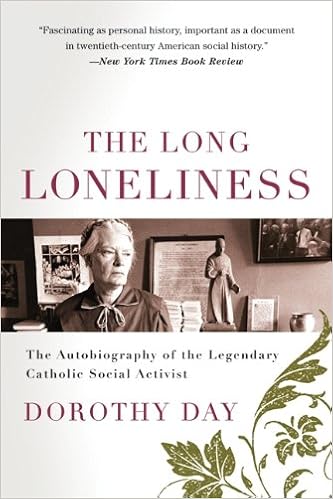
As usual, I’ve had a hard time finding the right thing to read lately. I want something that’s light and easy–a break from difficult scholarship. But, I also want it to be substantive. The Long Loneliness by Dorothy Day was the perfect solution during the holiday break. First of all, I had to read it with a title like that. (When I saw her face on the cover, I also knew I had to read it.) Secondly, I am always fascinated with and inspired by women who are doing things a little differently than the status quo, and Dorothy Day certainly has. The book is about her experience with community and the sacrifices she’s made in pursuit of her beliefs about the best way to live.

image from amazon.com

The first two-thirds of the book was of the most interest to me personally. In the first third of the book, she writes extensively about her childhood, about her friendships, her family life, and the reader can see the subtle ways these experiences influenced the choices she made later. Her descriptions of various little girls she befriended seemed tedious at times, but I think it helped make her larger point–that these connections and interactions we have with people are the stuff of life and far from inconsequential.

Next, she wrote about being a young women, her unconventional “marriage,” the birth and joy of her daughter, and the decisions she made to convert to Catholicism. In this section, I was deeply interested in her relationship with her partner and her response to her baby. I identified much with those very human experiences, even though I haven’t had them myself exactly.

The last third dragged on and I had to force myself to finish. I didn’t identify quite as strongly with her decision to convert to Catholicism. Like much of her thinking and decision making, as a reader, I sometimes had a hard time understanding her motivations. She’s very matter of fact about everything, and I found myself responding, “Yes, but…” That said, I love her unapologetic descriptions of joy and love earlier on, and I don’t need her to explain “why.” Still, the social activism, the writing, and the experiences with various people are a part of her story, but I was less interested, in part, because it was less about her and more about them.

Here are some insights I gained from reading the book. Day is unfaltering convinced that we must live together. After living alone for the bulk of my adult life, I am feeling ready to not live alone. I have felt loneliness and fear–something that was quite rare for me throughout my twenties. That’s fine. I was pursuing other things. Now I’m in a new stage, and I want to live in meaningful relationships. I have a much stronger urge to connect to other people and invest in them. In this way, Day’s message really resonated with me at this time.

Here are a few lines and ideas worth further consideration:

  • One hundred years ago, there were free medical clinics. If you were not poor, there was also affordable medical clinics that were a little nicer.–I can’t imagine how freeing it would be to go through life knowing that, should a major medical event occur, you could go on living without being forever indebted to a financial institution. We are living in fear or modern slavery.
  • Much of Day’s life’s work is in writing and writing for The Catholic Worker, and she understood what I am only being forced to understand now, which is just how crucial freedom of the press is and how important it is to communicate with the masses in this way.
  • “We cannot love God unless we love each other, and to love we must know each other. We know him in the breaking of bread, and we know each other in the breaking of bread, and we are not alone anymore” (285).
  • “We have all known the long loneliness and we have learned that that only solution is love and that love comes with community” (286).

By the end, I sort of just wanted to rise with the sun, and garden and bake bread, and pray and read and meditate, and wake the next morning to do it all over again.

Why Not Me? by Mindy Kaling

As you know, one of my favorite genres is a memoir from a female comedy writer. It’s like hanging out with a really funny best girlfriend all weekend. Is it weird that I artificially fabricate this experience through reading? Maybe. I don’t care. I read Mindy Kaling’s first book, Is Everyone Hanging Out Without Me? during a frantic “pleasure reading” phase I went through between the time I submitted my dissertation and the time I graduated.

This time, I am realizing (perhaps late) that Kaling writes, plays, (and maybe is?) just one character. But, like Jack Nicholson and James Franco (maybe I’ve only seen his stoner films?), nobody cares because it’s such a good character. The Office’s Kelly Kapoor, The Mindy Project’s Mindy Lahiri, and the identity Kaling develops in both of her books are all basically the same person. She’s a myopic, worst/best basic bitch kind of person, and it’s hilarious. She’s always simultaneously doing great commentary on gender and femininity. She describes the persona best: “Mindy is…a combination of Carrie Bradshaw and Eric Cartman” (75).

image from books.google.com

Here’s the take away of Why Not Me: First, you will want to eat McDonalds. And yes, there is some filler content. All of these books have filler. Like, okay, I’ll read a script that’s not going anywhere and a commencement speech that you gave. And, yes, the book was probably written by a ghost writer (but that ghost writer does a great job maintaining Kaling’s voice throughout!) And regardless, Kaling writes some grade-A jokes for these books, and even inspires her reader a bit toward the end. I was thinking, “Hey, yeah, why not me?!” Then, laced up my running shoes and achieved my dreams.

Here are some of the lines I loved:

Real Talk

  • “I’m skrilla flush with that dollah-dollah-bill-y’all” (4). This is the single best description of me on payday.
  • “[T]he gulf between a friend and a best friend is enormous and profound” (27).
  • On breakups: “So, the only decent way for him to have broken up with you is to not break up with you and stay with you forever” (39).
  • “As someone who enjoys secrets, exclusivity, and elitism…” (40).
  • People don’t say “Give me your honest opinion” because they want an honest opinion. They say it because it’s rude to say “Please tell me I’m amazing” (125).
  • “[R]ecycling makes America look poor” (139).
  • “[H]ard work must be rewarded with soul-replenishing gossip” (139).
  • “I have a terrible habit of impulsively sending text messages that reveal my true feelings” (140-41).

On Body Image

  • “One of the great things about women’s magazines is that they accept that drinking water and sitting quietly will make your breasts huge and lips plump up to the size of two bratwursts” (10).
  • “I cannot imagine a life more boring and a more time-consuming obsession than being preoccupied with watching what I eat” (194).
  • “But my secret is: even though I wish I could be thin, I don’t wish for it I don’t wish for it with all my heart. with all my heart. Because my is reserved for way more important things” (202).

I want to say some more about the body image stuff. So, I can work to get the sick body, the one with that weird vein between your lower ab and hipbone, but it does require me to think about what I’m eating and get regular exercise. It takes time and mental energy–time and mental energy I’m not always willing to give. Take graduate school, for example. I knew I would take four years and focus my energy on learning. And, so I didn’t think much about what I ate, and I taught and practiced yoga several times a week. I gained weight. I felt fine. This lasted four years.

Now, I can focus more time and energy on my body. Most people I know who pour 100% into looking good look great, but aren’t very interesting to talk to. Additionally, I simply have the kind of brain that requires me to spend time thinking about the meaninglessness of life and experiencing existential angst. I simply can’t/don’t want to transfer that energy into diet and exercise. I liked when Kaling wrote, “I don’t wish for it I don’t wish for it with all my heart. with all my heart” (202), and I think that’s a healthy approach. Anyway, I certainly haven’t found a balance, and I sort of don’t think a balance is possible (for women), and that sucks…is the way I’m going to end this post.

Modern Romance by Aziz Ansari

Oddly (or appropriately) enough, an ex-boyfriend recommended Modern Romance by Aziz Ansari. I like his work from Parks and Recreation, so I finally got around to reading it over the Christmas break. This is probably a useful read for anyone who didn’t settle down in their early twenties–which, at this point, is most of us. In my early twenties, I was getting all the degrees, forging deep friendships, and yes, “dating,” as well as staying in a few serious relationships. Mostly, I was writing and making art. I was not pursuing marriage.

image from amazon.com

I do not look back on the dating eras with any fondness. So, it was validating to read Ansari’s take on modern dating. In his book, he uses a very soft social science approach and couples it with his good humor. Pairing stand up with social science and commentary is actually pretty amusing, if not hard hitting. Oh, and when you’re reading it, feel free to skim through large swatches of some of the repetitive stuff through the middle.

Ansari’s parents are Indian and, like most Indian couples, have an arranged marriage. Like many people in arranged marriages, they report being very happy. Of course, on the contrary, in the US, we’re all looking for soul mates and have relatively low levels of happiness in marriage. Ansari’s exposure to both US and Indian cultural attitudes toward marriage gives him an interesting perspective.

Here are some of the main take aways from the book: technology has expanded our options for coupling, which means we have the potential to find a better match, but it also means we’re paralyzed by options; we’re not great at intellectualizing what we actually want in a partner (i.e. we think we know what we want, but we’re often wrong); the vast majority of men and women pretty much dislike dating and just want the relationship.

This last one was a surprise to me. I mean, I hate dating, sure. But, I would hate dating. I’m an introvert, which means I don’t love going out all the time. I don’t *love* people, which means I don’t particularly love meeting new people. I’m very sensitive, which means the sizing up, and the texting, and the strangers, and the whole process tends to be a bit too soul-violating for my constitution. And so in the end, when it comes to dating, I’m very much just like, “Forget it. Everyone please fuck off.”

But then, eventually, you find your person who gets it and gets you, and it’s all worth it. Until then, it sucks, and it surprised me that most other people also think it sucks. Before reading this book, I thought most people were out there playing the field, meeting new people, and having a great time doing the things I typically don’t enjoy doing. Evidently, most other people don’t enjoy it either.

Here are a few gems from the book:

On previous generations: “People were marrying neighbors who lived on the same street, in the same neighborhood, and even in the same building” (14).

Things have changed: “Until they got married…women were pretty much stuck at home under fairly strict adult supervision and lacked basic adult autonomy…For women in this era, it seemed that marriage was the easiest way of acquiring the basic freedoms of adulthood” (18).

On the prevalence of FOMI (fear of missing out): “…what I see at bars today, which is usually a bunch of people staring at their phones trying to find someone or something more exciting than where they are” (27).

On the influence of technology: “That’s the thing about the internet: It doesn’t simply help us find the best thing out there; it has helped to produce the idea [emphasis mine] that there is a best thing and, if we search hard enough, we can find it” (125).

This and most other social interactions: “I started to despise the bar scene. I had experienced every single version of these nights. I knew all the possible outcomes, and I knew the probabilities of those outcomes” (210).

On passionate vs. companionate love: “Passionate love always spikes early, then fades away, while companionate love is less intense but grows over time…It is love, just less intense and more stable. There is still passion, but it’s balanced with trust, stability, and an understanding of each other’s flaws” (215).

This basically sums it up: “We want a lifelong wingman/wingwoman who completes us and can handle the truth, to mix metaphors from three different Tom Cruise movies” (239).

The Skeleton Twins by Craig Johnson

Kristen Wiig and Bill Hader are amazing in this film. They have a ton of chemistry and that probably goes back to their days together at Saturday Night Live. If you’re me, and you’re a fan of SNL, and you’re a fan of Bill Hader and Kristen Wiig, you’ll love watching these two together on screen. Comedy actors can really excel at drama, and you see that in The Skeleton Twins.

image from wikipedia.org

image from wikipedia.org

Before I saw the film, I was told by a trusted person that it was “good, but dark.” And, that’s true. My mind goes in a million directions when someone says “dark,” and it really wasn’t so dark as all that, but it is a heavy film. It’s about twins who are desperately struggling in their lives. They are estranged, but the reasons are unclear throughout most of the film. Toward the end, catalyst for their decade-long estrangement slowly unfolds.

The acting is great. The characters are unique and real. (Luke Wilson is really good in this too!) The plot, writing, and direction are all unique and nuanced and good. However (HOWEVER!), I don’t think the film addresses a universal truth, and that’s something I think good film should do. I left the film thinking, “Yeah, it’d be nice to have a twin that is tuned in to me in my times of suffering, a twin who holds the key to cheering me up when I am down, but I don’t have a twin, and most of us don’t have a twin.” Life is long and hard—we see that in the film. Unlike the Wiig and Hader’s struggling characters, the rest of us have to schlog through this life alone. Maybe if we’re lucky we have some parents, a sibling or two, a few close friends. But very few of us have a twin.

Somehow this film reminded me of Broken Flowers—also critically acclaimed and good in so many ways (and Jarmusch!)—but lacking, in my view, of a universal truth or experience. The films look very closely a unusual circumstances. Now, this isn’t to write the film(s) off entirely. For some people, this story (and fabulous acting) is enough. I’m finding, though, that I want my films to get at something more universal—something that is moving me and something I know is moving my fellow audience members as well.

Me and Earl and the Dying Girl by Alfonso Gomez-Rejon

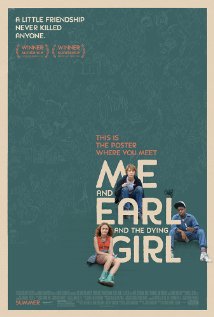
Me and Earl and the Dying Girl is a very Sundance-y Sundance movie, but it’s good! Sundance loves some great films, and this is one of them. First, this is indeed a movie about a dying girl. Because the title is so straightforward, I somehow thought it wouldn’t be so dark, but it was.

image from imdb.com

image from imdb.com

I also rewatched Mad Max: Fury Road this week (stay with me, it’s relevant!) and have continued to find meaning in the war boys’ concept of a “witness”—this idea of being witnessed in our acts of bravery, our acts of love, our acts of dying—all of it. It’s meaningful to me because I’ve always been so independent and only in the last few years have begun to understand the value of an invested witness.

I mention it because an important aspect of M&E&DG is that a very young man is witness to a dying girl. It’s something they stumble into, they resist, but, of course, it becomes meaningful in ways they couldn’t’ve anticipated or even previously comprehended. That kind of character growth and insight was lovely to watch, but it was also sophisticated enough that I think most audience members come away with deeper insights about what it means to connect more to “their people,” moving beyond assumptions and into really knowing another person.

One of the best moments in the film is when the cool history professor talks about how he lost his father at a young age. He said that even after his father’s death, he’s continues to learn about him. His father’s life continues to reveal itself. It started when his dad’s friends started sharing stories after his death. It continues all the time, in unimaginable ways, even decades later. I think the point here is that learning about our dead loved ones is part of what it means to be alive and self-aware.

As for me, I continue to learn about my own grandmothers. Both my great grandmother and her daughter (my mom’s mom) were a huge part of my early childhood. My great grandma even lived with us sometimes during the winter. She just stayed. She was Swedish. She was very quiet, and she loved me.  My grandma and great grandma died within two years of each other. They were a big part of my childhood, and then, in a relatively short period of time, they were both gone.

For awhile, it was sad, but okay, and this is the natural cycle of life. And then, I got really curious about them and asked my mom and aunties lots of questions about who my grandmothers were. I began to piece together my memories with their stories.  Over time, I can see how much the course of my life has been shaped by their influence. Decades later, I’ll remember idioms and wisdom about how to grow a garden, how to love one man. They suffered and loved for decades, and don’t we all? I am a witness to it all. There is meaning where meaninglessness wants to creep in. It reminds me that I am part of something bigger, family, culture, blood, brains. They are with me in memory and in my story, and that’s what I took away from M&E&DG.

Be Free Where You Are by Thich Nhat Hanh

I’m supposed to be gearing up for a spiritual year according to sundry esoteric readings and such. I entertain these mostly for fun, but when the idea reappeared to me in multiple venues, I thought, okay, I’m listening. I’m not particularly excited by the prospect of a spiritual year, but recognize that it’s a part of being. And, there’s no time like the present.

So, the other day on a friend’s table, I saw a copy of Thich Nhat Hanh’s Be Free Where You Are, which is a little pocket-sized book based on a lecture he have to a group of prisoners a few decades ago. “Take it,” she said. So, I slipped it into my purse and read it the other night. It is a very quick read. I read half of it, then decided to read the rest of it, and then read the Q&A after that—all in one sitting. I chose to read and reread a few key sections  slowly to try to really absorb his potential meanings.

Thich Nhat Hanh’s been on my radar after a respected mentor mentioned that his work had valid philosophical and scholarly potential. After reading this short book, I can’t say that I agree. Of course, it’s way too soon to make a definitive statement either way. But, he spoke about things like being in your heart and being positive, and while I can make a lot of assumptions about what that might mean, I’m not sure that means much. Or, maybe it means everything. The book is full of these kinds of assertions, and I can only hope that his longer works offer more depth.

Thich Nhat Hanh said that understanding is crucial for forgiveness.

He said to think about each bite of food and where it came from with gratitude.

He said to meditate always, while walking and washing dishes. While inhaling and exhaling. He encourages his audience to be present. Describing this, he wrote, “Here I am.” I read it a few times:  “Here I am.” I walked over to my full-length bedroom mirror and tore away the tens of sticky notes upon which I had scribbled affirmations in permanent marker, affirmations that I had written months earlier as they occurred to me. I threw the tiny stack of words into the recycling, got out a new sticky note and wrote, “Here I am.” I placed it alone on the mirror. Here I am.

I thought about an eye-gazing meditation I did recently that was either good or meaningless, and I thought, “Here I am. Here I am.”