Category Archives: existence

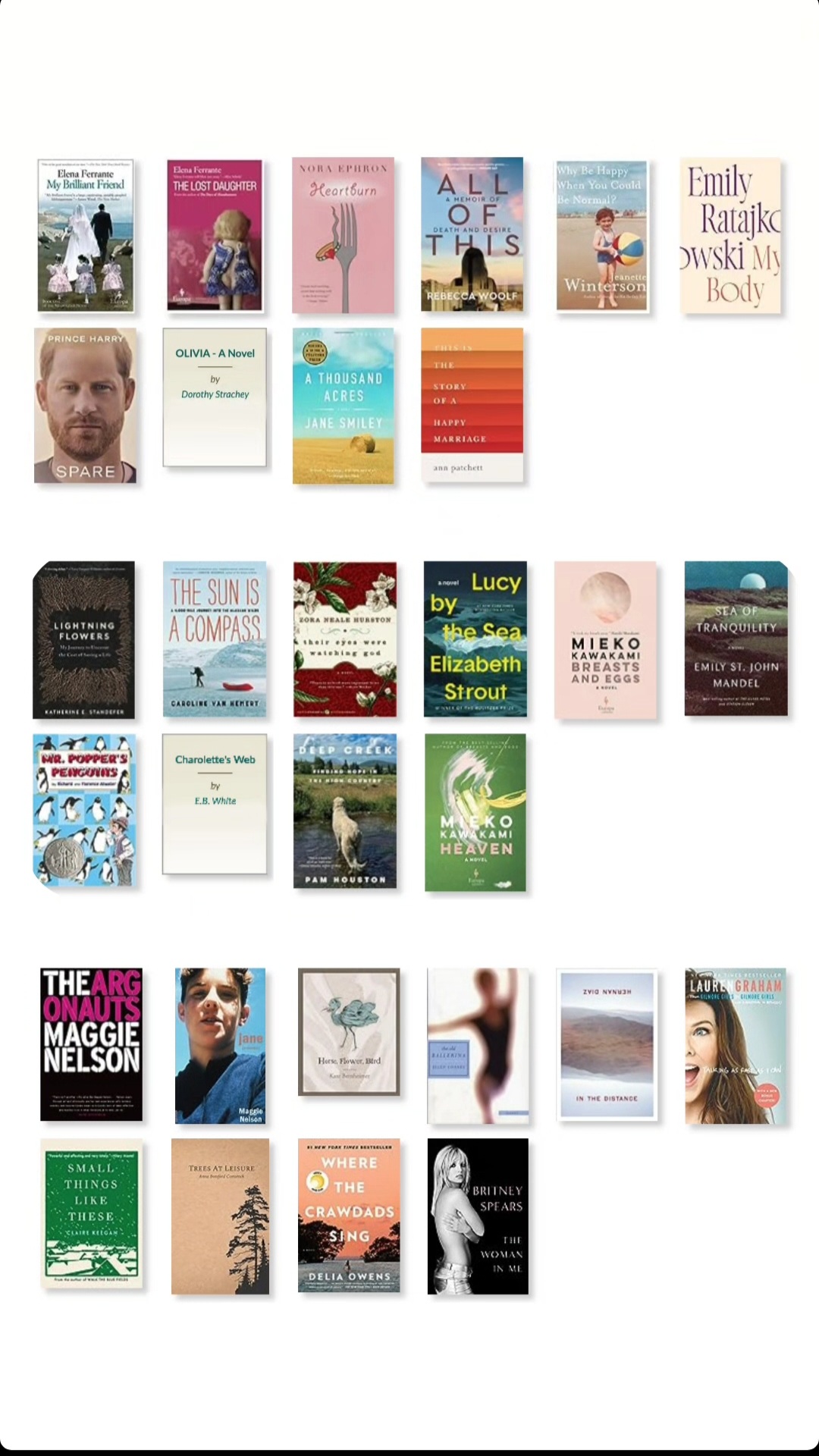
My Body by Emily Ratajkowski

My Body by Emily Ratajkowski is a unique book–part expose on the seedy world of modeling, fashion, Hollywood, and fame, and part memoir, with deep personal introspection. In the book, Ratajkowski, whom I was vaguely aware of as a model, but now a fan and follower on Instagram, shares the story of her rise to fame, known for her perfect body. But, she’s also critic of the abuse she suffers at the hands of both the industry and the larger culture. She’s a critic of herself too, acknowledging stories when she was too naive, too confused, too scared, or too complacent to do better. It’s a complicated book that sends readers on a trajectory of introspection about women’s bodies, while also offering a look into an elite (and also surprisingly not glamorous in so many ways) world that few get to experience. I hope she’ll write more, especially about motherhood. This book is worth the read!

All of This: A Memoir of Death and Desire by Rebecca Woolf

First, here are my unsolicited blurbs for this book:
“Please option this for a film asap.”
“Woolf is a modern day Nora Ephron.” (Possibly influenced by the fact that I just finished Heartburn, but still!)
“This book is the true LA Story.”

After following her work online for years (as one of the thousands of people whose fingers hold her up in this cosmic game of light as a feather, stiff as a board), I have been eagerly awaiting my chance to read All of This: A Memoir of Death and Desire by Rebecca Woolf.

The first half+ of this book is a gripping narrative. Later, the book becomes less plot driven and slows, and I think that’s because the “after” is not/could not be a linear trajectory.

Woolf wrestles with what it means to be a feminist, or to become a feminist, and puts a magnifying glass to some of the common dynamics of life, relationships, particularly heterosexual relationships that are, to say the least, problematic. I was with her for these points because I also wrestle with many of the same questions. I differ though. Unlike Woolf, I was less tied down in my early adult life, and more so now, even though still not very “tied down” by comparison, and that is by design. I had my children later, but a decade ago, I was also reading about her life online. To be reading this book now, as I have little ones of my own feels very full circle, which she would enjoy.

Here are some lines I loved or identified with and/or that gave me pause:

First, as a fan of her writing, I loved seeing her include her numbered lists with numbers that get longer and insaner each time.

“I will not shrink myself nor prioritize people’s pleasure over my own.” Simple, true. It can be hard to recognize when it’s happening.

“Then the 2016 election happened.” This changed me forever too, and I am still not over it.

“WHAT IF IT DID NOT TURN OUT TO BE CHILL?” Just, lol, yes, this is what it is like to be a parent, mother, woman in life.

“I soon realize that it’s a lot faster for me to pack four lunches on my own.” This is just simply true and a lot of people don’t know it.

“My daughters. They are only mine now.”

“The bravest women I know are not widows. They are divorced.”

“And there is nothing I can do but let it go and drive him home. This is the moment I became a single mother.”

My Brilliant Friend by Elena Ferrante

I discovered Elena Ferrante from Mothers by Jacqueline Rose, which I read recently. I started with Ferrante’s My Brilliant Friend, the first in a long series, and I loved it! The writing is excellent. The content is thought-provoking, and it also has the long sense of story found in easier, longer reads–not a common combination. Although it is long, I flew through it.

While I highly recommend the book, I will warn that I found the conclusion to be somewhat disappointing. I wanted a strong wrap up for this particular book, but instead found myself needing to read more of the series in order to get that. It will probably require reading all four books.

I ended the book somewhat exhausted and unwilling to continue with the series. Maybe I’ll return to them someday. They’re certainly worth it, but, and I can’t believe I’m writing this, I really don’t have the energy to give them at this point in my life.

I’m glad these books are out there. Sometimes I just need a good book, a good story, and I now know I can turn to Ferrante to get that.

I am also inexplicably obsessed with the cover art:

Orwell’s Roses by Rebecca Solnit

True to form, my “breezy summer beach read” was neither breezy nor read on a beach. Instead, I read Rebecca Solnit’s 2021 book, Orwell’s Roses. Solnit is an incredibly prolific author, and I like her work, but it is heavy and deep, and I rarely feel up to the task. However, at the beginning of the summer, this copy caught my eye at the local library, so I checked it out and read it whenever grading was complete and babies were asleep.

Here’s the copy that I read.

This book is about Orwell. Politics. The roses that he grew at his cottage. His interest in gardening and the natural world, and the hope that can be found there. Writ large, the book is about labor and freedom and politics and all of the themes of Orwell’s own writing, reflecting on labor and illness in Orwell’s time and also today. Solnit draws links between political strife that Orwell wrote about and the political strife of today.

As you know from my Instagram, I am interested in plants and gardening, especially flowers. I love the idea of growing food in whatever piece of earth one might inhabit. I like my own sheep, chickens, and flowers. I love to take a close look at a plant and watch it as it changes throughout the seasons and over the years. Evidently, Orwell and I have that in common. Unlike Orwell (and Solnit), however, I am less insightful and imaginative when it comes to politics, so I appreciated Solnit’s ability to meld the two together in ways that helped me learn and see these subjects all in a new light.

When I start reading Solnit, I think “This is mostly boring and only a little interesting,” and those thoughts are interspersed with with absolutely lovely prose and engaging content, and I love that about her writing. Reading Solnit is like the good feeling I have after I eat my vegetables and get my exercise. When it comes to nonfiction, Solnit is the realest deal. She also gives me permission to go on long tangents, and take up words and space, because it is meaningful to me, and trust that it will be meaningful to others as well.

What Remains by Carole Radziwill

What a beautiful book! What Remains by Carole Radziwill is a completely unique book, taking the reader locations you’ve never been—could never go—but also to fully human and universally recognizable places.

It’s no secret that the Real Housewives series are a guilty pleasure, and I always found Carole to be a fun, tell-it-like-it-is, type of “character,” so I thought this book might be decent, but it’s better than that!

A Memoir of Fate, Friendship, and Love

The book takes the reader to the poor gravel roads and streams of New York state, to the haphazard suburbs, to a chaotic, but close family life, to the rush of a bold new career in a city, to war zones, to falling in love (without cliché), and forging deep friendships with “America’s royalty.” Readers see that we all ache, love, suffer, and feel the joy of the sun on our skin and the wind in our hair universally. The life she lives once she’s seriously dating and married to her husband Anthony is (emotionally) much like other everyday relationships, except with better food, clothing, apartments, travel, and lovely places to stay. The reader might be surprised to find that this group of “elites” are thoughtful, frugal, playful, stressed, sometimes uncertain. Aren’t we all?

Radziwill has lived an extraordinary life, and so while this is a memoir, and a genre with which readers might be familiar, it’s is so completely unique in the extraordinary events and circumstances she’s survived. She loses her three closest people in the span of three weeks. Maybe she has survivor’s guilt, but I hope she doesn’t. I hope she is exploring what to do with this big, bold, beautiful life she gets to live. While there is a tight and lovely metaphor about fortune threaded throughout, which works on several levels, the reader leaves the book thinking, “Anything is possible. Anything can happen. Now, what am I going to do with this big bold, beautiful life?”

I read every word and, almost to prove a point, she thanks her bff and sister-in-law, Teresa, who–get this–is from my very own La Grande, Oregon! I am reminded that it truly is a very teeny tiny microscopic world, and anything is possible.

A Lover’s Discourse by Xiaolu Guo

I am blown away by the slow burn called A Lover’s Discourse by Xiaolu Guo. The first and majority of the book is a quiet, steady dialogue between the main character and her “lover.” As you know, I am not a theory hound, but this book was one of few that has made me want to turn steadily back to some of the theories presented in this book, and in grad programs across the world, including my own, and see if I can now find a different way in to them, more my own, perhaps feminine, a more first gen, working-class, creative, put two ideas next to each other to see the new, true, and also beautifully enigmatic knowing that emerges.

I love some of her snarky responses to the rote theories her partner espouses. I found the book to be an incredibly bold and feminist and completely empowering that she takes on subjects that are often, almost always (always?), interpreted through a male lens. She even uses Barthes’ exact same title. So bold! How might I do more of this myself? The book ends with both the theory and physicality of reproduction.

Often I find modern literature to be too cold and unemotional. This book had some of those qualities, but I still felt deeply and identified with many of the main character’s experiences. New motherhood is depicted in almost entirely negative terms, but much of the book is.

In new motherhood, I, too, started to think of mothers in response to every act of killing I heard on the news. These mothers have worked so hard to raise of their children, up until the very moment that their lives are taken. Guo has this exact same insight. We are all one, I suppose.

Finally, the relationship–I’ve felt nearly every one of the feelings or loneliness, isolation, desire, and confusion. I have yelled for him to “Bring wipes” as the baby’s mess grows, only to have him emerge too late, confused and groggy. “When have you had time to listen to music?” The changing home, the changing dynamic, described so uniquely and so true, perhaps especially for the creative woman.

Through it we are two people, changed, and in discourse with each other—lovers.

Wintering: The Power of Rest and Retreat in Difficult Times by Katherine May

Wintering: The Power of Rest and Retreat in Difficult Times by Katherine May was recommended by some well-read and well respected people, so perhaps my expectations were a bit too high. Still, I love the premise, which is about enduring difficult times, even leaning into them, moving through them, and eventually coming back to the light. So much of grief, sorrow, and depression is about stopping it, fixing it, and getting over it. This book is really the antithesis of that, which I find intriguing.

The intro is quite gripping, and this is where the strength of the book lies–when May is sharing her own personal story and experiences. However, there were also so many questions left unanswered. Like, did her husband’s health fully return? Why did she dislike her job? How did her husband and child feel about the author’s “wintering”? How did it impact her closest relationships?

There is also a trend in this kind of journalistic genre, where the author flip flops back and forth between personal writing and inquiry and an informative, lecture style. I am fully engaged by the personal story, but the lecture is always less interesting. First of all, while reading these sections, I often have an overwhelming reaction of “I already know this already.” It seems as though the insights in the lecture are not very insightful after all. Secondly, the transitions between the sections often seem awkward or unconvincing. Lastly, the lectures often feel forced. I can imaging an editor insisting that the author make the reader “eat their vegetables,” instead of just eating the cheesecake (cheesecake being the insights and personal journey).

There were even moments that rang false within the more journalistic sections. The section on wolves seemed particularly fraught. She claims that wolves don’t kill people. (They do.) That they kill more than they need and that’s reasonable. (How is that more reasonable than wasteful? murderous?). Finally, she claims that wolves are irrationally trapped, poisoned, shot, *beaten*, and killed, and that’s when I knew she was going a little overboard. I just highly doubt that these wild animals are tortured (beaten), though I’m not disputing that they are killed regularly by people. Also, I wanted to hear more about the bees.

Despite my complaints, this is a good book worth reading. I myself love restful times for quiet, recovery, reading, and introspection, and this book is really a celebration of that. While how the depression (she avoids this word) started is very developed, I would have loved to see that same development in the middle and then again at the end of her wintering. As I write in the beginning, this is a novel approach to sorrow and difficult times, and I think it’s a healthy approach, one that would be/will be helpful for me to return to in my own difficult times.

The Lais of Marie de France

The Lais of Marie de France are real bodice rippers, so to speak. You can see how these stories of ancient romance have influenced everything from Shakespeare to Rom Coms since. There is a strong sense of love and loyalty in each story. The same intensity of life and death love stories, like Romeo and Juliet, are played out repeatedly throughout the lais.

the library’s copy

I read through these relatively quickly, after learning about them from a dear one’s scholarship. First, I was looking for significance in fabrics and cloth. I also frequently thought about the fabrics having just read A Short History of the World According to Sheep and learning more about the wool and processes (and abuses) that went in to making these fabrics.

Eventually, I just got caught up in each story–the excitement and intensity of the love, the suffering, and the joy. (Though, as with most romance, the “ever after” is short changed, and I think most of us are left wondering how that part’s supposed to work.)

The lais capture an intensity that is unique to human love and courtship, and honestly, I think it’s a really intense thing worthy of our focus. The main characters aren’t being cool or dealing with their baggage. They’re just strong and perfect knights, who win all of their tournaments, and fair and beautiful women, who are kind and loving and good, so much so that a knight would sacrifice his life to her, a life that many other knights had tried taking many times before. That they are already married to someone else or in some way betraying someone else is a liner note.

These lais are over the top, sometimes to the point of being ridiculous, but they are entertaining. And, they have literary merit too, not only because of their rich history and staying power, but because, as I read them, I was also inspired, for the first time in a long time, to write a few poems myself!

Iep Jāltok: Poems from a Marshallese Daughter by Kathy Jetñil-Kijiner

Iep Jāltok: Poems from a Marshallese Daughter is a beautiful book of poetry by Kathy Jetñil-Kijiner. I don’t usually read a lot of poetry, but this one drew me in and held me there.

The place where I work has a relatively large population of Micronesian students. In fact, a summer program for work put this book on my radar, and I’m so glad it did. I find myself wanting to learn more about this population. From the book I read about the indigenous connection to place, language, racism, climate change, climate refugees, refugees from US nuclear testing, food, love, religion, womanhood, family, and more.

I found myself searching for plane tickets. Just how far away are the Marshall Islands?

The Secret Teachings of Plants by Stephen Harrod Buhner

I’m including The Secret Teachings of Plants by Stephen Harrod Buhner on my booklist this year, even though it got a hard skim after the first few chapters, which only occur after a lengthly “Note to Reader,” Introduction, and then Prologue. Finally, the reader gets to “Section One: Nature.”

The book promises to be split into two parts: the first half “Systole” and the second half “Diastole.” Systole promises to be the more linear, factual, mathematical half and diastole the more creative and emotional half of the book. However, the tone and approach is nearly identical in each “half.”

The approach is a rambling mix of pot smoker, metaphysical, mystical philosophy popular in the ’60s. It’s a meaningful and worthwhile philosophy, but it’s definitely a type. The writing is fragmented, made worse by constant quotes by the likes of Thoreau, which constantly disrupts the flow of the text.

My deepest disappointment is that the book promises to explore the emotional and creative teachings of plants, and that concept is completely intriguing and compelling to me. I would love to read that book! Unfortunately, this book does not deliver on it’s promise.