Category Archives: existentialism

Wintering: The Power of Rest and Retreat in Difficult Times by Katherine May

Wintering: The Power of Rest and Retreat in Difficult Times by Katherine May was recommended by some well-read and well respected people, so perhaps my expectations were a bit too high. Still, I love the premise, which is about enduring difficult times, even leaning into them, moving through them, and eventually coming back to the light. So much of grief, sorrow, and depression is about stopping it, fixing it, and getting over it. This book is really the antithesis of that, which I find intriguing.

The intro is quite gripping, and this is where the strength of the book lies–when May is sharing her own personal story and experiences. However, there were also so many questions left unanswered. Like, did her husband’s health fully return? Why did she dislike her job? How did her husband and child feel about the author’s “wintering”? How did it impact her closest relationships?

There is also a trend in this kind of journalistic genre, where the author flip flops back and forth between personal writing and inquiry and an informative, lecture style. I am fully engaged by the personal story, but the lecture is always less interesting. First of all, while reading these sections, I often have an overwhelming reaction of “I already know this already.” It seems as though the insights in the lecture are not very insightful after all. Secondly, the transitions between the sections often seem awkward or unconvincing. Lastly, the lectures often feel forced. I can imaging an editor insisting that the author make the reader “eat their vegetables,” instead of just eating the cheesecake (cheesecake being the insights and personal journey).

There were even moments that rang false within the more journalistic sections. The section on wolves seemed particularly fraught. She claims that wolves don’t kill people. (They do.) That they kill more than they need and that’s reasonable. (How is that more reasonable than wasteful? murderous?). Finally, she claims that wolves are irrationally trapped, poisoned, shot, *beaten*, and killed, and that’s when I knew she was going a little overboard. I just highly doubt that these wild animals are tortured (beaten), though I’m not disputing that they are killed regularly by people. Also, I wanted to hear more about the bees.

Despite my complaints, this is a good book worth reading. I myself love restful times for quiet, recovery, reading, and introspection, and this book is really a celebration of that. While how the depression (she avoids this word) started is very developed, I would have loved to see that same development in the middle and then again at the end of her wintering. As I write in the beginning, this is a novel approach to sorrow and difficult times, and I think it’s a healthy approach, one that would be/will be helpful for me to return to in my own difficult times.

The Lais of Marie de France

The Lais of Marie de France are real bodice rippers, so to speak. You can see how these stories of ancient romance have influenced everything from Shakespeare to Rom Coms since. There is a strong sense of love and loyalty in each story. The same intensity of life and death love stories, like Romeo and Juliet, are played out repeatedly throughout the lais.

the library’s copy

I read through these relatively quickly, after learning about them from a dear one’s scholarship. First, I was looking for significance in fabrics and cloth. I also frequently thought about the fabrics having just read A Short History of the World According to Sheep and learning more about the wool and processes (and abuses) that went in to making these fabrics.

Eventually, I just got caught up in each story–the excitement and intensity of the love, the suffering, and the joy. (Though, as with most romance, the “ever after” is short changed, and I think most of us are left wondering how that part’s supposed to work.)

The lais capture an intensity that is unique to human love and courtship, and honestly, I think it’s a really intense thing worthy of our focus. The main characters aren’t being cool or dealing with their baggage. They’re just strong and perfect knights, who win all of their tournaments, and fair and beautiful women, who are kind and loving and good, so much so that a knight would sacrifice his life to her, a life that many other knights had tried taking many times before. That they are already married to someone else or in some way betraying someone else is a liner note.

These lais are over the top, sometimes to the point of being ridiculous, but they are entertaining. And, they have literary merit too, not only because of their rich history and staying power, but because, as I read them, I was also inspired, for the first time in a long time, to write a few poems myself!

The Secret Teachings of Plants by Stephen Harrod Buhner

I’m including The Secret Teachings of Plants by Stephen Harrod Buhner on my booklist this year, even though it got a hard skim after the first few chapters, which only occur after a lengthly “Note to Reader,” Introduction, and then Prologue. Finally, the reader gets to “Section One: Nature.”

The book promises to be split into two parts: the first half “Systole” and the second half “Diastole.” Systole promises to be the more linear, factual, mathematical half and diastole the more creative and emotional half of the book. However, the tone and approach is nearly identical in each “half.”

The approach is a rambling mix of pot smoker, metaphysical, mystical philosophy popular in the ’60s. It’s a meaningful and worthwhile philosophy, but it’s definitely a type. The writing is fragmented, made worse by constant quotes by the likes of Thoreau, which constantly disrupts the flow of the text.

My deepest disappointment is that the book promises to explore the emotional and creative teachings of plants, and that concept is completely intriguing and compelling to me. I would love to read that book! Unfortunately, this book does not deliver on it’s promise.

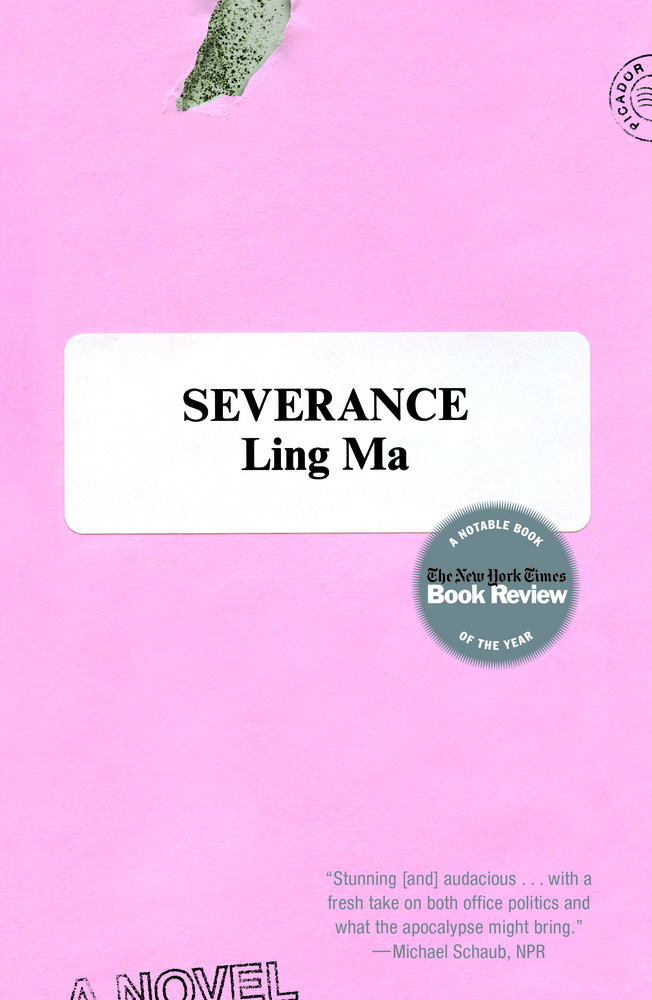
Severance by Ling Ma

While Covid19 was gaining momentum in China and just barely on my radar, I read Severance by Ling Ma. This is normally not my genre. Not by a mile. But, it’s well written and was gifted to me through an academic mamas holiday book exchange. I was in my first weeks after having a baby, and it was in between semesters. So, found myself with time to read while my baby took those nice, long newborn naps.

Character development: I did not identify with the main character whatsoever until near the end, when she was built up enough that I could see her suffering was human and shared by us all.

Plot: The premise is that a fever, originating in China, steadily makes it’s way through the human race. The “fever” is always deadly, taking 1-3 weeks to kill it’s host. It renders people into a zombie-like state, where they repeat seemingly mundane tasks until they perish by wasting away. The few who remain exist in a strange new world.

It’s a metaphor. It’s all a metaphor. That we’re all zombies going through the motions. That we are our parents’ memories. That existence is a memory. That knowing is memory. Something like that–I’m sure there’s more to it.

***spoiler alert*** below (mild)

severance1


Anyway, if you read it, tell me who you think was fevered in the end.

And I Shall Have Some Peace Here by Margaret Roach

Ok, I really need to start reading baby and childbirth-related book now. But, before I do, I read And I Shall Have Some Peace Here by Margaret Roach of A Way to Garden. I’ve been a long-time listener of her gardening podcast. The podcast is weird, quirky, nerdy, and good and probably the best gardening podcasts out there. It’s a celebration of plants and gardening, and “how to.” (It’s supposed to have some woo woo, but there’s none of that, really.)

And I Shall Have Some Peace Here is the same way: weird, quirky, nerdy, and good. She’s got this style of writing that’s stream of consciousness, double consciousness. There are always several threads going through each paragraph, sometimes each line. Sometimes it’s funny and intentional. Sometimes it seems that it’s just the way her brain works, and she can’t help herself.

Over the years, I’ve been inspired by Roach to do more gardening, even in my limited and sometimes uncertain space, to propagate hostas, to fertilize my houseplants, and much more. It’s nice to find another person, and even community, who care as much as I do about plants.

However, this book is not as much about gardening as it is about taking big risks and changing one’s life–following one’s calling, even if it means (and it so often does) leaving a life of security for the life you were meant to live.

I liked that about the book. I like that, once Roach leaves the corporate world, she is sedentary and uncertain for a long time before she is able to take meaningful action. The big change might lead immediately to bliss and certainty, but it doesn’t always, and Roach’s story is evidence of that. Oftentimes, big change leads to sitting, and reading, and drinking too much, and eating too much, and staring out the window, and being very alone, but strangely, not really lonely. Your diet falls apart. Your yoga practice falls by the wayside. Until finally you realize you’re doing it. You’re doing the thing. You’re getting healthier, living better, and it all was really worth it. I found her story to be inspiring.

The Reason for Crows: A Story of Kateri Tekakwitha by Diane Glancy

I first heard about Kateri Tekakwitha while reading about her sainthood in Erdrich’s Future Home of the Living Gods. I waded through a few books that reference her in  Erdrich’s latest, but Diane Glancy’s The Reason for Crows: A Story of Kateri Tekakwithawas the only one that held my attention.

This is a weird book, and, honestly, even after I’ve finished, I’m not sure if Glancy is being incredibly critical, cynical, or accurate in her depiction of Kateri. It’s a weird fever dream of a book and captivating and poetic on the sentence-level.

Here’s the thing: Kateri almost dies of smallpox. She survives, but is nearly blinded. After that, her life is a series of traumas–constant starvation, constant war, constant torture, murder, and freezing. Her life is a living hell, and then she dies at the young age of 24.

During her short, extremely traumatic life, she converts to Catholicism, following the lead of a few female family members. Christianity is met with skepticism by many members of her tribe, but it is also somewhat tolerated.

As she learns more about the religion, she becomes more zealous. She self flagellates and physically tortures herself in various other ways. She has strange dreams day and night, waking and in sleep. The author, Glancy, paints such a horrific picture of Kateri’s life that the reader can’t help but wonder if Kateri is having a genuine religious experience, or if she is quite predictably experiencing a kind of PTSD-induced psychosis. The latter seems quite reasonable. But, the author doesn’t dismiss Kateri’s experience of God and spirituality either. Religion and Kateri’s mystic experience is at the forefront of the text to the same extent as the torture and trauma.

Like in life, I suppose, the reader is left to wonder what’s real, and what’s spiritual, and what’s an apparition, and which ones are worth believing in.

Future Home of the Living God by Louise Erdrich

This is not my genre, but if Louise Erdrich writes an dystopic end-of-times novel, I’ll read it. While I haven’t read The Hunger Games, or even The Handmaid’s Tale, Future Home of the Living God seems to borrow from those of these themes and images. While I’m not well versed enough in the apocalypse genre to say for sure, I imagine that Erdrich’s work here does not expand the genre in terms of imagining what that world might look like, how it might function.

What I did love about the novel was that it tackled political issues and questions in ways that were artful and beautifully written. Erdrich seems to instantly and effortlessly create characters that are at once unique and familiar. She’s also just a master story teller, although there seemed to be some long scenes and plot points in the last third of the book that didn’t seem to expand the narrative. I trust Erdrich though, and perhaps on a second read, I would recognize the reasoning behind the plot in the last third of the book.

There were some great moments in the last third too though. For example, I loved how some of the characters evolved. I liked some of the surprises. I appreciated the commentary. I liked the way it ended.

Here were a few lines I liked:
The title, obviously. They don’t get much better than that: Future Home of the Living God

“An Announcement That Brought Incongruous Joy” (45).

“So do I love him at last? Child, I need him. It is hard to tell the two apart” (80).

A long section on how men smell (82).

“Where will you be, my darling, the last time it snows on earth?” (267).

Further reading:
Raids on the Unspeakable by Thomas Merton

Kateri Tekakwitha: Mohawk Maiden by Evelyn Brown

and possibly, The reason for crows : a story of Kateri Tekakwitha by Diane Glancy

Oranges Are Not the Only Fruit by Jeanette Winterson

Oranges Are Not the Only Fruit by Jeanette Winterson is my first book of 2018! I was slogging through another book for several weeks, before picking this up around the New Year and not really putting it down until I was finished.

I thought I’d read Winterson before, but I don’t think I have. I think I had her confused with Jean Rhys or something. Anyway, it’s a great book. It’s obvious, funny, and smart in ways that were accessible to me.

Here were just a few lines I liked:
“[S]he’d got rid of more smells than she’s eaten hot dinners” (33).

Needlepoint: “THE SUMMER IS ENDED AND WE ARE NOT YET SAVED” (40).

“I was not a selfish child and, understanding the nature of genius, would have happily bowed to another’s talent…” (50).

“…no emotion is the final one” (52).

“Time is a great deadener; people forget, get bored, grow old, go away” (176).

Further reading:
Goblin Market by Christina Rossetti:
https://www.poetryfoundation.org/poems/44996/goblin-market

Middlemarch by George Eliot

2017: year in review

2017 started as one of, if not the, worst years of my life, but it got a whole lot better by the end. I got sick (for the first time in my life, really). Weirdly sick, and doctors couldn’t figure it out, until finally some fringe health workers said maybe stress, maybe anxiety, maybe adrenal fatigue, but still nothing certain. So, after all of the scans and doctors appointments that showed nothing, I took lots of supplements, and ate green salads, and was very still and gentle with myself for several months. It was isolating. I was fearful. I laid on the couch a lot. I read books. In fact, I read a lot of books last winter to pass the time, which ultimately helped me heal, I think. (My 2017 reading list is posted here.) Slowly, my strength returned. Slowly I began to exercise again. Slowly, slowly.

Despite that cloud hanging over my head in the first half of the year, lots of good, and beautiful, and life changing things happened in 2017 as well. Just as I was regaining my strength, I traveled to Portland, Oregon in March, to present at an academic conference. Then I took a trip to Spokane, Washington (I love that city), then a trip to Tri-Cities, Washington, then Moab to hike through Arches, then lots of time in Idaho, gardening and working and writing, then back to Oregon for my cousin’s wedding and good time spent with the kiddos, the Stampede, more gardening with my mom, riding lessons (I hadn’t been on a horse in years), a few trips around the pond on a paddle boat with my dad and nephew, a tiny raspberry harvest from my tiny new raspberry patch, and a conversation that had my heart pounding in my throat and ended with him saying, “Ok,” ejc’s visit (twice), along with Piper, a trip to Teton National Park, and the Table Rock hike, despite horrible smoke from forest fires last summer, a tiny huckleberry harvest (that actually took forever because—huckleberries), a road trip through Wyoming, Nebraska, and Kansas to Missouri, for some art, a train depot, and wandering through Kansas City, MO, and a return to Little Sweden, then the total solar eclipse viewed from an overlook in the Idaho mountains, an experience that completely exceeded my expectations and changed my perspective on what the world was capable of, then on to Mom’s fall visit, and I loved having her here, and then back to Oregon for another cousin’s wedding (where I was maid of honor for the first time!), a little more time with my family in Oregon, and then back to work, and then back to Spokane (I love that city! (even though it was unseasonably cold this time)) to present at another conference, and then teaching my last class of yoga for the foreseeable future, and then on to Florida, where I walked in the warm Atlantic surf in December, and napped my way through a road trip in Alabama and on to Louisiana, where I spent some time with people I will probably know forever, and then back to Oregon for a really charming, idyllic Christmas week, with lots of baking, just the right amount of snow, and good visits with my family, and lots of good news and good cheer to share.

Cheers to a happy new year, everyone.

sherewin

my 2017 “best nine” from Instagram

Transit by Rachel Cusk

I continue to enjoy Rachel Cusk’s work–a constant good amid chaos. I read Outline a few years ago and The Last Supper just this winter. Transit: A Novel makes sense of The Last Supper.  Her observations on the human condition are unique and accurate. Her characters are honest, and sometimes they tell the truth.

Here are some lines I liked:

  • “[S]he was too obviously based on a human type to be, herself, human” (3).
  • “It was an interesting thought, that stability might be seen as the product of risk; it was perhaps when people tried to keep things the same that the process of decline began” (27).
  • “[S]omeone who cared about him once wrote that it was impossible not to reject him, that the friend himself has rejected him, that something about him just made people do it” (138).
  • “Fate, he said, is only truth in its natural state” (256).
  • “I felt something change far beneath me, moving deep beneath the surface of things, like plates of the earth blindly moving in their black traces” (260).

I’ve felt these subtle moments, sometimes after years, and it’s such a relief.