Category Archives: existentialism

Why Not Me? by Mindy Kaling

As you know, one of my favorite genres is a memoir from a female comedy writer. It’s like hanging out with a really funny best girlfriend all weekend. Is it weird that I artificially fabricate this experience through reading? Maybe. I don’t care. I read Mindy Kaling’s first book, Is Everyone Hanging Out Without Me? during a frantic “pleasure reading” phase I went through between the time I submitted my dissertation and the time I graduated.

This time, I am realizing (perhaps late) that Kaling writes, plays, (and maybe is?) just one character. But, like Jack Nicholson and James Franco (maybe I’ve only seen his stoner films?), nobody cares because it’s such a good character. The Office’s Kelly Kapoor, The Mindy Project’s Mindy Lahiri, and the identity Kaling develops in both of her books are all basically the same person. She’s a myopic, worst/best basic bitch kind of person, and it’s hilarious. She’s always simultaneously doing great commentary on gender and femininity. She describes the persona best: “Mindy is…a combination of Carrie Bradshaw and Eric Cartman” (75).

image from books.google.com

Here’s the take away of Why Not Me: First, you will want to eat McDonalds. And yes, there is some filler content. All of these books have filler. Like, okay, I’ll read a script that’s not going anywhere and a commencement speech that you gave. And, yes, the book was probably written by a ghost writer (but that ghost writer does a great job maintaining Kaling’s voice throughout!) And regardless, Kaling writes some grade-A jokes for these books, and even inspires her reader a bit toward the end. I was thinking, “Hey, yeah, why not me?!” Then, laced up my running shoes and achieved my dreams.

Here are some of the lines I loved:

Real Talk

  • “I’m skrilla flush with that dollah-dollah-bill-y’all” (4). This is the single best description of me on payday.
  • “[T]he gulf between a friend and a best friend is enormous and profound” (27).
  • On breakups: “So, the only decent way for him to have broken up with you is to not break up with you and stay with you forever” (39).
  • “As someone who enjoys secrets, exclusivity, and elitism…” (40).
  • People don’t say “Give me your honest opinion” because they want an honest opinion. They say it because it’s rude to say “Please tell me I’m amazing” (125).
  • “[R]ecycling makes America look poor” (139).
  • “[H]ard work must be rewarded with soul-replenishing gossip” (139).
  • “I have a terrible habit of impulsively sending text messages that reveal my true feelings” (140-41).

On Body Image

  • “One of the great things about women’s magazines is that they accept that drinking water and sitting quietly will make your breasts huge and lips plump up to the size of two bratwursts” (10).
  • “I cannot imagine a life more boring and a more time-consuming obsession than being preoccupied with watching what I eat” (194).
  • “But my secret is: even though I wish I could be thin, I don’t wish for it I don’t wish for it with all my heart. with all my heart. Because my is reserved for way more important things” (202).

I want to say some more about the body image stuff. So, I can work to get the sick body, the one with that weird vein between your lower ab and hipbone, but it does require me to think about what I’m eating and get regular exercise. It takes time and mental energy–time and mental energy I’m not always willing to give. Take graduate school, for example. I knew I would take four years and focus my energy on learning. And, so I didn’t think much about what I ate, and I taught and practiced yoga several times a week. I gained weight. I felt fine. This lasted four years.

Now, I can focus more time and energy on my body. Most people I know who pour 100% into looking good look great, but aren’t very interesting to talk to. Additionally, I simply have the kind of brain that requires me to spend time thinking about the meaninglessness of life and experiencing existential angst. I simply can’t/don’t want to transfer that energy into diet and exercise. I liked when Kaling wrote, “I don’t wish for it I don’t wish for it with all my heart. with all my heart” (202), and I think that’s a healthy approach. Anyway, I certainly haven’t found a balance, and I sort of don’t think a balance is possible (for women), and that sucks…is the way I’m going to end this post.

The Skeleton Twins by Craig Johnson

Kristen Wiig and Bill Hader are amazing in this film. They have a ton of chemistry and that probably goes back to their days together at Saturday Night Live. If you’re me, and you’re a fan of SNL, and you’re a fan of Bill Hader and Kristen Wiig, you’ll love watching these two together on screen. Comedy actors can really excel at drama, and you see that in The Skeleton Twins.

image from wikipedia.org

image from wikipedia.org

Before I saw the film, I was told by a trusted person that it was “good, but dark.” And, that’s true. My mind goes in a million directions when someone says “dark,” and it really wasn’t so dark as all that, but it is a heavy film. It’s about twins who are desperately struggling in their lives. They are estranged, but the reasons are unclear throughout most of the film. Toward the end, catalyst for their decade-long estrangement slowly unfolds.

The acting is great. The characters are unique and real. (Luke Wilson is really good in this too!) The plot, writing, and direction are all unique and nuanced and good. However (HOWEVER!), I don’t think the film addresses a universal truth, and that’s something I think good film should do. I left the film thinking, “Yeah, it’d be nice to have a twin that is tuned in to me in my times of suffering, a twin who holds the key to cheering me up when I am down, but I don’t have a twin, and most of us don’t have a twin.” Life is long and hard—we see that in the film. Unlike the Wiig and Hader’s struggling characters, the rest of us have to schlog through this life alone. Maybe if we’re lucky we have some parents, a sibling or two, a few close friends. But very few of us have a twin.

Somehow this film reminded me of Broken Flowers—also critically acclaimed and good in so many ways (and Jarmusch!)—but lacking, in my view, of a universal truth or experience. The films look very closely a unusual circumstances. Now, this isn’t to write the film(s) off entirely. For some people, this story (and fabulous acting) is enough. I’m finding, though, that I want my films to get at something more universal—something that is moving me and something I know is moving my fellow audience members as well.

My Body Is a Book of Rules by Elissa Washuta

image from amazon.com

image from amazon.com

For those of you who miss the bygone days of the grad school creative writing workshop, My Body is a Book of Rules by Elissa Washuta is going to be your jam. It fostered in me nostalgia for those rapid cycling days of pushing myself to the psychological and intellectual limits to produce the wildest new thing imaginable only to discover it’d already been done, and better, and then I was back to the drawing board, and I did this on repeat for a couple of years until maybe (maayyybee) I really did create a few new things.

Washuta’s book has the messy feel of a creative writing workshop. In many of the sections, you can almost imagine the writing prompts to which she’s responding. Readers unfamiliar with this kind of (independent?) prose could very well be put off by this book. And to be fair, even as far as independent presses go, this book has some clunky, first effort moments. As a reader, I was okay with these moments because I was just so glad to be reading something new and different and good and incredibly personal and raw. Maybe too raw.

It’s difficult to write about one’s own mental illness without seeming off-puttingly self-indulgent, and Washuta is aware of this problem and bravely soldiers on. Her themes are so smart—a beautifully nuanced commentary on interactions between race, gender, government, and society. It’s weird. Life’s weird.

Interestingly, both Lena Dunham and Washuta published their books last year and both sometimes use a footnote method, where they break down a piece of text (such as their online dating profile or food journal) with footnotes. The footnotes are so great and so real. It feels very intimate. The only downside (and it’s a big one for me) is that you’ll get vertigo from going back and forth between the original text and the footnotes.

Here are some words I loved:

First, the title: My Body is  Book of Rules is genius.
Next, a chapter title that she should’ve saved for the title of her next novel: “Faster Than Your Heart Can Beat.”

Her descriptions of bipolar:

“…decreased social judgement” (12).

“…a window left open to let the murderers in” (13).

Commentary on Cosmo’s “sex tips”:

“…definitely don’t forget his sack” (18).

Her literary criticism:

She nails her analysis of Catcher in the Rye (a book with which I was previously enamored) like I’ve never seen before when she writes that it “Talks about what’s wrong when that’s not really what’s wrong” (63).

Her insights on life:

“Hope is the thing that comes before the very fucking scary thing” (135).

“do it because you want to, so badly, because you can’t not” (176).

“I am enough” (177).

“Nowadays, when someone else wants to reach me, they get a perpetual busy signal while I whisper sweet nothings to myself late into the night” (177).

“Perfection is hard to stomach” (183).

Meru directed by Jimmy Chin, et al

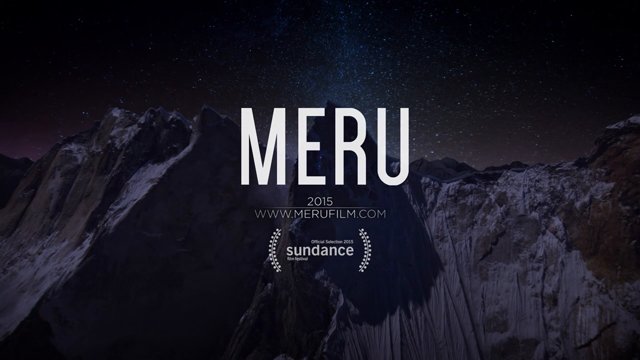
This year at Sundance, I had the opportunity to see Meru, a documentary film about Conrad Anker, Jimmy Chin, and Renan Ozturk’s summit of Mount Meru, or the “Shark Fin” in the Himalayas. I was a little worried that I might spend most of my time averting my gaze from the vertigo-inducing shots of men hanging by a rope over 20,000 foot drops. While there were plenty of those shots, there are also a lot of beautiful scenes that did not invoke a need to cover my eyes. The cinematography is absolutely beautiful and unforgiving throughout.

image from Meru trailer

image from Meru trailer

At about the mid-point, viewers get a lot of backstory on these three climbers. Each of them overcomes absolutely unbelievable obstacles. (Well, maybe not so unbelievable given that they are elite climbers.) I went in worried that this would be one of these films when men (yes, men) do these insane things that make no sense and risk their lives and everyone’s lives, and for what? But I enjoyed and admired these men throughout the film.

They each brought such unique personalities to the screen. Conrad is the hardened old-timer with tons of experience. He’s got a remarkable record for safety, but he’s got a thin exterior might be pushing too hard at this point in his career. There is evidence that Jimmy is aggressive and unstoppable in his pursuit of success, but he’s so quiet and understated about it. Renan has a natural, physical ability, but he’s got a spooked look in his eyes—maybe it’s the fear of being a newcomer or maybe he’s haunted by what’s to come.

Watching the film, I was proud to be in the same species as these guys. It makes me think about the things we’re driven to do. The things we obsess over until we absolutely must do them. Some of us know what we have to do, and it usually means logging countless hours alone with one’s self. This is why, though I recognize my need for relationships, I trust solitude. Important things happen there, and etching out that time and being willing to spend that time alone is key. For some people, that great thing is having a child.

During this film, though it is very masculine, I was reminded of doula work. Like the men climbing Meru, women in labor are inexplicably driven, but they reach their breaking point, they’re brought to the brink, and then beyond to the place where their skin starts to break—just like the climbers. They continue on as the animal body takes over and the higher intelligence and the spirituality are all forced to work together. All three are required, which is one of the lessons, I think. I always say, “What doesn’t kill you makes you stronger, or it weakens you badly.” However, in this film, what doesn’t kill them actually does make them stronger. Cliché as it may sound, the film reminded me of our greatness as human beings. I feel newly inspired to pursue the things I must do in this life, for more quiet focus to better understand what those things are, and a deeper commitment to the solitude they require.