Category Archives: film

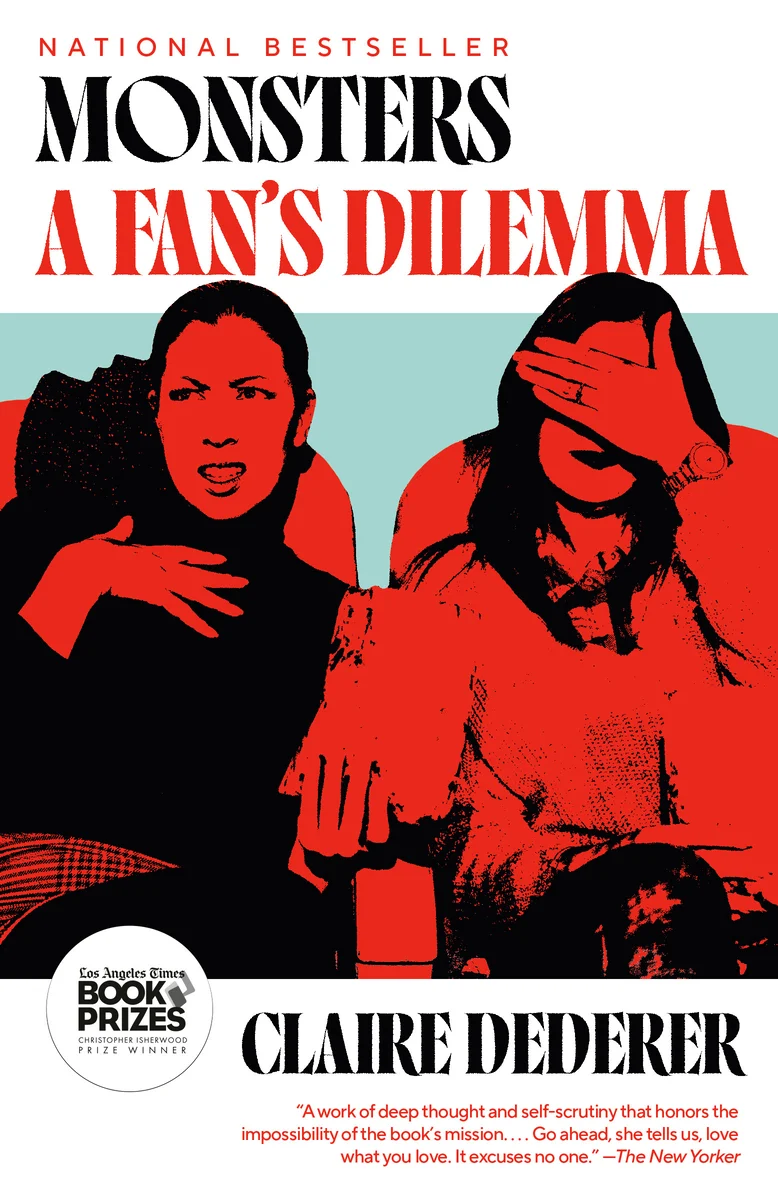
Monsters: A Fan’s Dilemma by Claire Dederer

Now this was a fascinating book! In Monsters: A Fan’s Dilemma by Claire Dederer, Dederer offers monstrous male artists (in every form) and analyzes their audience. As an avid reader, and citizen of the world, I am somewhat interested in the question, especially in the wake of the “me too” movement and subsequent “cancel culture.” Dederer wrestles with the question and avoids simple soundbites and quick solutions.
As a reader, I was interested in our similarities and differences. We both love Woody Allen movies, but she loves Polanski and I can take or leave his work. She has a distaste for Hemingway, and I still think his work is extraordinary. We both love Carver.

However, what was most interesting to me was in the last half of the book, when she turns her lens toward herself: “Am I a Monster?” and “Abandoning Mothers.” As a mother and an intellectual and an author, and, maybe above all else, someone who delights in deep focus, the questions Dederer asks are those that I share.

A question arises, “Do my children matter as much as my writing?” Dederer seems to have a good relationship with her children, seems to have balanced it all in some kind of positive way, but it was not without struggle.

However, for me, this is not the question, but rather an adjacent statement, which is that I matter too. Contemporary motherhood culture has women give of themselves so completely that there is no space for exploration, creation, for the self of the mother/person. To me this is intolerable, and I find myself needing to claw out a space for myself within the rigid expectations of motherhood within my culture, also still while the other thing is true: I love my children and feel deeply grateful for them. Plus, they inspire a greater depth of work in me that I otherwise could have created. And, amid all of these realities, I matter too.
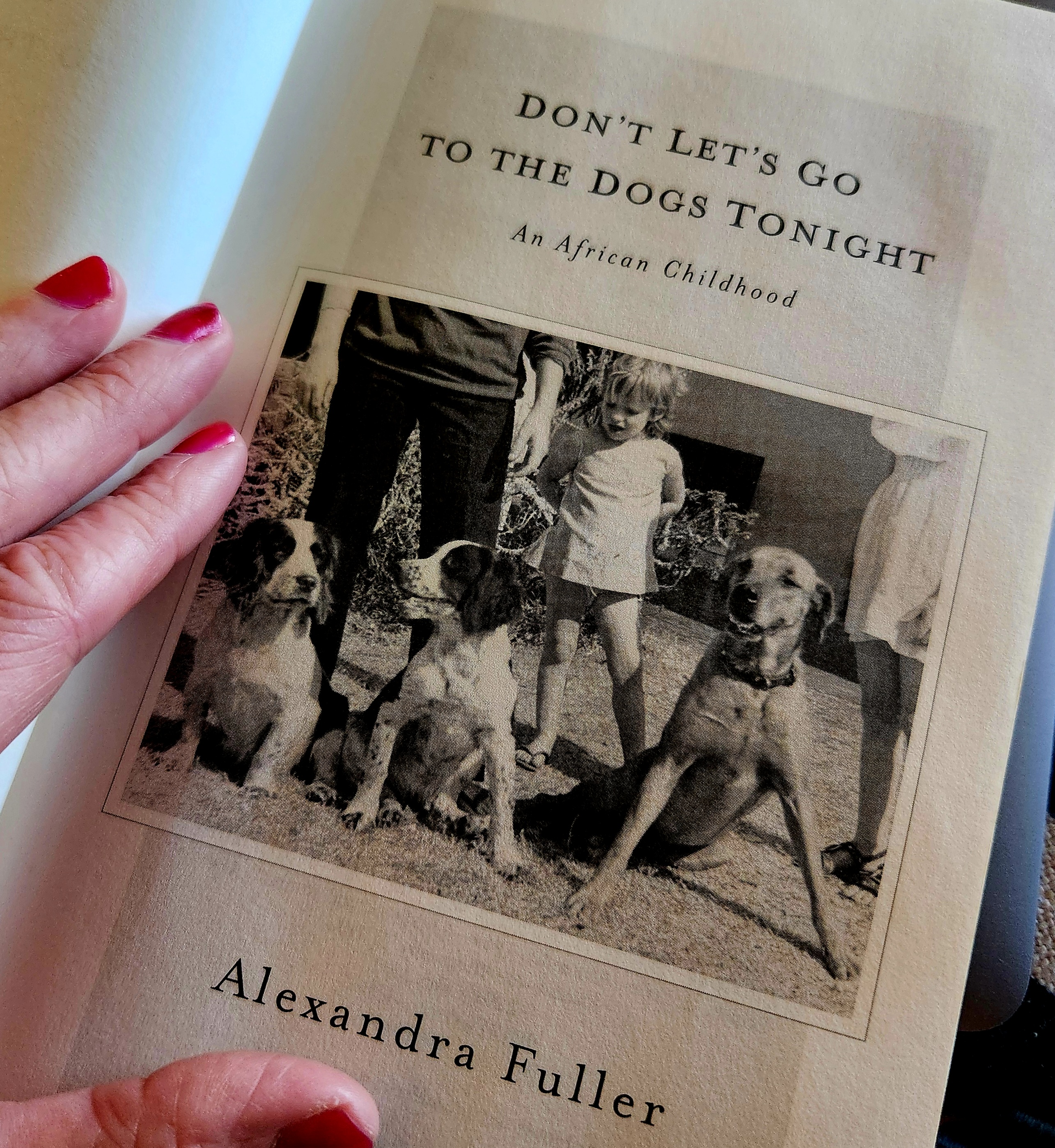
Don’t Let’s Go to the Dogs Tonight by Alexandra Fuller

Alexandra Fuller’s book, Don’t Let’s Go to the Dogs Tonight offers beautiful writing and insights on living in Africa through the 1970s-90s, amid war and revolution, amid those complicated social dynamics, but also amid the personal dynamics of family, of alcoholism, of mental illness, and parents who offer their children a childhood that is at once amazing and also, probably, negligent.

Fuller’s writing is consistently beautiful throughout. Even in its sometimes stark depictions, the book is infused with a contagious love of Africa. Zambia, Zimbabwe, Malawi have not necessarily been places I’ve ever wanted to visit. I’ve grown up in wilderness areas, and so the great safaris that have drawn others have less pull for me. However, this book made me see some of the other beautiful aspects of the country. After reading the book, I wouldn’t hesitate to go.

This year there’s a new movie out based on the book. From the trailer, it appears that the film follows the book closely. I hope I get a chance to watch it.

Tom Lake by Ann Patchett

The only other book I’ve read by Ann Patchett was This is the Story of a Happy Marriage, which I read last year. My thinking is that Patchett has had a long and illustrious career and has earned the time and patience it takes the readers to complete her books. Tom Lake is no exception. It might even be her crowing achievement in time and patience, which is not to say that it isn’t worth it.

Perhaps what strikes me most about Patchett, and that generation of woman writer, is the way they interact with men. Men seem to hold a higher interest than in contemporary literature. The women, even the author, seems to defer to them for knowledge and guidance.

I know of one woman of the same generation who is this way too. I’m not even sure if it’s a bad thing, but it strikes me as a bygone way being and thinking. Yeah, that little thing is probably what struck me most.

Second, I was struck by how much attention the people in the book gave the narrator, who is an aging mother and former actress. Her daughters were mostly riveted by her stories, and her husband was patient with her as well. Near the end, the reason for this interest becomes clearer, but throughout the bulk of the book, the narrator seems tedious and detailed, even delighting in her story and drawing it out for emphasis in a way that felt somewhat irritating to both the daughter and the readers.

In the end, I think it is a good book, calculating, safe, comfortable, and revealing a unique story not often told. It’s worth reading, but with patience.

And Then There Were None by Agatha Christie

For my third book of the year, I read Agatha Christie’s And Then There Were None. Murder/mystery is not my genre, but when this book came across my radar, I decided to read it. I’d never read Christie before, and she is supposed to be one of the greatest writers of all time!

It was fun to read a book that provided the foundation for the dinner party murder mysteries that are still so interesting to this day. The plot and the set up were meticulous, amusing, and layered. In fact, I took great interest in the plot, which was more clearly constructed to my view than most other books I read. I notoriously have a difficult time seeing the plot structure after I’m done reading, and especially not while I’m reading–at least not beyond the most basic structures.

I can say that the book was not very frightening. (I no longer have any tolerance for being frightened.) The book could have been made more frightening had Christie spend more time in character development. The characters sometimes seemed like flat caricatures (though not always!), and it can be hard to take caricatures seriously. But, it was still a fun page turner, and I wondered whodunnit until the very end.

One warning–I did a quick internet search on Christie before reading the book and was warned of some offensive and outdated language, which I did find in the book and might’ve even unknowingly glossed over if it wasn’t for the reminder.

I could see this novel being a wild success in film format, and it looks like films were made in 1945 and again in 2015. Maybe I’ll try to find the 2015 miniseries! I’d love to know if you’ve read the book or seen it on film or in theater. Let me know!

A Dangerous Business by Jane Smiley

A Dangerous Business by Jane Smiley is the first book I’ve read in 2024! I have so much writing due this year, that my expectations for reading are very low. However, I’m off to a good start!

This was an engaging book. I was curious to see what was going to happen and eager to turn the pages. Sometimes the plot felt too obvious. Sometimes the tone felt off–too hokey, too slap stick, too unbelievable. While there is some fine storytelling, lovers of literary fiction might feel indifferent toward this one. Also, this was a book that seemed to have a film in mind. I could easily see this book made into a film, and I would probably watch it.

The following are some of the things that I thought were best about the novel. I appreciated the somewhat mundane portrayal of prostitution. I liked the intricate details of a real city: Monterey, California. I liked the portrayal of sexuality without labels. I appreciated the handling of the historical aspect of the book. I appreciated the layering in of social issues. I appreciated the references to contemporary literature of the time.

All in all, this book is very Jane Smiley.

All of This: A Memoir of Death and Desire by Rebecca Woolf

First, here are my unsolicited blurbs for this book:
“Please option this for a film asap.”
“Woolf is a modern day Nora Ephron.” (Possibly influenced by the fact that I just finished Heartburn, but still!)
“This book is the true LA Story.”

After following her work online for years (as one of the thousands of people whose fingers hold her up in this cosmic game of light as a feather, stiff as a board), I have been eagerly awaiting my chance to read All of This: A Memoir of Death and Desire by Rebecca Woolf.

The first half+ of this book is a gripping narrative. Later, the book becomes less plot driven and slows, and I think that’s because the “after” is not/could not be a linear trajectory.

Woolf wrestles with what it means to be a feminist, or to become a feminist, and puts a magnifying glass to some of the common dynamics of life, relationships, particularly heterosexual relationships that are, to say the least, problematic. I was with her for these points because I also wrestle with many of the same questions. I differ though. Unlike Woolf, I was less tied down in my early adult life, and more so now, even though still not very “tied down” by comparison, and that is by design. I had my children later, but a decade ago, I was also reading about her life online. To be reading this book now, as I have little ones of my own feels very full circle, which she would enjoy.

Here are some lines I loved or identified with and/or that gave me pause:

First, as a fan of her writing, I loved seeing her include her numbered lists with numbers that get longer and insaner each time.

“I will not shrink myself nor prioritize people’s pleasure over my own.” Simple, true. It can be hard to recognize when it’s happening.

“Then the 2016 election happened.” This changed me forever too, and I am still not over it.

“WHAT IF IT DID NOT TURN OUT TO BE CHILL?” Just, lol, yes, this is what it is like to be a parent, mother, woman in life.

“I soon realize that it’s a lot faster for me to pack four lunches on my own.” This is just simply true and a lot of people don’t know it.

“My daughters. They are only mine now.”

“The bravest women I know are not widows. They are divorced.”

“And there is nothing I can do but let it go and drive him home. This is the moment I became a single mother.”

Talking As Fast As I Can by Lauren Graham

In a development that surprises me as much as it does you, last year, I watched the entire series of The Gilmore Girls. When I was done, I watched the new Netflix reboot. I’m not exactly sure why I did this. Some of the plot lines were infuriating. Some of the characters were inconsistent (Lorelai was such a powerful outspoken person when it came to raising her daughter, but a complete push over when it comes to the men in her life??).

But, I liked the relationship between mother and daughter, and I liked what the show was *trying* to do (and sometimes succeeded in doing), and I liked that I could see a quaint little town, with happy, supportive people, who always felt welcome and at home. Cheesy as it sometimes was, I needed it.

Lauren Graham plays Lorelai Gilmore, and Lauren Graham is also an English major in real life, who evidently wrote some successful, thinly disguised fiction awhile back, and so I thought I would read her memoir, Talking as Fast as I Can: From Gilmore Girls to Gilmore Girls (and Everything in Between).

It wasn’t half bad. Unlike all of these famous actor memoirs I’ve been reading over the past few years, this book did not appear to be ghost written. I was struck by how much the tone was very much like Lorelai Gilmore’s. It’s hard to tell where the actor/person Lauren ends and the character Lorelai begins. Perhaps that’s because it’s the truth of who Graham is, and that influenced her portrayal of the character, or perhaps it’s because she wrote the book, in part, during the Netflix reboot.

It’s mostly amusing and insightful, particularly if you’re interested in any aspect of the show. I did find myself tiring of some of the schtick, much like I tired of some of the long jabbering she did as Lorelai in the show. But, I’m still a fan. It reads up quickly, and if you’re a fan, you’ll read it. In fact, I’m sure you already have.

A Lotus Grows in the Mud by Goldie Hawn

I can’t remember where exactly, but Goldie Hawn’s book, A Lotus Grows in the Mud was recommended to me while I was reading some respectable piece of literature, and so I ordered it and set it aside for a month or so. I finally got the chance to read it over spring break, and it was surprisingly delightful–thanks in no small part, I’m sure, to “co-author” Wendy Holden.

Lotus Grows In The Mud

image from powells.com

Hawn has led a fascinating life, and her book really tries to get at some of the wisdom she’s gained in this life. And, you know what? Some of that wisdom was pretty darn inspiring and insightful.

Here’s what impressed me–Hawn follows her purpose, even when it is not obvious, even when she has doubt, even when others criticize her and roadblocks threaten her faith.

When I think about my purpose in life, I often have doubt and uncertainty. However, the predominant narrative one hears about one’s path is that it is easy and clear. But, that hasn’t been the case for me. I was an English major because I liked reading, but that seemed incidental. Now, I’ve made an entire career out this. I love practicing yoga because it is good for me, but a lot of times I phone it in, or have to talk myself into going, and sometimes I don’t go at all. I’m never the most flexible, most enlightened, or coolest person in the class. Still, I trained to teach yoga, and I’ve been teaching it since 2008. Most days when I enter into that classroom to teach, it feels really, really *right*. Same goes for the garden, for writing, for my friendships, for My Love.

So, I loved the message of her book. She was brave. She did hard things. It made me feel like I could be brave. I could do hard things–all while making a living and having Kurt Russell unexpectedly waltz in and save me in the final hour and then stay for the remainder of my decades. Yeah, I’ll have what she’s having.

In perfect timing, just as I finish this book, I see that Hawn is teaming up with Amy Schumer in a new film called Snatched. It looks lovely and hilarious, and I can’t wait to see it. I love seeing mother/daughter duos (that’s in the book too).

Wiener Dog by Todd Solondz

In late spring/early summer, I saw the preview for Wiener Dog and wanted to see it. (The trailer’s great.) I didn’t imagine I would be anywhere near an independent theater during the release date, but as luck would have it, I did happen to be at the right place at the right time and got to see the film last weekend.

image from ca.picclick.com

An woman, possibly a volunteer, taking movie tickets warned us that it was a weird movie, not for everyone, she didn’t really like it, and on and on. She also started explaining the plot—but nothing that wasn’t already implied in the movie trailer.

Then, before the movie began, I watched as she deterred several other movie-goers from seeing the film. In doing so, she also explained the plot of the film and this time she definitely gave away major spoilers! Fortunately, since plot doesn’t usually engage me all that much, spoilers don’t necessarily ruin a film for me.

Shock over a theater working handing out spoilers aside, the film was actually pretty great. My favorite scenes were with Greta Gerwig and Ellen Burstyn (not shown together), but the other sections are worth keeping as well. The film follows the wiener dog’s impact on various lives as it gets adopted, handed off, and so forth. Each section offers some unique, horrifying, and beautiful glimpse at human nature—not an easy task, but achieved here.

In terms of depth and complexity, the movie delivers. However, I did have some trouble with continuity. I don’t think I give away too much when I say that the movie starts off showing how the dog is transferred from one scenario to the next, but mid-way, that transfer is no longer documented. By the end, the viewer can’t tell if it’s supposed to be the same wiener dog. And I think it matters because my interpretation of some of the meaning in the film would have been altered by knowing if it was supposed to be the same dog throughout.

Next, one could argue that the final scenario moves outside of realism. Since the film seems solidly based in realism up to that point, the shift seemed more distracting and accidental, like the film was breaking its own rules. Sure, the filmmaker broke the rule for a purpose, which was effective, but I think the film would have been more consistent throughout if it could have found a way to make the same points without delving outside of the rules of our realm.

So yeah, it’s a good movie. Normally, I would probably call this dog a dachshund, but the movie will have you saying (and singing) “wiener dog.” Wiener dog.

The Revenant by Alejandro González Iñárritu

I got to see The Revenant, directed by Alejandro González Iñárritu, over the weekend because Leonardo DiCaprio and Iñárritu. I started seeing previews for it last fall and knew immediately that I wanted to see it…because Leonardo DiCaprio and Iñárritu. I’ll watch DiCaprio do anything. He gets a hard time from my male peers because the women in their lives made them watch Titanic (which is a great film, by the way), and they targeted their anger at DiCaprio. He became their nemesis, and they’ve overlooked all his work since then. However, while DiCaprio is beautiful, his work as an actor absolutely stands the test of time.

The Revenant (2015) Poster

image from imdb.com

DiCaprio does depth in The Revenant, but the role doesn’t particularly call for range or complexity. He might finally get the Oscar for this one, but it will be one of those that *are on behalf of his entire body of work* because he’s done plenty of roles that were absolutely Oscar-worthy. (From DiCaprio, you can always expect a shriek (his are singularly evocative), and they don’t make you wait for it in this film.)

The Revenant is beautiful. It’s shot only with natural light. The landscapes are breathtaking. Iñárritu frequently includes long clips of running water, scan birds flying through the sky, or unset through the black silouette of a forest–the kind of stuff I would Instagram. In that way, he has a tendency toward over romanticization and daydream and, in this case, it didn’t always fit the grittiness and realness of the film.

I thought Iñárritu’s Birdman was really interesting in that it broke convention, but still felt like an Aronofky film to me. Similarly, The Revenant does not break convention. If you know and love great mountain man films, like Jeremiah Johnson, you’ll notice pretty typical “mountain man tropes” from start to end. The film follows a pretty typical “mountain man movie” trope.

Here’s somewhat of a

***spoiler alert***

In the film, you get a stoic man, completely competent in hunting, fire building, and surviving for months on end in high mountain blizzards. His only drive is to avenge the death of his Indian wife and children–all senselessly murdered in cold blood, of course. He eats buffalo. He contents with wolves and a grizzly. He navigates seemlessly between the friendly and the hostile Natives. He speaks several Native languages. He survives a blizzard inside the carcass of a large dead animal. He stumbles through cold mountain streams. Audiences can’t believe he’s still alive. Audiences marvel at how quickly they themselves would be dead in similar circumstances. In the beginning, the man is stripped bare, by the end it goes unimaginably further. In the end we are all wondering, what now? What was it all for?

The Revenant is relentless. Some of it’s most difficult scenes are seem to never end. Despite it’s length, the film held my attention. I wasn’t dying for it to end. I was engaged throughout. This one’s worth seeing in the theater if just for the magnificent and enormous shots of landscape.