Category Archives: film

August: Osage County by John Wells

Let me start by quoting Cam from Modern Family, who astutely observed the following: “Excuse me, Meryl Streep could play Batman and be the right choice.” And I agree.

I watched this during a movie night with my mom. She was working on her art, and I was knitting, and we made the mistake of watching it after Terms of Endearment, which is perfection and nothing else can be said about it.

image from amazon.com

Netflix then suggested we watch August: Osage County directed by John Wells. This film has good acting all over the place. Each member of the stunning ensemble cast absolutely shines–as you would expect. Except there are so many other problems with the film that I started to marvel that the actors could pull off these impossible scenes.

So, first: melodrama. This film is melodrama. Midway through the film, Meryl Streep is running wildly through a hay field, chased by her reticent daughter (Julia Roberts), and the audience is just sort of embarrassed, and tired, and no longer buying in (even though we wanted to! even though we love Meryl Streep and Julia Roberts!). The scene where they’re running through the field and the very long, après funeral dinner scene are so over the top that there’s no recovering. The melodrama might go over better on stage.

That said, the film does deal with compelling emotional content and succeeds at pairing emotional content to characters, but struggles with putting those emotions to plot and story. The film deals with powerful stuff: struggles with addiction, unhealthy boundaries, and loving and withholding. With more subtlety, this film could have been spectacular.


Trumbo by Jay Roach

At this point I’ll watch Bryan Cranston do anything, which is why I went when I had a chance to see him in Trumbo, directed by Jay Roach. Diane Lane is always exquisite, and Louis CK’s in it too!

image from imdb.com

This film felt long. It’s about two hours and fifteen minutes. It took me awhile to warm up to the characters. I’m a big Louis CK fan, but it took me awhile to buy him in a dramatic role. (He gets there, don’t worry.) Though the whole film felt somewhat rigid at first, it does warm up and pick up so that it is not dragging at the end. While I left the film feeling satisfied, I still think it could’ve been edited more aggressively.

Politically, the “red scare,” and McCarthyism is a fascinating and disturbing (and ongoing?) part of US history. It doesn’t take much to engage me on the topic. Yet, I had a hard time getting into this film. That said, it is worth watching. Because it picks up. Because it’s beautiful. Because it rises to something interesting and important.

Now, let me break it down. First, the smoke. These people are smoking constantly, and the cinematographer is having some fun with it. There are these glorious shots of white smoke swirly slowly and intricately around people’s faces. There’s a smoke shot toward the end that is absolutely over the top. Thick white smoke swirls through each grain of thick, gray mustache hair, and it’s both repulsive and lovely and artful.

And on that note, I’ll also talk about Bryan Cranston’s physicality—something I think he’s understood for his entire acting career. (I first noticed it in his Malcolm in the Middle days). He, more than anyone, knows the power of an ordinary middle-aged man wearing tighty whiteys, and he’s not afraid to use it.

Finally, the design. This was L.A. in the 1940s and 1950s. Every couch, every glass of water, and every earring is on point. I was busy watching the design elements while I waited for characters to develop and the plot to pick up, and that was more than enough to keep me satisfied.

The Skeleton Twins by Craig Johnson

Kristen Wiig and Bill Hader are amazing in this film. They have a ton of chemistry and that probably goes back to their days together at Saturday Night Live. If you’re me, and you’re a fan of SNL, and you’re a fan of Bill Hader and Kristen Wiig, you’ll love watching these two together on screen. Comedy actors can really excel at drama, and you see that in The Skeleton Twins.

image from wikipedia.org

image from wikipedia.org

Before I saw the film, I was told by a trusted person that it was “good, but dark.” And, that’s true. My mind goes in a million directions when someone says “dark,” and it really wasn’t so dark as all that, but it is a heavy film. It’s about twins who are desperately struggling in their lives. They are estranged, but the reasons are unclear throughout most of the film. Toward the end, catalyst for their decade-long estrangement slowly unfolds.

The acting is great. The characters are unique and real. (Luke Wilson is really good in this too!) The plot, writing, and direction are all unique and nuanced and good. However (HOWEVER!), I don’t think the film addresses a universal truth, and that’s something I think good film should do. I left the film thinking, “Yeah, it’d be nice to have a twin that is tuned in to me in my times of suffering, a twin who holds the key to cheering me up when I am down, but I don’t have a twin, and most of us don’t have a twin.” Life is long and hard—we see that in the film. Unlike the Wiig and Hader’s struggling characters, the rest of us have to schlog through this life alone. Maybe if we’re lucky we have some parents, a sibling or two, a few close friends. But very few of us have a twin.

Somehow this film reminded me of Broken Flowers—also critically acclaimed and good in so many ways (and Jarmusch!)—but lacking, in my view, of a universal truth or experience. The films look very closely a unusual circumstances. Now, this isn’t to write the film(s) off entirely. For some people, this story (and fabulous acting) is enough. I’m finding, though, that I want my films to get at something more universal—something that is moving me and something I know is moving my fellow audience members as well.

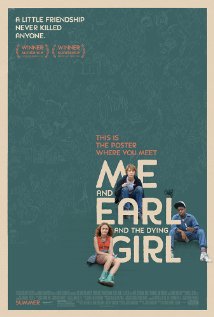
Me and Earl and the Dying Girl by Alfonso Gomez-Rejon

Me and Earl and the Dying Girl is a very Sundance-y Sundance movie, but it’s good! Sundance loves some great films, and this is one of them. First, this is indeed a movie about a dying girl. Because the title is so straightforward, I somehow thought it wouldn’t be so dark, but it was.

image from imdb.com

image from imdb.com

I also rewatched Mad Max: Fury Road this week (stay with me, it’s relevant!) and have continued to find meaning in the war boys’ concept of a “witness”—this idea of being witnessed in our acts of bravery, our acts of love, our acts of dying—all of it. It’s meaningful to me because I’ve always been so independent and only in the last few years have begun to understand the value of an invested witness.

I mention it because an important aspect of M&E&DG is that a very young man is witness to a dying girl. It’s something they stumble into, they resist, but, of course, it becomes meaningful in ways they couldn’t’ve anticipated or even previously comprehended. That kind of character growth and insight was lovely to watch, but it was also sophisticated enough that I think most audience members come away with deeper insights about what it means to connect more to “their people,” moving beyond assumptions and into really knowing another person.

One of the best moments in the film is when the cool history professor talks about how he lost his father at a young age. He said that even after his father’s death, he’s continues to learn about him. His father’s life continues to reveal itself. It started when his dad’s friends started sharing stories after his death. It continues all the time, in unimaginable ways, even decades later. I think the point here is that learning about our dead loved ones is part of what it means to be alive and self-aware.

As for me, I continue to learn about my own grandmothers. Both my great grandmother and her daughter (my mom’s mom) were a huge part of my early childhood. My great grandma even lived with us sometimes during the winter. She just stayed. She was Swedish. She was very quiet, and she loved me.  My grandma and great grandma died within two years of each other. They were a big part of my childhood, and then, in a relatively short period of time, they were both gone.

For awhile, it was sad, but okay, and this is the natural cycle of life. And then, I got really curious about them and asked my mom and aunties lots of questions about who my grandmothers were. I began to piece together my memories with their stories.  Over time, I can see how much the course of my life has been shaped by their influence. Decades later, I’ll remember idioms and wisdom about how to grow a garden, how to love one man. They suffered and loved for decades, and don’t we all? I am a witness to it all. There is meaning where meaninglessness wants to creep in. It reminds me that I am part of something bigger, family, culture, blood, brains. They are with me in memory and in my story, and that’s what I took away from M&E&DG.

The Imitation Game directed by Morten Tyldum

The Imitation Game, starring Benedict Cumberbatch, depicts a fascinating part of human history when war-time code encryption lead to massive breakthroughs in computing. This was thanks in no small part to the genius of Alan Turing. Understanding this history seems even more important when I think of the pervasive role of computers in my daily life: the bane and the joy.

image from google image

The history alone is deserving of a film. I would’ve loved to see even more details about how the early encryption machines worked and how the cryptologists did the work of encryption. The audience sees that they are working through a process of elimination within the limit of an 18-hour period. I’m sure that this is plenty of detail for an audience, but I was curious to know more. I also wanted to know more about how the “computer” worked–though the audience does get some idea of how the machine worked with algorithms and trial by elimination to crack the code.

In my view, Benedict Cumberbatch absolutely earned an Oscar, portraying a convincing (and interesting!) emotional transformation throughout the film. The film goes a bit awry when it forces some emotional drama and personal upheaval between Turing and Clarke, which seemed particularly forced. It follows the conventional romantic comedy pattern of connection, disagreement, and then reconnection. To be fair, Clarke and Turing’s relationship gets a bit more complicated toward the end of the film.

What’s really interesting is Turing’s emotional attachment to his childhood friend. That inner turmoil is unique and moving and, in my view, would’ve provided enough emotion to carry the film. Like the innovations in computing technology, in the relationship between Turning and Christopher, we see something new, unexpected, and complex.

Maybe Mad Max: Fury Road Is Not So Feminist After All

As I mentioned in the previous post, I’ve been absolutely blown away by the response to the new Mad Max: Fury Road film. The critics absolutely adore this film, and early on started claiming that the film is feminist. Social media has been blowing up with articles about the film. Mostly, I’ve been surprised and pleased that everyone else is noticing what, for a long time, felt like my own little secret.

Beyond that, I’ve been a little uncertain about the most pervasive argument. which is that the film is feminist. While there are many forms of feminism, and this film might encompass some of those interpretations, I’m not entirely convinced that this is a feminist film. In my view, simply adding female characters, and even a female lead, is not enough to make it feminist.

According to the Bechdel test, a movie has to have A) at least two women, who B) talk to each other, about C) something besides a man. Of course it’s shocking that so few films can pass the Bechdel test, but, in my opinion, just passing the Bechdel test is not enough to make it a feminist film. It’s just enough to make it not “problematic” and maybe not sexist. Sadly, however, with so few women represented in film, maybe this is all it takes to earn the “feminist” label. I, however, want a little more.

Yes, Fury Road has female characters, and yes they talked to each other, but did they ever talk about anything besides men—their captors who kept them in chains? Maybe a little bit. Not really. Their entire raison dêtre is a reaction to the men in power. The film is about reacting to a corrupt and toxic system of power, so maybe that could be construed as feminist, but a better reaction to the corrupt political system was never clearly defined (though perhaps implied here and there). We see women acting out of desperation. In my view, the film is mostly about a strong female lead with an action/reaction that may not be clearly feminist, but is (at least) not incredibly sexist.

Mad Max: Fury Road directed by George Miller

I saw Mad Max: Fury Road on opening night. I don’t watch many action movies, but I had to see this one. I had all kinds of weird memories like fever dreams about watching Mad Max: Road Warrior and Mad Max: Beyond Thunderdome with my brother when I was probably too young to be watching them. Through I hadn’t seen the films in decades, life often reminds me of Mad Max films. Frequently, when driving over Point of the Mountain, Utah, I feel like I am in a Mad Max film. Everyone increases their speed to about 80 miles per hour, semis barrel past me, shaking my little car, and motorcyclists with no helmets (and sometimes no shoes!) race past me in the fast lane. Once I saw a guy smoking a bong while driving. It’s just nuts out there, and it always reminds me of the apocalyptic lawless motifs of old Mad Max films.

I frequently reference Mad Max films, but don’t get a huge response from people. It had felt like I’m the only one for whom those films where impactful. In the weeks leading up to the release of Mad Max: Fury Road I rewatched both Mad Max: Road Warrior and Mad Max: Beyond Thunderdome to  prepare. The opening scene to Road Warrior is pretty great, but after that I began to doubt my ability to watch the old films. It seemed too much had changed, that they didn’t hold up over time. But, I persevered and found that, with some patience, both films do hold up in doing what they do best, which is to create a really specific and unique theme and motif that is carried through all of the Mad Max movies—and it’s a really weird motif that I absolutely love.

So, I went to see Fury Road on opening night and was blown away. I couldn’t’ve anticipated what it would be like, but I was delighted at every step of the way. Every image and moment is dedicated to building that same weird and delightful motif that George Miller creates in his other films—but even better this time. It looks like he took the time to add every layer and element that he wanted to add to the story, and it was so fun to see all of the references and connecting work throughout the piece. So, yes, I was already going to like this movie because I had a lot of nostalgia and positive bias, but even so, I still think the film is genius. It surpassed my expectations by a mile.

What Happened, Miss Simone? directed by Liz Garbus

I heard rave reviews about What Happened, Miss Simone? at Sundance this year, but I didn’t get to see it at the time. As luck would have it, KRCL and the SLC Library brought it back for a free screening in Salt Lake. The producer, Amy Hobby, took questions from KRCL’s Eugenie Hero Jaffe. So, that was fun!

But, the film. The film. Nina Simone wasn’t on my radar until maybe five or six years ago, when someone posted a video of her performance of “I’ve Got Life” on Facebook. I watched it many times and got a few of her cds and now it’s a part of my life. I sing her songs with some frequency.

The film creates an arc and fall for her life, which was certainly messier and less clear in the living. She was dedicated to the piano at a young age. This dedication ran parallel to extreme oppression, where any wrong move could lead to abuse or even death by lynching. No wonder a small child would cling to something, anything—perfection. She was poised to be the first black concert pianist. She ended up paying the bills by performing in night clubs. One thing lead to another, and she became the preeminent jazz and blues singer of her era and beyond.

As the civil rights movement picked up, so too did her purpose. Her songs became more political. Her artistic passion and creativity flourished like never before, but her music was banned by many stations and venues that did not want to be political. The film outlines her tumultuous relationship with her husband, her relationship with her daughter. The film also reveals her struggle with bipolar disorder, which she dealt with at a time when very little was known about it (even less so than now).

I’m sure she was successful because most people feel the same way, but I really relate to Nina Simone. It’s not just that I’m practicing piano these days. There’s something about watching the slow steady rage building in her throughout this film that seems so very human, and so very understandable. When you have the luxury of not feeling rage, it can seem silly to outsiders. Once it begins to build within you, expressing it in any sort of effective way is nearly impossible.

The rage happens when you begin to feel less free. Like when suddenly, in very real ways, you are losing legal control over what happens to your body, and others lose control over what happens to their bodies, when you feel limited in your ability to move around in the world. Of course we limit our freedoms in various ways, which takes a lifetime to work through, but when others do the harm, that is hard to bear.

The rage happens when you are cracked open by love and that makes you capable of much deeper intensity than ever before. It’s all very thrilling and terrifying, and some people call it bipolar, and some people call it art, and they are not the same, but there is a shared relationship to control, creating, being, and doing things…differently.

Simone works, and works hard, to translate her rage into something useful, into art, into commentary relevant to the time period. She does this beautifully. Like good theory, the music and lyrics sometimes seem deceivingly simple, but build and grow in their complexity until you are moved to something completely new.

Leaving the film, I felt renewed. What might I do with my own moods, my own passions? How might I better express myself creatively? How might I create? I have some ideas. I do.

Hysteria directed by Tanya Wexler

File this under sherewin sees another mainstream movie and interprets it as horror, but I finally saw Hysteria the other night, and it was just so bad. It’s a film about the invention of the vibrator, which was used to treat hysteria about a century and a half ago in England. At the time, the clitoris had not yet been “discovered” and medically it was “known” that women didn’t orgasm and could only experience pleasure from penis penetration. This is a film that had so, so much potential, but it completely failed.

image from wikipedia.com

image from wikipedia.com

Maggie Gyllenhaal is in equal parts irresistibly charming, light, airy, and funny, laughing easily—too easy—at every little thing, but also understandably angry at the rampant sexism all around her. The audience is supposed to wonder if she has hysteria, but the modern audience knows that she does not, and so the back and forth between moods just seems forced and works as a barrier to getting to understand any nuance in her character. (The accent’s pretty tough too.)

It should go without saying that this is supposed to be an erotic film. It doesn’t have to be a porno, but it should be at least a little bit erotic. There are political and historical aspects to the film that allow it to remain solidly in the mainstream, but it is also about vibrators, and orgasms, and female sexuality, and, while I’m sure they were trying not to go beyond an R rating (it really should’ve been PG-13), there was absolutely nothing erotic about this film.

Of the women who go in for the treatment of hysteria, two are spotlighted in the film closely. One is an older woman and her orgasms are portrayed with a physical kind of humor. Her sexuality is portrayed as absurd, ridiculous. The underlying message is that she’s just an old woman trying having a good time. Her sexuality, her hysteria, the conditions that brought her to the doctor’s office is not taken seriously. Though what’s at stake for this woman is institutionalization or worse if her hysteria cannot be effectively treated. People’s lives are at stake. The other woman is fat, so she too is portrayed humorously, singing opera as she orgasms. These two women are portrayed as safe, silly, unsexy women (though of course old and fat women can be dangerous! serious! sexy!). In that way, the filmmakers totally let us down.

Of course, if they had portrayed a more conventional looking bombshell having a more erotic looking orgasm, they might’ve lost their R rating, despite the fact that the women are heavily clothed (as was the style at the time), they are covered by a cloth covered box, which they stick their legs into, and no skin is shown whatsoever. The relationships portrayed in the film are not at all sexual either. They’re confused and dysfunctional. That this film got an R rating is a testament to the resistance toward what would happen if a woman was empowered enough to unapologetically express her sexuality.

I wanted this film to do so much. I wanted it to speak to the historical, the political, and the sexual. These themes are still so very relevant today as women are denied legal control over their bodies in various way. The film should have been a drama. Instead, it is a contrived romantic comedy, minus the romance and minus the comedy. In making it a romantic comedy, it seems they took the easy way out. Any stars this film might get come directly from the title and the concept, which are provocative and important. Sadly, the film itself in no way lived up to that potential.

Meru directed by Jimmy Chin, et al

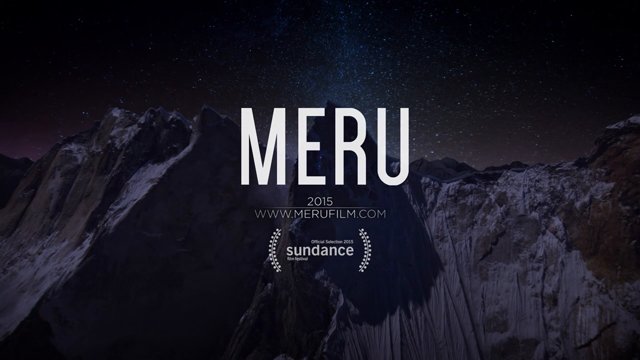
This year at Sundance, I had the opportunity to see Meru, a documentary film about Conrad Anker, Jimmy Chin, and Renan Ozturk’s summit of Mount Meru, or the “Shark Fin” in the Himalayas. I was a little worried that I might spend most of my time averting my gaze from the vertigo-inducing shots of men hanging by a rope over 20,000 foot drops. While there were plenty of those shots, there are also a lot of beautiful scenes that did not invoke a need to cover my eyes. The cinematography is absolutely beautiful and unforgiving throughout.

image from Meru trailer

image from Meru trailer

At about the mid-point, viewers get a lot of backstory on these three climbers. Each of them overcomes absolutely unbelievable obstacles. (Well, maybe not so unbelievable given that they are elite climbers.) I went in worried that this would be one of these films when men (yes, men) do these insane things that make no sense and risk their lives and everyone’s lives, and for what? But I enjoyed and admired these men throughout the film.

They each brought such unique personalities to the screen. Conrad is the hardened old-timer with tons of experience. He’s got a remarkable record for safety, but he’s got a thin exterior might be pushing too hard at this point in his career. There is evidence that Jimmy is aggressive and unstoppable in his pursuit of success, but he’s so quiet and understated about it. Renan has a natural, physical ability, but he’s got a spooked look in his eyes—maybe it’s the fear of being a newcomer or maybe he’s haunted by what’s to come.

Watching the film, I was proud to be in the same species as these guys. It makes me think about the things we’re driven to do. The things we obsess over until we absolutely must do them. Some of us know what we have to do, and it usually means logging countless hours alone with one’s self. This is why, though I recognize my need for relationships, I trust solitude. Important things happen there, and etching out that time and being willing to spend that time alone is key. For some people, that great thing is having a child.

During this film, though it is very masculine, I was reminded of doula work. Like the men climbing Meru, women in labor are inexplicably driven, but they reach their breaking point, they’re brought to the brink, and then beyond to the place where their skin starts to break—just like the climbers. They continue on as the animal body takes over and the higher intelligence and the spirituality are all forced to work together. All three are required, which is one of the lessons, I think. I always say, “What doesn’t kill you makes you stronger, or it weakens you badly.” However, in this film, what doesn’t kill them actually does make them stronger. Cliché as it may sound, the film reminded me of our greatness as human beings. I feel newly inspired to pursue the things I must do in this life, for more quiet focus to better understand what those things are, and a deeper commitment to the solitude they require.