Category Archives: reading

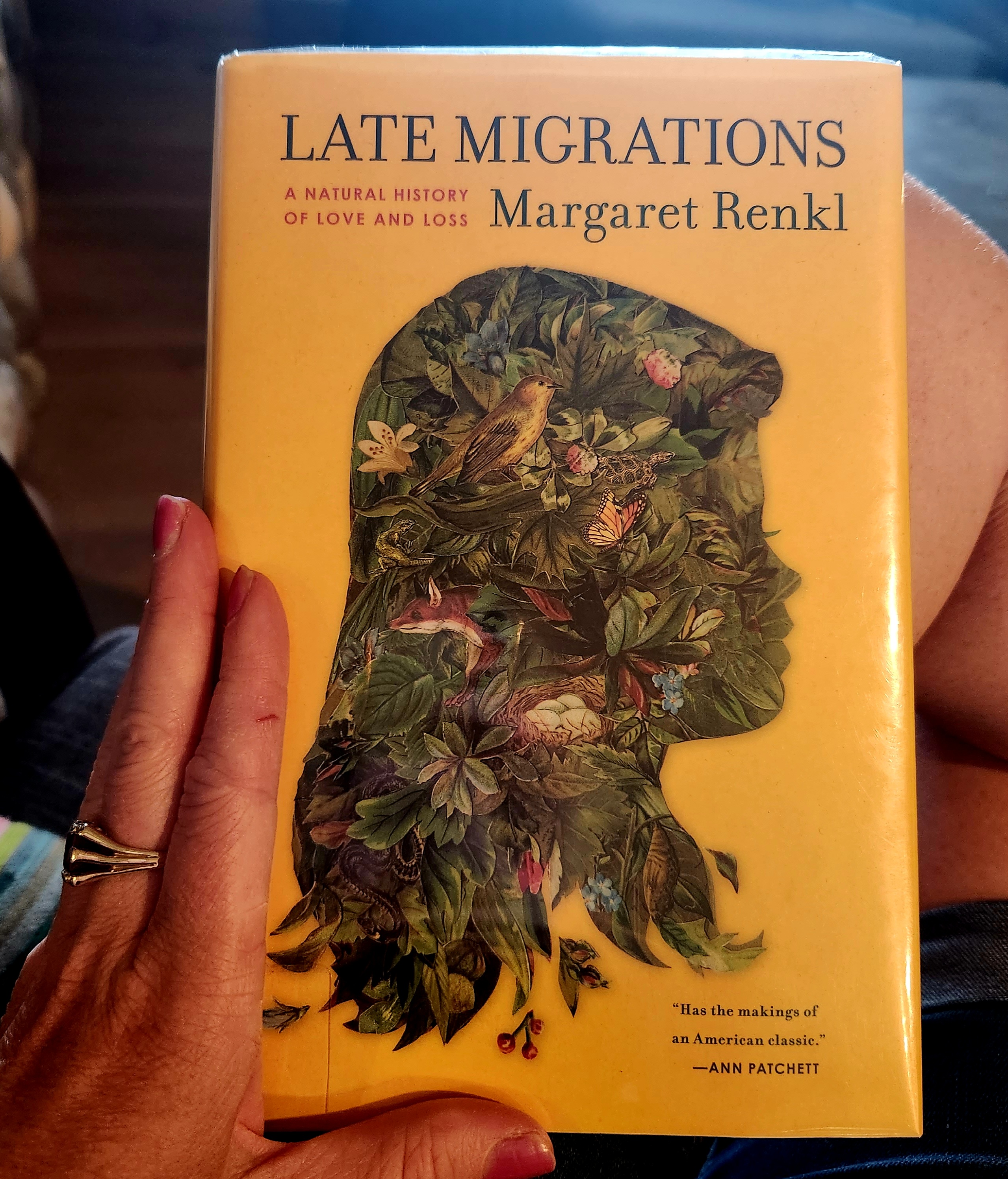
Late Migrations: A Natural History of Love and Loss by Margaret Renkl

I read somewhere that Wendell Berry (and I mostly like Wendell Berry!) was one of Margaret Renkl’s influences, and I could definitely see that as I read, especially in the attention to and elevation of the natural world.

Late Migrations: A Natural History of Love and Loss is a beautifully written book that does so many important things: it captures the lifespan intimate family relationships, the landscapes that hold them, and the socio cultural aspects of these southern spaces as well.

It is also very clear that Renkl is a trained poet, as this makes the prose beautiful to read. I always love it when writers are able to produce unconventional structures in books AND also get published. Overall–a bittersweet, but life affirming book.

The Best American Short Stories 2024

My creative writing classes keeps me reading The Best American Short Stories each year, but looking back through my notes, it appears that I don’t typically write about it, which is a shame! This year’s story collection was edited by Lauren Groff, who I have been reading and enjoying lately. (Though honestly I typically don’t have a sense of an editor’s taste from one year to the next.)

This year’s collection was epic and stunning as always. In my opinion, these anthologies are the single best way to get a sense of contemporary writing, although the works remain fairly conservative in their form and approach. These are all typical short stories.

One of the most memorable stories this year had abuse in it. As I think back over the years, I now realize that some of the stories that stand out the most have featured some type of abuse. Not because they are better stories, but because they can be so traumatizing to the reader. I don’t like it and seem to get increasingly sensitive to it with each passing year. I even think the series may need to start integrating trigger warnings. Maybe literary fiction more broadly needs to integrate trigger warnings. And, yet, as I write this, I am aware that the trigger warning significantly changes the reading experience. I don’t have the answers. I think this work should exist. It lends insight into the human condition. Even still, at this point I can’t help but think that the subtler works are the greater works.

Don’t Let’s Go to the Dogs Tonight by Alexandra Fuller

Alexandra Fuller’s book, Don’t Let’s Go to the Dogs Tonight offers beautiful writing and insights on living in Africa through the 1970s-90s, amid war and revolution, amid those complicated social dynamics, but also amid the personal dynamics of family, of alcoholism, of mental illness, and parents who offer their children a childhood that is at once amazing and also, probably, negligent.

Fuller’s writing is consistently beautiful throughout. Even in its sometimes stark depictions, the book is infused with a contagious love of Africa. Zambia, Zimbabwe, Malawi have not necessarily been places I’ve ever wanted to visit. I’ve grown up in wilderness areas, and so the great safaris that have drawn others have less pull for me. However, this book made me see some of the other beautiful aspects of the country. After reading the book, I wouldn’t hesitate to go.

This year there’s a new movie out based on the book. From the trailer, it appears that the film follows the book closely. I hope I get a chance to watch it.

I Like to Watch by Emily Nussbaum

If you’re an intellectual who also likes to watch bad TV, then I Like to Watch by Emily Nussbaum is the book for you. Of course, if you also like high quality TV, then this book is also for you. Nussbaum offers nuance, attention to detail, deep insights, but also brings a real love and fandom to the shows to she describes.

I don’t get to watch much TV these days, and I haven’t finished (and in many cases even started) most of the shows Nussbaum analyzes. I still got a lot out of this book. I think TV is so ubiquitous that many readers will appreciate her analysis too.

As short reels and clips and homemade YouTube videos start to take over media consumption, I found myself feeling appreciative, nostalgic, and impressed by the many shows Nussbaum mentions in the book. If you’ve watched some TV, this book is worth reading.

Women by Chloe Caldwell

I had two of Chloe Caldwell’s books in my backpack, and so I read them back to back. Women by Chloe Caldwell is her more well-known book, and I do think it it has the most literary merit and staying power of her work that I’ve read so far. Caldwell offers a very focused, very detailed immersion into an intense, obsessive, and destructive relationship with a woman.

This book is not the triumphant lesbian novel I think people want it to be. It is unclear to the reader the extent that Caldwell is lesbian, bisexual, or heterosexual, and this is a key question throughout the book–for Caldwell and for her readers.

A clear look at the experience of being intensely caught up in forbidden love is the point of the book, I think, and also just that experience of living life as a human with desires, stupidity, and pleasure, plus some good old fashioned bed rot and mental illness. Most readers with a beating heart will recognize at least some pieces of this book.

I’ll Tell You in Person by Chloe Caldwell

I read I’ll Tell You in Person by Chloe Caldwell right before reading her other more well-known and previous book entitled Women. The book reads as a memoir and Caldwell as the main character is unhinged and insufferable, but recognizable, and this seems intentional and is the interesting thing about this book.

Caldwell’s depictions of coming of age in the 90s and early aughts is detailed and nostalgic, and this part will resonate with most readers who have lived through that era.

There’s something to say about privilege/social class and mental illness, but I’m not sure what except maybe just that people with support networks can experience drug addiction and depression more safely than those in more precarious situations.

I found myself wishing I’d read the book 20 years ago, but it was published in 2016.

There There by Tommy Orange

There There by Tommy Orange has been on my tbr pile since shortly after it was published in 2019. The timing was right when I finally got around to reading it, as, interestingly, I have been reading more indigenous work for my scholarship this winter, learning more about my family’s history, and this book has helped inform all of that thinking.

It’s a good book. It is another one that I’ve read recently that has a very cinematic quality, and I could easily see it being made into a movie at some point. The book has an intentional and unique plot and timeline, with characters unknown to each other moving apart and together in each other’s lives.

I’m not sure what to say about the theory, exactly. Orange’s characters are urban Indians. Orange has them defying societal expectations and also interacting with stereotypes.

I think most readers have a lot of learn from a book like this, both in terms of good literary prose and the commentary about contemporary, urban indigenous lives.

I Who Have Never Known Men by Jacqueline Harpman

I can admit when a book is perfect, and I Who Have Never Known Men by Jacqueline Harpman is a perfect book. While maybe I do not love this book, and while maybe this book will never be one that I recall with fondness, and while this is not typically my genre, it is one that is wholly unique and one that will stick with me forever. 

On Chesil Beach by Ian McEwan

On Chesil Beach by Ian McEwan is a painstaking, painstaking novella. It’s beautifully written, no doubt. McEwan captures human nature and places it in a time of properness, confusion, ignorance. The book offers some wisdom about coupling, big picture, that would likely be lost on most readers who have not yet been in a relationship with a partner or spouse. McEwan uses a very detailed account of a sexual encounter to make some smart, larger commentary about human coupling. It’s good, but it is painful.

My Mother Gets Married by Moa Martinson

This book has been on my tbr list for over a year now, and I finally found a copy to read through interlibrary loan. My Mother Gets Married is an account of Moa Martinson’s own childhood growing up in impoverished Sweden around the turn of the last century

My own grandma was frugal, but everyone was who lived through the great depression. It wasn’t clear to me if her family immigrated more because of harsh living conditions in the old country or more because of the promise of the “new” world.

While I can’t be exactly certain of my family’s exact circumstances, I think perhaps things weren’t so dark as Martinson depicts in her book based on some information I have. Either way, the book offers insights into some of the culture in Sweden at that time. I appreciated learning about the schooling they would have received, the dresses they would have worn, and the tokens that would have been important to them.

Personal interests aside, Martinson’s writing is strong. There is a subtle, underlying and scathing observations on gender, social class, and justice. Martinson’s writing reveals a deep insight and understanding of the human condition.