Category Archives: relationships

A Lotus Grows in the Mud by Goldie Hawn

I can’t remember where exactly, but Goldie Hawn’s book, A Lotus Grows in the Mud was recommended to me while I was reading some respectable piece of literature, and so I ordered it and set it aside for a month or so. I finally got the chance to read it over spring break, and it was surprisingly delightful–thanks in no small part, I’m sure, to “co-author” Wendy Holden.

Lotus Grows In The Mud

image from powells.com

Hawn has led a fascinating life, and her book really tries to get at some of the wisdom she’s gained in this life. And, you know what? Some of that wisdom was pretty darn inspiring and insightful.

Here’s what impressed me–Hawn follows her purpose, even when it is not obvious, even when she has doubt, even when others criticize her and roadblocks threaten her faith.

When I think about my purpose in life, I often have doubt and uncertainty. However, the predominant narrative one hears about one’s path is that it is easy and clear. But, that hasn’t been the case for me. I was an English major because I liked reading, but that seemed incidental. Now, I’ve made an entire career out this. I love practicing yoga because it is good for me, but a lot of times I phone it in, or have to talk myself into going, and sometimes I don’t go at all. I’m never the most flexible, most enlightened, or coolest person in the class. Still, I trained to teach yoga, and I’ve been teaching it since 2008. Most days when I enter into that classroom to teach, it feels really, really *right*. Same goes for the garden, for writing, for my friendships, for My Love.

So, I loved the message of her book. She was brave. She did hard things. It made me feel like I could be brave. I could do hard things–all while making a living and having Kurt Russell unexpectedly waltz in and save me in the final hour and then stay for the remainder of my decades. Yeah, I’ll have what she’s having.

In perfect timing, just as I finish this book, I see that Hawn is teaming up with Amy Schumer in a new film called Snatched. It looks lovely and hilarious, and I can’t wait to see it. I love seeing mother/daughter duos (that’s in the book too).

Willfull Disregard by Lena Andersson

At last I’ve found a book that I really, really like. (!). It’s Willful Disregard by Lena Andersson, and I can’t remember how I found it, but I’m very glad that I did. I read it quickly because it’s a library book, and I’m at the end of summer semester, and so I’m busy grading, but also busy getting ready to hit the ground running, which is what I do every summer since adulthood and even now in order to escape my current city and state. (Gorgeous state. Currently insufferable.) So, I only had a week to read this thing.

image from amazon.com

When I first learn of the title, I knew Willful Disregard was going to be my kind of novel. It is funny and smart and good in exactly the way that title is funny and smart and good. It’s the kind of book that makes me glad to learn that the author (Lena Andersson) exists in the world. It gave me hope for humanity.

It’s funny, but it’s also devastating. It captures the analysis and the over analysis and the helplessness of unrequited love. It captures how long it takes. It captures the intense meaning read into every single event and adverb and sideways glance. You think you’re better and smarter than all of this, only to see (years later with the clarity of hindsight) that you were insane, that your precious friends and onlookers were gentle with your…willful disregard of all evidence and reality suggesting otherwise than your well laid plans, intentions, and interpretations.

And even if you have been strong enough or numb enough to have never fallen into this type of stupid, full-body kind of love, you’ll probably still enjoy the deep insights into humanity, the smart philosophizing, along with mocking pretension that Andersson offers up in this novel. It’s her fifth book and first translated into English. With any luck, we’ll get more from her.

Modern Romance by Aziz Ansari

Oddly (or appropriately) enough, an ex-boyfriend recommended Modern Romance by Aziz Ansari. I like his work from Parks and Recreation, so I finally got around to reading it over the Christmas break. This is probably a useful read for anyone who didn’t settle down in their early twenties–which, at this point, is most of us. In my early twenties, I was getting all the degrees, forging deep friendships, and yes, “dating,” as well as staying in a few serious relationships. Mostly, I was writing and making art. I was not pursuing marriage.

image from amazon.com

I do not look back on the dating eras with any fondness. So, it was validating to read Ansari’s take on modern dating. In his book, he uses a very soft social science approach and couples it with his good humor. Pairing stand up with social science and commentary is actually pretty amusing, if not hard hitting. Oh, and when you’re reading it, feel free to skim through large swatches of some of the repetitive stuff through the middle.

Ansari’s parents are Indian and, like most Indian couples, have an arranged marriage. Like many people in arranged marriages, they report being very happy. Of course, on the contrary, in the US, we’re all looking for soul mates and have relatively low levels of happiness in marriage. Ansari’s exposure to both US and Indian cultural attitudes toward marriage gives him an interesting perspective.

Here are some of the main take aways from the book: technology has expanded our options for coupling, which means we have the potential to find a better match, but it also means we’re paralyzed by options; we’re not great at intellectualizing what we actually want in a partner (i.e. we think we know what we want, but we’re often wrong); the vast majority of men and women pretty much dislike dating and just want the relationship.

This last one was a surprise to me. I mean, I hate dating, sure. But, I would hate dating. I’m an introvert, which means I don’t love going out all the time. I don’t *love* people, which means I don’t particularly love meeting new people. I’m very sensitive, which means the sizing up, and the texting, and the strangers, and the whole process tends to be a bit too soul-violating for my constitution. And so in the end, when it comes to dating, I’m very much just like, “Forget it. Everyone please fuck off.”

But then, eventually, you find your person who gets it and gets you, and it’s all worth it. Until then, it sucks, and it surprised me that most other people also think it sucks. Before reading this book, I thought most people were out there playing the field, meeting new people, and having a great time doing the things I typically don’t enjoy doing. Evidently, most other people don’t enjoy it either.

Here are a few gems from the book:

On previous generations: “People were marrying neighbors who lived on the same street, in the same neighborhood, and even in the same building” (14).

Things have changed: “Until they got married…women were pretty much stuck at home under fairly strict adult supervision and lacked basic adult autonomy…For women in this era, it seemed that marriage was the easiest way of acquiring the basic freedoms of adulthood” (18).

On the prevalence of FOMI (fear of missing out): “…what I see at bars today, which is usually a bunch of people staring at their phones trying to find someone or something more exciting than where they are” (27).

On the influence of technology: “That’s the thing about the internet: It doesn’t simply help us find the best thing out there; it has helped to produce the idea [emphasis mine] that there is a best thing and, if we search hard enough, we can find it” (125).

This and most other social interactions: “I started to despise the bar scene. I had experienced every single version of these nights. I knew all the possible outcomes, and I knew the probabilities of those outcomes” (210).

On passionate vs. companionate love: “Passionate love always spikes early, then fades away, while companionate love is less intense but grows over time…It is love, just less intense and more stable. There is still passion, but it’s balanced with trust, stability, and an understanding of each other’s flaws” (215).

This basically sums it up: “We want a lifelong wingman/wingwoman who completes us and can handle the truth, to mix metaphors from three different Tom Cruise movies” (239).

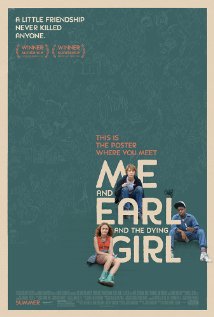
Me and Earl and the Dying Girl by Alfonso Gomez-Rejon

Me and Earl and the Dying Girl is a very Sundance-y Sundance movie, but it’s good! Sundance loves some great films, and this is one of them. First, this is indeed a movie about a dying girl. Because the title is so straightforward, I somehow thought it wouldn’t be so dark, but it was.

image from imdb.com

image from imdb.com

I also rewatched Mad Max: Fury Road this week (stay with me, it’s relevant!) and have continued to find meaning in the war boys’ concept of a “witness”—this idea of being witnessed in our acts of bravery, our acts of love, our acts of dying—all of it. It’s meaningful to me because I’ve always been so independent and only in the last few years have begun to understand the value of an invested witness.

I mention it because an important aspect of M&E&DG is that a very young man is witness to a dying girl. It’s something they stumble into, they resist, but, of course, it becomes meaningful in ways they couldn’t’ve anticipated or even previously comprehended. That kind of character growth and insight was lovely to watch, but it was also sophisticated enough that I think most audience members come away with deeper insights about what it means to connect more to “their people,” moving beyond assumptions and into really knowing another person.

One of the best moments in the film is when the cool history professor talks about how he lost his father at a young age. He said that even after his father’s death, he’s continues to learn about him. His father’s life continues to reveal itself. It started when his dad’s friends started sharing stories after his death. It continues all the time, in unimaginable ways, even decades later. I think the point here is that learning about our dead loved ones is part of what it means to be alive and self-aware.

As for me, I continue to learn about my own grandmothers. Both my great grandmother and her daughter (my mom’s mom) were a huge part of my early childhood. My great grandma even lived with us sometimes during the winter. She just stayed. She was Swedish. She was very quiet, and she loved me.  My grandma and great grandma died within two years of each other. They were a big part of my childhood, and then, in a relatively short period of time, they were both gone.

For awhile, it was sad, but okay, and this is the natural cycle of life. And then, I got really curious about them and asked my mom and aunties lots of questions about who my grandmothers were. I began to piece together my memories with their stories.  Over time, I can see how much the course of my life has been shaped by their influence. Decades later, I’ll remember idioms and wisdom about how to grow a garden, how to love one man. They suffered and loved for decades, and don’t we all? I am a witness to it all. There is meaning where meaninglessness wants to creep in. It reminds me that I am part of something bigger, family, culture, blood, brains. They are with me in memory and in my story, and that’s what I took away from M&E&DG.

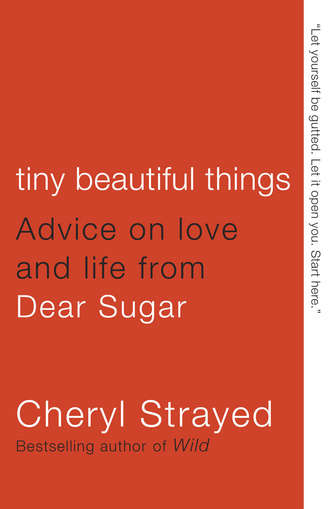
Tiny Beautiful Things: Advice on Love and Life From Dear Sugar by Cheryl Strayed

I ordered Tiny Beautiful Things and my mom was visiting when I got it. So, she read it first and kept saying out loud, “You need to read this.” She even marked a few passages for me. I watched the movie adaptation of Wild about a month earlier, but could never get into the book. Tiny Beautiful Things was not hard to get into. It takes right off.

I started reading it after my mom went home. I’m not sure if there was one catalyst, or just all the things, but I was an emotional wreck during the few weeks it took me to read the book. I sent frantic texts to my long-suffering bff, and I droned on and on to my dear, long-suffering mother, and I even sobbed a little on the phone with Z, who either suffers most or least of all.

I read and quietly sobbed the duration of a long, cross-country flight. People on either side of my armrests humanely ignored me. The flight attendant retrieved a fistful of tissues for me. Clearly, I’m going through some stuff, and I think it was the potent cocktail of heartache, family, fear, love, effort, HUMANITY!, and Tiny Beautiful Things that created a big emotional purge.

Here are two quotes that meant something to me:

  • On partnering: “This is called intimacy. This is called fuck yes. When people do this with us, it’s an honor” (197).
  • On doing crazy things for love: “Love is our essential nutrient. Without it, life has little meaning. It’s the best thing we have to give and the most valuable thing we receive. Its’ worthy of all the hulabaloo” (219).

Is the book any good? I think it is good. It might be good like wine and ice cream are good: indulgent. I think there’s some useful stuff there. Cheryl Strayed turns herself inside out, revealing her most intimate and painful stories, and in doing so, we readers see the universality of our most painful and humiliating experiences, but also the universality of love, passion, of falling in love. In this book of advice, Strayed convinced me again that the heady passion between two people is rare and real and beautiful and possible and sacred, and I so, so need to believe that right now.

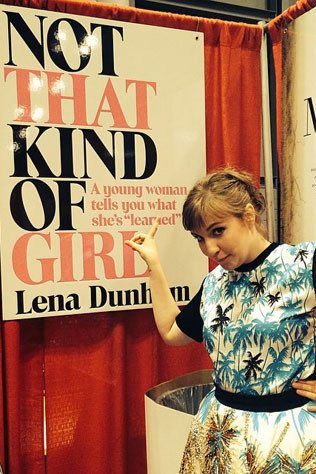
Not That Kind of Girl by Lena Dunham

I have a [smart] friend who thinks Lena Dunham’s work is bad, irresponsible. We go rounds on this because I love her and think that he’s too caught up on having morally good, heroic main characters. He says I’m missing the point. Dunham’s work is shrouded in controversy, but if you’re a fan of her show Girls, you’ll definitely like Not That Kind of Girl. In fact, if you just sort of like her show, you’ll still like her book. Lena Dunham’s work is so incredibly personal and vulnerable and embarrassing and painful, and human. I identify with her so much.

First, I am fascinated with the way she deals with first/early sexual experience. It is the most honest depiction of the kinds of sexual experiences people have in their late teens and early twenties. It can be weird, awkward, and embarrassing. People are unsure about what to do where and for how long. There are strange acts that exist solely because porn tells us that’s what people do for pleasure, even if very few people are doing that thing for pleasure. I actually think this is unavoidable for the most part because there are very few activities that are comparable to coupled sex. In the process, mistakes are made and confusion abounds. Young women are in a constant negotiation with owning and expressing their sexuality, while simultaneously figuring out where the media pressures and social expectations end and where their own pleasure and desire begins. [By the way, I think this is true for men, too, but I don’t read much about it.] So, that’s important.

She’s also balancing art and social commentary, which can be weird and bad, but she does it well. One could easily assume that her work is this off the cuff confessional style, and it is, but there is also real artistry in her work. She has a deep familiarity with language and a knack for creative expression through  her writing. My expectation is that she will continue to write books, and they will be revolutionary, yes, and will only improve from a literary perspective.

Now, let me address the whole scuttlebutt over childhood sexual abuse when the book first came out. I assumed that it would be honest and artfully done, and even be good in that it would help us to think more critically about childhood sexuality. I wanted to read it first before forming my opinion, and after reading it, I thought it was good and important, and did the thing of making us think openly about childhood sexuality. The story is weird, and a bit uncomfortable, but true and not abuse, in my opinion. You can bet that Dunham thinks about consent and abuse because they are major themes in her work.

While I am highly invested in the topic of female sexuality, obviously, Dunham covers other ideas that resonate with me so strongly. Like, there are people who love people, and people who can’t stand to be alone, and people who are curious about other people [I might fall into that last category], but usually I have, as Dunham states, “the nagging sense that my true friends are waiting for me” (xiii). I have met some of my true friends, and when we meet, and recognize each other, there is much rejoicing! I love these people. They are my forever friends and lovers. But, they number so few I can count them on my hands, and I often feel lonely or out of place, wishing that I could be with one of my people when I’m tired of being alone. Lena Dunham—she gets me.

image from vogue.com

image from vogue.com

Here are some quotes I highlighted:

  • “There is nothing gutsier to me than a person announcing that their story is one that deserves to be told, especially if that person is a woman” (xvi).
  • “He was nervous, and, in a nod toward gender equality, neither of us came” (7).
  • “This was the time in life before I learned it wasn’t considered appropriate by society at large to like yourself” (34).
  • She quotes Joan Didion: “There is a common superstition that “self-respect” is a kind of charm against snakes, something that keeps those who have it locked in some unblighted Eden, out of strange beds, ambivalent conversations, and trouble in general. It does not at all. It has nothing to do with the face of things, but concerns instead a separate peace, a private reconciliation” (38).
  • A list from a relationship…”One very unnecessary pregnancy test” (54).
  • “Wherever you go, there you are” (69). An old favorite.
  • “After several interactions in which he questioned my authority and pretended not to hear me speaking, it was clear he was my type” (71).
  • “I had broken up with him on my seventh try, and one try didn’t even count because all I could muster was “I love you” (76).
  • On meeting her love: “Look, there is my friend” (76).
  • “…desire is the enemy of contentment” (143).
  • “You will find,” she says, “that there’s a certain grace to having your heart broken” (144).
  • “…you’ll see that later and be very, very proud” (262).

And so many others.

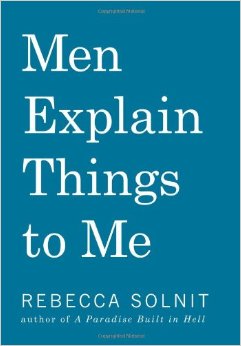
Men Explain Things to Me by Rebecca Solnit

I just finished Men Explain Things to Me by Rebecca Solnit over the course of a few evenings. It’s a *heavy* read, but it’s composed of short, manageable essays. The first most noticeable thing about this book is that it is not funny. There is absolutely nothing funny or lighthearted about it, and that was a surprise. The title is sort of funny, and alludes to “mansplaining,” which is terrible and indicative of larger social issues surrounding gender, but it’s also sort of funny. The title is not a good indication of the book.

image from amazon.com

image from amazon.com

Solnit is unrelenting in her depiction of the “longest war,” a war on women. Reading it was overwhelming—a reminder of the violence and disdain lobbed at women by our society. The statistics were staggering. Having heterosexual relationships with men seemed increasingly fraught for both genders. I was left wondering how we navigate these weird power dynamics in our most personal relationships. I felt overwhelmed by the violence. I felt overwhelmed by the reminders of the constraints I face each day as a woman.

For example, each day before dark, I try to accomplish all tasks that require me to walk any distance alone or through a parking lot. Every day, I, mostly subconsciously at this point, plan my day with safety in mind. When I overtly think about these habits, it makes me sad that I live in such a violent world, and it makes me sad that safety has to be such an underlying factor in my daily decisions. Surely this has unknown negative effects. Solnit writes, “My feminism waxed and waned, but the lack of freedom to move through the city for women hit me hard and personally at the end of my teens, when I came under constant attack in my urban environment and hardly anyway seemed to think that is was a civil rights issue” (128). Solnit argues for an emphasis on turning the lens on men and why they are so frequently the perpetrators of violence, opposed to giving women the sole responsibility of preventing violence. This “Top 10 Tip to Avoid Rape” meme has made the rounds and points out the profound role that men (obviously) play in “rape culture.”

image found here

image found here.

Like Solnit, I wonder why these problems are not viewed as a deeper crisis and as a civil rights issue. In recent years, I have felt a real personal fear as politicians have made absolutely horrifying, and often scientifically inaccurate, claims about women’s bodies. As the Hobby Lobbys and various right wingers argue about what I can and cannot do with my own body, for the first time, it has felt very personal and very stifling.

Of course, the reaction to these issues is often, yes, but “not all men.” And, Solnit carefully dedicates sections of each chapter, writing “not all men, but…” This is unfortunate. We can’t just talk about this issue without spending a lot of time reassuring men and women that not all men are bad. In so many ways it seems like this reassurance is also indicative of the problem. It’s a problem that we literally can’t even talk about women’s issues without spending a good deal of time reassuring men and talking about men and turning the focus, even just briefly, back to men. On the other hand, they’re half the population, and they’re our partners, fathers, brothers, and friends, and so it makes sense that we can’t talk about women without spending some time also talking about men.

The book isn’t entirely matched thematically, and she delves into some literacy criticism, as a way to address the larger social problems that she unpacks earlier in the book. She wrote of a criticism that “does not put the critic against the text” (101). In her exchange with Susan Sontag, Solnit writes that “you don’t know if your actions are futile; that you don’t have the memory of the future” (93). This is in response to Sontag’s assertion that resistance is required, even if it is futile, and maybe it is always futile.

On Woolf, Solnit writes of a botanist that had “a knack for finding new species by getting lost in the jungle, by going beyond what he knew and how he know it, by letting experience be larger than his knowledge, by choosing reality rather than the plan” (96), and I love this idea so much. For living life, for finding new ideas, for creating art. I am such a planner and a researcher, and I love the idea of this kind of purposeful method (which, yes, requires planning and research). I love the idea of using this method as a means of discovery, rather than following what is known: “a compass by which to get lost” (106).

Of measurement and discovery, Solnit also writes about “the tyranny of the quantifiable,” which is “the way what can be measured almost always takes precedence over what cannot” (104-105). This has been a frustration for me lately. Working in bureaucracies, and within high education, too often means a singular focus on the quantifiable, on the assessable. When other ways of being or knowing are scoffed at as being dangerous, even life-threatening, we are limited by what we can do as dreamers, thinkers, creators, and teachers.

This book reads up so quickly and so powerfully that there’s really no reason not to read it. Afterward, you can spend some time thinking through what it all means for gender, relationships, and the way men and women exist in the world. I think I’ll even pick up her other book, Wanderlust because it is about walking and maybe other things too.

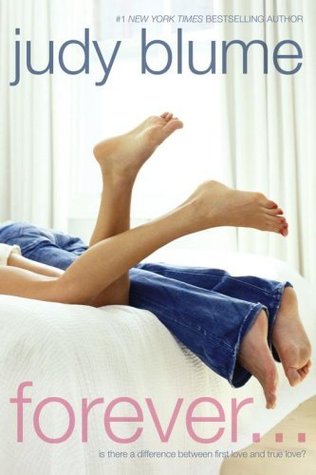
Forever by Judy Blume

I recently saw Forever by Judy Blume on a list of great books by women for women. I haven’t read young adult literature since…probably since I was a teenager. I was immediately struck by how bad the writing was. The book is a study in telling instead of showing. After deciding early on that it was not worth a close read, I just skipped ahead, read all of the sexy parts, and called it a day.

image from goodreads.com

image from goodreads.com

However, after a few days of reflection, I’ve come to realize that it probably is an important book. Sure, I found most of the writing off-putting, but it was probably pretty good/typical/appropriate/accessible for young adult fiction. Evidently, it’s one of the first books that’s about young people entering into their first sexual relationships. Blume portrays a very white, middle class, private school kind of normal. So, that was limiting, but still useful. It depicts young people being very straightforward with each other. All of the experiences are very consensual and thoughtful. If someone has a feeling or doesn’t want to do something, that’s okay. They talk about it. Blume is modeling a relationship, though perhaps overly simplified, is straightforward and consensual, and sadly, that’s really rare. So, after reading the thing, I’d agree that this is an important book for all women, especially young women, and the people who want to be intimate with them.

Meru directed by Jimmy Chin, et al

This year at Sundance, I had the opportunity to see Meru, a documentary film about Conrad Anker, Jimmy Chin, and Renan Ozturk’s summit of Mount Meru, or the “Shark Fin” in the Himalayas. I was a little worried that I might spend most of my time averting my gaze from the vertigo-inducing shots of men hanging by a rope over 20,000 foot drops. While there were plenty of those shots, there are also a lot of beautiful scenes that did not invoke a need to cover my eyes. The cinematography is absolutely beautiful and unforgiving throughout.

image from Meru trailer

image from Meru trailer

At about the mid-point, viewers get a lot of backstory on these three climbers. Each of them overcomes absolutely unbelievable obstacles. (Well, maybe not so unbelievable given that they are elite climbers.) I went in worried that this would be one of these films when men (yes, men) do these insane things that make no sense and risk their lives and everyone’s lives, and for what? But I enjoyed and admired these men throughout the film.

They each brought such unique personalities to the screen. Conrad is the hardened old-timer with tons of experience. He’s got a remarkable record for safety, but he’s got a thin exterior might be pushing too hard at this point in his career. There is evidence that Jimmy is aggressive and unstoppable in his pursuit of success, but he’s so quiet and understated about it. Renan has a natural, physical ability, but he’s got a spooked look in his eyes—maybe it’s the fear of being a newcomer or maybe he’s haunted by what’s to come.

Watching the film, I was proud to be in the same species as these guys. It makes me think about the things we’re driven to do. The things we obsess over until we absolutely must do them. Some of us know what we have to do, and it usually means logging countless hours alone with one’s self. This is why, though I recognize my need for relationships, I trust solitude. Important things happen there, and etching out that time and being willing to spend that time alone is key. For some people, that great thing is having a child.

During this film, though it is very masculine, I was reminded of doula work. Like the men climbing Meru, women in labor are inexplicably driven, but they reach their breaking point, they’re brought to the brink, and then beyond to the place where their skin starts to break—just like the climbers. They continue on as the animal body takes over and the higher intelligence and the spirituality are all forced to work together. All three are required, which is one of the lessons, I think. I always say, “What doesn’t kill you makes you stronger, or it weakens you badly.” However, in this film, what doesn’t kill them actually does make them stronger. Cliché as it may sound, the film reminded me of our greatness as human beings. I feel newly inspired to pursue the things I must do in this life, for more quiet focus to better understand what those things are, and a deeper commitment to the solitude they require.

Birth, Breath, and Death: Meditations on Motherhood, Chaplaincy, and Life as a Doula by Amy Wright Glenn

Since I began the doula certification process through DONA International, I have had to read myriad required books on labor and the work of being a labor companion. My favorite book by far has been Ina May Gaskin’s Ina May’s Guide to Childbirth. I pretty much love everything she does, but that book was has been the best so far.

image from Amazon

image from Amazon

As I’ve completed the required reading for the doula certification, I’ve been able to branch out and read some related works that are not on the list. While I’ve browsed through a few other titles, Birth, Breath, and Death: Meditations on Motherhood, Chaplaincy, and Life as a Doula by Amy Wright Glenn has been the standout. It’s a really interesting book that (perhaps controversially) makes the connection between doula work and chaplaincy.

Let me get my criticisms out of the way first (because that’s always the worst part). Organization. This book has an organization problem. It appears to be a mash up of personal reflection (that is wonderful!) and what reads like long excerpts from a recycled academic paper on spirituality, love, philosophy (which is fine, but less wonderful). I sometimes found myself wanting her to get back to her stories, lovely insights, and self-reflection.

Glenn’s experience and her perspective is absolutely rich. It felt like an indulgence, and I wanted more. Since I began this work, I have often thought of the close connection between doula work and chaplaincy—although I haven’t thought chaplaincy was the right word—it makes me think of religion. Like yoga, doula work is more than spirituality. It also deals with the emotional and very much the physical. In fact, I imagine that chaplaincy work would do well to take a lead from the female-centric way that doulas have of guiding new life on to Earth (no big deal).

At a recent doula gathering, a new friend, still very emotional, shared that her father had recently passed away. As doulas, we discussed the way that doulas might facilitate a more peaceful, less medicalized passing, just like we are often asking questions and making plans in advance to help facilitating a more peaceful, empowered, and oftentimes a less medicalized birth.

It appears that Glenn has made that connection between birth and death in her own life’s work. A highlight of her book is her birth story. It’s one of the best I’ve ever read (though I have read [and witnessed!] many beautiful birth stories). Like all births, Glenn’s labor is unpredictable, and she is skilled at reflecting and sharing insights from the experience. More generally, I loved her insights on motherhood. I wanted to know even more about her thoughts on her own mother. I loved reading about the way she loves her son and the hesitations she had at becoming a mother in the first place.

If you find deep complexity in doula work, motherhood, childhood, life, and death, you’ll like this book. You might have to forgive it for lacking some of the polish (and organization) of other books, but if you’re like me, that forgiveness will be easy for the insight she offers.