Category Archives: relationships

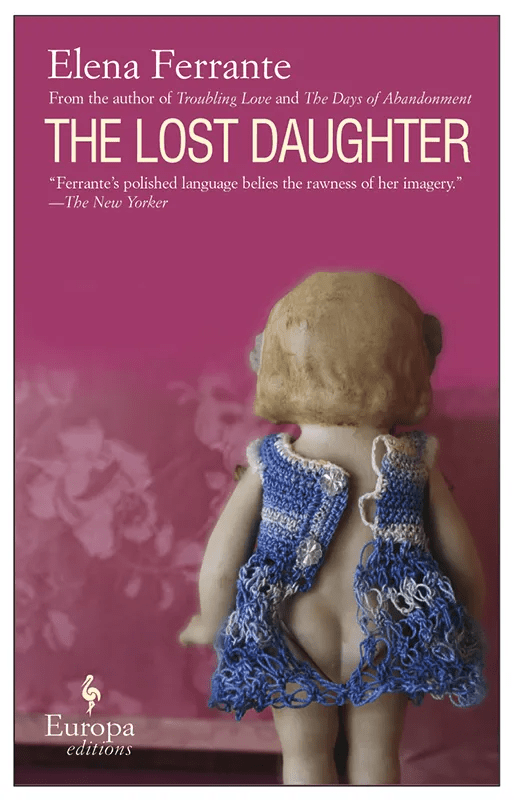
The Lost Daughter by Elena Ferrante

I read Elena Ferrante’s The Lost Daughter immediately after finishing My Brilliant Friend. This is another excellent, although perhaps more literary, piece than the first book of the Neopalitan Quartet series.

The Lost Daughter, also referenced in the Mother’s book, is about the darker side of motherhood, in a way that I found entirely relatable. Too often, critical books on motherhood are too critical, too negative–children are too exhausting, it’s not worth it, end of story. However, I truly appreciate Ferrante’s more nuanced approach. In The Lost Daughter, she turns a magnifying glass on the difficulties, violences, and burden of motherhood, the complete selfless turning over of the self that is required of the job, an ask that is far too demanding and made worse by societal constructs around motherhood and a general lack of support.

However, instead of dismissing the mothering journey altogether, as too exhausting, too violent, Ferrante acknowledges the duality of the role, the positive life changing aspects of it–the more complicated relationship it can foster in the self in regards to love, compassion, nurturance, service, and ambition. The little girl in The Lost Daughter is depicted as both angelic and beautiful from a distance, but up close is whiny, snot-nosed, crusty-eyed, and clawing, swatting, and pinching at adults around her. This is the reality of living with and loving a child. They are, each and every one of them all at once both transcendently perfect and also demanding, selfish, and incidentally cruel. To be a mother is to live within this duality constantly throughout the day. It’s complicated and beautiful and ugly too.

My Brilliant Friend by Elena Ferrante

I discovered Elena Ferrante from Mothers by Jacqueline Rose, which I read recently. I started with Ferrante’s My Brilliant Friend, the first in a long series, and I loved it! The writing is excellent. The content is thought-provoking, and it also has the long sense of story found in easier, longer reads–not a common combination. Although it is long, I flew through it.

While I highly recommend the book, I will warn that I found the conclusion to be somewhat disappointing. I wanted a strong wrap up for this particular book, but instead found myself needing to read more of the series in order to get that. It will probably require reading all four books.

I ended the book somewhat exhausted and unwilling to continue with the series. Maybe I’ll return to them someday. They’re certainly worth it, but, and I can’t believe I’m writing this, I really don’t have the energy to give them at this point in my life.

I’m glad these books are out there. Sometimes I just need a good book, a good story, and I now know I can turn to Ferrante to get that.

I am also inexplicably obsessed with the cover art:

James and the Giant Peach by Roald Dahl

I found a copy of James and the Giant Peach by Roald Dahl in a Little Free Library and read it to the boys this summer. While there’s no doubt that Dahl is an excellent writer with great control on the sentence level and wonderful descriptions, I was struck by the antiquated fatphobic language and some other negativity in the book that you don’t see in new children’s publications and that, honestly, I do not miss. The plot is fine, but I found myself hoping for some deeper meaning and purpose in the adventure, some deeper symbolism in it all. I found very little. Instead, Dahl takes readers on a simple, uncomplicated adventure, but one with plenty of antics, wordplay, and vivid description. It’s worth the read for those alone. I also see that there’s a 2010 movie, so maybe we’ll check that out this summer too.

Our “used” copy, now even more tattered.

Reader, as you know by now, James and the Giant Peach is “not my genre,” but it is a classic, and I’m glad we read it. I might try it again in a few years when the boys are older and have a better understanding, but likely there will be many other favorites old and new to read. The littlest one lost interest several times this time around. However, it is the longest book we’ve read so far, and, overall, the boys tolerated it well. I am hopeful for our journey into longer (still illustrated) chapter books. Reading books to the boys is one of my greatest daily joys in parenting. It’s something we all truly enjoy and can share, and I look forward to reading many more classics together!

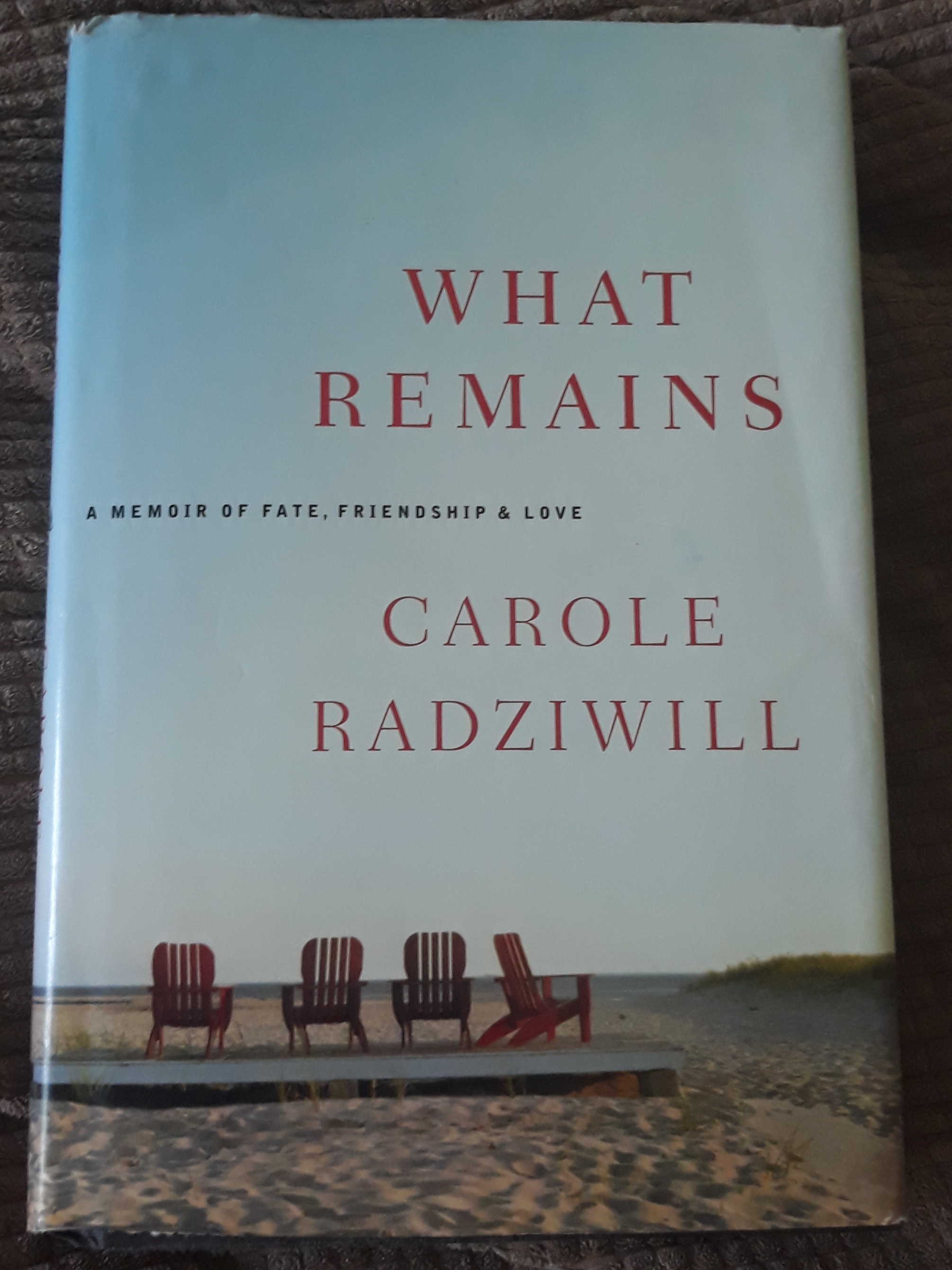
What Remains by Carole Radziwill

What a beautiful book! What Remains by Carole Radziwill is a completely unique book, taking the reader locations you’ve never been—could never go—but also to fully human and universally recognizable places.

It’s no secret that the Real Housewives series are a guilty pleasure, and I always found Carole to be a fun, tell-it-like-it-is, type of “character,” so I thought this book might be decent, but it’s better than that!

A Memoir of Fate, Friendship, and Love

The book takes the reader to the poor gravel roads and streams of New York state, to the haphazard suburbs, to a chaotic, but close family life, to the rush of a bold new career in a city, to war zones, to falling in love (without cliché), and forging deep friendships with “America’s royalty.” Readers see that we all ache, love, suffer, and feel the joy of the sun on our skin and the wind in our hair universally. The life she lives once she’s seriously dating and married to her husband Anthony is (emotionally) much like other everyday relationships, except with better food, clothing, apartments, travel, and lovely places to stay. The reader might be surprised to find that this group of “elites” are thoughtful, frugal, playful, stressed, sometimes uncertain. Aren’t we all?

Radziwill has lived an extraordinary life, and so while this is a memoir, and a genre with which readers might be familiar, it’s is so completely unique in the extraordinary events and circumstances she’s survived. She loses her three closest people in the span of three weeks. Maybe she has survivor’s guilt, but I hope she doesn’t. I hope she is exploring what to do with this big, bold, beautiful life she gets to live. While there is a tight and lovely metaphor about fortune threaded throughout, which works on several levels, the reader leaves the book thinking, “Anything is possible. Anything can happen. Now, what am I going to do with this big bold, beautiful life?”

I read every word and, almost to prove a point, she thanks her bff and sister-in-law, Teresa, who–get this–is from my very own La Grande, Oregon! I am reminded that it truly is a very teeny tiny microscopic world, and anything is possible.

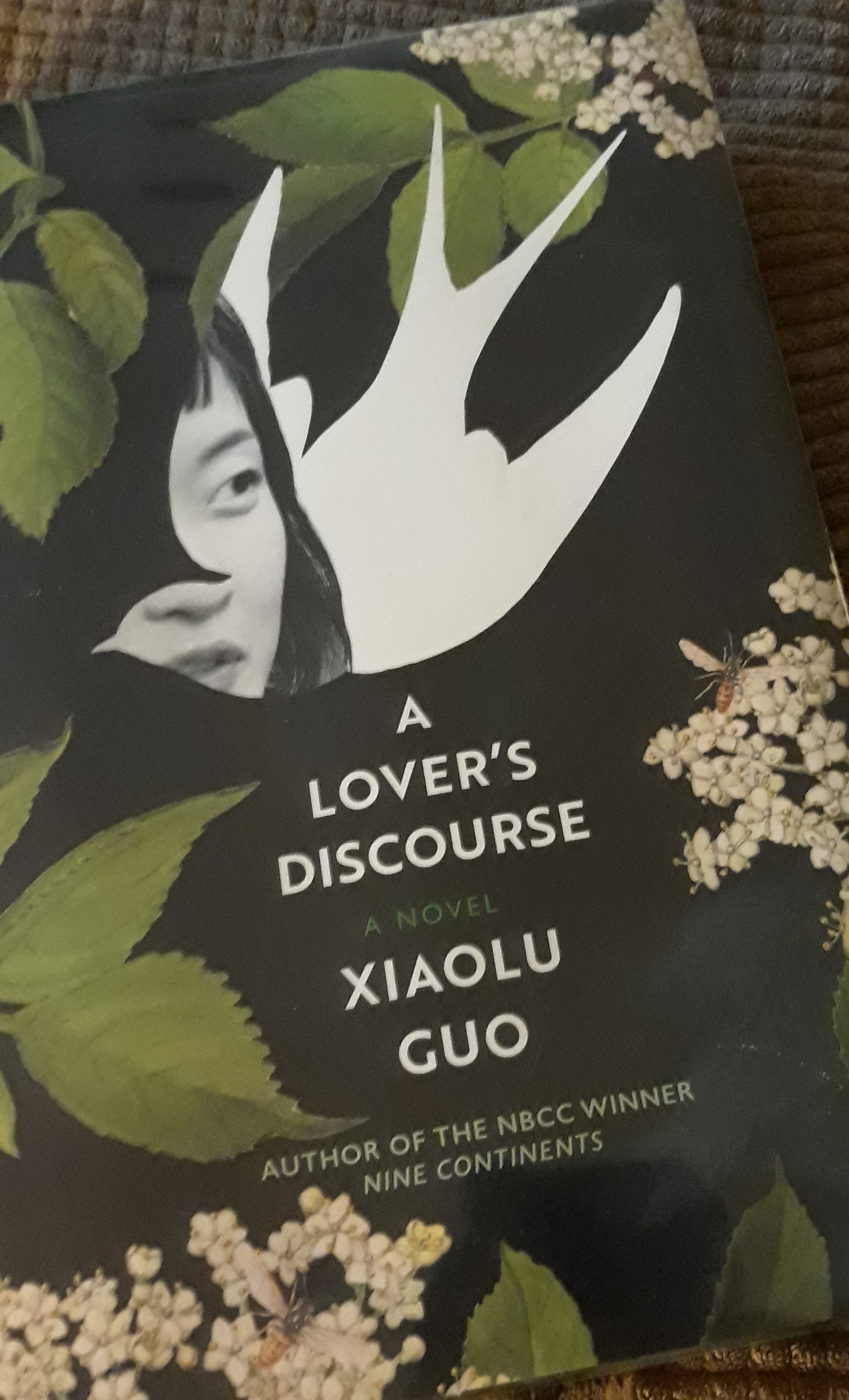
A Lover’s Discourse by Xiaolu Guo

I am blown away by the slow burn called A Lover’s Discourse by Xiaolu Guo. The first and majority of the book is a quiet, steady dialogue between the main character and her “lover.” As you know, I am not a theory hound, but this book was one of few that has made me want to turn steadily back to some of the theories presented in this book, and in grad programs across the world, including my own, and see if I can now find a different way in to them, more my own, perhaps feminine, a more first gen, working-class, creative, put two ideas next to each other to see the new, true, and also beautifully enigmatic knowing that emerges.

I love some of her snarky responses to the rote theories her partner espouses. I found the book to be an incredibly bold and feminist and completely empowering that she takes on subjects that are often, almost always (always?), interpreted through a male lens. She even uses Barthes’ exact same title. So bold! How might I do more of this myself? The book ends with both the theory and physicality of reproduction.

Often I find modern literature to be too cold and unemotional. This book had some of those qualities, but I still felt deeply and identified with many of the main character’s experiences. New motherhood is depicted in almost entirely negative terms, but much of the book is.

In new motherhood, I, too, started to think of mothers in response to every act of killing I heard on the news. These mothers have worked so hard to raise of their children, up until the very moment that their lives are taken. Guo has this exact same insight. We are all one, I suppose.

Finally, the relationship–I’ve felt nearly every one of the feelings or loneliness, isolation, desire, and confusion. I have yelled for him to “Bring wipes” as the baby’s mess grows, only to have him emerge too late, confused and groggy. “When have you had time to listen to music?” The changing home, the changing dynamic, described so uniquely and so true, perhaps especially for the creative woman.

Through it we are two people, changed, and in discourse with each other—lovers.

The Lais of Marie de France

The Lais of Marie de France are real bodice rippers, so to speak. You can see how these stories of ancient romance have influenced everything from Shakespeare to Rom Coms since. There is a strong sense of love and loyalty in each story. The same intensity of life and death love stories, like Romeo and Juliet, are played out repeatedly throughout the lais.

the library’s copy

I read through these relatively quickly, after learning about them from a dear one’s scholarship. First, I was looking for significance in fabrics and cloth. I also frequently thought about the fabrics having just read A Short History of the World According to Sheep and learning more about the wool and processes (and abuses) that went in to making these fabrics.

Eventually, I just got caught up in each story–the excitement and intensity of the love, the suffering, and the joy. (Though, as with most romance, the “ever after” is short changed, and I think most of us are left wondering how that part’s supposed to work.)

The lais capture an intensity that is unique to human love and courtship, and honestly, I think it’s a really intense thing worthy of our focus. The main characters aren’t being cool or dealing with their baggage. They’re just strong and perfect knights, who win all of their tournaments, and fair and beautiful women, who are kind and loving and good, so much so that a knight would sacrifice his life to her, a life that many other knights had tried taking many times before. That they are already married to someone else or in some way betraying someone else is a liner note.

These lais are over the top, sometimes to the point of being ridiculous, but they are entertaining. And, they have literary merit too, not only because of their rich history and staying power, but because, as I read them, I was also inspired, for the first time in a long time, to write a few poems myself!

Iep Jāltok: Poems from a Marshallese Daughter by Kathy Jetñil-Kijiner

Iep Jāltok: Poems from a Marshallese Daughter is a beautiful book of poetry by Kathy Jetñil-Kijiner. I don’t usually read a lot of poetry, but this one drew me in and held me there.

The place where I work has a relatively large population of Micronesian students. In fact, a summer program for work put this book on my radar, and I’m so glad it did. I find myself wanting to learn more about this population. From the book I read about the indigenous connection to place, language, racism, climate change, climate refugees, refugees from US nuclear testing, food, love, religion, womanhood, family, and more.

I found myself searching for plane tickets. Just how far away are the Marshall Islands?

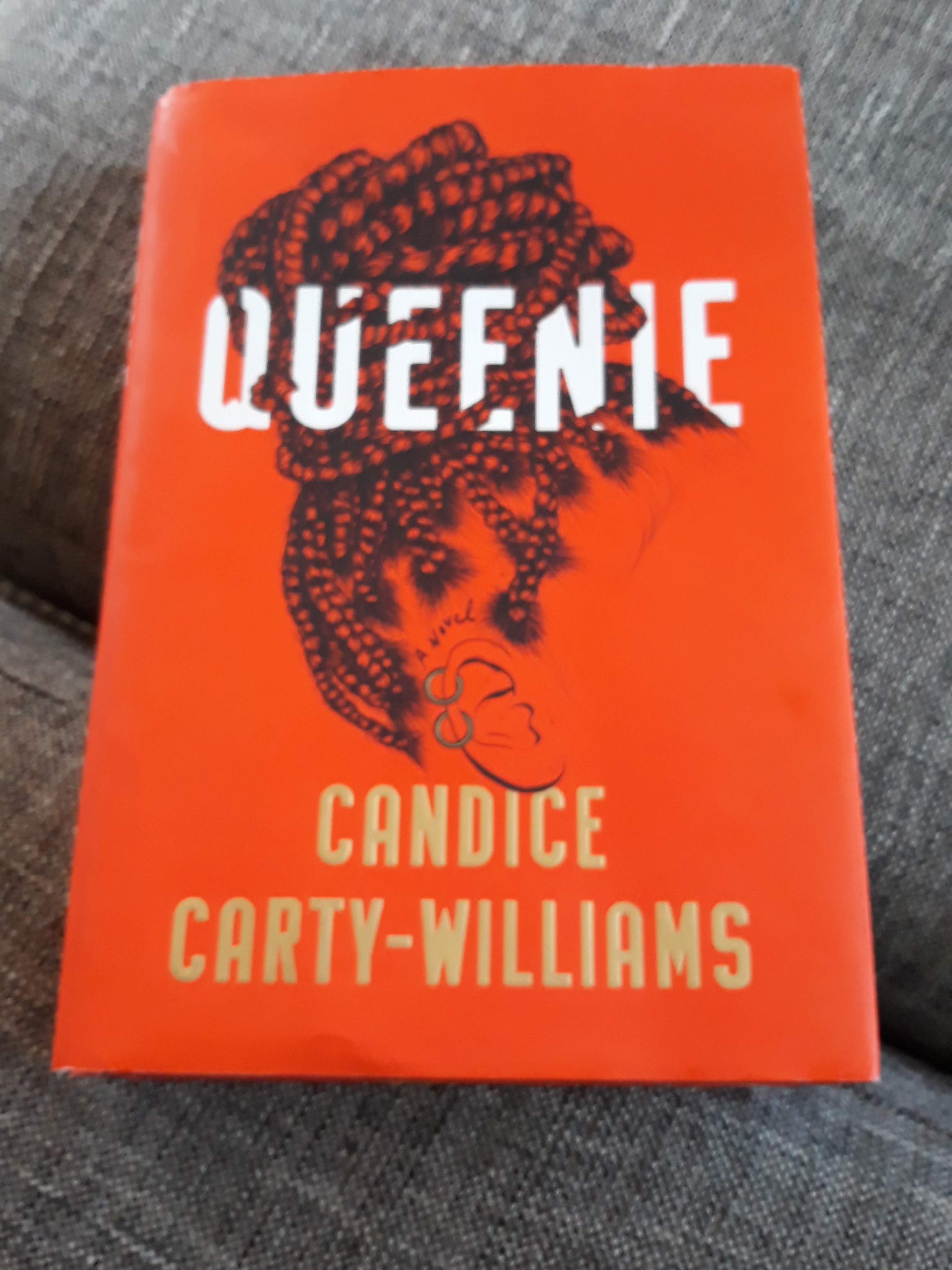
Queenie by Candice Carty-Williams

If you’ll recall, in December 2019, I was part of a book gift exchange with a group of women who also had babies that year. I was gifted two books by one woman. The first I read and wrote about here: https://sherewin.com/2020/03/09/severance-by-ling-ma/. The second was Queenie by Candice Carty-Williams. Both were shockingly timely to 2020. Severance was about a global pandemic and Queenie is about, in part, race and racial injustice.

20200830_154359

So, here’s my take on the book. The story immediately drew me in. It starts with some relationship drama, and I am always happy to be a fly on the wall to any and all relationship drama.

But, as the book progressed, I grew weary of Queenie’s antics, and I didn’t always have enough emotional connection to the story to be patient with her as she navigated her failed relationship, her abusive/borderline abusive sexual escapades, and sabotaged her career. Certainly there were reasons, and certainly we would grow to understand them, but I sometimes grew weary in the waiting. (This happens more and more with me when reading works of fiction.)

While her relationships with friends didn’t always resonate with me (which probably says more about my relationship to “friends” than about her depiction), her relationship with her family became the most interesting aspect of the book to me. Fortunately, that narrative builds and builds throughout the story to a nice conclusion. (Not nice as in happy or resolved per se, but nice as in well done.)

Overall, this piece has literary merit, is well done, if a bit too long. I hate to make the comparison, but it really does allude to the Bridget Jones’s Diary story. It’s a workplace romance starring woman who is a mess. It’s a hallmark of British Literature, and Carty-Williams carries it on and makes it her own in Queenie. The author artfully integrates trauma and politics, specifically the #BLM movement. I am glad I read it, and I think you will be too.

A’s birth story

91099257_10222563971474455_2803633970837716992_o

A was born at 7:44pm on December 5th, 2019. He was due on December 1st, although an early ultrasound read a Nov. 30th due date, I rounded “late” to give myself more time. I did the same last year with L. Given a family history of long gestations and big birth weight babies, I wanted to avoid induction pressure as much as possible, while still being relatively accurate and medically responsible. I was in labor with L on his due date—not late at all! However, during this pregnancy, I was bombarded with so many stories of people barely making it the hospital with their second babies and stories of early babies that, despite knowing better, I began to think that I might have a quick, early labor with this baby too. But first, let me back up.

I found out I was pregnant around the middle/end of March 2019. (A few days before, I had submitted an application for my dream job in Oregon.) I was still nursing 8 month old L around the clock and had not yet start my period. So, my only indication of pregnancy was implantation cramping, which happens during a very specific window of time after conception, and, in my body, is a very specific feeling that I’ve only felt twice. Thinking of it now, I cannot draw up the memory of the feeling. But, I know it when I feel it. I noted the date, told T I thought I might be pregnant, and loaded L in the car and made the drive from Driggs, ID to my home in Utah. Around that time, I had also just received word that Grandpa H was dying of kidney failure. Mom met me in Utah, and we began a week of tender visits with Grandpa as his kidneys failed, and then he passed away. Privately, I began taking pregnancy tests and saw that first faint line get darker with each test. I told both T and my mom. Although this pregnancy was a surprise and came to me much faster than my first pregnancy, I felt strongly that this was a precious miracle baby, and I was grateful for the timing. Questions about if and when to have a second child were suddenly no longer a concern. This was how it would happen. This was the answer.

Shortly thereafter, in mid-April, we made our first trip to Louisiana with L. The trip went well, but I felt that first trimester exhaustion and had an upset stomach the entire time—something I never felt with my first pregnancy. When we returned, I had my first prenatal appointment, where the due date was confirmed, and we did prenatal testing to find out, “It’s a boy!” Around this time, I also learned that I was a finalist for the job in Oregon. So, once again, I packed up L, and we made the long trek to Oregon. I felt great the day of the job interview, but it was taxing. I continued to struggle with first trimester exhaustion, upset stomach, and also scheduled nursing sessions with L throughout the day.

Shortly after returning from Oregon, in early June, I was offered the job. I accepted, and by mid-June, I made arrangements to put my house in Utah on the market, with a goal to sell it within a month. That process required cleaning and trips to Utah and packing up my life (once again). My mom came for another visit, which coincided with my uncle Roger’s sculpture reveal at This is the Place Park in Utah. Mom helped me pack, then T came to Utah at the end of July to help finish packing and load my belongings into storage pods, which would be shipped to Oregon. During this time, I was also house shopping in Oregon, via video walkthroughs with the realtor and my mom’s visits to properties. I made a few offers, until finally finding the home I would buy at a great location.

I spent the rest of the summer enjoying my time in Idaho with L, taking long walks in the stroller with him and generally enjoying the slower pace that life there affords. In mid-August, I found childcare in Oregon and moved in with my mom temporarily while I began working at my new job. I also saw the house that I was in the process of buying for the first time. Buying the house ended up having several unforeseen setbacks, and the one month I was supposed to stay with my mom turned into three months. I had repairs and updates completed, and I moved in during my third trimester, only a month or so before A was born, with the help of my mom and T and other family members.

I mention all of this to indicate the intensity of this entire pregnancy. While staying with my mom, L and I shared a small bedroom. He began daycare for the first time, he caught every cold imaginable, and so did I. Antibiotics were even required at one point, and while I was sick, I had regular, painful contractions that made me wonder if my baby would arrive early. T was also supposed to arrive and stay about a month before the due date. However, work obligations kept him away several weeks longer than anticipated.

In the final weeks of pregnancy, I felt huge. I was huge, gaining 65 pounds this time. By far the most difficult part was caring for L while pregnant. Tasks like lifting him, changing him, getting him in and out of the car seat, and putting him in this crib sometimes felt impossible. I held him not on my lap, but beside me now—a emotional transition as I began to feel what it would be like to not be able to fully baby my first baby as much as I had in the previous year and a half.

My due date came and went. At the 38 week mark, I began nesting and became much more motivated to finish unpacking the house. The few weeks previously were spent moving and unpacking too, but I was tired and less motivated. In the last few weeks of pregnancy, I’d finished enough of the interior of the house to feel satisfied and ready for baby.

The due date came and went. I felt uncomfortable at night, tossing and turning, but never went in to labor. At 36 weeks, I was dilated 2-3 cm. At 40 weeks, I was dilated to 4cm. One night, near my due date, I had a wave of hormonal nausea and a painful contraction, followed by another painful contraction. I told T that I felt certain I was in labor, and I tried to sleep. I awoke the next morning. Contractions had faded away. I wasn’t in labor after all.

At around 2:20am on Thursday, December 5th, I woke up feeling uncomfortable. I was struggling with the bedsheets and felt a pop or a shifting in my uterus. Steady, painful contractions started right away. After about an hour, T and I made our way to the hospital, while Mom stayed home with L. I arrived around 4am and was at 4-5cm. About an hour later, I asked for an epidural and the anesthesiologist arrived around 6am. Contractions were not regular (between 3-7 minutes) and never established a regular pattern, which is what happened last time too. I couldn’t talk during the contractions and had to moan and close my eyes and sway to get through them. The anesthesiologist encouraged me to get the epidural then based on my pain level. However, the epidural was not so easy. This time, the anesthesiologist was unable to easily place the epidural. This was not a problem last time, but this time they thought it might be cause of mild scoliosis, which was the first I’d ever heard of it. I did get a severe headache last time, which doctors thought might’ve been the beginnings of postpartum preeclampsia, but the anesthesiologist felt certain that it was a spinal headache. My last epidural did leave my legs completely paralyzed for the duration of the epidural, so I guess that’s not normal.

After three attempts, a second anesthesiologist was brought in. She was tried a fourth time, and then was able to place it the fifth time. (She said it would be her last attempt.) I was so, so grateful that it was finally successful! Especially since I ended up having another very long, slow labor, just like last time. It was definitely not the fast second baby that so many had warned me of. My mom showed up at the hospital around 9am, after getting L ready and taking him to daycare, where he would spend the night, since baby arrived at 7:44pm, which was after L’s bedtime, and the following day. It felt hard to have L spending the night away for the first time, but it was our only option, and at least he was familiar with the daycare.

After the epidural was set, I waited and rested. There was talk of breaking my water (more) because it might have already broken a little. There was talk of Pitocin, which I eventually got, because my labor stalled out again once I had the epidural. After a long day, with little progress, the obgyn came to the hospital after a full day in the clinic and had me labor in hands and knees (more like child’s pose) since I had so much more sensation and mobility with my legs with this epidural. Then, she was going to break my water, but baby had shifted, and she didn’t feel comfortable doing it. After laboring awhile longer, she broke my water. A short time later, I was complete and able to start pushing. Although I had spoken to the obgyn about it, and the birth team, and put it in my birth plan, I was cued to curl around my baby and do purple pushing. Personally, I hate this method of pushing. I feel no leverage in the lithotomy position, and it feels like a frustrating and an unproductive waste of energy. I tried pushing in this way again, at the insistence of everyone in the room, but felt nothing but lack of oxygen and straining in my face and neck.

The obgyn suggested the squat bar, since I had so much mobility in my legs. This pushing felt very productive. After one push, I felt baby’s head move down significantly. I told everyone that the push felt productive. I was then made to lie back after the contraction. Lying back felt unnecessary and bad because baby’s head was descending so much now. With the second contraction, I got up on the squat bar and pushed the baby’s head out. At that point, the medical staff started yelling at me to stop and to lay back. Again, this did not feel good. I could tell that something was wrong, and they began to break down the bed and prepare for delivery. Since this was expected to be such a big baby, I guess they thought that pushing would take awhile. In the meantime, I wasn’t sure what was wrong. I wasn’t too worried, but I was hyper focused. I thought maybe the baby was a surprise breach. Once they were ready, they began yelling at me to push again. Afraid of what was going on, I pushed with all of my might. I knew I was tearing. I knew it was going too fast. I knew that if I could go slower and ease my baby down, it would be better, but I felt I had no other choice but to listen and push because my baby might be in danger. Within just a push or two, trying with all of my might to get the baby out, my baby slipped out of my body and into this world.

I said I wish I’d been allowed to stay in the squatting position. The obgyn said she couldn’t deliver a baby upside down. I said, you might’ve surprised yourself. The obgyn said the urgency was that the umbilical cord was wrapped around the baby’s neck. However, later my mom told me that the urgency was that the umbilical cord actually came out first, which can also be dangerous. Despite some lingering bad feelings about the pushing and delivery, the mood in the room was pleasant and celebratory. I would have guessed the baby was having breathing problems because he didn’t seem to cry or breath as much as L did when he was born. However, L was the one that needed oxygen, while this baby was fine. It just goes to show that I’m not a baby doctor, and mother’s intuition is not always right. This baby’s face was quite swollen. His hair was dark. He looked very different than his brother did at birth. He weighed 9 lbs 10.2 oz and was 21.5 inches long. He felt so tiny in my arms. It was hard to believe he was actually slightly bigger at birth than his brother was. How are they ever this small? It’s impossible to remember, until a new baby is placed in your arms again.

I held him, and within the first few hours, he began to nurse. As is common with big babies, he had low blood sugar and needed to be supplemented with small amounts of formula. I felt that the hospital’s standard for blood sugar, hydration, and bilirubin was impossibly high and that most babies probably have to get formula while there, which makes me feel sad for all of the breastfeeding mamas in there. Since this was my second baby, I felt less stressed about formula derailing breastfeeding. But, it was a stressor nonetheless.

L came to meet his brother the next evening. He was sweet and curious. We left the hospital the following day, without a name. Going into labor, we had a few top contender names picked out, but after 48 hours, none of them seemed right. After a few days at home, and a lot of work, and deliberation on our part, we finally found his name.

This baby came to me easily, naturally, and without any effort. I knew my body in birth better, so as labor unfolded, it felt familiar. Breastfeeding, sleeping, holding, even moving my own body was easier and more familiar the second time around. I didn’t yet know him, but he smelled and felt perfect in my arms, and I loved spending hours with him snuggled up against my belly while he slept—easy love.

2019: year in review

Last year I said that 2018 was the best year of my life. 2019 might’ve topped it. In early 2019, I had a six month old baby. I was still up every two hours or so throughout the night with him. I was on a very strict, allergy-free diet and was therefore wire thin. I was finding my stride as a mother, but I was still very tired. I was living almost entirely in Idaho, enjoying a cozy winter inside while the snow fell outside. I took my baby on walks on days that weren’t too cold, and I read the same baby books to him over and over again.

157765732854840741034

In March three things happened. I applied for my dream job in my home state. Then, I felt the twinge of implantation that is unlike any other feeling I’ve ever felt before. I couldn’t describe it now, but I knew it when I felt it because I also felt it when I became pregnant with L. The other thing that happened was I received news that Grandpa was dying. Mom and I both drove to Utah to spend time with him in his final says. I quietly took pregnancy tests and watched the thin pink line darken each day.

In April, we made the trek to Louisiana to introduce L to his extended family. It was a lot of work, and I was exhausted from early pregnancy, but I ate two muffulettas and other delicious foods and felt sick to my stomach a lot. We also attended a friend’s wedding. Then, I flew back on my own with L. The flight was only between Dallas and SLC, but it was exhausting. I had to nurse him while sitting next to a (very considerate) older man and was constantly diligent, feeding L, entertaining him, and praying he would take a nap. He was so much smaller then!

In May I had my first prenatal appointment to confirm my pregnancy and determine my due date—Dec. 1st. I also drove with L to Oregon to interview as a finalist for that dream job I mentioned earlier. There, I interviewed around my nursing schedule, feeding L between meetings and a teaching demo. The interview went well, but I was still quite tired from nursing a baby and also being in the first trimester with my second.

By the end of the month, I was offered the job. Normally I make pro/con lists for any big decision, but this time it didn’t seem like I was making a decision. I just put my house in Utah up for sale and made plans to move. My house sold quickly, and I made an offer on a small house in Oregon with a few acres, sight unseen. Meanwhile, I spent a long summer in Idaho, still taking my baby on long walks and reading books to him. By now, life with L was much easier. He was doing great, and I was getting more sleep.

In August, I moved to Oregon and made plans to stay with my mom for about a month. That month turned into three months. I lived in an house that was not baby proofed, sharing a room with my one year old, who was a loud, fussy sleeper, while I slept on a loud, squeaky mattress. During that time, L started to go to daycare for the first time, which meant I was hauling my increasingly heavy pregnant body up early every morning, getting my baby to daycare, and then driving to work. Near the end of my pregnancy, this routine became increasingly impossible. Getting L in and out of his car seat was particularly hard.

After my new home closed, I waited a few more weeks for new wood flooring to go in. I updated light fixtures and added a shower the a bathroom. Then, I orchestrated two sets of movers and U-Hauls, and I moved into the home that I imagine I could live in for a very long time.

At last, I moved into my new home with only a few weeks left before my new baby would arrive. On December 5th, I welcomed my second son (that story is forthcoming). I spent the final weeks of 2019 enjoying my new baby, my angel, and adjusting to a wonderful new life with a newborn and a toddler.