Tag Archives: book review

Bluets by Maggie Nelson

I needed to read something artistic, and so I finally read Bluets by Maggie Nelson. I read it quickly. (It did not need to be read slowly.) It seemed like I’d read this book before. It reminded me of Coeur de Lion by Ariana Reines, but not as beautiful as that in terms of the sentence. It was beautiful, though, and smart–one of the best books I’ve read in the genre. I had little patience for the sexual aspects of the book. That’s me though. Lately, those inclusions seem cheap. I used to “get it.” Adding the sexual gave writing that perfect blend of raw and mystery. Anymore I only want to think about birds and botany.

Bluets - Maggie Nelson

image from wavepoetry.com


Lines I liked:

“My Thought has though itself through and reached a Pure Idea. What the rest of me has suffered during the at long agony, is in describable” (Mallarmé 2-3).

“Now I like to remember the question alone, as it reminds me that my mind is essentially a sieve, that I am mortal” (62).

“…the blue of the sky depends on the darkness of empty space behind it” (62).

“For some, the emptiness itself is God; for others, the space must stay empty” (86).

“…ask not what has been real and what has been false, but what has been bitter, and what has been sweet” (86).

“As a rule we find pleasure much less pleasurable, pain much more more painful that we expected” (87).

“She is too busy asking, in this changed form, what makes a livable life, and how she can live it” (88).

“Imagine someone saying, “Our fundamental situation is joyful.” Now imagine believing it…Or forget belief: imagine feeling, even if for a moment, that it were true” (89).

“When I was alive, I aimed to be a student not of longing, but of light” (95).

Words/concepts that inspired further study:

  • the male satin bowerbird
  • International Klein Blue
  • samsara
  • the jacaranda tree
  • the Tuareg
  • The Oblivion Seekers

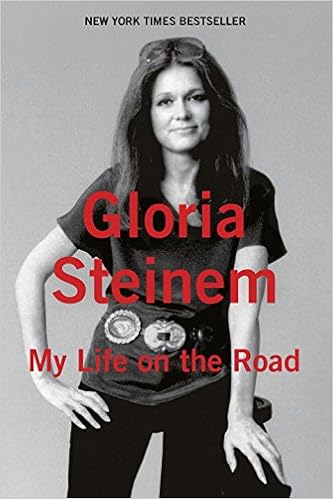
My Life on the Road by Gloria Steinem

Gloria Steinem has been in my peripheral for years now. She’s lovely. She’s a feminist journalist. We both have a penchant for large sunglasses. She did waitressed for Playboy to write an exposé. She’s an iconic feminist figure. Sometimes her politics and approach seemed too bland for me to really deeply identify with her. Other times she seemed too out there.

I read her latest book, My Life on the Road, and here’s what stood out to me. Because of her known beauty and brains, she could have chosen a conventional path: marrying for love and money, children, soccer games, and charities–all meaningful work, but too often requires the sacrificing of the self for the good of the others (family). That she chose not to pursue a more conventional path, one that so many women value and judge themselves against, is powerful. Steinem had a choice, and she chose feminism. (I’m fully aware the this observation might seem less than feminist, but I think her beauty is part of her particular feminism, and I’m treating it as such.)

image from amazon.com

The book itself if full of important feminist history. I tend to be exposed to more “high theory,” academic feminism. Steinem’s history is a political one, a public one. She’s a journalist after all, with a wide readership.

First–and this blew my mind–she began the book by dedicating it to her abortionist. Her abortionist. I found this to be completely provocative and outrageous and wonderful and true. And for that I loved it.

Here are some quotes from the book that I thought were of interest (with page number):

On violence against women and a healthy society: “We might have known sooner that the most reliable predictor of whether a country is violent within itself—or will use military violence against another country—is not poverty, natural resources, religion, or even degree of democracy; it’s violence against females. It normalizes all other violence” 43.

On the economy and the environment: “pressuring women to have too many children is the biggest cause of environmental distress, and economic courses should start with reproduction, not just production” 100.

On our Democratic nominee Hillary Clinton: “she was potentially, as one said, “a great girlfriend” who had their backs” 160.

Cultural problems: “Women are always better liked if we sacrifice ourselves for something bigger—and something bigger always means including men, even though something bigger for men doesn’t usually mean including women” 165.

This one’s just a good line: “Laughter is an orgasm of the mind” 181.

These song lyrics:

It’s a rainy night in Georgia
and it looks like
it’s rainin’
all over the world

Just another great line: “Surrealism is the triumph of form over content” 189.

This is going to take forever: “According to the wisdom of Indian Country on my own continent, it takes four generations to heal one act of violence” 202.

Here’s why it’s so important to me that Hillary Clinton received the presidential nomination: “…when God is depicted only as a white man, only white men seem godly” 205.

A great chapter title that has me thinking about my relationship to Truth: “What Was Once Can be Again” 211.

Truth: “YOU CANNOT THINK YOURSELF INTO RIGHT LIVING. YOU LIVE YOURSELF INTO RIGHT THINKING. –Native  Elders 234.

On women: “Women elders were keeping the rhythm of life” 241.

Something to remember in regards to politics: “Anybody who is experiencing something is more expert in it than the experts” 245.

Parting wisdom to remember: “My father did not have to trade dying alone for the jobs of the road. My mother did not have to give up a journey of her own to have a home.

Neither do I. Neither do you” 251.

Be well, my loves.

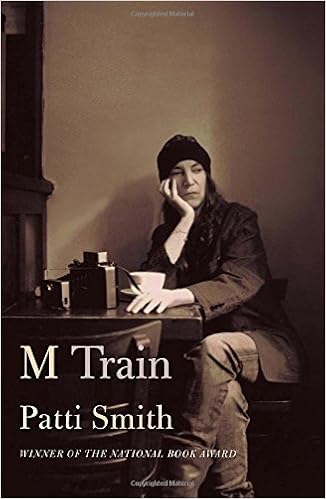
M Train by Patti Smith

It’s so hard to find a good new book these days. So when I find one, I tend to spend as much time in it as possible. That’s what happened with Patti Smith’s new book, M Train.

image from amazon.com

I read Just Kids a few years ago and loved it. In her rock and roll heyday (which is still now for many of us), Smith was known for brilliantly blending poetry with rock and roll. So it makes sense that she is a writer and also a fan of writing, which, in part, is what this book is about. It’s also about coffee. It’s about strange rituals and missions dreamed up by an amalgamation of literature, dreams, conversations and her own notions, which has her leaving stones at gravesites of people she knew or didn’t know, caring deeply about a small idea, about a small token, a small memory, a spirit.

I’ve always identified deeply with Smith. Her dreamy, creative way of moving through the world is similar to me at my best self. On some existential level, I know the deep love she knew with Fred, and the deep loss, and the new existing in this strange world, but hers is deeper, more, and a guidepost for us all.

I don’t know that I would like her. The day in/day out of her life seems sometimes boring, and dusty, and littered with cat hair, but there’s something about what she produces as an artist that opens me up, reminds me, shows me something new. So I stay in her books for as long as I can, and then hold on to them again afterward.

Girl in a Band by Kim Gordon

I read Girl in a Band by Kim Gordon on the heals of reading Carrie Brownstein’s Hunger Makes Me a Modern Girl and Patti Smith’s Just Kids a few years earlier. Gordon’s book pales in comparison to Brownstein, who is a genius–capable of exposing those real and unflattering (and flattering!) human emotions and experiences by showing instead of telling, and to Smith, who’s skill with language has always been a huge part of her success as a musician and artist. It makes sense that Smith and Brownstein would both write books that are both informative to fans, but that also hold up as literary works as well. Gordon’s book doesn’t do that.

Gordon portrays herself as a frustrated artist, and she accurately conveys that frustration in her lifelong relationship with visual art and music. At many times, she says she felt vulnerable, but the reader doesn’t see or feel the vulnerability. Sometimes Gordon seems to confuse vulnerability with victimhood, which also comes off as somewhat confused.

Here’s what I think: I think she is tough, and numb, and this is part of her personality, but it’s also exacerbated by her heartbreak and divorce from Thurston Moore. The pain is still too fresh for her to have any useful insight. One imagines that her heartache still weighs her every day, and without the clarity of some of that pain having lifted, she is not yet in a position to write about her experience in a useful way. She comes off as guarded–the opposite of vulnerable. She pulls back, and the reader pulls back too.

If you are a fan of Sonic Youth, it’s worth reading for the history. If you are a fan of that musical movement, it serves up a fine history. Otherwise, this is one you can skip. If she does this again in about a decade, I’d give the new one a read. Perhaps by then she’ll have deeper insight and also remind us what any of this had to do with being human in the first place.

Crazy Brave by Joy Harjo

I read this book almost entirely while lying in bed, while falling in love. Joy Harjo’s a fixture in poetry and literature. Before now, I’d only ever read a poem or two here and there, but I’d never really gotten into her work…that is until I read her memoir, Crazy Brave. It was one of those books that I started reading in a bookstore, and then read a chapter or two from the library, and then finally bought my own damn copy and finished it at home…while lying in bed. I love this book.

image from amazon.com

Harjo is mostly known for her poetry. I don’t enjoy reading a lot of poetry, and so that’s why I haven’t been very familiar with her work. After reading and loving Crazy Brave, I read She Had Some Horses, which is also beautiful, and I love it, and it’s poetry. It’s a collection I see myself returning to.

As for Crazy Brave, what I love about the book is how she captures a creative, feminine life experience that I (mostly) really relate to. It’s soulful. It captures pain, and specifically women’s pain, in a profound way. It shows us another way. It does so in poetic prose–she’s a poet after all.

This is from the back cover of She Had Some Horses, but I think it pertains to all Harjo’s work: “If you want to remember what you never listened to & what you didn’t know you knew, or wanted to know, open this sound & forget to fear. A woman is appearing in the horizon light.” ~ Meridel Le Sueur.

And then I saw her picture and remembered that maybe I met her. Or maybe I heard her read once. She is familiar to me. Her name. Her face. Her work. And yet I only really found her work now, when of course I needed it most.

I was captured throughout the entire book, but  by the end, I was a little lost: WHAT DOES IT ALL MEAN?! I wondered about the title: crazy brave. Now I think I can say that the larger message was, for me personally, a message to women to be brave, an admonition that it will be crazy, and you will be crazy, and you will be brave, and that is life.

Part of this is about surrendering to the flow of the river, instead of fighting against it, using the strength of the current to pursue yourself, but also acknowledge or accept that the river will be violent, and it will wound you deeply, and it might kill you, and it might lull you to sleep, and part of this we can control, and part of it we cannot control, and this is the wisdom we gain from being in the river. I am reminded of the time I went underwater in the Colorado River, the immense crushing noise turned warm and quiet and then I emerged. Part of this book is about acknowledging fear, working around it, using it, but not being controlled by it. I left the book thinking I should do what I must do before the river does it for me, even as the river does it for me.

Some of the words I loved:

“Yet everyone wanted the same thing: land, peace, a place to make a home, cook, fall in love, make children and music” (19).

“Because music is a language that live sin the spiritual realms, we can hear it, we can notate it and create it, but we cannot hold it in our hands” (19).

“In the end, we must each tend to our own gulfs of sadness, though others can assist us with kindness, food, good words, and music. Our human tendency is to fill these holes with distractions like shopping and fast romance, or with drugs and alcohol” (23).

“Water people can easily get lost. And they may not comprehend that they are lost. They succumb easily to the spirits of alcohol and drugs. They will always search for a vision that cannot be found on earth” (25).

“They continue to live as if the story never happened” (43).

“Our  heartbeats are numbered. We have only so many allotted. When we use them up, we die (52).

“All of these plant medicines, like whiskey, tequila, and tobacco, are potent healers. There’s a reason they’re called spirits. You must use them very carefully. They open you up. If you abuse them, they can tear holes in your protective, spiritual covering” (77).

“I noticed a marked change in the quality of light when we made it to New Mexico” (83).

“Each scar was evidence that we wanted to live” (90).

“I told Lupita I wanted to paint, to be an artist. She told me that what she wanted was someone to love her” (102).

“I was given the option of being sterilized” (121).

“I believe that if you do not answer the noise and urgency of your gifts, they will turn on you” (135).

“We were in that amazed state of awe at finding each other in all the millions and billions of people in the world” (143).

“Her intent made a fine unwavering line that connected my heart to hers” (146).

Hunger Makes Me A Modern Girl by Carrie Brownstein

First, Hunger Makes Me a Modern Girl by Carrie Brownstein made me incredibly nostalgic for my graduate school in creative writing at Bellingham, Washington. It made me grateful for my best friend, whom I met there. It made me grateful for the training I received there. It made me grateful to be part of the contagious creative energy of that place.

image from nytimes.com

Sleater-Kinney is a group composed of women. With some privilege. Who were highly intellectual. And well-educated. They understood the conversation, their conversation, the conversation that was happened around them, the way everyone was getting it wrong, or right. Beyond all that, they were a band making good music, and I think that’s an important takeaway from the book, which is worth owning, by the way (and I don’t say this lightly as someone who hates “things” and loves the library).

There are some lovely lines, some deeply insightful lines. I loved the descriptions of fanzines and the embarrassingly long letter writing of yesteryear–something that generations with access to the internet will never understand.  And there were great vocab words (metonym, diffidence, jocose, internecine, lugubrious, interstices, peripatetic)! The book was informational. It was moody. The end is triumphant, while simultaneously sucking the air out of the room because that is life no matter now stupidly depressed or optimistic we are in our tender little human brains.

I can’t tell you how important it is for me to look to female artists, who aren’t trying to be particularly female, nor artist, nor political, but are all of these things and end up providing a path, an option, an expression that is contrary to the rest of it–the blinding, crushing, deafening roaring messages. The dominant voice is so overpowering that you feel all alone thinking it’s wrong, they’re wrong. You search desperately for some whispered message, some quiet, lovely beat, an undertow more powerful than the surface waves, a person across the way who is looking at you and nodding her head to the same lovely beat.

Carrie Brownstein and Sleater-Kinney–they’re looking back and me and they’re nodding.

Here are a few lines from the book that I loved:

  • “[T]o be a fan is to know that loving trumps being beloved” (3).
  • “It is difficult to express how profound it is to have your experience broadcast back to you for the first time, how shocking it feels to be acknowledged, as if your own sense of realness had only existed before as a concept” (55).
  • “Books grounded me, helped me feel less alone” (115).
  • “A nomadic life fosters inconsistencies and contradictions within you, a vacillation between loneliness and needing desperately to be left alone” (150).
  • On the difficulty of relationships: “When do you ever get to be alone? To think, to read, to reflect, to not have to be “on,” to do nothing to just…be” (152).
  • I feel this in regards to teaching: “An audience doesn’t want female distance, they want female openness and accessibility, familiarity that validates femaleness” (166).
  • “In the end, all I could manage was the kind of shoulder dance moms do when they make shrimp scampi in the kitchen while drinking white wine and listening to Bruce Hornsby” (175).
  • “If you’re ever wondering how sad I was…you would know by the fact that I won the Oregon Humane Society Volunteer Award in 2006” (226). – I have my own similar life markers that look like success, but are mostly a reflection of a deeply sad time in my life.
  • “If the fake crow were looking down on us, he would see a woman in her thirties, living alone, jobless and aimless, with animals to fill the space and to patch the holes” (228). – It’s taken herculean strength for me not to patch the holes with innocent mammals.

Why Not Me? by Mindy Kaling

As you know, one of my favorite genres is a memoir from a female comedy writer. It’s like hanging out with a really funny best girlfriend all weekend. Is it weird that I artificially fabricate this experience through reading? Maybe. I don’t care. I read Mindy Kaling’s first book, Is Everyone Hanging Out Without Me? during a frantic “pleasure reading” phase I went through between the time I submitted my dissertation and the time I graduated.

This time, I am realizing (perhaps late) that Kaling writes, plays, (and maybe is?) just one character. But, like Jack Nicholson and James Franco (maybe I’ve only seen his stoner films?), nobody cares because it’s such a good character. The Office’s Kelly Kapoor, The Mindy Project’s Mindy Lahiri, and the identity Kaling develops in both of her books are all basically the same person. She’s a myopic, worst/best basic bitch kind of person, and it’s hilarious. She’s always simultaneously doing great commentary on gender and femininity. She describes the persona best: “Mindy is…a combination of Carrie Bradshaw and Eric Cartman” (75).

image from books.google.com

Here’s the take away of Why Not Me: First, you will want to eat McDonalds. And yes, there is some filler content. All of these books have filler. Like, okay, I’ll read a script that’s not going anywhere and a commencement speech that you gave. And, yes, the book was probably written by a ghost writer (but that ghost writer does a great job maintaining Kaling’s voice throughout!) And regardless, Kaling writes some grade-A jokes for these books, and even inspires her reader a bit toward the end. I was thinking, “Hey, yeah, why not me?!” Then, laced up my running shoes and achieved my dreams.

Here are some of the lines I loved:

Real Talk

  • “I’m skrilla flush with that dollah-dollah-bill-y’all” (4). This is the single best description of me on payday.
  • “[T]he gulf between a friend and a best friend is enormous and profound” (27).
  • On breakups: “So, the only decent way for him to have broken up with you is to not break up with you and stay with you forever” (39).
  • “As someone who enjoys secrets, exclusivity, and elitism…” (40).
  • People don’t say “Give me your honest opinion” because they want an honest opinion. They say it because it’s rude to say “Please tell me I’m amazing” (125).
  • “[R]ecycling makes America look poor” (139).
  • “[H]ard work must be rewarded with soul-replenishing gossip” (139).
  • “I have a terrible habit of impulsively sending text messages that reveal my true feelings” (140-41).

On Body Image

  • “One of the great things about women’s magazines is that they accept that drinking water and sitting quietly will make your breasts huge and lips plump up to the size of two bratwursts” (10).
  • “I cannot imagine a life more boring and a more time-consuming obsession than being preoccupied with watching what I eat” (194).
  • “But my secret is: even though I wish I could be thin, I don’t wish for it I don’t wish for it with all my heart. with all my heart. Because my is reserved for way more important things” (202).

I want to say some more about the body image stuff. So, I can work to get the sick body, the one with that weird vein between your lower ab and hipbone, but it does require me to think about what I’m eating and get regular exercise. It takes time and mental energy–time and mental energy I’m not always willing to give. Take graduate school, for example. I knew I would take four years and focus my energy on learning. And, so I didn’t think much about what I ate, and I taught and practiced yoga several times a week. I gained weight. I felt fine. This lasted four years.

Now, I can focus more time and energy on my body. Most people I know who pour 100% into looking good look great, but aren’t very interesting to talk to. Additionally, I simply have the kind of brain that requires me to spend time thinking about the meaninglessness of life and experiencing existential angst. I simply can’t/don’t want to transfer that energy into diet and exercise. I liked when Kaling wrote, “I don’t wish for it I don’t wish for it with all my heart. with all my heart” (202), and I think that’s a healthy approach. Anyway, I certainly haven’t found a balance, and I sort of don’t think a balance is possible (for women), and that sucks…is the way I’m going to end this post.

Single, Carefree, Mellow by Katherine Heiny

I subscribe to Vogue, and I do so for the fabric and the writing. I’ve read a few great books based on their recommendations. Unfortunately, Single, Carefree, Mellow is not one of their great recommendations, and it serves as a reminder that, while Vogue has some great writers on their staff, the book mentions in Vogue probably have less to do with their keen eye, and more to do with commercial demands.

image from amazon.com

I sympathize though because Single, Carefree, Mellow is probably what would happened if I set out to write a popular, commercial, plot-driven novel about single women. In fact, I’m sure it’s much better than anything I could muster. Still, it’s bad.

First, the writing: much of the description does nothing to move the plot forward or deepen meaning or character. It seems to only serve the purpose of “my writing teacher said good writing has lots of description so I’ll add some here.”

Next, the themes: these characters are weirdly detached and casual about cheating, destroying marriages, and are either morally corrupt *in uninteresting ways* or disconnected from their real wants and desires *in uninteresting ways*.

To be fair, lately I have been really sensitive to moral corruption. The last few years have been so tumultuous for me that I have craved security, stability, and people who are who they say they are–people who are straightforward about their motives. As a result, my tolerance for books and shows that delve into vapid characters, driven by quick and easy gratification, is at it’s lowest.

The Orgy by Muriel Rukeyser

It took me months to finish The Orgy: An Irish Journey of Passion and Transformation by Muriel Rukeyser, and I have to start by saying this: for a book with “orgy” in the title, there is actually very little sex. If you read the book, you’ll think that was funny because this is not a sexy book. This is capital “L” Literature. You know–a thinking piece.

image from books.google.com

A well-respected friend recommended it to me, and I tried and tried, and it never really took off, and that’s because it’s not a book that “takes off.” It’s poetry. I mean, it’s prose, but it’s basically poetry in terms of accessibility, sound, rhythm, and so forth. (Rukeyser explains here.)

For several months, both The Orgy and Thich Nhất Hanh’s How to Love* lie prone in my living room . I’d forget about them, and visitors would come over and raise their eyebrows at the display. Now I find it amusing, but at the time, I remember feeling embarrassed. The titles convey two really different messages. And, in hindsight, not entirely unrelated to my summer. (There were no orgies! Sheesh!)

As for Rukeyser, the book was meaningful in the sentences, but not so much the big picture. The book is about the author’s (semi-autobiographical) journey to the Puck Fair for one of the last pagan festivals of it’s kind. That kind of premise holds so much intrigue for me. I was hopeful for deep description and weird plot points and characters. But nope. It’s not really that kind of book.

Instead, we are gifted with subtle sentence level gems and an overall sense, but nothing concrete, as is the way of good capital “L” Literature, and that’s fine. It’s fine. IT’S JUST THAT I THINK WE WERE ALL EXPECTING A BIT MORE IN THE ORGY DEPARTMENT.

Here are a few lines for continued consideration:

On walking through shit: “I thought, joy and release is it! and put my foot down slowly, gained an inch, and slipped” (69).

“[T]he book compared peace with monogamy” (91).

On the infant cry: “It is the most profound and powerful force in nature” (102).

“Though they may kill, killing is not their aim…” (103).

“verbal arabesques” (114).

“Nicholas began to relax; it was as if he remembered his whole life, and unwound” (115).

*Thich Nhất Hanh’s critically acclaimed, and I really liked his Be Free Where You Are, and wrote about it here, but he’s phoning it in on How to Love, so there will be no blog post on that one.

My Body Is a Book of Rules by Elissa Washuta

image from amazon.com

image from amazon.com

For those of you who miss the bygone days of the grad school creative writing workshop, My Body is a Book of Rules by Elissa Washuta is going to be your jam. It fostered in me nostalgia for those rapid cycling days of pushing myself to the psychological and intellectual limits to produce the wildest new thing imaginable only to discover it’d already been done, and better, and then I was back to the drawing board, and I did this on repeat for a couple of years until maybe (maayyybee) I really did create a few new things.

Washuta’s book has the messy feel of a creative writing workshop. In many of the sections, you can almost imagine the writing prompts to which she’s responding. Readers unfamiliar with this kind of (independent?) prose could very well be put off by this book. And to be fair, even as far as independent presses go, this book has some clunky, first effort moments. As a reader, I was okay with these moments because I was just so glad to be reading something new and different and good and incredibly personal and raw. Maybe too raw.

It’s difficult to write about one’s own mental illness without seeming off-puttingly self-indulgent, and Washuta is aware of this problem and bravely soldiers on. Her themes are so smart—a beautifully nuanced commentary on interactions between race, gender, government, and society. It’s weird. Life’s weird.

Interestingly, both Lena Dunham and Washuta published their books last year and both sometimes use a footnote method, where they break down a piece of text (such as their online dating profile or food journal) with footnotes. The footnotes are so great and so real. It feels very intimate. The only downside (and it’s a big one for me) is that you’ll get vertigo from going back and forth between the original text and the footnotes.

Here are some words I loved:

First, the title: My Body is  Book of Rules is genius.
Next, a chapter title that she should’ve saved for the title of her next novel: “Faster Than Your Heart Can Beat.”

Her descriptions of bipolar:

“…decreased social judgement” (12).

“…a window left open to let the murderers in” (13).

Commentary on Cosmo’s “sex tips”:

“…definitely don’t forget his sack” (18).

Her literary criticism:

She nails her analysis of Catcher in the Rye (a book with which I was previously enamored) like I’ve never seen before when she writes that it “Talks about what’s wrong when that’s not really what’s wrong” (63).

Her insights on life:

“Hope is the thing that comes before the very fucking scary thing” (135).

“do it because you want to, so badly, because you can’t not” (176).

“I am enough” (177).

“Nowadays, when someone else wants to reach me, they get a perpetual busy signal while I whisper sweet nothings to myself late into the night” (177).

“Perfection is hard to stomach” (183).