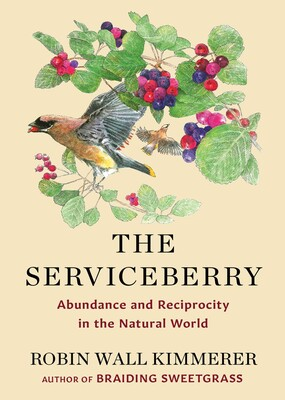
Once again, Robin Wall Kimmerer’s book does not disappoint. The Serviceberry: Abundance and Reciprocity in the Natural World is a beautiful little book that is so worth reading. Kimmerer invites readers to imagine alternative economic models and theories, all while helping us understand and appreciate natural systems and especially plants like the serviceberry.
Serviceberries are common wild plants and they flourish in the countryside where I grew up. They can be tart and coarse and crunchy. They are not the pure treat of huckleberries or raspberries, but they do seem naturally healthy and normal and good when you eat them. More than ever, it seems important for people to know and consume natural foods. Kimmerer helps us get there.
I read somewhere that Wendell Berry (and I mostly like Wendell Berry!) was one of Margaret Renkl’s influences, and I could definitely see that as I read, especially in the attention to and elevation of the natural world.
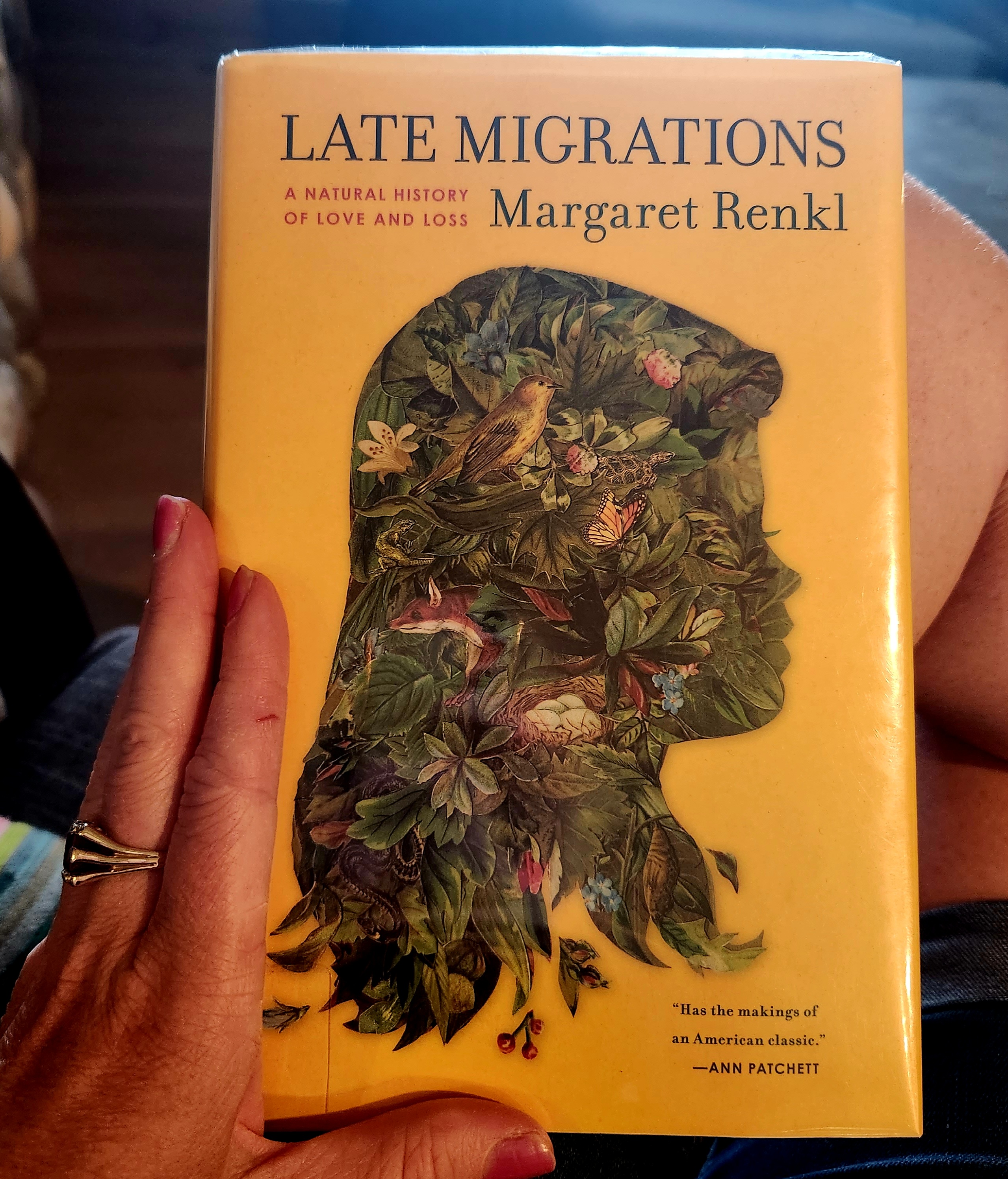
Late Migrations: A Natural History of Love and Loss is a beautifully written book that does so many important things: it captures the lifespan intimate family relationships, the landscapes that hold them, and the socio cultural aspects of these southern spaces as well.
It is also very clear that Renkl is a trained poet, as this makes the prose beautiful to read. I always love it when writers are able to produce unconventional structures in books AND also get published. Overall–a bittersweet, but life affirming book.
So, Pamela Anderson is interesting. She’s raised her children. She’s gardening in Canada. She’s on Broadway. She’s galavanting around Paris Fashion Week with a bare face! Gasp! I’m really enjoying seeing an iconic figure doing something a little different than the status quo, in both subtle and overtly radical ways.
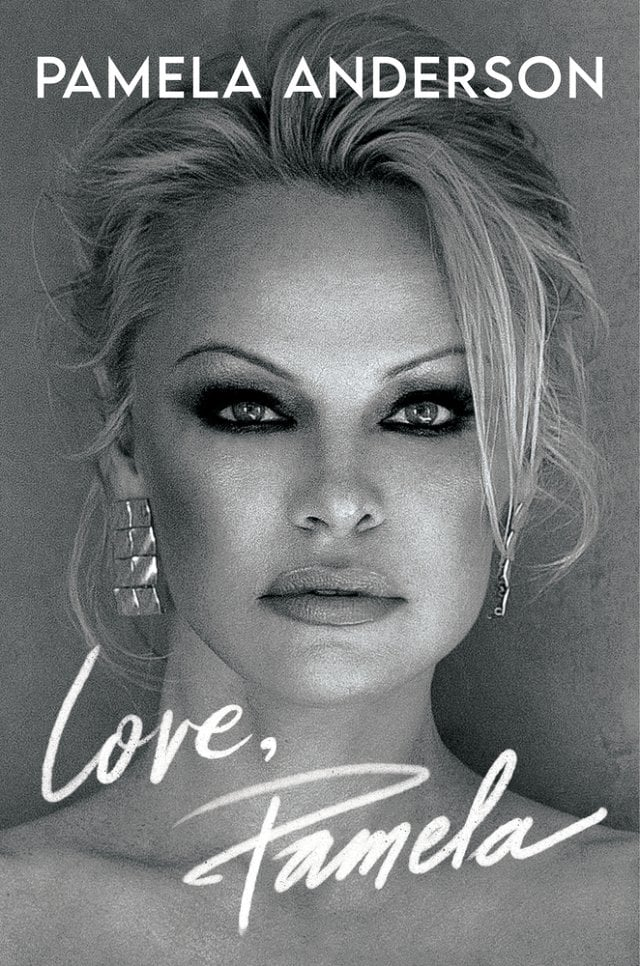
I just finished her book, Love, Pamela, and I really enjoyed it. She comes across as aware, intentional, not overtly prudish at all, but much more thoughtful than most women in her position are ever allowed to be.
Weirdly, perhaps, I identify with some aspects of Pamela’s life, especially her whirlwind romance with Tommy. He even proposed with a skull ring similar to the one that I received after a show from the person with whom I would later have children. Like Pamela, I also have seen some things, but like grounding back in familiar land, gardening, chickens, etc. Of course, there are also some critical and obvious differences too!
I appreciate that her voice is being amplified, and I look forward to seeing what’s next from this icon.
A few weeks ago, as we approached the end of 2024, I began looking back through old photos, and I was surprised to see just how much I did this year: a winter break in Idaho, a springtime trip to Louisiana, some good summer fun in Idaho; a epic trip to the Oregon coast; and then up to Guemes Island in the San Juans for a beautiful wedding, and then back through the state of Washington; and finally a trip to Palm Springs, before buckling up for the marathon of end-of-year holiday festivities.
In 2023, I started exercising a bit, but in 2024 I actually got strong. I ran two 5ks and one 10k, and even ran a PR (post high school) in one of the 5ks at 26.29 minutes, which is not fast, for the record, but felt good and fast in my body, and I was 5th in my category!
I loved my little farm, I sheared my little sheep, and I watched the northern night sky light up with aurora borealis. I put together a two-story playhouse, made what is becoming an annual pilgrimage to Yellowstone (especially Lake Isa), watched rodeos, and entered my homegrown raspberries in the county fair. I got two new chicks, hatched from my hen’s own fertilized eggs, so now I have three: the original hen and her two black and white-laced daughters. Hopefully I’ll get my first eggs from them in 2025.
Through it all I also worked on several major work-related writing projects and one major creative project, which I hope will soon see the light of day, so that I can share them with everyone! I also read many lovely books.
As this year comes to an end, I also find myself at the end of a nine year in numerology. I can see some obvious themes and projects wrapping up in my life, but if the upcoming one year is anything like my last one year, it will be full of big, transformative life changes that I can’t yet fully see now. There’s a lot to like about life right now, but I’m trying to work on embracing the inevitable changes and growth that come my way.
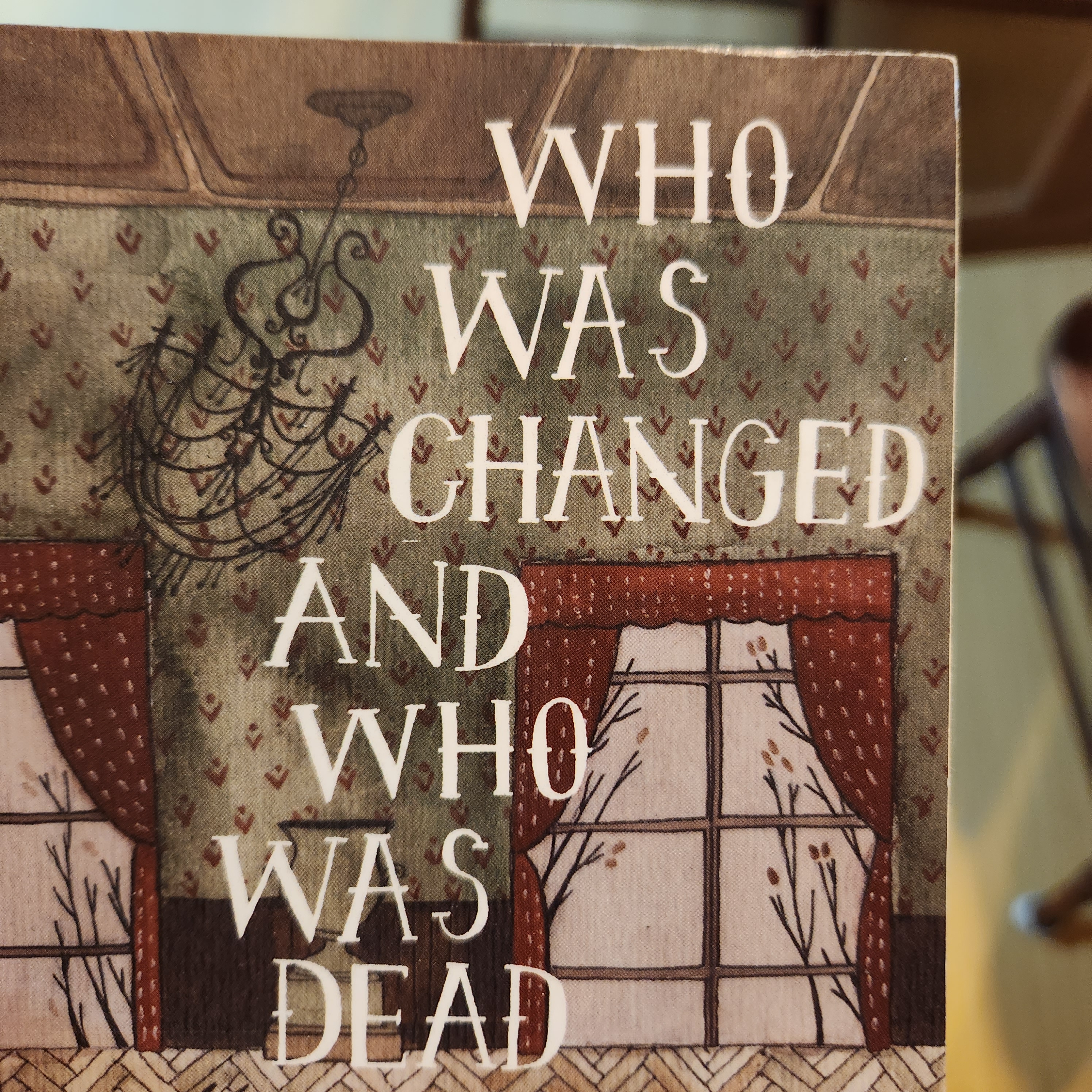
I’m grateful for Dorothy, A Publishing Project for breathing life back into this 1954 gem by Barbara Comyns, entitled Who Was Changed and Who Was Dead. The title alone got my attention, and the rest of the book did not disappoint either. It is a great narrative, that paints a bizarre, almost mystical crisis within a small town. Comyns portrays all of human ugliness with great humor and insight. The imagery is also beautifully done.
Interestingly, I started the year with an Agatha Christie murder mystery, and there is something I really appreciate about this era of writing. It is very straightforward, but that close and careful approach also highlights the intentional writing and brings the descriptions into greater focus.
Robinson’s reputation precedes her. I first read Marilynne Robinson book Housekeeping, which I thought was extraordinary. Robinson is one of the authors that my grandpa used to read out loud, his gravely voice adding even more significance to each word. I frequently thought of him during this book.
Robinson’s Lila, which I have read out of order from the other books in this series (Gilead and Home), is a quiet, thoughtful book. I wondered at the repetition of some of the ideas the repeated detail of laughing with Doll. The repetition of imagining geraniums at the window. Was this intention. These details certainly make the point, but why were they repeated? At the end, I do not know and cannot tell if it was intentional.
After reading this book, I can confirm that I will also look to read Gilead and Home at some point in the future, though somehow I doubt that any will be as good as Housekeeping. Still, it’s nice to know I have them to turn to when I need a guarantee of a good book.
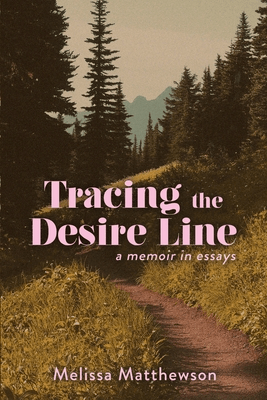
I read Tracing the Desire Line by Melissa Matthewson over the course of a few months. I started the first half before the holidays and the last half after. The book is beautifully written on the level of the line. I mean, it has a lovely structure overall as well, but the line really stands out.
The content of the book was personally challenging for me to read. The author navigates desire, FOMO, long term relationships, and does so through a lot of pain, and also some pleasure, though even that pleasure often seems anything but pleasurable (I often imaged the smells of old cigarettes, sour alcohol sweat oozing through pores, and someone else’s odor that just does not smell right).
I guess because of my age, and the relationships that are all around me. So many are navigating similar relationships, reactions, etc., and so it felt true and also frustrating. I admired the author’s ability to be the “bad guy” in the book. I think it’s so much easier to write from a sense of false victimhood, but the author doggedly avoids that and stays firmly in a place of truth telling, even when it is not flattering, even when it is something readers might imagine she’d rather forget, and even when this mistakes are out there for everyone to see.
I am reminded just how vulnerable one has to be in order to write good books. As for this one–it is worth reading for the line, but also because of the honesty, even when it is ugly and difficult.
Trees at Leisure by Anna Botsford Comstock is a very unusual little book! At first I thought it was a chapbook. Then, perhaps a small book of poetry. I was a few pages in before I decided to Google it and find that this is actually an instructional book, intended and funded to inspire understanding and appreciation for trees–and originally published in 1916 no less! The illustrations are gorgeous. The text is strange and insightful. It’s worth the quick read through.
True to form, my “breezy summer beach read” was neither breezy nor read on a beach. Instead, I read Rebecca Solnit’s 2021 book, Orwell’s Roses. Solnit is an incredibly prolific author, and I like her work, but it is heavy and deep, and I rarely feel up to the task. However, at the beginning of the summer, this copy caught my eye at the local library, so I checked it out and read it whenever grading was complete and babies were asleep.
Here’s the copy that I read.
This book is about Orwell. Politics. The roses that he grew at his cottage. His interest in gardening and the natural world, and the hope that can be found there. Writ large, the book is about labor and freedom and politics and all of the themes of Orwell’s own writing, reflecting on labor and illness in Orwell’s time and also today. Solnit draws links between political strife that Orwell wrote about and the political strife of today.
As you know from my Instagram, I am interested in plants and gardening, especially flowers. I love the idea of growing food in whatever piece of earth one might inhabit. I like my own sheep, chickens, and flowers. I love to take a close look at a plant and watch it as it changes throughout the seasons and over the years. Evidently, Orwell and I have that in common. Unlike Orwell (and Solnit), however, I am less insightful and imaginative when it comes to politics, so I appreciated Solnit’s ability to meld the two together in ways that helped me learn and see these subjects all in a new light.
When I start reading Solnit, I think “This is mostly boring and only a little interesting,” and those thoughts are interspersed with with absolutely lovely prose and engaging content, and I love that about her writing. Reading Solnit is like the good feeling I have after I eat my vegetables and get my exercise. When it comes to nonfiction, Solnit is the realest deal. She also gives me permission to go on long tangents, and take up words and space, because it is meaningful to me, and trust that it will be meaningful to others as well.
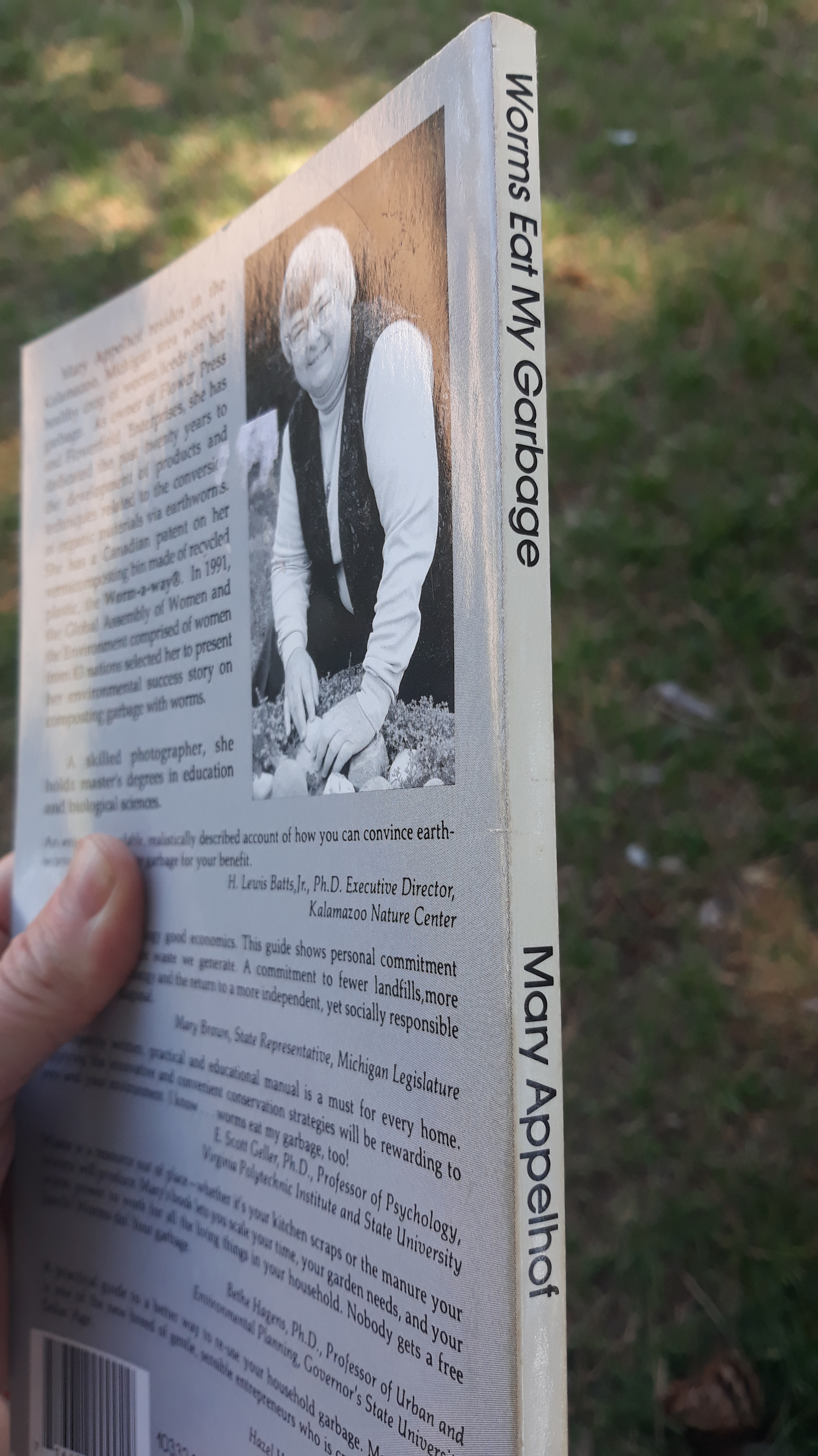
Worms Eat My Garbage by Mary Appelhof was a Little Free Library find and a quick read. I was first introduced to the idea of composing with worms from a professor in grad school. It’s an intriguing idea, and since this version of the book was published in 1982, it’s easier than ever thanks to YouTube and relatively affordable worm containers and systems. Back in 1982, they were building their own boxes, for example.
My take away is that it’s a great idea and is especially suitable for people who do a lot of cooking and eat a lot of vegetables and are not squeamish about worms. I, on the other hand, am a little afraid of worms, and, while it hate to admit it, I do think a lot of the garbage my household produces is…junk food. And, evidently junk food is salt and spicy and might mess up the ph of the soil. Reading this book does make me want to figure out a good composting system for my home. That’s my takeaway.



 SHEREWIN