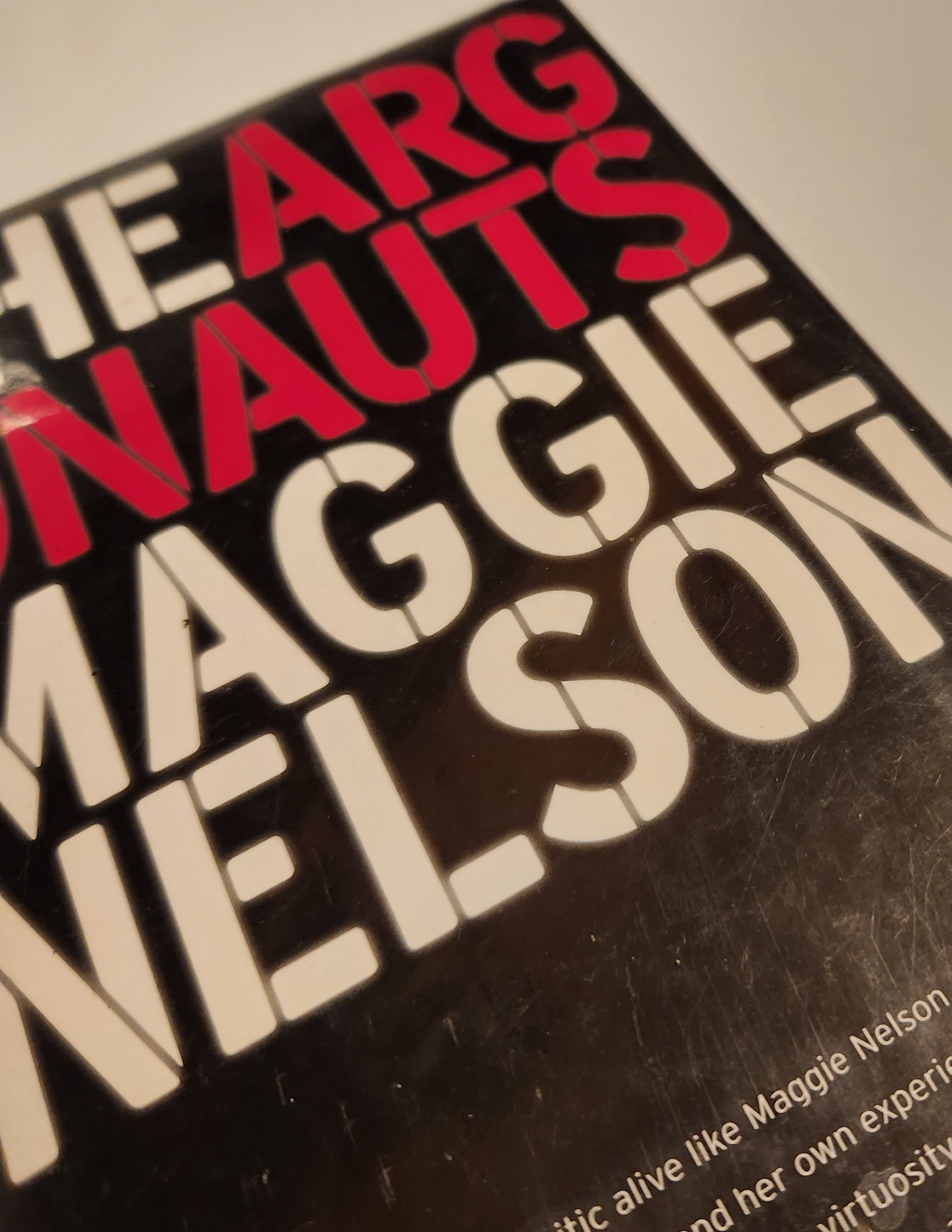
The Argonauts by Maggie Nelson wasn’t on my reading list, but I dropped everything when I remembered I hadn’t read it. What a great book! First, it should be taught in graduate-level theory courses. (It probably is, but nothing like this was taught in mine.) We need more feminist theory like this that truly integrates the (deeply) personal with the philosophical. I can’t be the only one who gobbled this up, and I suppose I can do my part by quoting it and integrating it into my scholarship myself.
The blurbs about this book say it’s about art and philosophy, but, I don’t know, somehow those descriptions fail to capture what Nelson is doing, which is, admittedly, unparalleled and difficult to describe.
The book helped me understand some philosophy and culture more deeply through her insights and critique. Unsurprisingly, I clung to her thoughts on motherhood, joy, femininity, womanhood, and culture. Perhaps especially as a mother, I appreciated the spare, yet complex prose. What can I say–The Argonauts is yet another important book by Nelson.
Breasts and Eggs by Mieko Kawakami delves into a modern, urban female experience. The main character navigates the big questions women must face and the relationships they must navigate. Kawakami leads the reader through these issues without defaulting to any oversimplifications. The opposite, actually. Each question and relationship is as complex as real life. This book feels almost memoiristic, as I imagined Kawakami as the main character. (I’m prone to doing this though.)
The main character, Natsu, comes from poverty and brings herself out of that slowly as a novelist (the most unlikely of stories!). This character’s life leads her away from her family roots (in a sense) and complicates her relationships with her now very small extended family, not that these relationships are ever uncomplicated.
Her past (experiences with poverty and loss) also complicate her relationships and her abilities to be in a romantic relationship and to create a family of her own.
The book is strange. Natsu is confused. There is tragedy and there is triumph. It is nuanced, and that is true of the human experience, and in this case, it’s focused especially on the female experience.
I read that Breasts and Eggs was once published as a novella and then was expanded into a longer novel, which is the version I read. Through most of the book, I found myself wishing that this was two separate books, but then again, I love a good, short, digestible read. However, now that I’ve reached the conclusion, I do think extending it into one long book is defensible.
For the first half of this book, I felt myself impatient with the main character, Lucy. I am so hungry for a female lead who is not so passive, who knows her own mind. However, the writing was good enough that I suspected this all too common characterization of female leads was going somewhere meaningful, and I was right. I also grew to appreciate the spare writing style and the diary-entry style that she uses to develop a consistent sense of voice and theme throughout.
Elizabeth Strout’s Lucy by the Sea is a great book worth reading. Although this history seems so very recent, Strout’s book helps me recall just what the early days of the pandemic were like and the politics surrounding that time.
Even more interesting to me were her characters and the subtle insights she develops through the book to help the reader see just how they came to think and act like they do. None of this life gets wrapped up in a pretty bow, and Strout’s work reflects that not uncomplicated reality.
What a gorgeous book. Caroline is a friend from grad school, and so this book has been on my radar since it came out. However, it’s publication coincided with the birth of my son, and so I’ve been delayed in reading it. I’m so glad the time has finally arrived!
This story is undeniably epic. Reading it will reacquaint you with your adventuresome spirit, no matter how modest. At the very least, you will want to get outside and go for a hike. Information about birds and migration is artfully interspersed throughout. The uniqueness of the land and animals is overlaid with insights about climate change, and it’s impact.
Caroline’s book is the antidote to the seemingly cool, unemotional adventure teams that appear to work solely from complex datasets. And mostly male. She is fully human, full of life’s most pressing questions, full of fears and doubts, and also gumption and bravery. She brings readers intimately into the complex experience of a 4,000 mile human powered trek. We learn that just like the choices we make in life, sometimes there isn’t a well established path forward, and the answer is found in weighing options, wrestling with the odds, and searching one’s own preferences.
My Body by Emily Ratajkowski is a unique book–part expose on the seedy world of modeling, fashion, Hollywood, and fame, and part memoir, with deep personal introspection. In the book, Ratajkowski, whom I was vaguely aware of as a model, but now a fan and follower on Instagram, shares the story of her rise to fame, known for her perfect body. But, she’s also critic of the abuse she suffers at the hands of both the industry and the larger culture. She’s a critic of herself too, acknowledging stories when she was too naive, too confused, too scared, or too complacent to do better. It’s a complicated book that sends readers on a trajectory of introspection about women’s bodies, while also offering a look into an elite (and also surprisingly not glamorous in so many ways) world that few get to experience. I hope she’ll write more, especially about motherhood. This book is worth the read!
What can I say about Why Be Happy When You Could Be Normal by Jeanette Winterson? She has an incredible life story to draw from and she does so in writing that understands all of the conventions of good writing. She writes about the horrors and abuse that kids face with little to no place to go to escape and how severely this is amplified for queer kids, and I think she started telling this story before many narratives like this existed. That’s important.
In many ways this book felt like the same book she’s written before. This one is about her mother “Mrs. Winterson,” and about herself. I found myself wanting it to be more about her biological mother, whom she journey’s to find in this book. However, I suppose it makes sense that it’s more about her adoptive mother, about whom she’s spent a lifetime thinking, and much less time processing a biological mother.
It’s a book worth reading. Just like the title, the book is shocking, profound, makes no sense, and is kind of funny.
First, here are my unsolicited blurbs for this book: “Please option this for a film asap.” “Woolf is a modern day Nora Ephron.” (Possibly influenced by the fact that I just finished Heartburn, but still!) “This book is the true LA Story.”
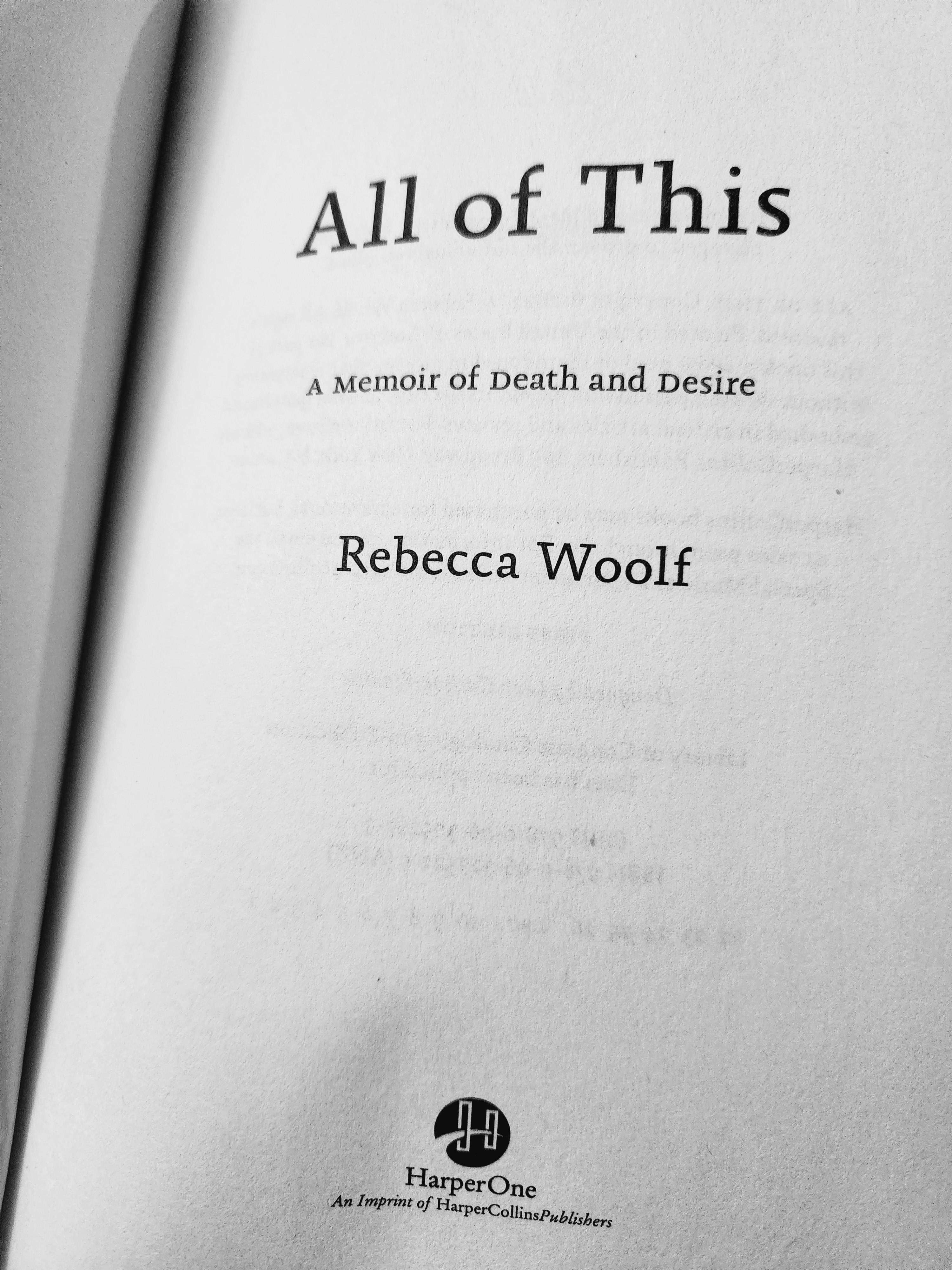
After following her work online for years (as one of the thousands of people whose fingers hold her up in this cosmic game of light as a feather, stiff as a board), I have been eagerly awaiting my chance to read All of This: A Memoir of Death and Desire by Rebecca Woolf.
The first half+ of this book is a gripping narrative. Later, the book becomes less plot driven and slows, and I think that’s because the “after” is not/could not be a linear trajectory.
Woolf wrestles with what it means to be a feminist, or to become a feminist, and puts a magnifying glass to some of the common dynamics of life, relationships, particularly heterosexual relationships that are, to say the least, problematic. I was with her for these points because I also wrestle with many of the same questions. I differ though. Unlike Woolf, I was less tied down in my early adult life, and more so now, even though still not very “tied down” by comparison, and that is by design. I had my children later, but a decade ago, I was also reading about her life online. To be reading this book now, as I have little ones of my own feels very full circle, which she would enjoy.
Here are some lines I loved or identified with and/or that gave me pause:
First, as a fan of her writing, I loved seeing her include her numbered lists with numbers that get longer and insaner each time.
“I will not shrink myself nor prioritize people’s pleasure over my own.” Simple, true. It can be hard to recognize when it’s happening.
“Then the 2016 election happened.” This changed me forever too, and I am still not over it.
“WHAT IF IT DID NOT TURN OUT TO BE CHILL?” Just, lol, yes, this is what it is like to be a parent, mother, woman in life.
“I soon realize that it’s a lot faster for me to pack four lunches on my own.” This is just simply true and a lot of people don’t know it.
“My daughters. They are only mine now.”
“The bravest women I know are not widows. They are divorced.”
“And there is nothing I can do but let it go and drive him home. This is the moment I became a single mother.”
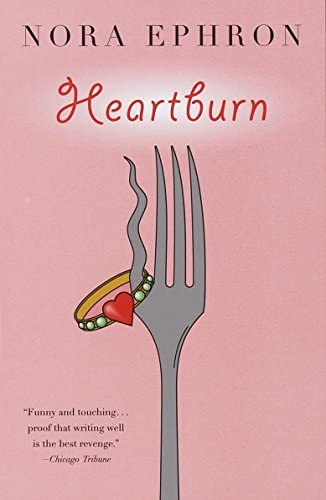
I had to set aside Heartburn by Nora Ephron shortly after I started because, after reading some of the other seemingly deeper, more “artful” books, I found the content to be a little too silly or irreverent. When I returned to it though, I was ready, and it is an excellent book.
Published in 1983, it really captures an interesting period of time (aren’t they all?) for women. The book is simultaneously feminist and sexist. There is truly some insightful feminist though. There’s also some internalized, unselfconscious sexism too though. There are definitely some dated jokes that would not fly today. The book perfectly captures the culture of the 1980s, especially When Harry Met Sally, which I should watch again (have I ever seen it in it’s entirety?), which is a film that was also written by Ephron. For example, I could easily image Diane Keaton playing the read role.
I loved the portrayal of motherhood in this novel. Probably due in no small part to the amount of wealth and therefore help that these characters have, motherhood in the early ’80s seems lovely, enriching, rewarding, sometimes hard. These women have time to also be themselves and explore their interests (frivolous though they may seem). I think this is next to impossible in motherhood today, where women are expected to/have few other options than to do so much, everything, constantly, every second, for their children.
Still, though it may at times seem frivolous, Ephron packs a surprising amount of insights about the human condition into every single sentence. It’s a good book. There is some really good humor in it too, and I don’t say that lightly.
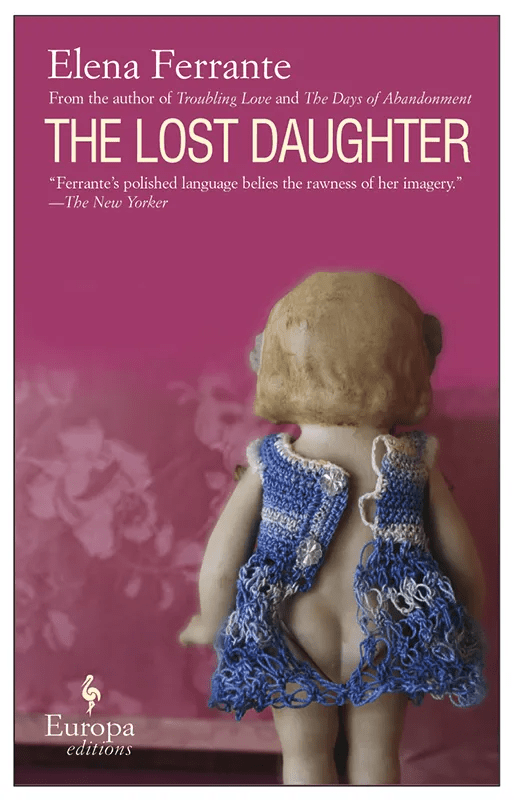
I read Elena Ferrante’s The Lost Daughter immediately after finishing My Brilliant Friend. This is another excellent, although perhaps more literary, piece than the first book of the Neopalitan Quartet series.
The Lost Daughter, also referenced in the Mother’s book, is about the darker side of motherhood, in a way that I found entirely relatable. Too often, critical books on motherhood are too critical, too negative–children are too exhausting, it’s not worth it, end of story. However, I truly appreciate Ferrante’s more nuanced approach. In The Lost Daughter, she turns a magnifying glass on the difficulties, violences, and burden of motherhood, the complete selfless turning over of the self that is required of the job, an ask that is far too demanding and made worse by societal constructs around motherhood and a general lack of support.
However, instead of dismissing the mothering journey altogether, as too exhausting, too violent, Ferrante acknowledges the duality of the role, the positive life changing aspects of it–the more complicated relationship it can foster in the self in regards to love, compassion, nurturance, service, and ambition. The little girl in The Lost Daughter is depicted as both angelic and beautiful from a distance, but up close is whiny, snot-nosed, crusty-eyed, and clawing, swatting, and pinching at adults around her. This is the reality of living with and loving a child. They are, each and every one of them all at once both transcendently perfect and also demanding, selfish, and incidentally cruel. To be a mother is to live within this duality constantly throughout the day. It’s complicated and beautiful and ugly too.
I discovered Elena Ferrante from Mothers by Jacqueline Rose, which I read recently. I started with Ferrante’s My Brilliant Friend, the first in a long series, and I loved it! The writing is excellent. The content is thought-provoking, and it also has the long sense of story found in easier, longer reads–not a common combination. Although it is long, I flew through it.
While I highly recommend the book, I will warn that I found the conclusion to be somewhat disappointing. I wanted a strong wrap up for this particular book, but instead found myself needing to read more of the series in order to get that. It will probably require reading all four books.
I ended the book somewhat exhausted and unwilling to continue with the series. Maybe I’ll return to them someday. They’re certainly worth it, but, and I can’t believe I’m writing this, I really don’t have the energy to give them at this point in my life.
I’m glad these books are out there. Sometimes I just need a good book, a good story, and I now know I can turn to Ferrante to get that.
I am also inexplicably obsessed with the cover art:



 SHEREWIN