Category Archives: nihlism

When: The Scientific Secrets of Perfect Timing by Daniel H. Pink

(Yes, audiobooks have entered the chat.) I recently finished When: The Scientific Secrets of Perfect Timing by Daniel H. Pink. This was an interesting book that was full of tidbits all loosely connected to the idea of timing. Pink pulls from every imaginable study on timing and presents them in the book, adding lots of his own examples and anecdotes.

While some will call this a kind of pseudoscience and others may find the content to be too broad or too common, I think Pink balances enough really interesting information on timing throughout to engage readers. I have already found myself sharing anecdotes from the book in the days since I finished it.

I think I might also be feeling some “life-hacking” or “bio-hacking” fatigue lately and sometimes just want to “let the soft animal of my body love what it loves.” However, I have to admit that in the past, I’ve known and used some of the tactics he mentions in the book, and there has definitely been a benefit. I think it’s worth the read, especially if you’re on an uptick in life and feeling motivated to improve.

Anatomy of the Spirit by Caroline Myss

Next up in my series in the self-help genre was Anatomy of the Spirit by Caroline Myss. I have read, or skimmed (or was supposed to read?) Myss in the past–I can’t quite remember–but either way, this book was familiar. In it, Myss compares the Eastern concept of the seven chakras to the Catholic concept of the seven sacraments.

Peronally, I am much more familiar with the chakras than I am with the seven sacratments. But, based on my limited understanding, I thought the comparison was often clunky, especially in regards to the first three chakras and first of the seven sacraments. Sure, both are seven, and sure, seven is considered a sacred number across many traditions, but beyond that, the comparisons often felt like a stretch.

Myss, like many of the gurus in The Wisdom of Sundays, has to hedged her integration of an Eastern tradition into her practice or theory. I find this kind of hedging to be kind of sad and frustrating. On one hand, it can dumb down the content, and on the other hand, I am just baffled and disappointed about what this says about society’s ability to hold on to complex and/or competing ideas. Still, I suppose these baby steps are necessary. Either way, while I was sometimes weary of Myss’s use of Christianity as a foundation for the philosophies in ways that did not feel productive, I still found a lot of wisdom in her words. There are many nuggets of truth to be had here.

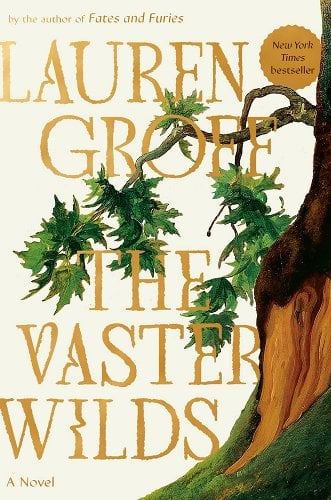
The Vaster Wilds by Lauren Groff

I can now join your book club because I have finally finished reading Lauren Groff’s The Vaster Wilds. Now, what to say.

I am a fan of Groff since I read her book of shorts titled Florida. So, I knew The Vaster Wilds would be good, and it was. It was also torturous. I feel like culturally we have a Game of Thrones kind of obsession with torture right now, and that also makes sense culturally, and all of the anger, hate, and misogyny we see is reflected in our art, and so it does makes sense. However, that does not make it easy.

Still, the book is good and worth reading. This is especially true if you like popular books, but strive to read more literary works because this has some of the elements of popular fiction, while also feeding the nourishing steamed broccoli that is literary-quality writing. (Given the starvation of colonizers in early 1600s America, all food analogies probably fall flat.) Funnily enough, I was near the end before I realized the vaster in the title was not a reference to a proper noun. In years to come, I could see this piece taught in college courses because I think there is just so much here.

Rough House by Tina Ontiveros

Rough House by Tina Ontiveros is excellent. Excellent. I don’t say it lightly when I say that I think she is like a female Raymond Carver–Carver, a magnificent writer, who, in my mind, so perfectly captured the unique culture of the Northwest, the logging, the mill towns, and the landscapes (portrayed unromantically, but true). In fact, Ontiveros has lived in some of the exact same towns as Carver!

Carver died decades ago, and the Northwest of the ’80s, ’90s, and today deserve their own new depictions. Ontiveros does just that. The author writes about her troubled childhood and geniusly pairs the horrific abuse with the love in that unique way that it is so often packaged together in families.

Because I am so deeply rooted in the Northwest, having grown up here myself, being a part of a larger family that has lived here since the time of the Oregon trail, and living in a family whose income came from logging, mill work and the like, Ontiveros’s novel was so very familiar to me. I loved how she captured the culture, the strong sense of place, even the language.

I am stunned by this work.

Lila by Marilynne Robinson

Robinson’s reputation precedes her. I first read Marilynne Robinson book Housekeeping, which I thought was extraordinary. Robinson is one of the authors that my grandpa used to read out loud, his gravely voice adding even more significance to each word. I frequently thought of him during this book.

Robinson’s Lila, which I have read out of order from the other books in this series (Gilead and Home), is a quiet, thoughtful book. I wondered at the repetition of some of the ideas the repeated detail of laughing with Doll. The repetition of imagining geraniums at the window. Was this intention. These details certainly make the point, but why were they repeated? At the end, I do not know and cannot tell if it was intentional.

After reading this book, I can confirm that I will also look to read Gilead and Home at some point in the future, though somehow I doubt that any will be as good as Housekeeping. Still, it’s nice to know I have them to turn to when I need a guarantee of a good book.

Remembering Laughter by Wallace Stegner

Remembering Laughter by Wallace Stegner is a classic novel that reveals why people are the way they are. Or, more specifically, why this one family is the way they are.

In his book, Stegner reveals himself to be a master author, demonstrating artful craft on the sentence level, accompanied by deep insights into the human condition. None of this is news though. Stegner is obviously a renowned author–though I don’t think I’ve read his work before.

I found myself wondering why this novel isn’t taught more often. It’s a short, manageable size and one that students could easily get through in a short timeframe, leaving plenty of time for discussion, analysis, and response.

Stegner’s more famous work is Angle of Repose, which evidently has some criticisms on it surrounding plagiarism, which then calls into question his methods and all of his work. Remembering Laughter is worth the read though and won’t take up much of your time.

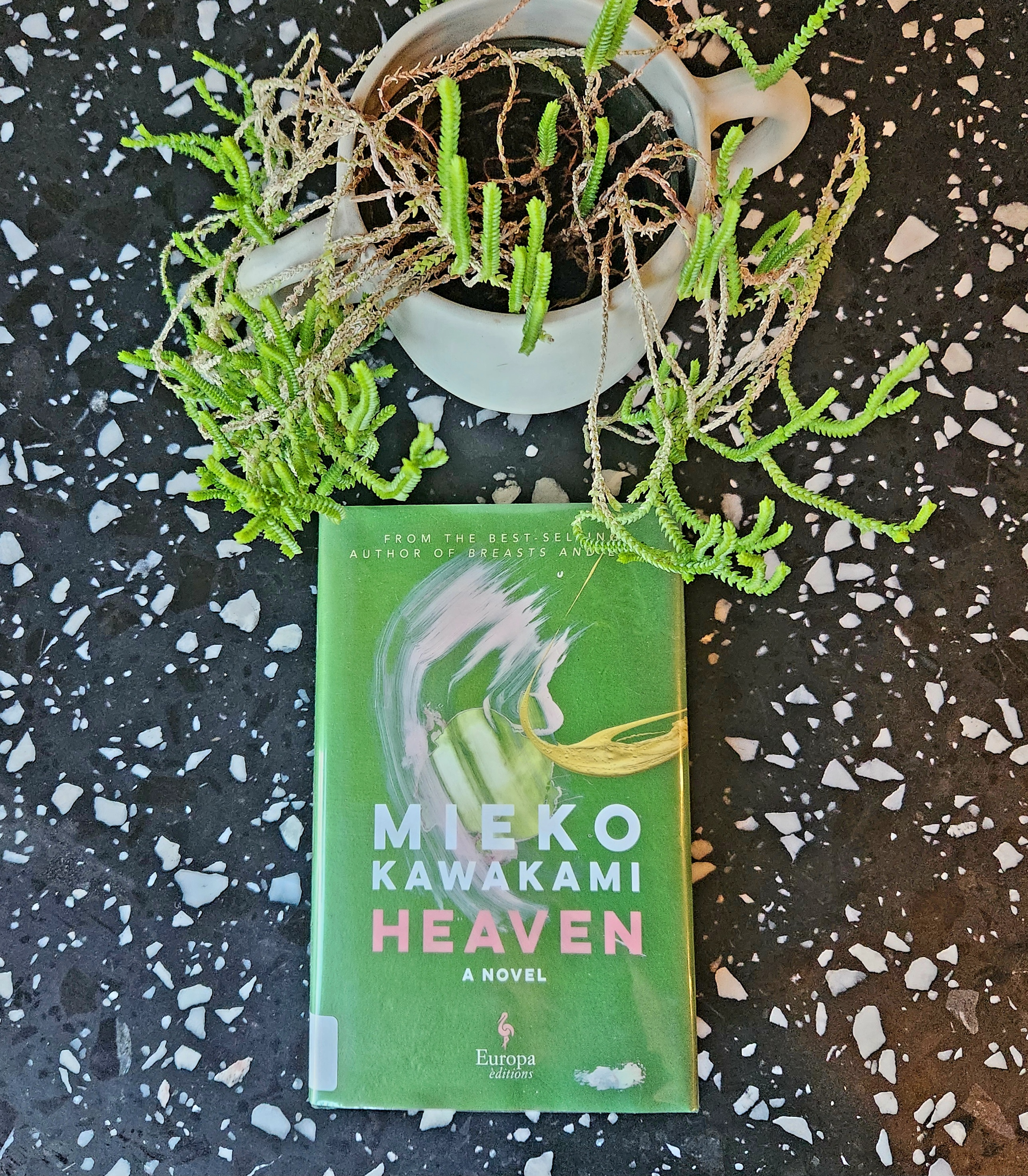
Heaven by Mieko Kawakami

I decided to go ahead and read Heaven by Mieko Kawakami this summer while I was at it, and, wow, this is a heavy, but, of course, excellent book. It is such a departure from the much more distanced and gentler narrative in Breasts and Eggs, which I also read and wrote about a few weeks ago.

I’m not sure how I missed this, but there is a heavy portrayal of bullying in Heaven, and I don’t think that’s a spoiler, but I do think it actually does need kind of a big “trigger warning” splashed across the front of this book because it.is.intense.

However difficult this book may be, it is excellent, as Kawakami is proving herself (to me) to be an excellent writer–excellent pacing, character development, and a deep emotional landscape.

As an aside, this book is also much shorter than Breasts and Eggs, but my copy also included an excerpt of Breasts and Eggs at the end, and I’m not quite sure why this choice is being made because the current version available of Breasts and Eggs is also an elongated version of the original, but I just wanted to add here that this length of book–just Heaven–is a great length, and I think Kawakami works really well within this frame.

Spare by Prince Harry

After watching some of the recent interviews with Harry and Meghan, my curiosity was piqued to read Spare by Prince Harry. For those who have been following along, this is a great book. Fans of Princess Diana will appreciate it too. The book effectively captures his tone. It offers the kind of inside look that audiences never get access to. Prince Harry bravely takes up vulnerable and taboo topics in the book. He openly admits to his bad behavior. He openly admits to his anxiety and depression.

Where this book is a triumph is in its ability to show the royals as real, fallible, human people. Of course logically we know this, but due to tabloids, celebrities often get distilled down to products for consumption rather than treated as real people. I appreciated that about the book.

Strangely, I sort of identified with some aspects of Prince Harry’s experience. He writes about visiting the site of his mother’s death years later and mentions that its the first time he’d been to Paris, but I assumed he would have traveled to all of the world’s major cities frequently. His visit was in close proximity to my own first visit to Paris. But for me, it was more understandable. I was raised in a rural location without a lot of firsthand experience with the outside world. I could read about it, but I’d never actually, for example, walked the streets of Paris. It’s great, but it’s also a somewhat isolated experience. Prince Harry’s experience seems somewhat similar. While school and studies take up a big part of his life, another big part of his life seems to have been safely sitting alone in castles.

It’s clear that Prince Harry is traumatized by the loss of his mother at the hands of paparazzi. It’s clear that the trauma informs his own reaction to the paparazzi today, and that’s made even more evident in his drive to protect his new family. While others may say that he should ignore it, or that by recounting these baseless stories in his book, he’s just giving them more air time. There’s no accounting for a broken heart and how it will make you feel and what it will make you do.

I am sympathetic to Prince Harry, but I don’t see eye to eye with him on everything. I don’t need to. In fact, challenging the audience in these areas is probably part of what makes him so compelling. I am more sympathetic to the circumstances of the other members of the royal family. I think they’re in both a really privileged situation and a really limiting one as well. As is made clear in Spare, the royals are, again, real people with all of their own strengths and challenges, living within a limited, but also very privileged world.

Orwell’s Roses by Rebecca Solnit

True to form, my “breezy summer beach read” was neither breezy nor read on a beach. Instead, I read Rebecca Solnit’s 2021 book, Orwell’s Roses. Solnit is an incredibly prolific author, and I like her work, but it is heavy and deep, and I rarely feel up to the task. However, at the beginning of the summer, this copy caught my eye at the local library, so I checked it out and read it whenever grading was complete and babies were asleep.

Here’s the copy that I read.

This book is about Orwell. Politics. The roses that he grew at his cottage. His interest in gardening and the natural world, and the hope that can be found there. Writ large, the book is about labor and freedom and politics and all of the themes of Orwell’s own writing, reflecting on labor and illness in Orwell’s time and also today. Solnit draws links between political strife that Orwell wrote about and the political strife of today.

As you know from my Instagram, I am interested in plants and gardening, especially flowers. I love the idea of growing food in whatever piece of earth one might inhabit. I like my own sheep, chickens, and flowers. I love to take a close look at a plant and watch it as it changes throughout the seasons and over the years. Evidently, Orwell and I have that in common. Unlike Orwell (and Solnit), however, I am less insightful and imaginative when it comes to politics, so I appreciated Solnit’s ability to meld the two together in ways that helped me learn and see these subjects all in a new light.

When I start reading Solnit, I think “This is mostly boring and only a little interesting,” and those thoughts are interspersed with with absolutely lovely prose and engaging content, and I love that about her writing. Reading Solnit is like the good feeling I have after I eat my vegetables and get my exercise. When it comes to nonfiction, Solnit is the realest deal. She also gives me permission to go on long tangents, and take up words and space, because it is meaningful to me, and trust that it will be meaningful to others as well.

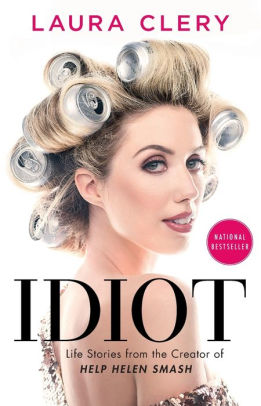
Idiot by Laura Clery

Ok, I have very mixed feelings about this book. On one hand, some of this author’s work is genuinely funny, and she has some genuinely crazy and frightening stories resulting from her addiction. On the other hand, there aren’t many laughs in the book, and the entire experience is somewhat cliche.

The story is one we have all heard. Attractive broken person heads off to Hollywood to make it big (in no small part because there is absolutely nothing else they could possibly succeed at). Person spirals into a chaotic and frightening world of addiction, “success” slipping in and out of grasp, until finally, after a decade or two in the business, some modicum of success is achieved and a tell-all book is written.

Clery’s comedy is more slapstick than is my taste. A lot of it is also pretty contrived. A central part of her work involves fat shaming to a degree. Her accent is imprecise. I find myself searching for her authentic voice, but it constantly oscillates between suburban Chicago housewife, valley girl, vapid model, and British.

In this book, the narrator is unreliable. She writes that her husband was divorcing when they met. But, fails to mention the wife when recapping her husband’s bio. She reveals herself making stupid choices, then she demonstrates awareness of stupid choices, but she also seem unaware of some of her toxic habits as well: borrowing money, codependency, and requiring caretakers, even in current presumably healthy state. She unselfconsciously mentions how lame it is that she can’t make a new friend group within a two month time period. Staying home alone for a few days is a rock bottom lameness that sends her spiraling. I think it would be funnier if she acknowledged her own neediness and superficiality. I want to believe that there’s a lot more complexity to this person, and maybe it was just an issue of editing.

And yet! For a book that was most definitely dictated into one of those little handheld tiny recorders, and then pieced together by a beleaguered ghostwriter, the stories are gripping, and the attitude works. Positive affirmations, eating lots of raw fruits and veggies, meditating, being tall and thin and beautiful, marrying a successful man, living in a temperate climate, attending AA, trying, and persisting actually is a recipe for inspiration and success! I’m glad I read it.

Idiot: Life Stories from the Creator of Help Helen Smash