Category Archives: work

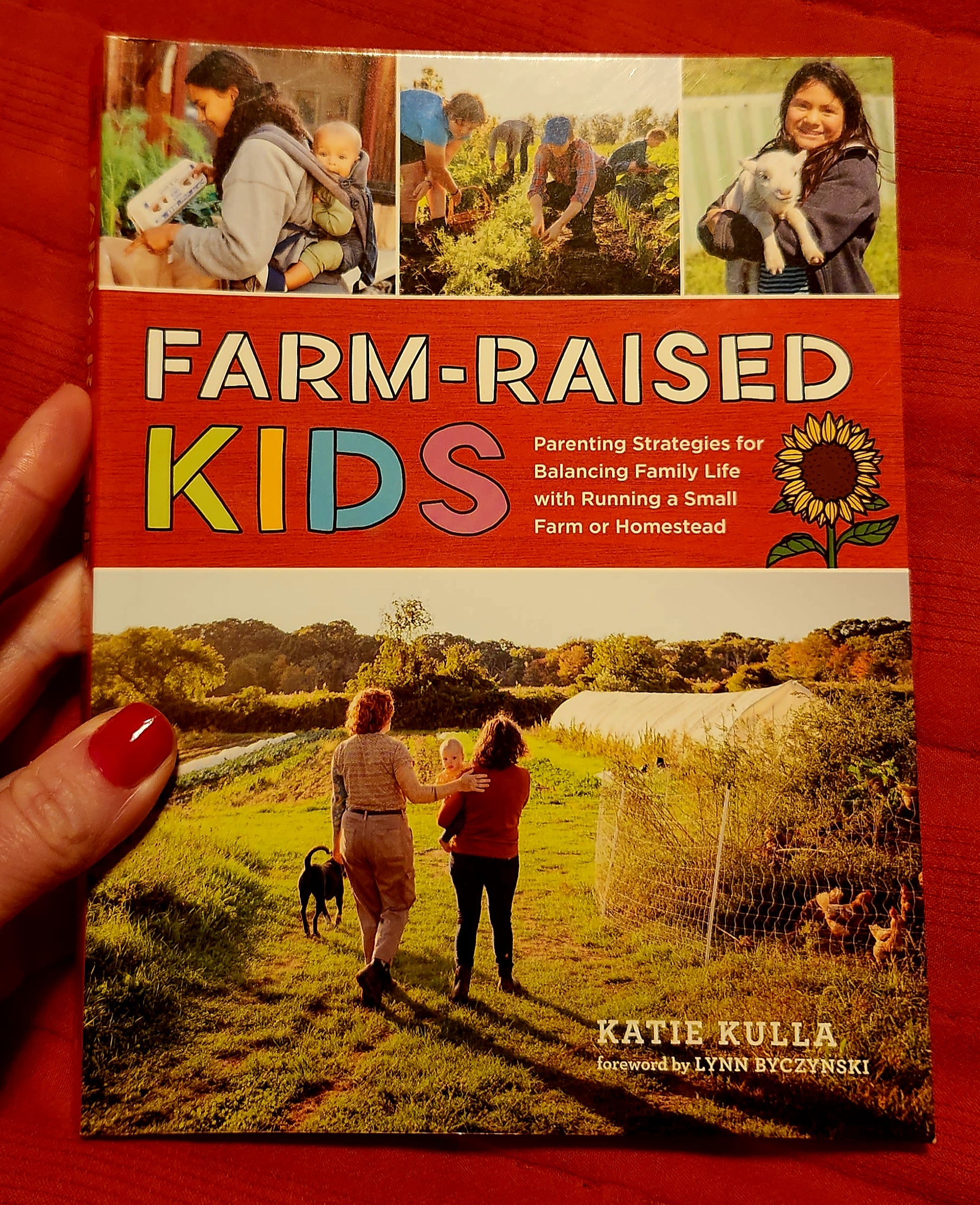
Farm-Raised Kids by Katie Kulla

This was a charming little book by a farmer I know from the west side of Oregon, Katie Kulla.

Parenting books can be difficult because parents tend to be exhausted, and advice and ideas are need, but there is no quiet, peaceful time to read! However, this book is easy to read, easy to digest, and it is informative, without making readers feel guilty or overwhelmed. It’s more like, “Hey, it’s good for kids walk go outside and walk on uneven ground.” Then, readers can feel good about letting their kid walk on uneven surfaces, play in dirt, or feel the sun on their skin once in awhile. It’s simple, basic stuff. It’s reaffirming, and I found it to be inspiring and encouraging.

I was also heartened to read that there are many different families, scenarios, and “farms” depicted, so that a broad range of readers might identify with the lives and lifestyles of these people. Go order Farm-Raised Kids by Katie Kulla now!

2024 year in review

A few weeks ago, as we approached the end of 2024, I began looking back through old photos, and I was surprised to see just how much I did this year: a winter break in Idaho, a springtime trip to Louisiana, some good summer fun in Idaho; a epic trip to the Oregon coast; and then up to Guemes Island in the San Juans for a beautiful wedding, and then back through the state of Washington; and finally a trip to Palm Springs, before buckling up for the marathon of end-of-year holiday festivities.

In 2023, I started exercising a bit, but in 2024 I actually got strong. I ran two 5ks and one 10k, and even ran a PR (post high school) in one of the 5ks at 26.29 minutes, which is not fast, for the record, but felt good and fast in my body, and I was 5th in my category!

I loved my little farm, I sheared my little sheep, and I watched the northern night sky light up with aurora borealis. I put together a two-story playhouse, made what is becoming an annual pilgrimage to Yellowstone (especially Lake Isa), watched rodeos, and entered my homegrown raspberries in the county fair. I got two new chicks, hatched from my hen’s own fertilized eggs, so now I have three: the original hen and her two black and white-laced daughters. Hopefully I’ll get my first eggs from them in 2025.

Through it all I also worked on several major work-related writing projects and one major creative project, which I hope will soon see the light of day, so that I can share them with everyone! I also read many lovely books.

As this year comes to an end, I also find myself at the end of a nine year in numerology. I can see some obvious themes and projects wrapping up in my life, but if the upcoming one year is anything like my last one year, it will be full of big, transformative life changes that I can’t yet fully see now. There’s a lot to like about life right now, but I’m trying to work on embracing the inevitable changes and growth that come my way.

Image from my 2024 Instagram “Top Nine” @sherewin

From Here to the Great Unknown by Lisa Marie Presley and Riley Keough

For the last decade or so, I’ve had a heightened interest in Elvis. What a legend! I love his staying power. I love his unique voice. I love the performance of it all. I especially love this song that totally melts my face.

So when I found out that Riley Keough and Lisa Marie Presley had written a memoir, I could not wait to read it. I was really hoping that Lisa Marie would have narrated her part, but it was read by Riley and Julia Roberts, and that was good too. Julia Roberts has a subtle Southern accent that really piques the imagination. There are also a few excerpts from Lisa Marie, and that is very satisfying.

Overall, From Here to the Great Unknown is an excellent book. Lisa Marie’s life was incredibly intense and full of tragedy, and the book portrays much of that in extreme detail. I learned new things. The descriptions of Graceland were incredible that I felt like I was there. Now I really want to visit Graceland!

Be Ready When the Luck Happens

I’m not quite sure when I first became aware of The Barefoot Contessa (and Ina Garten), but it seems as though I’ve watched her forever on TV. I’ve always been drawn to her husky, steady voice, her cheery, but steadfast demeanor, and the aesthetic of her work–the food and ambiance. I also just love that name–Barefoot Contessa. So when she finally wrote her memoir, Be Ready When the Luck Happens, I knew I wanted to read it.

The book is great, and her life is really fascinating. I was surprised to see the degree to which a feminist ideology ran through her story, through her life, and her choices. I found that I identified strongly with that aspect of her work.

However, I also noticed an incredible financial privilege and security that mostly goes without comment in the book. She is honest about times when she needed $100K for a building or a project. So it seems as though they were not super wealthy, but she definitely has always had access to circles that could help support her success. I’m sure some might think more commentary on that aspect of her life would have seemed uncouth, but I actually think her readers could handle more candid commentary on what the financial security felt like. For example, she writes about her uncertainty and turning down projects. But, interestingly, she was in a position to turn down work, and, well, that’s quite an interesting place of privilege.

Overall, it’s a great memoir, and I adore her even more. Now I’m going back to look at all of the beautiful cookbooks she’s created over the years too.

Prairie, Dresses, Art, Other by Danielle Dutton

The beginning of this book was not what I expected. The middle part, however, was. I expected Prairie, Dresses, Art, Other by Danielle Dutton to be much more theoretical (and it was!), but the first few chapters threw me. In a good way. The first few chapters were even scary!

This book reminds me of some of Maggie Nelson’s recent stuff, but this book of Dutton’s has more imagery, perhaps even more narrative, throughout than Nelson’s most recent, On Freedom, for example. Both are from Coffee House Press, which continues to publish all of the best stuff that the mainstream publishers are afraid of.

The Virginia State Colony for Epileptics and Feebleminded by Molly McCully Brown

I don’t read a lot of poetry, but recently picked up The Virginia State Colony for Epileptics and Feebleminded by Molly McCully Brown, and I’m so glad I did. I first read Molly McCully Brown when someone shared a link to an article she had written. I was blown away by the quality of the writing then. I follow her socials, and see that we know some people in common. So, I follow her work. In fact, I thought for sure that I had already read The Virginia State Colony for Epileptics and Feebleminded, but once I picked it up, I realized I had not. I would have remembered!

This is an excellent book of poetry. The whole project really needs to be poetry, and I like that about it, and I think nonpoetry readers (beyond popular poetry, anyway) will find this book to be a bit more accessible, and still completely artful. It reads up quickly. It does not need to be belabored. It just exists, and it is good. Go read it.

Molly McCully Brown won the Lexi Rudnitsky First Book Prize The Virginia State Colony for Epileptics and Feebleminded

The Uptown Local by Cory Leadbeater

After reading Joan Didion’s Blue Nights, I picked up Cory Leadbeater’s The Uptown Local at the library because it is about his life working as Didion’s assistant, and my interest in Didion had been renewed. This is a memoir, and Leadbeater has quite a lot to share about his own life and creative process, as well as what it meant to him to work so closely with Didion.

This book is honest and insightful, and very self aware. Readers will get some Didion fixes, but more than that, it offers insight into what it might’ve been like to be her assistant in her final years. And, I’m sure many readers and writers probably have fantasized about just such a job. I have.

Leadbeater portrays their dynamic as a kind of mother son relationship. In fact, Didion refers to herself a “mommy” in her book inscription to him. Leadbeater seems to wear his troubles on his sleeve, and Didion seems to not shy away from them. She seems to fully embrace and welcome him, even despite (or because?) of his challenges. Even when her more aristocratic friends disregard him, Didion is stalwart. I wonder if she saw her own daughter in Leadbeater. Some of their troubles seemed the same, from what I can gather, which is very little.

In the end, both Didion and Leadbeater both offer insights on relationships, art appreciation, poetry, and how to live a meaningful life–something we could all probably use.

Fleishman is in Trouble (miniseries)

Each year I budget time for about one show, and this year that show was the tv miniseries Fleishman is in Trouble. After reading the book, and hearing all the hype about the show, I wanted to see what it was all about. And, let me tell you, the show was what they said it would be. I think the show is better than the book, and I don’t need to feel bad about saying that since the author, Taffy Brodesser-Akner, also wrote the tv adaption.

[Continue reading only after you’ve seen the show.]

Basically, I just want to write out some of the things that I thought were really interesting about this piece. I thought the role reversal of the Toby character was interesting. I appreciated how he was in the traditional “woman’s” role in the show as emotional laborer and primary caretaker of the children in the family. His work is meaningful, but it (and he) is chronically undervalued.

I also appreciated how complicated Rachel’s role was. Like all of the characters in the book (really), she behaves terribly, and is good, but her backstory and raison d’être is fully and humanely formed. As a career-driven woman, she cannot win with her husband, and yet she is sexualized by a friend’s husband exactly because she is career driven, opposed to his own stay-at-home wife.

Lastly, and I think this is where the tv series really shines in the last few episodes, I really appreciated Libby’s complexity too. As the narrator, I wanted to trust her to make sense of these people, but it becomes clear that she is also emotionally stuck and is actually behaving in really sexist ways, even though she identifies and pontificates as an outspoken feminist. Her husband also takes on a typically female role in the relationship, managing the family and holding it all together as Libby gallivants around.

A take away for me lately is that relationships are hard and divorce is hard. We are too caught up in our own stories to see anything clearly. And yet, there is hope. And also cynicism. Everything. The entire show just pulls it together beautifully.

Blue Nights by Joan Didion

I just finished Joan Didion’s Blue Nights with actual tears running down my face. That’s probably not the best way to describe this book because while it is known to be about loss and aging, it is also not a tear jerker in my opinion. It is a beautifully written book that I read with great care, even taking the time to look up some of images and stories from the designers and famous characters she mentions. Even still, this slow burn packs a powerful punch as readers round the bend toward the ending.

Didion is one of the most famous writers of our time and is critically untouchable in my opinion. Some reviewers said this book was not as tight as her earlier work, but if that is true, and I do not think that it is, it is still a great book that offers a good deal of artistry around some of the most challenging of human experiences.

I read female writers of this generation with a good deal of interest (and I seem to read a lot of them lately). The tone in their writing has this formal, northeastern accent type of thing going on, and they have this deep femininity that I don’t think even exists anymore due to cultural constraints. I just…marvel at these people.

Didion is completely modern and completely relevant, and she made her daughter’s school lunches, and she wore red leather sandals with four-inch heals every day. What an icon.

Women Talking by Miriam Toews

My latest read was Women Talking by Miriam Toews. I did not see the film, but heard about the horrifying real-life premise, and it really stuck with me. This book was excellent yes, but I do have more to say about it.

This is a dialogue-heavy book. And those are tough, imho. It actually is mostly “women talking.” Most of the book struck me as a kind of feminist 12 Angry Men, and that was exciting to me. Toews pulls off the heavy dialogue, though it must have been no easy task. Toews was also able to draw out the unique qualities of the characters in a fairly limited space. Furthermore, Toews is particularly well-positioned to write this book, based on her own Mennonite background. She is able to draw on the kinds of religious philosophy in a way that felt very real to me as a reader.

[Spoiler] (though I still think the book would be worth reading): The book is narrated by a male character, August, who is a troubled young man and village teacher of the local young men. He is also a victim of the same oppressive culture of men that has also preyed upon these women. He takes notes during the women’s meetings. (The women are not allowed to learn to read and write, so they cannot take notes themselves.) At first, it seems powerful that the women cannot take their own notes, and August’s presence serves as a reminder of that. He also helps add some drama and intrigue.

However, by the end of the book, the emotional landscape really shifts to August entirely. On one hand, this is the reality for so many women’s lives: their story is not told, except maybe through the perspective of men. I was cheering this book on, as one that was still able to center women’s voices and dialogue throughout. In the end, though, I felt that the story became August’s story, and I am willing to entertain the notion that this is just the framing, and this is just how it is, and this can still be a feminist account, but as a reader, I wanted it to end differently. I wanted it to end through the lenses and perspectives of the women.

If you read it, tell me if you loved the ending, or if you wanted something different.