Category Archives: writing

Yes Please by Amy Poehler

After reading books like Tina Fey’s Bossypants, Mindy Kaling’s Is Everyone Hanging Out Without Me?, and Chelsea Handler’s Are You There, Vodka? It’s Me, Chelsea, I was excited to read this latest one by a comedian. I’m a die hard fan of Saturday Night Live. I tend to love the work that comes from their alums–probably because they know all the good writers. Of her SNL bits, I mostly loved the ensemble skits she was in. Leslie Knope, the character she’s gone on to play in Parks and Recreation, is just great. When it comes to Amy Poehler, I like her, but I think she’s best in collaborative efforts.

Her book was not a favorite. If you’re a die hard fan and will read anything related to SNL, then read it. Otherwise, it’s okay to skip this one. There are funny moments, there are insightful moments, there’s biographical information, and there’s behind the scenes stuff from her work in comedy. But, there’s also a difficult self consciousness that doesn’t always work. Throughout, she complains about how hard and terrible it is to write a book, and those feelings begin to wear off on the reader. The book is repetitive in some ways that don’t seem intentional. The book’s organization is baffling. More importantly, the pages are thick and weird and glossy. What is probably supposed to be “good quality” comes off as too slick, and it makes the book too heavy. It will hurt your wrists while you are reading it in bed.
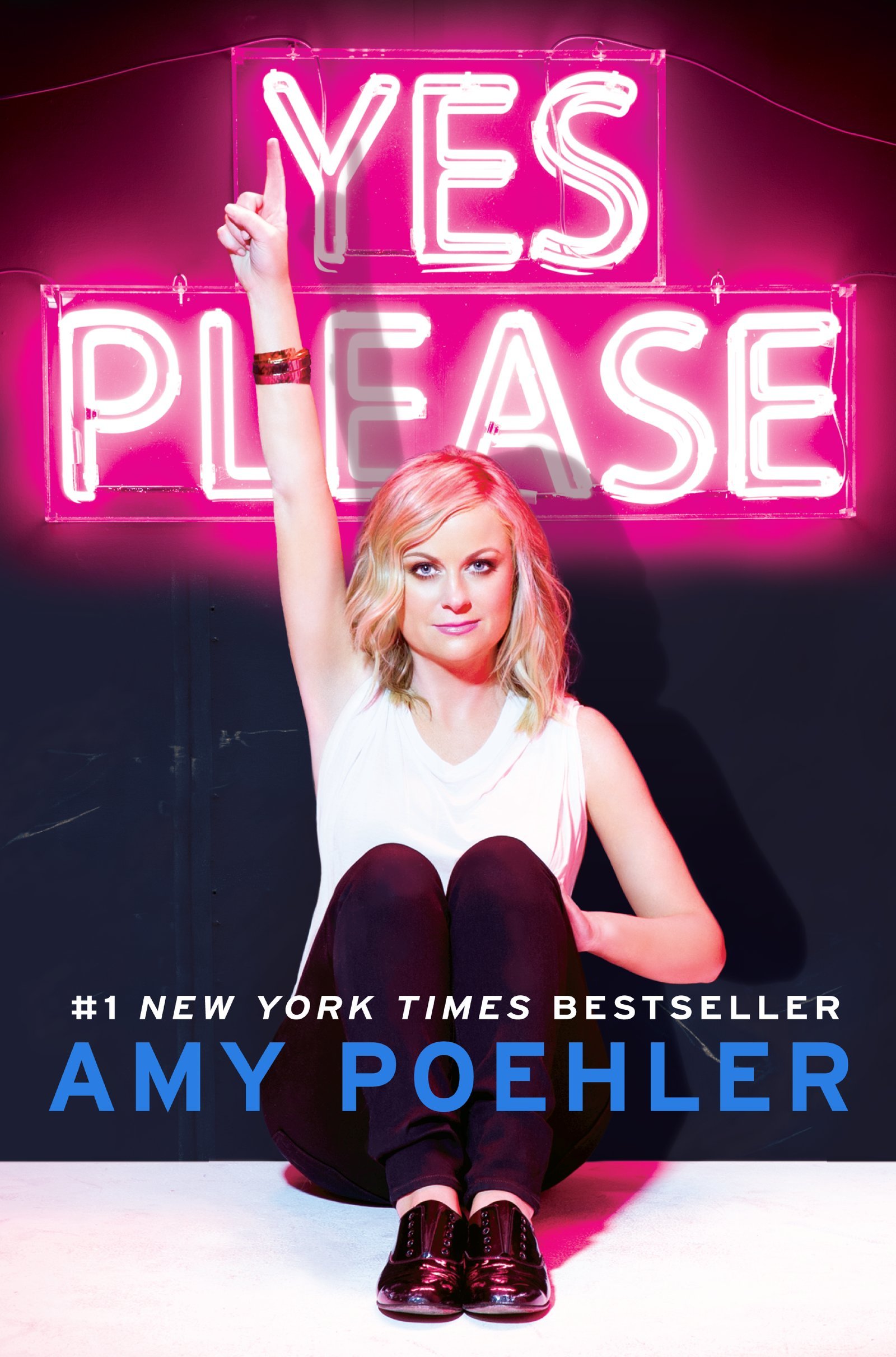
image from amazon.com

image from amazon.com

Here are a few lines for further discussion:

  • “Make sure he’s grateful to be with you” (202). This wisdom is via Poehler’s mother. It’s simple, but it resonated with me. I’ve had a few relationships for which I am (and was) very grateful. Like, look around at the sun shining and birds chirping and thank my lucky stars kind of grateful every day. With other people, not so much. Your level of gratitude for the other person says a lot.
  • “Hairspray was king, and the eighties silhouette…was big hair, giant shoulder pads, chunky earrings, thick belts, and form-fitting stretch pants. My silhouette was an upside-down triangle. Add in my round potato face and hearty eyebrows and you’ve got yourself a grade-A boner killer” (207-08). See, there were plenty of lolz! (Also, I want to reintroduce “grade-A boner killer” into more of my conversations.)
  • “And I count myself very lucky. That is what “very lucky” feels like. Oof” (235). These sentences ended a long paragraph on the various violences Poehler has endured–muggings, physical and sexual harassment, sexual violence–but never rape. She makes a powerful point here.
  • “‘Smile’ doesn’t really work either. Telling me to relax or smile when I’m angry is like bringing a birthday cake into an ape sanctuary. You’re just asking to get your nose and genitals bit off” (236). I like this for two reasons. One, being told to “smile” is a weird thing that men say to women. To be on the receiving end of this kind of command feels icky. Two, I love making jokes about ape violence despite the fact that it rarely draws laughs. I’m glad to see Poehler going for it here.
  • “[I]f you do start crying in an argument and someone asks why, you can always say, “I’m just crying because of how wrong you are” (237). This one made me laugh, and I hope I have the wherewithall to use it sometime.

**Edit: There’s also this place where she tells a story of having a casting director ask her to share her most embarrassing story. Poehler refused and didn’t get the job. Then, she told the reader that you don’t have to tell people your most embarrassing story when they ask. I liked that.
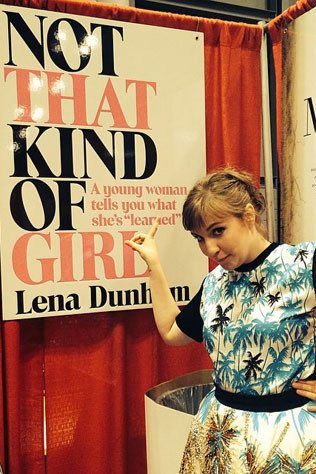
Not That Kind of Girl by Lena Dunham

I have a [smart] friend who thinks Lena Dunham’s work is bad, irresponsible. We go rounds on this because I love her and think that he’s too caught up on having morally good, heroic main characters. He says I’m missing the point. Dunham’s work is shrouded in controversy, but if you’re a fan of her show Girls, you’ll definitely like Not That Kind of Girl. In fact, if you just sort of like her show, you’ll still like her book. Lena Dunham’s work is so incredibly personal and vulnerable and embarrassing and painful, and human. I identify with her so much.

First, I am fascinated with the way she deals with first/early sexual experience. It is the most honest depiction of the kinds of sexual experiences people have in their late teens and early twenties. It can be weird, awkward, and embarrassing. People are unsure about what to do where and for how long. There are strange acts that exist solely because porn tells us that’s what people do for pleasure, even if very few people are doing that thing for pleasure. I actually think this is unavoidable for the most part because there are very few activities that are comparable to coupled sex. In the process, mistakes are made and confusion abounds. Young women are in a constant negotiation with owning and expressing their sexuality, while simultaneously figuring out where the media pressures and social expectations end and where their own pleasure and desire begins. [By the way, I think this is true for men, too, but I don’t read much about it.] So, that’s important.

She’s also balancing art and social commentary, which can be weird and bad, but she does it well. One could easily assume that her work is this off the cuff confessional style, and it is, but there is also real artistry in her work. She has a deep familiarity with language and a knack for creative expression through  her writing. My expectation is that she will continue to write books, and they will be revolutionary, yes, and will only improve from a literary perspective.

Now, let me address the whole scuttlebutt over childhood sexual abuse when the book first came out. I assumed that it would be honest and artfully done, and even be good in that it would help us to think more critically about childhood sexuality. I wanted to read it first before forming my opinion, and after reading it, I thought it was good and important, and did the thing of making us think openly about childhood sexuality. The story is weird, and a bit uncomfortable, but true and not abuse, in my opinion. You can bet that Dunham thinks about consent and abuse because they are major themes in her work.

While I am highly invested in the topic of female sexuality, obviously, Dunham covers other ideas that resonate with me so strongly. Like, there are people who love people, and people who can’t stand to be alone, and people who are curious about other people [I might fall into that last category], but usually I have, as Dunham states, “the nagging sense that my true friends are waiting for me” (xiii). I have met some of my true friends, and when we meet, and recognize each other, there is much rejoicing! I love these people. They are my forever friends and lovers. But, they number so few I can count them on my hands, and I often feel lonely or out of place, wishing that I could be with one of my people when I’m tired of being alone. Lena Dunham—she gets me.

image from vogue.com

image from vogue.com

Here are some quotes I highlighted:

  • “There is nothing gutsier to me than a person announcing that their story is one that deserves to be told, especially if that person is a woman” (xvi).
  • “He was nervous, and, in a nod toward gender equality, neither of us came” (7).
  • “This was the time in life before I learned it wasn’t considered appropriate by society at large to like yourself” (34).
  • She quotes Joan Didion: “There is a common superstition that “self-respect” is a kind of charm against snakes, something that keeps those who have it locked in some unblighted Eden, out of strange beds, ambivalent conversations, and trouble in general. It does not at all. It has nothing to do with the face of things, but concerns instead a separate peace, a private reconciliation” (38).
  • A list from a relationship…”One very unnecessary pregnancy test” (54).
  • “Wherever you go, there you are” (69). An old favorite.
  • “After several interactions in which he questioned my authority and pretended not to hear me speaking, it was clear he was my type” (71).
  • “I had broken up with him on my seventh try, and one try didn’t even count because all I could muster was “I love you” (76).
  • On meeting her love: “Look, there is my friend” (76).
  • “…desire is the enemy of contentment” (143).
  • “You will find,” she says, “that there’s a certain grace to having your heart broken” (144).
  • “…you’ll see that later and be very, very proud” (262).

And so many others.

Men Explain Things to Me by Rebecca Solnit

I just finished Men Explain Things to Me by Rebecca Solnit over the course of a few evenings. It’s a *heavy* read, but it’s composed of short, manageable essays. The first most noticeable thing about this book is that it is not funny. There is absolutely nothing funny or lighthearted about it, and that was a surprise. The title is sort of funny, and alludes to “mansplaining,” which is terrible and indicative of larger social issues surrounding gender, but it’s also sort of funny. The title is not a good indication of the book.

image from amazon.com

image from amazon.com

Solnit is unrelenting in her depiction of the “longest war,” a war on women. Reading it was overwhelming—a reminder of the violence and disdain lobbed at women by our society. The statistics were staggering. Having heterosexual relationships with men seemed increasingly fraught for both genders. I was left wondering how we navigate these weird power dynamics in our most personal relationships. I felt overwhelmed by the violence. I felt overwhelmed by the reminders of the constraints I face each day as a woman.

For example, each day before dark, I try to accomplish all tasks that require me to walk any distance alone or through a parking lot. Every day, I, mostly subconsciously at this point, plan my day with safety in mind. When I overtly think about these habits, it makes me sad that I live in such a violent world, and it makes me sad that safety has to be such an underlying factor in my daily decisions. Surely this has unknown negative effects. Solnit writes, “My feminism waxed and waned, but the lack of freedom to move through the city for women hit me hard and personally at the end of my teens, when I came under constant attack in my urban environment and hardly anyway seemed to think that is was a civil rights issue” (128). Solnit argues for an emphasis on turning the lens on men and why they are so frequently the perpetrators of violence, opposed to giving women the sole responsibility of preventing violence. This “Top 10 Tip to Avoid Rape” meme has made the rounds and points out the profound role that men (obviously) play in “rape culture.”

image found here

image found here.

Like Solnit, I wonder why these problems are not viewed as a deeper crisis and as a civil rights issue. In recent years, I have felt a real personal fear as politicians have made absolutely horrifying, and often scientifically inaccurate, claims about women’s bodies. As the Hobby Lobbys and various right wingers argue about what I can and cannot do with my own body, for the first time, it has felt very personal and very stifling.

Of course, the reaction to these issues is often, yes, but “not all men.” And, Solnit carefully dedicates sections of each chapter, writing “not all men, but…” This is unfortunate. We can’t just talk about this issue without spending a lot of time reassuring men and women that not all men are bad. In so many ways it seems like this reassurance is also indicative of the problem. It’s a problem that we literally can’t even talk about women’s issues without spending a good deal of time reassuring men and talking about men and turning the focus, even just briefly, back to men. On the other hand, they’re half the population, and they’re our partners, fathers, brothers, and friends, and so it makes sense that we can’t talk about women without spending some time also talking about men.

The book isn’t entirely matched thematically, and she delves into some literacy criticism, as a way to address the larger social problems that she unpacks earlier in the book. She wrote of a criticism that “does not put the critic against the text” (101). In her exchange with Susan Sontag, Solnit writes that “you don’t know if your actions are futile; that you don’t have the memory of the future” (93). This is in response to Sontag’s assertion that resistance is required, even if it is futile, and maybe it is always futile.

On Woolf, Solnit writes of a botanist that had “a knack for finding new species by getting lost in the jungle, by going beyond what he knew and how he know it, by letting experience be larger than his knowledge, by choosing reality rather than the plan” (96), and I love this idea so much. For living life, for finding new ideas, for creating art. I am such a planner and a researcher, and I love the idea of this kind of purposeful method (which, yes, requires planning and research). I love the idea of using this method as a means of discovery, rather than following what is known: “a compass by which to get lost” (106).

Of measurement and discovery, Solnit also writes about “the tyranny of the quantifiable,” which is “the way what can be measured almost always takes precedence over what cannot” (104-105). This has been a frustration for me lately. Working in bureaucracies, and within high education, too often means a singular focus on the quantifiable, on the assessable. When other ways of being or knowing are scoffed at as being dangerous, even life-threatening, we are limited by what we can do as dreamers, thinkers, creators, and teachers.

This book reads up so quickly and so powerfully that there’s really no reason not to read it. Afterward, you can spend some time thinking through what it all means for gender, relationships, and the way men and women exist in the world. I think I’ll even pick up her other book, Wanderlust because it is about walking and maybe other things too.

Be Free Where You Are by Thich Nhat Hanh

I’m supposed to be gearing up for a spiritual year according to sundry esoteric readings and such. I entertain these mostly for fun, but when the idea reappeared to me in multiple venues, I thought, okay, I’m listening. I’m not particularly excited by the prospect of a spiritual year, but recognize that it’s a part of being. And, there’s no time like the present.

So, the other day on a friend’s table, I saw a copy of Thich Nhat Hanh’s Be Free Where You Are, which is a little pocket-sized book based on a lecture he have to a group of prisoners a few decades ago. “Take it,” she said. So, I slipped it into my purse and read it the other night. It is a very quick read. I read half of it, then decided to read the rest of it, and then read the Q&A after that—all in one sitting. I chose to read and reread a few key sections  slowly to try to really absorb his potential meanings.

Thich Nhat Hanh’s been on my radar after a respected mentor mentioned that his work had valid philosophical and scholarly potential. After reading this short book, I can’t say that I agree. Of course, it’s way too soon to make a definitive statement either way. But, he spoke about things like being in your heart and being positive, and while I can make a lot of assumptions about what that might mean, I’m not sure that means much. Or, maybe it means everything. The book is full of these kinds of assertions, and I can only hope that his longer works offer more depth.

Thich Nhat Hanh said that understanding is crucial for forgiveness.

He said to think about each bite of food and where it came from with gratitude.

He said to meditate always, while walking and washing dishes. While inhaling and exhaling. He encourages his audience to be present. Describing this, he wrote, “Here I am.” I read it a few times:  “Here I am.” I walked over to my full-length bedroom mirror and tore away the tens of sticky notes upon which I had scribbled affirmations in permanent marker, affirmations that I had written months earlier as they occurred to me. I threw the tiny stack of words into the recycling, got out a new sticky note and wrote, “Here I am.” I placed it alone on the mirror. Here I am.

I thought about an eye-gazing meditation I did recently that was either good or meaningless, and I thought, “Here I am. Here I am.”

The First Bad Man by Miranda July

An autographed copy of Miranda July’s The First Bad Man arrived in a cardboard box propped against my front door. I did not order it. I was coming back from yoga. It was any old day, and my mind very slowly bended around the idea that someone had bought something for me. I brought it inside and carefully opened it. Inside was a note from Z and the book. I immediately read the first few paragraphs, smiled to myself, and set it aside for later.

I’ve been reading a lot lately and savored this one, reading it slowly over the course of a few weeks. There are so many lines in the first few chapters that made me laugh, or made me reach for a pencil to draw a thin gray line under a phrase or beside a passage. Miranda July is an artist who makes me feel not alone in this world. It is absolutely novel how she can capture all the strange little quips and quirks that brains do.

July also writes about really disgusting, gross-out, putrid sorts of things, and the sheer quantity of that mid-way through The First Bad Man started to get me down. The suffocation the main character creates for herself, her home, her kitchen, her frying pan, her throat condition, the containers of urine, the breast punching—it all got to be too much, and I didn’t want to spend any more time in the book. But, of course, I did and in the last few chapters, I started underlining things again, and smiling as I read, and once again, felt that I was not alone in the world.

When I read a particularly delightful passage, I found myself turning to the title page and running my finger over her indecipherable magic marker signature. Who was this woman? Is she like me? Or, is she commenting on what it’s like to be me?

Palo Alto: Stories by James Franco

Despite having recently lost my ability to read anything with a discernible plot, I read and enjoyed James Franco’s first selection of shorts stories, entitled, Palo Alto: Stories. And, it was good. I mean, everyone’s reading it and wondering if they’re just reading it because he’s famous, and while that might be the case, the writing holds its own. He tips his hat to his teachers, and I so hope that he workshopped this stuff like the rest of us.

While it’s got a major publisher, it feels independent. Ideally, this is the sort of text that could help bridge the gap between big conglomerate publishers and small independent presses. I don’t really think capitalism or consumerism work that way, but as a reader, I cannot tell you how badly I want to read more of this kind of work.

Anyway, these are small, plot-driven stories. They are careful and conceptually rich. While I’ll admit I wasn’t too eager to spend a lot of time with teenaged-boys or high school, I think some of the territory Franco covers is important, even necessary. The first story, “Halloween,” is really so good. It’s one that has stuck with me for the past few days. It’s one I’ll remember.

I’ve been a fan of Franco’s since his Freaks and Geeks years (or rather, when I watched it on DVD several years after the fact), but even still, I’ve been a fan, and I’m glad to see his genuine success in writing.

As you know, I read George Saunders this summer, and I actually thought Franco’s work could be categorized with Saunders. Franco’s work is much more accessible, mind you, but it is somewhat indicative of the real made strangely dystopic that is happening in contemporary male writing these days, and it’s satisfying to see that aesthetic emerge culturally.

Also, and more importantly, is it just me, or do the pages smell vaguely of cologne?

palo alto

image from amazon.com

The Room Lit by Roses by Carole Maso

Carole Maso is one of the few authors who I will read over and over again. Her work has a quality that just gives and gives each time I read it. Oddly, I haven’t even come close to reading all of her work. With the short time before work for the semester really starts in earnest, I decided to grab a few books to frantically and recklessly read before I got down to business. That has involved forsaking some exercise and sunlight to read while lounging in air-conditioned spaces–sometimes with a popsicle.

I grabbed a few new books from the New York Times Bestseller list along with Carole Maso’s The Room Lit by Roses. I began reading it after working a long shift as a doula. My wrist was sore (still not recovered from a bike wreck two months ago) and my body weary. I tossed by hospital clothes in the hamper and showered the hospital germs away and propped myself up in bed with pillows on my cool white feather down comforter (enter also swamp cooler and popsicle).

I was done thinking about childbirth and labor when I cracked the spine and for the first time realized the rest of the book’s title: A Journal of Pregnancy and Birth. The universe clearly wants me to examine the issue more closely, so “here we go again,” I thought. I scarcely could put it down until it was finished about 24 hours later with the strong impulse to turn around and read it again, which I will not do right now.

Years ago, I read The American Woman in the Chinese Hat and read it again to prepare for my trip to France. I assume I’ll return to The Room Lit by Roses if I become pregnant or want to write more extensively on the topic. For now, I’m glad it exists and I’m glad I can return to it. What I love about Maso’s work is how real and raw and open she is. The ultimate sacrifice, I get the feeling that she splays herself open for us, dear reader, and for art and probably for world peace. Carole Maso is one of those authors for whom I am incredibly grateful.

Sometimes a line or two will be entirely dumb and petty and ugly, which works to magnify the stuff that is brilliant and important and beautiful. As I read her work, I find myself saying yes! That’s how it is. That’s how I feel! She wrote, “Always knew I wanted to have the experience of pregnancy.” I swear I say those exact words. The rest of it, the child, the life, that’s the part I’m not always sure about. But pregnancy and labor, yes. It’s such a bizarre and most intense human experience that is felt only a few times, or once, or never, so of course I’d like to have that. Maso puts into words how absolutely terrible and wonderful and necessary the experience can be, and I clung to each word.

Let’s Explore Diabetes with Owls by David Sedaris

I recently finished another book by David Sedaris, Let’s Explore Diabetes with Owls. As with all of his books, this one was well worth the read. I found myself having deep feelings of gratitude for the author as I laughed, and was moved by, his prose.

Let's Explore Diabetes with Owls

image from NPR

My favorite stories are the ones where he pokes fun at himself. I love the stories of his childhood. “Loggerheads” is wonderfully cringe-worthy and funny and sad. I love the stories of his early adulthood. For me, “Stand Still” covered the well-worn territory of parental expectations, masculinity vs. humanism, and adulthood vs. pettiness. I love the stories of his life now. His story “Rubbish” tackles the fine line between being a good human and the deep relationship with neuroses that such an endeavor might inspire.

Though I’m on board with his politics, the overtly political pieces were funny, yes, but less engaging on all counts.  Still, it’s funny. And smart. And absolutely worth reading. Framed differently, perhaps in first person and expertly woven with his own life, they might be even better.

As I mentioned earlier, I had a strong feeling of gratitude as I read. I frequently hear stories of people “thanking” their favorite  artists for their work. Sedaris is one whom I want to thank, and this sense of gratitude was with me throughout the entire book.

Flight Behavior by Barbara Kingsolver

My introduction to Barbara Kingsolver happened over a decade ago when I first read her debut novel, The Bean Trees. At the time, I loved the book. I had just discovered popular, contemporary women writers, and I could not get enough. I can’t remember exactly what went down in The Bean Trees, but it had to do with a woman living life on her own terms, a theme that makes me weak in the knees. There was probably also some troubling imperialist nostalgia stuff going on there too, but, like I said, it’s been over a decade. Who can remember?

I hadn’t read Kingsolver for many years, when I picked up her latest book, Flight Behavior. The book takes place in Appalachia and centers on Dellarobia, an uneducated, but curious and sympathetic character, who is trapped in an unhappy marriage, which is really just an unhappy life. That life is changed forever when the family land is inundated with monarch butterflies, whose migratory patterns are disrupted by climate change. The butterflies are the catalyst for opening up a world of possibilities and [spoiler alert!] ultimately leading Dellarobia to self fulfillment and transformation. The message is education and information are key.

image from NPR

The book has everything I love: a down on her luck Appalachian woman, monarch butterflies, and sheep! It’s everything I look for in a novel, and yet the book sometimes fell flat. Kingsolver is writing from a rural poor Appalachian perspective, but in many ways Kingsolver herself seems to lack that perspective. I think of myself as someone who understands both sheep farming and the rural poor (though, to be fair, not the Appalachian variety), two things that are dealt with extensively in the novel. The book demonstrates that Kingsolver is a scientist at heart and a keen observer of humans and nature, but seems one step removed.

In regards to the sheep details, I recognized most of the information from a sheep raising manual written by Carol Ekarius, who herself is a transplant to sheep farming and a hobby farmer. In Flight Behavior, these characters are trying to make a living off of sheep, and to do so, they would need a completely different approach than the hobby farming Kingsolver portrays.

Next, it has been my experience that the rural poor have a certain pride, but the Dellarobia character has none of that pride. She is just completely insecure and humiliated by her life in every way. This is made clear as visitors and highly educated scientists begin to visit the butterflies. Even the transformed Dellarobia seemed to lack some necessary perspective in regards to her own behavior. I guess that’s reality though, isn’t it?

The pros of the book are that Kingsolver is a scientist, and her nerdy descriptions of the labs, the butterflies, and the processes are endearing. This kind of novel has the difficult task of balancing an engaging narrative and characters, while simultaneously commenting on environmental politics, and that’s not an easy job. In the end, I think Kingsolver achieved that balance. I read the thing to the end, and got something out of it. There are lovely uses of language and description throughout, and her metaphors are apt. It wasn’t a story that allowed me to suspend disbelief and fully engage because of the moments where I was thinking, “She would never do/say that thing.” Or, “a sheep farmer would never do xyz.”

When I hear “Appalachian women’s literature,” my heart melts a little bit. If you’re like me, Flight Behavior is worth reading. If environmentalist gets your blood pumping, you’ll probably love the book. If you find that this book isn’t for you, do go back and read her first book, though. That one was a real gem.

When Women Were Birds by TTW

When Women Were Birds, the latest book from Terry Tempest Williams (TTW), is a wonderful, painful, poetic, and intensely personal meditation on Williams’ life: her femininity, her spirituality, her relationship with her mother, and more. Her work resonates with me because, like TTW, my family has been affected by cancer–cancer that was likely caused by exposure to radiation. “Clan of the One-Breasted Women” was the first beautiful thing I’d ever read that spoke directly to that experience.

Grandma on her wedding day

My own grandmother died after a painful, decade-long battle with cancer at the age of 54. I gasped as I read that TTW’s mother also died of cancer at 54–an age that becomes painfully young the older I get. My grandmother’s youngest sister was also afflicted with cancer and did not survive childhood. Her siblings, who lived to adulthood, got cancer too. The doctor said the type of cancer indicated that the kids “must have gotten into something.” Indeed, they lived along a river in Northeast Oregon, with an air stream that carried plutonium from Hanford, Washington. Though it was over 100 miles away, the pollution seeped into the atmosphere and even caused green snow one winter. Locals were unaware of it’s toxic nature.

Williams reminds us that silence and secrecy have long plagued the female experience. But within a family, women also navigate the most beautiful and painful experiences together: the loneliness and intimacy of marriage, the pain and power of childbirth, the joy of children, the suffering of disease; death. TTW navigates this territory with raw honesty and vulnerability. In addition to her connection to the women in her family, she reveals her own unique path, her own choices.

Like Williams, I have often felt that I have very few role models. I am a woman who has chosen a somewhat unconventional life. I tend to give less energy to relationships (although, at times, my love for Z has been completely consuming), and I currently have no children. I have not always understood my path, but it is one that has clearly deviated from my peers. My friends from high school have careers, yes, but they have also invested their energy profoundly into their husbands and their children in ways that I have not.

My nearest role models are women in my field, colleagues and former teachers. Even still, I’ve yet to meet one whose relationship to her partner and to her children, or lack thereof, has really reflected my own choices and relationships. This is a theme that TTW explores in When Women Were Birds. In the early years of her marriage, her inclination not to have children (at least not right away) made her different from her peers. And yet, like me, she does not seem to reject or disidentify with her femininity or her capacity and potential as a mother.

In a world where these stories seem too few and far between, her admissions are brave. It is this bravery that allows her to share her fear in enduring a hemangioma in her brain. For a writer, a woman whose world is in her thoughts and creativity, I cannot imagine the trauma, fear, and doubt involved in recovering from such an injury. But she does recover–though changed, perhaps–and the eloquence and insight in her book is a testament to that.

I first discovered TTW sometime during my undergraduate degree. I was struck by the accuracy with which she addressed the themes that most interested me in my own life. She feels like a kindred spirit, and I think that’s the sign of a great artist: she shares her secrets with the reader, and the reader has the same secrets, and then everyone is united in realizing how much we are the same.

After finishing the book, I remembered a bird feeder that was still boxed up in the basement from my recent move. I brought it upstairs, dusted it off, and filled it with fresh sunflower seeds. It now hangs on my front porch, waiting for birds.