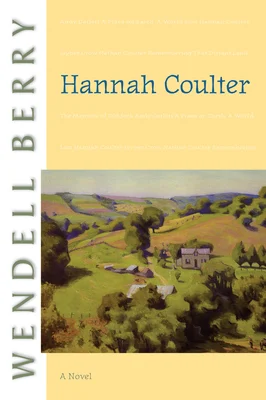
I wanted to add more to my thoughts on Hannah Coulter by Wendell Berry. In this post, I want to address farming, and generational farming. Having grown up on a ranch myself, I have more complicated thoughts about some of the portrayals in Berry’s book.
[spoilers ahead; not that this book has a dramatic plot]
In the book, after growing up on what is described as a beautiful, but hard-earned farm, all of Hannah’s children “choose” not to return to the farm/farming. This is perceived somewhat as a moral failing on the part of the children and their parents. One child is not really interested in farming and goes on to make big money in California. The other boy is very interested in farming. However, after studying agriculture in college, he stays in academia, becoming a well-respected professor and scholar. The daughter goes on to be a school teacher, something she seems to be passionate about from a young age.
However, even if Margaret wanted to stay on the farm, given the sexism and cultural expectations of the time and place, it is difficult to see how a young woman might make a life for herself on a farm, especially not without a husband. She inherits her grandparents’ place, but even if she were to live there at some point, it might have created a difficult power dynamic with a husband, since she would likely be landowner and therefore the more powerful of the two. Opportunities for women, especially single women, are rare in rural settings. Likewise, opportunities for dating and relationships are much fewer in rural settings as well.
The son Mattie found great success away from the farm, both personally and financially. Hannah doubts his happiness, but can’t argue that he was ever deeply interested or suited in farming. That’s okay. Not everyone will be. Though his life is very different, even unrecognizable to Hannah, he might be happy.
To me, Caleb represents the biggest heartbreak. His parents are deeply disappointed that he decides not to return to the farm after college. However, at that point, it would have meant taking on a life of near poverty, a life that would make affording a family incredibly difficult. Caleb is likely heartbroken by this realization too. Small-scale farming would not provide him financial stability. Meanwhile, increased financial stability might give him the greatest chance of eventually keeping the farm for generations to come, maybe returning to it to live and to farm during his own lifetime. That possibility is not out of the question by the end of the novel, though Hannah never seems to think of it. She has this typical, well, I guess they’re just gone, type of attitude. I know some old farmers who are like that too, and it’s like they cannot even see the financial side of things.
At the end, and here is the real spoiler, Virgie returns, Virgie who has rebelled and disappeared for years. When he is at rock bottom, he finally comes back to his grandma and her farm, and she allows him to stay and start farming, with their older extended family and friends serving as mentors to him. Hannah feeds him and houses him and pays him an hourly wage for work he does on her farm, and the others pay him an hourly wage for work he does for them. This would have been around the turn of the last century, and I find it hard to believe that these small-time farmers are able to pay someone, especially someone who lacks much skill, an hourly wage. Hannah probably could in her older age, but not as a long term solution.
Hannah is not naive and does not assume that Virgie will stay and take over the farm, but maybe he will. In the end, the kid who demonstrates the least amount of responsibility and follow through may end up with the farm? More complicated still is the fact that Mattie’s children may have taken an interest in farming too, but having not grown up in the area, it’s unlikely they would ever gain the knowledge required to run the place.
Yes, there was a huge exodus from small farming in rural America in the latter half of the last decade, but I’d argue that the shift did not have to do with disinterest, or pursuing seemingly easier lives. It had everything to do with the monopolization of farming in the US and the lack of profits in small-scale farming. There were significant cultural and especially economic factors at play that Hannah (Berry?) seemed to overlook.
This all resonates so much with me because I also grew up on a ranch, as I stated earlier. I’m one of the kids who really loved farming–the cycles of the season, the fresh air, working with the animals, the constant scheming and figuring out hay supplies and breeding seasons, and lambing seasons, and on. This still is deep within me, and I love it. However, as a child, I quickly saw that it would be nearly impossible to be able to afford land of my own. “Working out” would always be a necessity, which is fine now since so much mechanization is available. Still, the landscape and reality is changing and worsening for farming. It’s not a matter of choice, or who is willing to work harder. For many–it’s a reality.
Amid such a challenging landscape, I’ve considered myself lucky that I was eventually able to get a little place of my own, and raise animals, and live in this way. I definitely can’t (and wouldn’t want to) quit my day job! Farming is not for everyone. However, it is for me. But, it’s complicated.

 SHEREWIN