Originally published in 1922, A Homesteader’s Portfolio by Alice Day Pratt is an account of Pratt’s experience as a solo female homesteader in Eastern Oregon over 100 years ago. The book reads almost like a series of journal entries, with several engaging stories and also some content that was difficult for me, as a modern reader, to get through. I simply do not usually love the cadence and style of older writing. This book was part entertainment, but mostly about research for me.
I think I first heard about this book from by Susan Butruille, who wrote Women’s Voices from the Oregon Trail. From this experience, I was very intrigued to learn that there were so many single female homesteaders! Experts think about 15% of homesteaders were single females. In some areas, it was more like 20%. The predominant narrative is that homesteaders were families or solo men seeking gold, so this new-to-me statistic really changes my understanding of that migration and feels very empowering too!
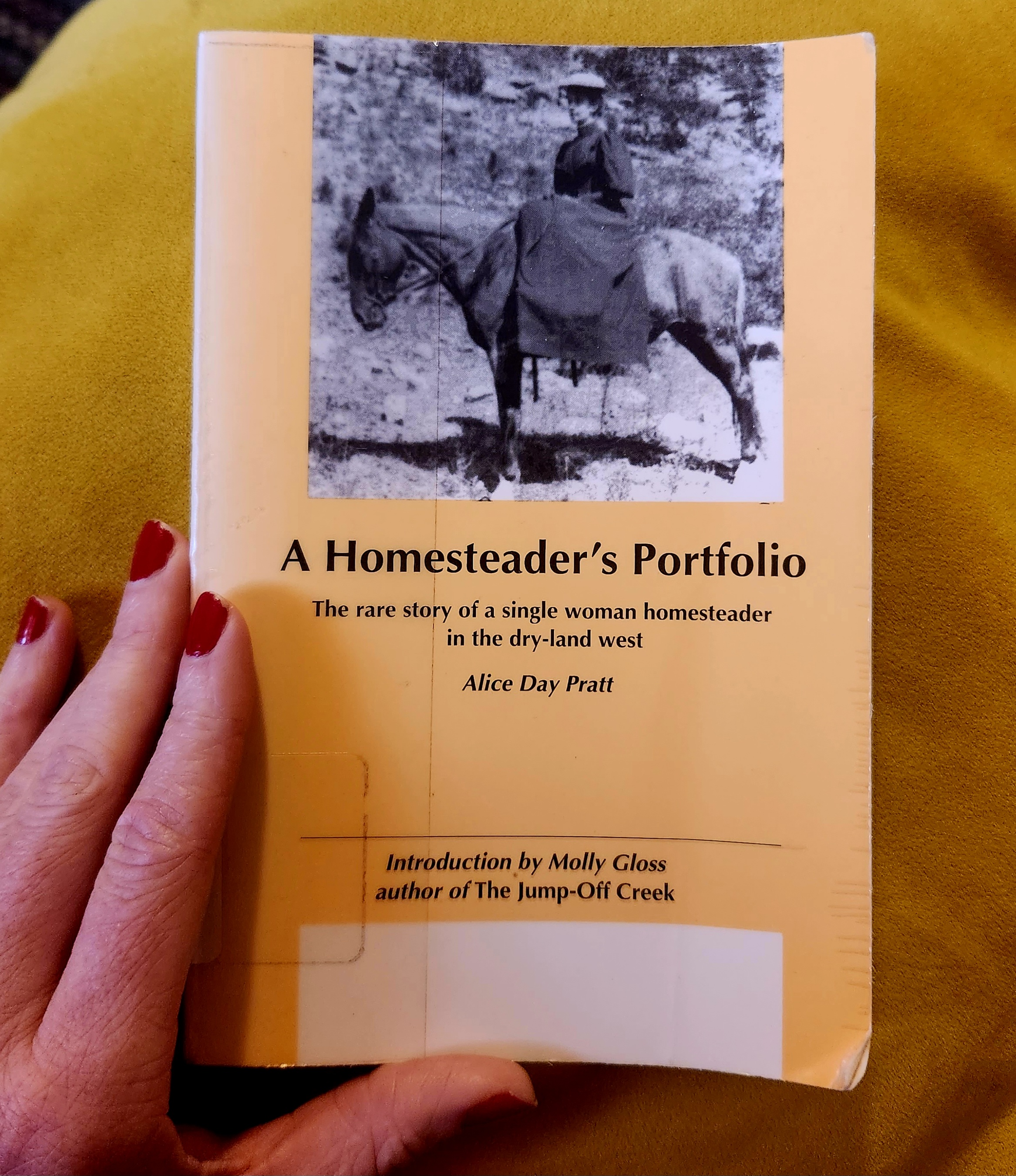
So, I was particularly interested to read Alice Day Pratt’s account of homesteading in Oregon. She kept her day job as a school teacher, while purchasing an “unimproved” plot of land that she named Broadview. There she started various agricultural endeavors, including dairy cows (a rarity in the area) and chickens for eggs and some meat. She had a cat and dogs and horses and dealt with the challenges of being viewed as different by the neighbors, some who were happy to help her in kind and others who seemed to disregard her, or try to take advantage of her, or who actually fostered some form of ill will.
As a many generation Oregonian, who is also deeply involved in agriculture, I found her story intriguing. As an ag insider, I could see the ways she was messing up and causing more work for herself and her neighbors, and I could see the ways she seemed more interested in the narrative and the poetry and the story than in the actual agricultural process. But, I could also see her genuine interest, her genuine struggles, and the genuine value in her endeavor. I could identity with the passion, the sense of difference, and so much more. She did have some great success in ag too, and that’s saying something in a field that can be so precarious that even experts can continually fail.
While not revealed in the book, Alice Day Pratt’s life ends in an apartment in New York City, where presumably in her final decades she continues to read, write, and share her passion for teaching. She does not keep her farmstead, and according to accounts, she is not able to keep it–she loses it somehow. The story does not end in victory. Except that it does in that the world gains a new kind of story, one of a woman who is able to live life on her own terms–smartly, passionately–and is able to share it through her writing.
 SHEREWIN