Single, Carefree, Mellow by Katherine Heiny

I subscribe to Vogue, and I do so for the fabric and the writing. I’ve read a few great books based on their recommendations. Unfortunately, Single, Carefree, Mellow is not one of their great recommendations, and it serves as a reminder that, while Vogue has some great writers on their staff, the book mentions in Vogue probably have less to do with their keen eye, and more to do with commercial demands.

image from amazon.com

I sympathize though because Single, Carefree, Mellow is probably what would happened if I set out to write a popular, commercial, plot-driven novel about single women. In fact, I’m sure it’s much better than anything I could muster. Still, it’s bad.

First, the writing: much of the description does nothing to move the plot forward or deepen meaning or character. It seems to only serve the purpose of “my writing teacher said good writing has lots of description so I’ll add some here.”

Next, the themes: these characters are weirdly detached and casual about cheating, destroying marriages, and are either morally corrupt *in uninteresting ways* or disconnected from their real wants and desires *in uninteresting ways*.

To be fair, lately I have been really sensitive to moral corruption. The last few years have been so tumultuous for me that I have craved security, stability, and people who are who they say they are–people who are straightforward about their motives. As a result, my tolerance for books and shows that delve into vapid characters, driven by quick and easy gratification, is at it’s lowest.

The Orgy by Muriel Rukeyser

It took me months to finish The Orgy: An Irish Journey of Passion and Transformation by Muriel Rukeyser, and I have to start by saying this: for a book with “orgy” in the title, there is actually very little sex. If you read the book, you’ll think that was funny because this is not a sexy book. This is capital “L” Literature. You know–a thinking piece.

image from books.google.com

A well-respected friend recommended it to me, and I tried and tried, and it never really took off, and that’s because it’s not a book that “takes off.” It’s poetry. I mean, it’s prose, but it’s basically poetry in terms of accessibility, sound, rhythm, and so forth. (Rukeyser explains here.)

For several months, both The Orgy and Thich Nhất Hanh’s How to Love* lie prone in my living room . I’d forget about them, and visitors would come over and raise their eyebrows at the display. Now I find it amusing, but at the time, I remember feeling embarrassed. The titles convey two really different messages. And, in hindsight, not entirely unrelated to my summer. (There were no orgies! Sheesh!)

As for Rukeyser, the book was meaningful in the sentences, but not so much the big picture. The book is about the author’s (semi-autobiographical) journey to the Puck Fair for one of the last pagan festivals of it’s kind. That kind of premise holds so much intrigue for me. I was hopeful for deep description and weird plot points and characters. But nope. It’s not really that kind of book.

Instead, we are gifted with subtle sentence level gems and an overall sense, but nothing concrete, as is the way of good capital “L” Literature, and that’s fine. It’s fine. IT’S JUST THAT I THINK WE WERE ALL EXPECTING A BIT MORE IN THE ORGY DEPARTMENT.

Here are a few lines for continued consideration:

On walking through shit: “I thought, joy and release is it! and put my foot down slowly, gained an inch, and slipped” (69).

“[T]he book compared peace with monogamy” (91).

On the infant cry: “It is the most profound and powerful force in nature” (102).

“Though they may kill, killing is not their aim…” (103).

“verbal arabesques” (114).

“Nicholas began to relax; it was as if he remembered his whole life, and unwound” (115).

*Thich Nhất Hanh’s critically acclaimed, and I really liked his Be Free Where You Are, and wrote about it here, but he’s phoning it in on How to Love, so there will be no blog post on that one.

a typical day (in art)

Recently, someone asked me what my typical day looks like, and while I did my best to answer the question, I felt that my response did not do justice to my life.

More recently, I found that an artist by the name of Irene Sheri* had actually captured a typical day in my life, and so I present it to you here now–an accurate portrayal of my typical day:

red 1

red 3 red 4 red 5 red 6 red 7 red 8 red 9 red 10 red 11
red 12

red 13  *Images from www.galleryone.com and www.world-wide-art.com

The Skeleton Twins by Craig Johnson

Kristen Wiig and Bill Hader are amazing in this film. They have a ton of chemistry and that probably goes back to their days together at Saturday Night Live. If you’re me, and you’re a fan of SNL, and you’re a fan of Bill Hader and Kristen Wiig, you’ll love watching these two together on screen. Comedy actors can really excel at drama, and you see that in The Skeleton Twins.

image from wikipedia.org

image from wikipedia.org

Before I saw the film, I was told by a trusted person that it was “good, but dark.” And, that’s true. My mind goes in a million directions when someone says “dark,” and it really wasn’t so dark as all that, but it is a heavy film. It’s about twins who are desperately struggling in their lives. They are estranged, but the reasons are unclear throughout most of the film. Toward the end, catalyst for their decade-long estrangement slowly unfolds.

The acting is great. The characters are unique and real. (Luke Wilson is really good in this too!) The plot, writing, and direction are all unique and nuanced and good. However (HOWEVER!), I don’t think the film addresses a universal truth, and that’s something I think good film should do. I left the film thinking, “Yeah, it’d be nice to have a twin that is tuned in to me in my times of suffering, a twin who holds the key to cheering me up when I am down, but I don’t have a twin, and most of us don’t have a twin.” Life is long and hard—we see that in the film. Unlike the Wiig and Hader’s struggling characters, the rest of us have to schlog through this life alone. Maybe if we’re lucky we have some parents, a sibling or two, a few close friends. But very few of us have a twin.

Somehow this film reminded me of Broken Flowers—also critically acclaimed and good in so many ways (and Jarmusch!)—but lacking, in my view, of a universal truth or experience. The films look very closely a unusual circumstances. Now, this isn’t to write the film(s) off entirely. For some people, this story (and fabulous acting) is enough. I’m finding, though, that I want my films to get at something more universal—something that is moving me and something I know is moving my fellow audience members as well.

Me and Earl and the Dying Girl by Alfonso Gomez-Rejon

Me and Earl and the Dying Girl is a very Sundance-y Sundance movie, but it’s good! Sundance loves some great films, and this is one of them. First, this is indeed a movie about a dying girl. Because the title is so straightforward, I somehow thought it wouldn’t be so dark, but it was.

image from imdb.com

image from imdb.com

I also rewatched Mad Max: Fury Road this week (stay with me, it’s relevant!) and have continued to find meaning in the war boys’ concept of a “witness”—this idea of being witnessed in our acts of bravery, our acts of love, our acts of dying—all of it. It’s meaningful to me because I’ve always been so independent and only in the last few years have begun to understand the value of an invested witness.

I mention it because an important aspect of M&E&DG is that a very young man is witness to a dying girl. It’s something they stumble into, they resist, but, of course, it becomes meaningful in ways they couldn’t’ve anticipated or even previously comprehended. That kind of character growth and insight was lovely to watch, but it was also sophisticated enough that I think most audience members come away with deeper insights about what it means to connect more to “their people,” moving beyond assumptions and into really knowing another person.

One of the best moments in the film is when the cool history professor talks about how he lost his father at a young age. He said that even after his father’s death, he’s continues to learn about him. His father’s life continues to reveal itself. It started when his dad’s friends started sharing stories after his death. It continues all the time, in unimaginable ways, even decades later. I think the point here is that learning about our dead loved ones is part of what it means to be alive and self-aware.

As for me, I continue to learn about my own grandmothers. Both my great grandmother and her daughter (my mom’s mom) were a huge part of my early childhood. My great grandma even lived with us sometimes during the winter. She just stayed. She was Swedish. She was very quiet, and she loved me.  My grandma and great grandma died within two years of each other. They were a big part of my childhood, and then, in a relatively short period of time, they were both gone.

For awhile, it was sad, but okay, and this is the natural cycle of life. And then, I got really curious about them and asked my mom and aunties lots of questions about who my grandmothers were. I began to piece together my memories with their stories.  Over time, I can see how much the course of my life has been shaped by their influence. Decades later, I’ll remember idioms and wisdom about how to grow a garden, how to love one man. They suffered and loved for decades, and don’t we all? I am a witness to it all. There is meaning where meaninglessness wants to creep in. It reminds me that I am part of something bigger, family, culture, blood, brains. They are with me in memory and in my story, and that’s what I took away from M&E&DG.

The Imitation Game directed by Morten Tyldum

The Imitation Game, starring Benedict Cumberbatch, depicts a fascinating part of human history when war-time code encryption lead to massive breakthroughs in computing. This was thanks in no small part to the genius of Alan Turing. Understanding this history seems even more important when I think of the pervasive role of computers in my daily life: the bane and the joy.

image from google image

The history alone is deserving of a film. I would’ve loved to see even more details about how the early encryption machines worked and how the cryptologists did the work of encryption. The audience sees that they are working through a process of elimination within the limit of an 18-hour period. I’m sure that this is plenty of detail for an audience, but I was curious to know more. I also wanted to know more about how the “computer” worked–though the audience does get some idea of how the machine worked with algorithms and trial by elimination to crack the code.

In my view, Benedict Cumberbatch absolutely earned an Oscar, portraying a convincing (and interesting!) emotional transformation throughout the film. The film goes a bit awry when it forces some emotional drama and personal upheaval between Turing and Clarke, which seemed particularly forced. It follows the conventional romantic comedy pattern of connection, disagreement, and then reconnection. To be fair, Clarke and Turing’s relationship gets a bit more complicated toward the end of the film.

What’s really interesting is Turing’s emotional attachment to his childhood friend. That inner turmoil is unique and moving and, in my view, would’ve provided enough emotion to carry the film. Like the innovations in computing technology, in the relationship between Turning and Christopher, we see something new, unexpected, and complex.

blueberry, zucchini, chia seed, & walnut muffins

My refrigerator is full of zucchini—zucchini that I fully intend to cook, but don’t necessarily think I can eat, so I decided to reimagine my not-too-sweet breakfast muffin. Once school starts, I’ll want something I can easily take with me, something that is not too sweet. My solution is these muffins that are dense in seeds and nuts, which I’ll freeze and use as needed. Since they’re not very sweet, I’m fairly certain these are not a “crowd pleaser,” but they work for me.

beware the berries do explode

beware the berries do explode

Here’s what I did:

Blueberry, Zucchini, Chia Seed, & Walnut Muffins
Preheat oven at 350. Mix together dryish ingredients. Mix wet ingredients separately. Then, combine the two. Lastly, fold in chunky ingredients. Spoon dough into muffin tin. I used muffin liners, but I think those are optional. Bake at 350 for about 20 minutes or until done. (Insert and remove toothpick. Muffins are done when the toothpick comes out clean.) Let cool for 15 min.

Dry ingredients:
1 cup gluten-free flour blend
¾ cup oats
shredded flax (2 heaping tablespoons)
chia seeds (3 heaping tablespoons)
½ teaspoon cinnamon
¼ teaspoon cardamom
½ teaspoon of fine sea salt
1 teaspoon of baking soda
1 teaspoon of baking powder
½ cup of light brown sugar
lightly sprinkle ground ginger and ground cloves

Wet ingredients:
1 teaspoon vanilla extract
½ cup vegetable oil
1+ egg
2 cups shredded zucchini (I just blended it this time)

Chunky ingredients:
walnuts 1+ cups
blueberries 1+ cups

Enjoy!

round 4: knitting a baby blanket (with pattern!)

For years I did not like crafting. It seemed like the antithesis of art, and art was what I was after. However, that’s shifted for me in recent years when suddenly things like tying knots with sticks and stitching little squares into aida cloth has seemed strangely satisfying and important. I’ve even developed a few philosophical justifications for crafting. (And I’ve been delighted that people in my own field of study have taken up the subject as well.)

Recently a colleague,  who takes crafting above and beyond anything I will ever do, stopped by my office to talk about the stuff we’re making, and I was motivated to put together this post about my last baby blanket. I made it as a gift for my cousin’s daughter. Her son got one when he was born, but I hadn’t made one for the older daughter. My homemade blankets have imperfections (which makes them unique! which isn’t something everyone values!)), so I was delighted when my cousin’s husband mentioned that their son loved his blanket and used it all the time.

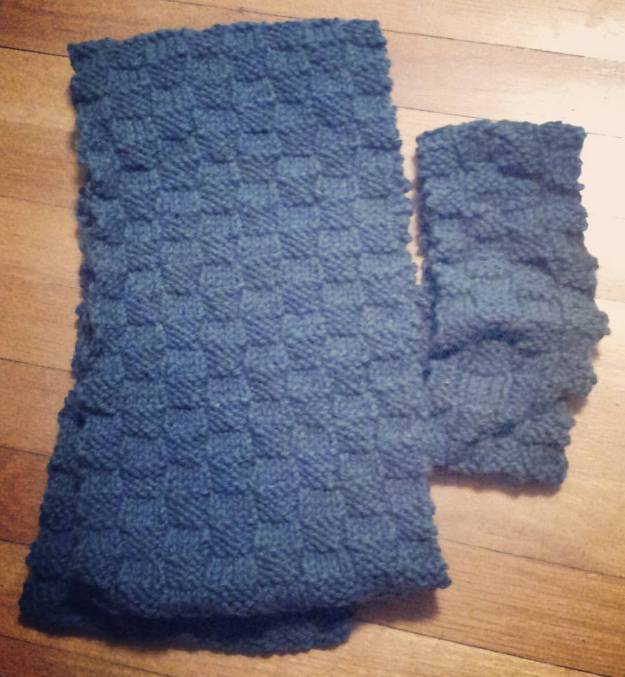
Here’s the blanket that I made for my cousin’s daughter. I’ll be using this pattern again. I think it is my best baby blanket to date.

Loops and Looms—Lavender

skein of Loops and Looms—Lavender Blues

I used four skeins of Loops and Threads: Country Loom – Lavender Blues. To start, cast on 73 stitches and knit five rows.  Then, to create the border, knit four (mark) add increase, then knit across for 63 stitches. Add another increase, (mark) and then knit the last four. In the next row, knit four (mark), add increase, and then alternate between decrease/slip, increase/knit stitch all the way across for for 63 stitches. At the end, add increase (mark), and then knit the last four stitches.

increase/decrease stitch border

increase/decrease stitch border

For the body of the blanket, continue to knit four (to the mark), increase, knit across (for 63), increase, then knit the last four. For the next row, knit four, then decrease, purl across, decrease again, and then knit the last four. Continue to alternate between knitting/increasing rows and purling/decreasing rows. Stitch to the desired length. I ended on knit stitch (with increases on each end before moving on to border).

At the very end, knit four, decrease/slip, increase/knit (for 63), then knit the last four stitches. That creates the last border edge. Then, knit the last five rows, and cast off.

finished and folded

finished and folded

Maybe Mad Max: Fury Road Is Not So Feminist After All

As I mentioned in the previous post, I’ve been absolutely blown away by the response to the new Mad Max: Fury Road film. The critics absolutely adore this film, and early on started claiming that the film is feminist. Social media has been blowing up with articles about the film. Mostly, I’ve been surprised and pleased that everyone else is noticing what, for a long time, felt like my own little secret.

Beyond that, I’ve been a little uncertain about the most pervasive argument. which is that the film is feminist. While there are many forms of feminism, and this film might encompass some of those interpretations, I’m not entirely convinced that this is a feminist film. In my view, simply adding female characters, and even a female lead, is not enough to make it feminist.

According to the Bechdel test, a movie has to have A) at least two women, who B) talk to each other, about C) something besides a man. Of course it’s shocking that so few films can pass the Bechdel test, but, in my opinion, just passing the Bechdel test is not enough to make it a feminist film. It’s just enough to make it not “problematic” and maybe not sexist. Sadly, however, with so few women represented in film, maybe this is all it takes to earn the “feminist” label. I, however, want a little more.

Yes, Fury Road has female characters, and yes they talked to each other, but did they ever talk about anything besides men—their captors who kept them in chains? Maybe a little bit. Not really. Their entire raison dêtre is a reaction to the men in power. The film is about reacting to a corrupt and toxic system of power, so maybe that could be construed as feminist, but a better reaction to the corrupt political system was never clearly defined (though perhaps implied here and there). We see women acting out of desperation. In my view, the film is mostly about a strong female lead with an action/reaction that may not be clearly feminist, but is (at least) not incredibly sexist.