i do rush home

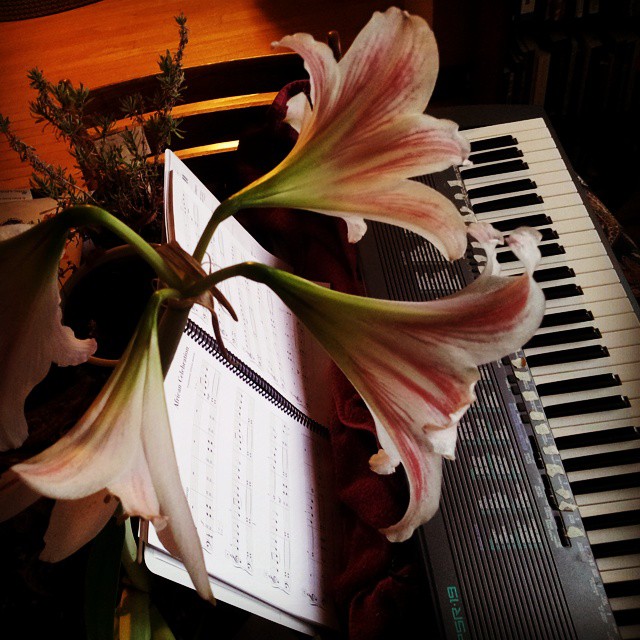
I rush home to play the piano. (Well, keyboard.) I listen to songs on the radio and try to figure them out while driving. I fill out all of the exercises in my lesson book just for the joy of it.

My mom’s pretty competent at the piano, but has always wanted to play the violin. She started taking lessons this summer and absolutely loved it. I, on the other hand, have always wanted to play the piano. I took lessons when I was very young, but they were short-lived.

This summer, my mom inspired me with her violin lessons. She kept saying things like, “I just love it,” and “It’s so great.” It’s probably the English major in me, but I’m always prompting her to explain what she means. “What’s great about it?” She couldn’t quite explain. Now, neither can I.

I found a teacher who lives nearby and signed up for lessons this fall. I immediately loved it and, like my mom, find myself sort of inarticulate about it: “It’s the best thing ever,” and “It’s just so great.” At first I really loved the forced meditation. Music requires your entire brain, and when I’m concentrating, there is no room for chatter. There is no room for anything else, and it is divine.

One of the things I miss from my last relationship is music. I miss singing (though I am shy!) and I miss hearing the new song and the song that’s dedicated to me. So, I’ve tried to create that for myself. I’ve been surprised by how quickly I’ve been able to move through the lesson book and how satisfying it is to play.

I’ve always felt drawn the to piano. I have always wanted to be able to play. I love the sound of the piano. I’m also really fast at typing (and I think that actually helps.)

I don’t know what else to say. See how rambling and incoherent I am about it? Other than just “YES! I am doing it! And it is so great!”

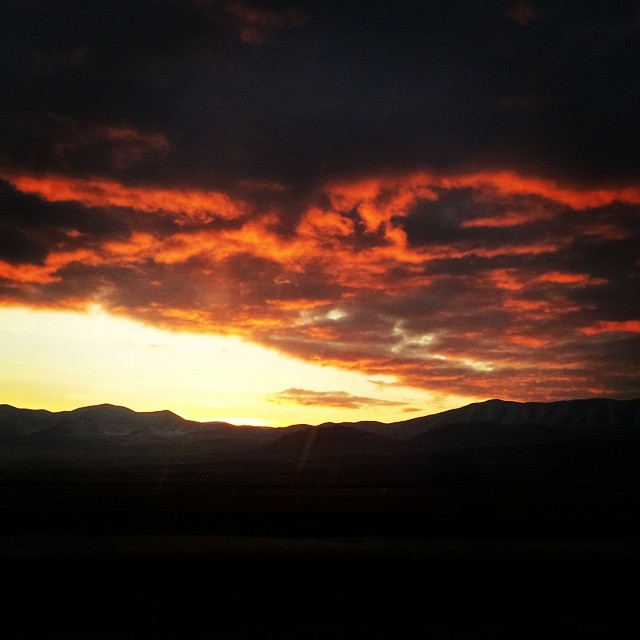
morning scene

morning scene

Coeur De Lion by Ariana Reines

One of those things went around Facebook asking people to list the top ten most influential books they’ve ever read, and several writer-friends mentioned Coeur De Lion by Ariana Reines. So, I got it, and read it in a few hours late one morning (which, coupled with a cup of tea, felt amazingly indulgent, by the way).

image from amazon.com

image from amazon.com

The book is erotic and smart, and gives the impression of effortlessness. Like when the untrained eye looks at a piece of abstract expressionism and says, “hey, I could do that!” In so many ways, it feels like the emotional frenzied jotting down of ideas that happens thoughtlessly in a bedside journal. But there is such an attention to sound, such perfection throughout, it is clear the effortlessness is no accident. Here, for example: “She has curly hair like me, but in this jpeg it looks like she puts more emollients in hers.” While it may sound very conversational, the sound and rhythm are just beyond.

Here are a few other lines I liked in the order that they appear:

“She is sexually terrifying. Her elegance
And intelligence dignify the insanity so
Much I forget not to be charmed”

“The melancholic
Loses the object of desire while the object
Is still there.”
(Reines paraphrasing Zizek paraphrasing Freud)

“It’s been so easy for you
To disengage yourself from your
Behavior, as though you really
Were conjectural, as though
Your desire really were as limitless
And general as the fucking internet.”

That last one was worth the wait, wasn’t it? Anyway, go now. Read the book.

The Room Lit by Roses by Carole Maso

Carole Maso is one of the few authors who I will read over and over again. Her work has a quality that just gives and gives each time I read it. Oddly, I haven’t even come close to reading all of her work. With the short time before work for the semester really starts in earnest, I decided to grab a few books to frantically and recklessly read before I got down to business. That has involved forsaking some exercise and sunlight to read while lounging in air-conditioned spaces–sometimes with a popsicle.

I grabbed a few new books from the New York Times Bestseller list along with Carole Maso’s The Room Lit by Roses. I began reading it after working a long shift as a doula. My wrist was sore (still not recovered from a bike wreck two months ago) and my body weary. I tossed by hospital clothes in the hamper and showered the hospital germs away and propped myself up in bed with pillows on my cool white feather down comforter (enter also swamp cooler and popsicle).

I was done thinking about childbirth and labor when I cracked the spine and for the first time realized the rest of the book’s title: A Journal of Pregnancy and Birth. The universe clearly wants me to examine the issue more closely, so “here we go again,” I thought. I scarcely could put it down until it was finished about 24 hours later with the strong impulse to turn around and read it again, which I will not do right now.

Years ago, I read The American Woman in the Chinese Hat and read it again to prepare for my trip to France. I assume I’ll return to The Room Lit by Roses if I become pregnant or want to write more extensively on the topic. For now, I’m glad it exists and I’m glad I can return to it. What I love about Maso’s work is how real and raw and open she is. The ultimate sacrifice, I get the feeling that she splays herself open for us, dear reader, and for art and probably for world peace. Carole Maso is one of those authors for whom I am incredibly grateful.

Sometimes a line or two will be entirely dumb and petty and ugly, which works to magnify the stuff that is brilliant and important and beautiful. As I read her work, I find myself saying yes! That’s how it is. That’s how I feel! She wrote, “Always knew I wanted to have the experience of pregnancy.” I swear I say those exact words. The rest of it, the child, the life, that’s the part I’m not always sure about. But pregnancy and labor, yes. It’s such a bizarre and most intense human experience that is felt only a few times, or once, or never, so of course I’d like to have that. Maso puts into words how absolutely terrible and wonderful and necessary the experience can be, and I clung to each word.

round 3: knitting a baby blanket (with pattern!)

In the summer months, it’s harder to knit. It’s hot, and I don’t quite crave the cozy warmth of knitting by lamplight, my legs covered with whatever I happen to be knitting. However, there is still travel and downtime and conversations that stretch on through the long, light evenings that are conducive to good knitting.

My last blanket was intended for my cousin’s new baby boy. When I began his baby blanket, I did not realize that every other woman in my family also intended to make a baby blanket for him. Over the last few months, I’ve seen pictures posted via social media of the various baby blankets that have been sent for this little guy. I almost decided not to send mine because mine was such a mess. (I sent it anyway.)

front of the blanket

here you can see the unintended bunching around the border

I used smaller thread than I had ever used before and really enjoyed working with the finer material. Although it took a lot longer to knit up, it was actually more pleasant to work with than the chunky, bulky stuff that I’ve been learning on.

I used Loops & Threads Impeccable Big in Seaside Ombre. This was a big skein of yarn that stretched 582 yards. I was hoping to do the entire baby blanket in one skein, but it wasn’t quite enough, so I bought another small skein at the end (from a different lot number, no less!)


front of the blanket

front of the blanket (smooth surface)

I cast on 125 stitches.

After casting on, I knitted 16 more rows.

Then, I marked off the sides for a border, knitting 12 stitches. Then I purled for 101 stitches across the body of the blanket. I marked it there and knitted the remaining 12 stitches to complete the border on the other side.  For the entire body of the baby blanket, I did a regular knit stitch for the border and then alternated knitting and purling to create a smoother surface.

back of blanket

back of blanket (notice the difference in texture and border)

The blanket turned out to be stretchy and bouncy. As I was knitting, it was difficult to tell if the blanket was long enough because the borders were really bunched up. As a result, it is a little too wide and a little too short—more square-ish than the true rectangle I wanted it to be.

The yarn was a mix of dark blue, light blue, greens, grey, and cream. Using the variegated yarn created a more interesting visual texture to the blanket. The stripes, varied in color, looked thick on one side and thin on the other. Also, the small yarn, which calls for US 8 knitting needles, makes the border stand out much more prominently than it did with the bulkier yarn I’d been using on previous projects.

If I had to do it over again, I’d add another five inches or so. I end up needing to buy another skein of yarn to finish it. The new skein was only about 100 yards long, and I didn’t use it all because it was hard to tell if the blanket was long enough. In hindsight, I should’ve used it all. Now, I’m left with a blanket that’s just a little too short and a half a skein of yarn that I don’t know what to do with. I’d also use a different pattern for the border–one that doesn’t scrunch up the ends so much. In the end, I think the blanket will be durable, and because of it’s strange shape, will work well for a floor blanket for tummy time.

Tenth of December by George Saunders

I recently finished a collection of short stories by George Saunders called Tenth of December. I’ve never read Saunders before and didn’t intend to, but I saw the title in a favorite new and used bookstore and had to pick it up. I’ve always loved the bookstore. It used to be called Earth ‘N Book in La Grande, Oregon. Years ago, it changed hands, and I felt that it wasn’t quite what it used to be. However, I popped my head in on a recent visit to Oregon, and it drew me in—just like a good new and used bookstore (is there any other kind?) always does.

image from usatoday.com

image from usatoday.com

I scanned the new releases, and that’s when the title caught my attention: Tenth of December. You see, that’s a significant date for me. That’s the date that My Love was born. (Though for years I had it in my head that his birthday was on the seventh.) I picked it up and read some praise on the back cover. There was a conversation at the end with David Sedaris—a favorite! I decided to get it as a gift for Z, who would be visiting me in Oregon on his way through. (He is currently on a bike trek from Utah through the Northwest.) So, I bought the book, along with another great book called This is Not My Hat for my nephew. (That book encouraged a good four-year old-appropriate conversation on the ethics of stealing. Z pointed out that it also taught dramatic irony.)

Tenth of December starts with a short story called “Victory Lap,” which is absolutely stunning. It is hilarious and traumatic—something Saunders does very well. He also has a distinct and innovative voice, but doesn’t seem like he’s trying too hard—which means he was probably trying very, very hard. I know that seems so very nonspecific, so I’ll try to elaborate. Saunders does this thing where he integrates these informal aspects of text-speak and typing. So, for example, the “ha ha has” we get when we’re chatting or texting are integrated into his work in a profound and poetic, but (of course) understated way. There are a few good authors who are absolutely genius with their ability to make the colloquial profound (Raymond Carver is among them), and Saunders does that too. But, what’s most interesting, I think, is the way he integrates a really modern colloquial that is clearly influenced by the way changing and omnipresent technology evolves our language.

“Victory Lap” was probably my favorite piece. I also really appreciated “Puppy.” In my opinion, a few pieces were too dark and/or difficult for their payoff, but I am particularly sensitive to such things. As you, dear readers, may recall, I am making an effort to read mostly female authors for the time being. It’s difficult to describe why exactly, but suffice it to say that for my current creative endeavors, I want to have the voices of women in my head.

Despite that current constraint, I picked up and read Tenth of December as quickly as I could. When Z arrived in Oregon, I kept reading it for several days, trying to finish in case he wanted to take it with him on his bike trek. Though it was an emotional rollercoaster, I’m glad I read it. I’m also glad I’ve given it as a gift. I won’t mind that it is in someone else’s care for awhile.

round 2: knitting a baby blanket (with pattern!)

These baby blankets have been really fun to make! They provide a good opportunity to practice knitting. It’s a good way to get really comfortable knitting, purling, casting on, casting off, and joining in a new skein of yarn. They’re not very challenging, but they’re fun and satisfying. Also, as a doula, there are a lot of babies. So, baby blankets it is!

My most recent endeavor is making a baby blanket for a woman I work with who is having a baby within the month. I really loved the yarn I used. It’s Loops & Threads Morocco in the color “Spiced Chai.” I originally bought four lovely skeins on sale, all from the same lot. As I neared the end of my fourth skein, I realized I would need another one. Unfortunately, two nearby stores had discontinued the yarn, which is weird, because I love the color(s). Thankfully, I found a skein out in West Valley, which was, of course, from a different lot. Oh well.

The thread was Loops & Threads Morocco in "Spiced Chai."

The thread was Loops & Threads Morocco in “Spiced Chai.”

For some reason, this blanket turned out a lot more uneven than the last two. The end that was cast off was really pinched and tighter than the other end where it was cast on. I also dropped two stitches (oops!), and cobbled it back together, but I ended up with two holes, the largest being a little less than a centimeter in diameter. Not very noticeable, given the loose stitches I was using, but definitely something you can see if you’re looking.

The Materials:
I used five skeins of Loops & Threads Morocco in the color “Spiced Chai.” I used size US 13 knitting needles on the round. The needles were too big for this yarn, which might be why the blanket turned out lopsided. I liked the loose look of the knit, but in hindsight, it probably would’ve been better to knit it on US 11 needles. I can’t remember what size of needles the yarn called for.

The Pattern:
Cast on about 75 stitches. Stitch for 9 rows. Last time, I only stitched 7 rows and the border on the ends was thinner than the border on the sides, so I tried to make the ends a little bigger by adding two more rows. In hindsight, I probably should have add even more rows because the borders on the ends, were still a bit thinner than the sides.

Row 10: I knit seven stitches, marked it (with a twisty tie!), then purl stitched 61 stitches, marked it, then knit stitched the last seven stitches.

Row 11: I knit stitched seven stitches, marked it, then knit stitched 61 stitches, marked it again, and then knit stitched seven stitches.

Row 12-?: I continued to knit a regular stitch for the first and last seven stitches of each row, and then I alternated knitting and purling each row until I had almost finished five skeins of yarn. The end result was about 32 inches wide and 45 inches long.

Last 7 rows: I did a regular knit stitch for the last seven rows and then cast off.

The Final Product:

The baby blanket with border with Loops & Threads Morocco in Spiced Chai.

The baby blanket with border with Loops & Threads Morocco in Spiced Chai.

And another one, just because I love this wrapping paper! Here it is. All wrapped up.

gift wrapped

gift wrapped baby blanket

Fyi, a previous baby blanket knitting entry can be found here.

Birth, Breath, and Death: Meditations on Motherhood, Chaplaincy, and Life as a Doula by Amy Wright Glenn

Since I began the doula certification process through DONA International, I have had to read myriad required books on labor and the work of being a labor companion. My favorite book by far has been Ina May Gaskin’s Ina May’s Guide to Childbirth. I pretty much love everything she does, but that book was has been the best so far.

image from Amazon

image from Amazon

As I’ve completed the required reading for the doula certification, I’ve been able to branch out and read some related works that are not on the list. While I’ve browsed through a few other titles, Birth, Breath, and Death: Meditations on Motherhood, Chaplaincy, and Life as a Doula by Amy Wright Glenn has been the standout. It’s a really interesting book that (perhaps controversially) makes the connection between doula work and chaplaincy.

Let me get my criticisms out of the way first (because that’s always the worst part). Organization. This book has an organization problem. It appears to be a mash up of personal reflection (that is wonderful!) and what reads like long excerpts from a recycled academic paper on spirituality, love, philosophy (which is fine, but less wonderful). I sometimes found myself wanting her to get back to her stories, lovely insights, and self-reflection.

Glenn’s experience and her perspective is absolutely rich. It felt like an indulgence, and I wanted more. Since I began this work, I have often thought of the close connection between doula work and chaplaincy—although I haven’t thought chaplaincy was the right word—it makes me think of religion. Like yoga, doula work is more than spirituality. It also deals with the emotional and very much the physical. In fact, I imagine that chaplaincy work would do well to take a lead from the female-centric way that doulas have of guiding new life on to Earth (no big deal).

At a recent doula gathering, a new friend, still very emotional, shared that her father had recently passed away. As doulas, we discussed the way that doulas might facilitate a more peaceful, less medicalized passing, just like we are often asking questions and making plans in advance to help facilitating a more peaceful, empowered, and oftentimes a less medicalized birth.

It appears that Glenn has made that connection between birth and death in her own life’s work. A highlight of her book is her birth story. It’s one of the best I’ve ever read (though I have read [and witnessed!] many beautiful birth stories). Like all births, Glenn’s labor is unpredictable, and she is skilled at reflecting and sharing insights from the experience. More generally, I loved her insights on motherhood. I wanted to know even more about her thoughts on her own mother. I loved reading about the way she loves her son and the hesitations she had at becoming a mother in the first place.

If you find deep complexity in doula work, motherhood, childhood, life, and death, you’ll like this book. You might have to forgive it for lacking some of the polish (and organization) of other books, but if you’re like me, that forgiveness will be easy for the insight she offers.

knitting a baby blanket (with pattern!)

I wanted to learn to knit for years before I finally got the chance. It was on my ‘things to do after graduate school’ list. However, I didn’t have to wait that long because in my last year of graduate school a new student offered to teach a group of us to knit. Before the lesson, she instructed me to go out and buy a big pair of knitting needles and a chunky skein of yarn. Later, I would learn that the chunky yarn knits up faster, which is encouraging for new knitters who spend the first few lessons staring at a strange little tangle of knots hanging from a stick. I can’t remember how many times we met (just a few, I think), and, in those sessions, she taught me to knit!

So, I’ve been knitting. In the past few years, I’ve knitted all manner of squares and rectangles and even branched out to a pretty terrible-looking hat (more on hats later). For Christmas, I made a blanket for my nephew, which turned out to be bigger than I originally intended (he’ll grow into it, right?) The blanket was fun through. It was simple, and it didn’t take a lot of concentration—it was something I could do while watching a show or in a meeting. I’ve decided to tackle a few more “baby blanket” projects, and now that I’m a little more confident, I’ve decided to start working more with textures and borders. My first post-holiday project has been a baby blanket for my cousin’s son’s first birthday. Since he’s a year old now, I wanted to make a blanket that was a little bigger than the patterns I was seeing online for newborn baby blankets.

Below is a description of the pattern I created (which is not in typical knitting pattern speak). If you try it out or alter it, please let me know what you think!

The Materials:

I used four skeins of “Loops & Threads Country Loom” in a color called “driftwood.” I chose this color because it has a natural green tone to it that I hope will complement the baby’s current bedding.

driftwood yarn

Loops & Threads Country Loom in Driftwood; image from Michaels

The Pattern:

Row 1-7: I cast on seventy stitches across. Many of the patterns called for 50-60 stitches across for a 32 inch width. Since my blanket is for a one-year old, I went a little bigger, and I’m glad I did because it was none too wide. Back to the pattern: I knit stitched for seven rows. (See notes below for what I would do differently.)

Row 8: I knit stitched seven stitches, marked it, then purl stitched 56 stitches, marked it again, and then knit stitched seven stitches.

Row 9: I knit stitched seven stitches, marked it, then knit stitched 56 stitches, marked it again, and then knit stitched seven stitches.

Row 10-?: I did a regular stitch for the first and last seven stitches, and then I alternated knit stitch and purl stitch until I had almost finished four skeins of yarn. I was aiming for about 36 inches long, but mine ended up being about 45 inches long—which looked about right.

Last 7 rows: I did a regular knit stitch for the last seven rows and then cast off.

Notes: I created this pattern myself, and I really liked the way it turned out. However, if I had to do it all over, I would probably knit ten rows instead of seven before beginning to alternate the knit/purl stitches in the middle of the blanket because the resulting boarder around the edge of the blanket is not quite as long as the border around the sides of the blanket. I was, however, happy with the length of sides of the border, which was the seven stitches that I marked off on either side of the blanket.

The Final Product:

The final product was a bordered baby blanket about 32×45 inches. I should’ve taken better pictures, but I shipped it off too soon! Just trust me that the actual color is a little better than in this photo. Also, the border doesn’t show up very well–though it is a subtle border. Here it is:

20140121_204412

baby blanket with Loops & Threads Country Loom in Driftwood

The Favored Daughter: One Woman’s Fight to Lead Afghanistan Into the Future by Fawzia Koofi

I just finished reading The Favored Daughter: One Woman’s Fight to Lead Afghanistan Into the Future by Fawzia Koofi. It was a fascinating glimpse into the life of a Middle Eastern woman and a reminder of how quickly a dictatorship can destroy people’s lives, especially women.

The Favored Daughter

image from NPR

Several years ago, I also read Inside the Kingdom: My Life in Saudi Arabia by Carmen Bin Laden, and it was also spellbinding. The books are both from the perspective of educated women from the Middle East. I love getting their perspective because that experience is so vastly different than my own and also because it is represented so infrequently in literature. On one hand, these women are very similar to me in that we are all highly educated. On the other hand, I have much more relative freedom here in the US than many women in the Middle East. A highly educated woman living in an incredibly conservative patriarchal society is fascinating.

What I loved most was Koofi’s description of her childhood, growing up in the remote mountains of Afghanistan to a politician father in a polygamous family. It illustrated the bygone days when rampant spousal abuse and deadly sexism prevailed. The book provides a lens to a culture that is very different from my own. The passages about her childhood and early womanhood are lovely and interesting. It seemed that the love and unusual attention her mother gave her, even though she was “only” a girl, inspired her to a different life than one lived by most women in Afghanistan.

It is no spoiler than Koofi goes on to have a political career and that is where the book falters a bit. The last few chapters become a bit repetitive and have a distinctly political. The book ends in a tone that is political and not always in a good way. Not at that her points aren’t valid. They are! And, she is incredibly inspiring and her work as one of the few female politicians is no doubt incredibly important. All of that is gripping and exciting—but it’s not as exciting as the personal view she takes of her life in the first two-thirds of the book. By the end, she sounds like a politician who is on the campaign trail—a politician who might one day become the president of Afghanistan.

Let’s Explore Diabetes with Owls by David Sedaris

I recently finished another book by David Sedaris, Let’s Explore Diabetes with Owls. As with all of his books, this one was well worth the read. I found myself having deep feelings of gratitude for the author as I laughed, and was moved by, his prose.

Let's Explore Diabetes with Owls

image from NPR

My favorite stories are the ones where he pokes fun at himself. I love the stories of his childhood. “Loggerheads” is wonderfully cringe-worthy and funny and sad. I love the stories of his early adulthood. For me, “Stand Still” covered the well-worn territory of parental expectations, masculinity vs. humanism, and adulthood vs. pettiness. I love the stories of his life now. His story “Rubbish” tackles the fine line between being a good human and the deep relationship with neuroses that such an endeavor might inspire.

Though I’m on board with his politics, the overtly political pieces were funny, yes, but less engaging on all counts.  Still, it’s funny. And smart. And absolutely worth reading. Framed differently, perhaps in first person and expertly woven with his own life, they might be even better.

As I mentioned earlier, I had a strong feeling of gratitude as I read. I frequently hear stories of people “thanking” their favorite  artists for their work. Sedaris is one whom I want to thank, and this sense of gratitude was with me throughout the entire book.