Category Archives: Uncategorized

Crazy Brave by Joy Harjo

I read this book almost entirely while lying in bed, while falling in love. Joy Harjo’s a fixture in poetry and literature. Before now, I’d only ever read a poem or two here and there, but I’d never really gotten into her work…that is until I read her memoir, Crazy Brave. It was one of those books that I started reading in a bookstore, and then read a chapter or two from the library, and then finally bought my own damn copy and finished it at home…while lying in bed. I love this book.

image from amazon.com

Harjo is mostly known for her poetry. I don’t enjoy reading a lot of poetry, and so that’s why I haven’t been very familiar with her work. After reading and loving Crazy Brave, I read She Had Some Horses, which is also beautiful, and I love it, and it’s poetry. It’s a collection I see myself returning to.

As for Crazy Brave, what I love about the book is how she captures a creative, feminine life experience that I (mostly) really relate to. It’s soulful. It captures pain, and specifically women’s pain, in a profound way. It shows us another way. It does so in poetic prose–she’s a poet after all.

This is from the back cover of She Had Some Horses, but I think it pertains to all Harjo’s work: “If you want to remember what you never listened to & what you didn’t know you knew, or wanted to know, open this sound & forget to fear. A woman is appearing in the horizon light.” ~ Meridel Le Sueur.

And then I saw her picture and remembered that maybe I met her. Or maybe I heard her read once. She is familiar to me. Her name. Her face. Her work. And yet I only really found her work now, when of course I needed it most.

I was captured throughout the entire book, but  by the end, I was a little lost: WHAT DOES IT ALL MEAN?! I wondered about the title: crazy brave. Now I think I can say that the larger message was, for me personally, a message to women to be brave, an admonition that it will be crazy, and you will be crazy, and you will be brave, and that is life.

Part of this is about surrendering to the flow of the river, instead of fighting against it, using the strength of the current to pursue yourself, but also acknowledge or accept that the river will be violent, and it will wound you deeply, and it might kill you, and it might lull you to sleep, and part of this we can control, and part of it we cannot control, and this is the wisdom we gain from being in the river. I am reminded of the time I went underwater in the Colorado River, the immense crushing noise turned warm and quiet and then I emerged. Part of this book is about acknowledging fear, working around it, using it, but not being controlled by it. I left the book thinking I should do what I must do before the river does it for me, even as the river does it for me.

Some of the words I loved:

“Yet everyone wanted the same thing: land, peace, a place to make a home, cook, fall in love, make children and music” (19).

“Because music is a language that live sin the spiritual realms, we can hear it, we can notate it and create it, but we cannot hold it in our hands” (19).

“In the end, we must each tend to our own gulfs of sadness, though others can assist us with kindness, food, good words, and music. Our human tendency is to fill these holes with distractions like shopping and fast romance, or with drugs and alcohol” (23).

“Water people can easily get lost. And they may not comprehend that they are lost. They succumb easily to the spirits of alcohol and drugs. They will always search for a vision that cannot be found on earth” (25).

“They continue to live as if the story never happened” (43).

“Our  heartbeats are numbered. We have only so many allotted. When we use them up, we die (52).

“All of these plant medicines, like whiskey, tequila, and tobacco, are potent healers. There’s a reason they’re called spirits. You must use them very carefully. They open you up. If you abuse them, they can tear holes in your protective, spiritual covering” (77).

“I noticed a marked change in the quality of light when we made it to New Mexico” (83).

“Each scar was evidence that we wanted to live” (90).

“I told Lupita I wanted to paint, to be an artist. She told me that what she wanted was someone to love her” (102).

“I was given the option of being sterilized” (121).

“I believe that if you do not answer the noise and urgency of your gifts, they will turn on you” (135).

“We were in that amazed state of awe at finding each other in all the millions and billions of people in the world” (143).

“Her intent made a fine unwavering line that connected my heart to hers” (146).

Hunger Makes Me A Modern Girl by Carrie Brownstein

First, Hunger Makes Me a Modern Girl by Carrie Brownstein made me incredibly nostalgic for my graduate school in creative writing at Bellingham, Washington. It made me grateful for my best friend, whom I met there. It made me grateful for the training I received there. It made me grateful to be part of the contagious creative energy of that place.

image from nytimes.com

Sleater-Kinney is a group composed of women. With some privilege. Who were highly intellectual. And well-educated. They understood the conversation, their conversation, the conversation that was happened around them, the way everyone was getting it wrong, or right. Beyond all that, they were a band making good music, and I think that’s an important takeaway from the book, which is worth owning, by the way (and I don’t say this lightly as someone who hates “things” and loves the library).

There are some lovely lines, some deeply insightful lines. I loved the descriptions of fanzines and the embarrassingly long letter writing of yesteryear–something that generations with access to the internet will never understand.  And there were great vocab words (metonym, diffidence, jocose, internecine, lugubrious, interstices, peripatetic)! The book was informational. It was moody. The end is triumphant, while simultaneously sucking the air out of the room because that is life no matter now stupidly depressed or optimistic we are in our tender little human brains.

I can’t tell you how important it is for me to look to female artists, who aren’t trying to be particularly female, nor artist, nor political, but are all of these things and end up providing a path, an option, an expression that is contrary to the rest of it–the blinding, crushing, deafening roaring messages. The dominant voice is so overpowering that you feel all alone thinking it’s wrong, they’re wrong. You search desperately for some whispered message, some quiet, lovely beat, an undertow more powerful than the surface waves, a person across the way who is looking at you and nodding her head to the same lovely beat.

Carrie Brownstein and Sleater-Kinney–they’re looking back and me and they’re nodding.

Here are a few lines from the book that I loved:

  • “[T]o be a fan is to know that loving trumps being beloved” (3).
  • “It is difficult to express how profound it is to have your experience broadcast back to you for the first time, how shocking it feels to be acknowledged, as if your own sense of realness had only existed before as a concept” (55).
  • “Books grounded me, helped me feel less alone” (115).
  • “A nomadic life fosters inconsistencies and contradictions within you, a vacillation between loneliness and needing desperately to be left alone” (150).
  • On the difficulty of relationships: “When do you ever get to be alone? To think, to read, to reflect, to not have to be “on,” to do nothing to just…be” (152).
  • I feel this in regards to teaching: “An audience doesn’t want female distance, they want female openness and accessibility, familiarity that validates femaleness” (166).
  • “In the end, all I could manage was the kind of shoulder dance moms do when they make shrimp scampi in the kitchen while drinking white wine and listening to Bruce Hornsby” (175).
  • “If you’re ever wondering how sad I was…you would know by the fact that I won the Oregon Humane Society Volunteer Award in 2006” (226). – I have my own similar life markers that look like success, but are mostly a reflection of a deeply sad time in my life.
  • “If the fake crow were looking down on us, he would see a woman in her thirties, living alone, jobless and aimless, with animals to fill the space and to patch the holes” (228). – It’s taken herculean strength for me not to patch the holes with innocent mammals.

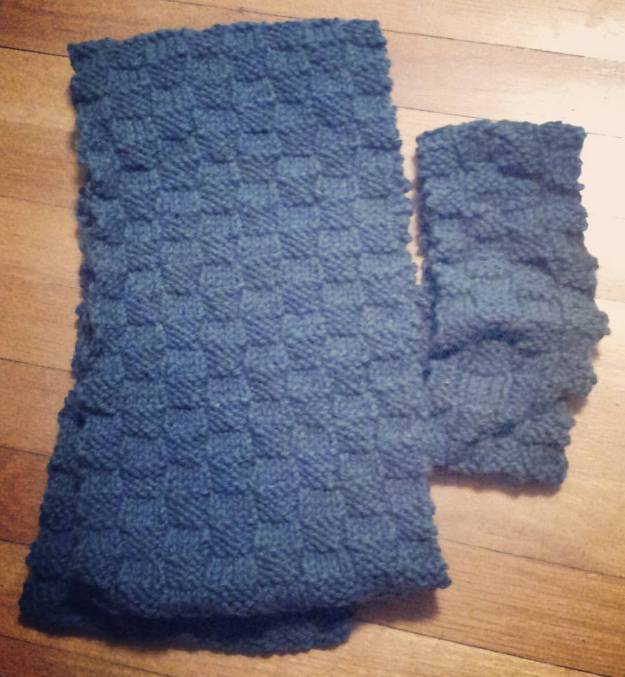
knitting scarves and headbands in basket weave

This year I made a few headbands and scarves to give away as Christmas gifts. I’ve done this before, but this year there’s a marked improvement in the quality if my stitching. I’m using better yarn (wool and wool blends) and experimenting with different stitches. This year, I learned the basket weave stitch, which is featured here.

For the basket weave, you cast on the number of stitches that you want. (It has to be a number that is divisible by four.) Then you knit four, purl four, knit four until you’ve reached the end of the row. You turn it over, and you repeat: knit four, purl four until you’ve reached the end of the row. In each new row, you’re actually knitting and purling the opposite of what you stitched in the previous row. Repeat this knit/purl pattern for four rows, and then reverse it. Purl four, then knit four until the end of your row. Continue switching it every four rows until you’ve reached the end to create the basket weave texture.

The end result should look something like this:

12496298_10208685273635683_3237265430737643510_o.jpg

basket weave

For my first attempt, I made a scarf that had about seven inches of basket weave on both ends and regular knit stitch for the rest of the scarf. I didn’t love the way it turned out. In addition to the ends, I think continuing the basket weave stitch along the sides of the scarf would’ve created more continuity throughout the piece. So, I’ll continue to experiment with that.

Here’s a picture of the first attempt that paired basket weave paired with a regular knit stitch:

12489378_10208685271595632_5758091019624433059_o.jpg

scarf and headband with Patons Classic Wool (worsted) in Dark Grey Mix

What I think really turned out well was the scarf done entirely in basket weave. For it, I used Patons Classic Wool worsted in Jade Heather and US 7 (bamboo) knitting needles. I made a headband first, and then used the remainder of the skein on the scarf (which could’ve been longer).

Here’s a picture of the scarf and headband that I liked the best:

12469438_10208685274755711_2153974380356381323_o.jpg

scarf and headband in Patons Classic Wool (worsted) in Jade Heather

For the headband, I cast on 16 stitches, and then proceeded with the basket weave until it fit snugly around my head. Then, I cast off and stitched up the ends of the headband with the loose ends of the yarn and tied it off with a simple knot.

For the scarf, I cast on 32 stitches (and this width was absolutely perfect). I then proceeded with the basket weave until casting off at the end of my skein.

I’ll definitely continue with the basket weave. Once you get the hang of it, you can do it pretty mindlessly (while watching tv, road tripping, etc.), and the end result creates a lot of nice texture and depth.

August: Osage County by John Wells

Let me start by quoting Cam from Modern Family, who astutely observed the following: “Excuse me, Meryl Streep could play Batman and be the right choice.” And I agree.

I watched this during a movie night with my mom. She was working on her art, and I was knitting, and we made the mistake of watching it after Terms of Endearment, which is perfection and nothing else can be said about it.

image from amazon.com

Netflix then suggested we watch August: Osage County directed by John Wells. This film has good acting all over the place. Each member of the stunning ensemble cast absolutely shines–as you would expect. Except there are so many other problems with the film that I started to marvel that the actors could pull off these impossible scenes.

So, first: melodrama. This film is melodrama. Midway through the film, Meryl Streep is running wildly through a hay field, chased by her reticent daughter (Julia Roberts), and the audience is just sort of embarrassed, and tired, and no longer buying in (even though we wanted to! even though we love Meryl Streep and Julia Roberts!). The scene where they’re running through the field and the very long, après funeral dinner scene are so over the top that there’s no recovering. The melodrama might go over better on stage.

That said, the film does deal with compelling emotional content and succeeds at pairing emotional content to characters, but struggles with putting those emotions to plot and story. The film deals with powerful stuff: struggles with addiction, unhealthy boundaries, and loving and withholding. With more subtlety, this film could have been spectacular.


Trumbo by Jay Roach

At this point I’ll watch Bryan Cranston do anything, which is why I went when I had a chance to see him in Trumbo, directed by Jay Roach. Diane Lane is always exquisite, and Louis CK’s in it too!

image from imdb.com

This film felt long. It’s about two hours and fifteen minutes. It took me awhile to warm up to the characters. I’m a big Louis CK fan, but it took me awhile to buy him in a dramatic role. (He gets there, don’t worry.) Though the whole film felt somewhat rigid at first, it does warm up and pick up so that it is not dragging at the end. While I left the film feeling satisfied, I still think it could’ve been edited more aggressively.

Politically, the “red scare,” and McCarthyism is a fascinating and disturbing (and ongoing?) part of US history. It doesn’t take much to engage me on the topic. Yet, I had a hard time getting into this film. That said, it is worth watching. Because it picks up. Because it’s beautiful. Because it rises to something interesting and important.

Now, let me break it down. First, the smoke. These people are smoking constantly, and the cinematographer is having some fun with it. There are these glorious shots of white smoke swirly slowly and intricately around people’s faces. There’s a smoke shot toward the end that is absolutely over the top. Thick white smoke swirls through each grain of thick, gray mustache hair, and it’s both repulsive and lovely and artful.

And on that note, I’ll also talk about Bryan Cranston’s physicality—something I think he’s understood for his entire acting career. (I first noticed it in his Malcolm in the Middle days). He, more than anyone, knows the power of an ordinary middle-aged man wearing tighty whiteys, and he’s not afraid to use it.

Finally, the design. This was L.A. in the 1940s and 1950s. Every couch, every glass of water, and every earring is on point. I was busy watching the design elements while I waited for characters to develop and the plot to pick up, and that was more than enough to keep me satisfied.

shelter from the storm

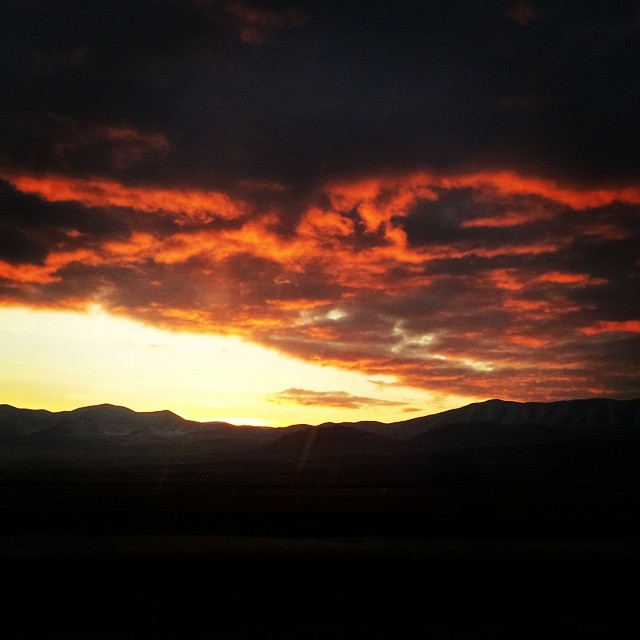
red skies over Utah

red skies over Utah

I go back and forth on whether or not a relationship is right for me. If I look at my adult life, I’ve gone back and forth between being single and coupled in practice too. So, assuming I’m doing what serves me, maybe I need a combination of both worlds.

That said, today is one of those days when I wish I was coupled. You see, I “put myself out there.” Professionally and creatively, I expose myself, I write, I share, I create, I publish, and that opens me up to failure, criticism, and rejection. I’m used to it. It’s par for the course. In many ways, I view failure as an important part of the process—a sign that I am pushing up against my potential.

However, sometimes rejection and pushback is hard to take. Sometimes it hurts my feelings, sometimes it feels bad, and in those moments, I crave a soft place to land, to come home to someone who is close, understands the project, and what’s at stake. I crave to be with someone who is invested, someone who can comfort and offer suggestions on how I might view things differently.

In so many ways, I can see how writers, artists, musicians—people who expose themselves to failure and criticism—would benefit tremendously from an intimate support person, someone to remind us that we are not alone in what sometimes seems like a sea of crushing criticism. I benefit from having close people who can reiterate the story that I’ve been telling myself for years—to get up and try again. If I can, I must. 

Silver Linings Playbook by David O. Russell

I know I’m a few years behind with this one, but Silver Linings Playbook is on Netflix, so I finally watched it. All stars are brilliant in the film, but Jennifer Lawrence was a bad casting choice. She is still too young to bring the necessary complexity to this character. She needed to be world-weary, but soft, broken. With her husky voice and masculine (beautiful!) characteristics, I had a hard time believing her in this role. The topper is that we are supposed to believe that, in her spare time, this woman enjoys somewhat serious, competitive dancing. Dear Jennifer Lawrence provides a one-two punch of beauty and real acting ability, but she is not graceful by any stretch of the imagination. Based on what I’ve read of her in interviews, she embraces a boyish sense of humor and boyish way of moving through the world. I think even she would agree that being cast as a dancer is a bit of a stretch.

First, the beginning: what’s really innovative about this film is the role of bipolar disorder and Bradley Cooper’s portrayal of that mental illness as it evolves throughout the film. As the movie progresses, it becomes clear that other characters, the father, the long-suffering mother, the leading lady, and even the best friend, are all really struggling with their own, very real, mental distress. The main character, Pat, has a troubled relationship with his father, which is increasingly revealed as very controlling and made a significant contribution to the main character’s distress.

***spoiler alert***Ok, here’s where the real spoilers begin because I’m going to talk about the ending. In the end, Pat (Bradley Cooper) ends up falling in love with Tiffany (Jennifer Lawrence), and I’m not sure what to make of it. On one hand, it is a “happily ever after” ending that does not do justice to the complexity that is established earlier in the movie. It also comes as somewhat of a surprise. While it is clear that Pat is beginning to lust after Tiffany (as does the audience), a more substantive connection between the two is less clear. Still, okay, they fell in love, Pat and Tiffany live happily ever after while mom continues to make snacks for the big game and dad continues to recklessly gamble away the family’s financial security on football. Somehow, these two mentally ill people manage to heal each other and all is well and saved forever the end.

The second reading is much darker, it’s my own, and I highly doubt it was the intended interpretation. It is that Pat is a vulnerable person, still suffering deeply from a bipolar breakdown. Because of long-term manipulation and mental illness from his own father, Pat is used to unhealthy intimate relationships. When Tiffany comes along and lies and manipulates her way into his life, he recognizes it as the dysfunction to which he is accustomed, and he is unhealthy enough to get caught up in the troubled relationship. Tiffany will continue to exploit the relationship to its inevitably volatile end, and Pat will repeat his bipolar breakdown cycle because no evidence of new learning, growth, or healing ever really occurred. If you ask me, it’s a dark, messed-up film ending indeed.

Birdman by Alejandro González Iñárritu

I watched Birdman over the break, and it’s a spectacular film worth seeing, especially if you haven’t already watch Aronofky’s The Wrestler or Black Swan—all portrayals of big celebrity personalities who have lost touch, or are losing touch, with reality. While Aronofsky is probably wondering how Alejandro González Iñárritu got ahold of his script, viewers are growing weary of the possibility of seeing suicide and self-harm, as emotionally unstable characters linger closer and closer to dangerous edges.

Michael Keaton is wonderful and nuanced and vulnerable, as are Edward Norton, Naomi Watts, Andrea Riseborough, and Amy Ryan. Emma Stone, who I love in over-the-top comedic and big blockbuster performances, seemed less capable of a performance en par with the work of her colleagues. It can’t be fun to be the novice among acting giants.

In part, the movie provides a delightful and smashing critique of…well, critique. And so, I am aware of the complexity of my own participation in the writing of a critique of the film. Bottom line, it was a pretty good film, with great actors, who did their best to bring new light to material and subject matter that has already been done to perfection by Darren Aronofsky.