Me and Earl and the Dying Girl by Alfonso Gomez-Rejon

Me and Earl and the Dying Girl is a very Sundance-y Sundance movie, but it’s good! Sundance loves some great films, and this is one of them. First, this is indeed a movie about a dying girl. Because the title is so straightforward, I somehow thought it wouldn’t be so dark, but it was.

image from imdb.com

image from imdb.com

I also rewatched Mad Max: Fury Road this week (stay with me, it’s relevant!) and have continued to find meaning in the war boys’ concept of a “witness”—this idea of being witnessed in our acts of bravery, our acts of love, our acts of dying—all of it. It’s meaningful to me because I’ve always been so independent and only in the last few years have begun to understand the value of an invested witness.

I mention it because an important aspect of M&E&DG is that a very young man is witness to a dying girl. It’s something they stumble into, they resist, but, of course, it becomes meaningful in ways they couldn’t’ve anticipated or even previously comprehended. That kind of character growth and insight was lovely to watch, but it was also sophisticated enough that I think most audience members come away with deeper insights about what it means to connect more to “their people,” moving beyond assumptions and into really knowing another person.

One of the best moments in the film is when the cool history professor talks about how he lost his father at a young age. He said that even after his father’s death, he’s continues to learn about him. His father’s life continues to reveal itself. It started when his dad’s friends started sharing stories after his death. It continues all the time, in unimaginable ways, even decades later. I think the point here is that learning about our dead loved ones is part of what it means to be alive and self-aware.

As for me, I continue to learn about my own grandmothers. Both my great grandmother and her daughter (my mom’s mom) were a huge part of my early childhood. My great grandma even lived with us sometimes during the winter. She just stayed. She was Swedish. She was very quiet, and she loved me.  My grandma and great grandma died within two years of each other. They were a big part of my childhood, and then, in a relatively short period of time, they were both gone.

For awhile, it was sad, but okay, and this is the natural cycle of life. And then, I got really curious about them and asked my mom and aunties lots of questions about who my grandmothers were. I began to piece together my memories with their stories.  Over time, I can see how much the course of my life has been shaped by their influence. Decades later, I’ll remember idioms and wisdom about how to grow a garden, how to love one man. They suffered and loved for decades, and don’t we all? I am a witness to it all. There is meaning where meaninglessness wants to creep in. It reminds me that I am part of something bigger, family, culture, blood, brains. They are with me in memory and in my story, and that’s what I took away from M&E&DG.

The Imitation Game directed by Morten Tyldum

The Imitation Game, starring Benedict Cumberbatch, depicts a fascinating part of human history when war-time code encryption lead to massive breakthroughs in computing. This was thanks in no small part to the genius of Alan Turing. Understanding this history seems even more important when I think of the pervasive role of computers in my daily life: the bane and the joy.

image from google image

The history alone is deserving of a film. I would’ve loved to see even more details about how the early encryption machines worked and how the cryptologists did the work of encryption. The audience sees that they are working through a process of elimination within the limit of an 18-hour period. I’m sure that this is plenty of detail for an audience, but I was curious to know more. I also wanted to know more about how the “computer” worked–though the audience does get some idea of how the machine worked with algorithms and trial by elimination to crack the code.

In my view, Benedict Cumberbatch absolutely earned an Oscar, portraying a convincing (and interesting!) emotional transformation throughout the film. The film goes a bit awry when it forces some emotional drama and personal upheaval between Turing and Clarke, which seemed particularly forced. It follows the conventional romantic comedy pattern of connection, disagreement, and then reconnection. To be fair, Clarke and Turing’s relationship gets a bit more complicated toward the end of the film.

What’s really interesting is Turing’s emotional attachment to his childhood friend. That inner turmoil is unique and moving and, in my view, would’ve provided enough emotion to carry the film. Like the innovations in computing technology, in the relationship between Turning and Christopher, we see something new, unexpected, and complex.

blueberry, zucchini, chia seed, & walnut muffins

My refrigerator is full of zucchini—zucchini that I fully intend to cook, but don’t necessarily think I can eat, so I decided to reimagine my not-too-sweet breakfast muffin. Once school starts, I’ll want something I can easily take with me, something that is not too sweet. My solution is these muffins that are dense in seeds and nuts, which I’ll freeze and use as needed. Since they’re not very sweet, I’m fairly certain these are not a “crowd pleaser,” but they work for me.

beware the berries do explode

beware the berries do explode

Here’s what I did:

Blueberry, Zucchini, Chia Seed, & Walnut Muffins
Preheat oven at 350. Mix together dryish ingredients. Mix wet ingredients separately. Then, combine the two. Lastly, fold in chunky ingredients. Spoon dough into muffin tin. I used muffin liners, but I think those are optional. Bake at 350 for about 20 minutes or until done. (Insert and remove toothpick. Muffins are done when the toothpick comes out clean.) Let cool for 15 min.

Dry ingredients:
1 cup gluten-free flour blend
¾ cup oats
shredded flax (2 heaping tablespoons)
chia seeds (3 heaping tablespoons)
½ teaspoon cinnamon
¼ teaspoon cardamom
½ teaspoon of fine sea salt
1 teaspoon of baking soda
1 teaspoon of baking powder
½ cup of light brown sugar
lightly sprinkle ground ginger and ground cloves

Wet ingredients:
1 teaspoon vanilla extract
½ cup vegetable oil
1+ egg
2 cups shredded zucchini (I just blended it this time)

Chunky ingredients:
walnuts 1+ cups
blueberries 1+ cups

Enjoy!

round 4: knitting a baby blanket (with pattern!)

For years I did not like crafting. It seemed like the antithesis of art, and art was what I was after. However, that’s shifted for me in recent years when suddenly things like tying knots with sticks and stitching little squares into aida cloth has seemed strangely satisfying and important. I’ve even developed a few philosophical justifications for crafting. (And I’ve been delighted that people in my own field of study have taken up the subject as well.)

Recently a colleague,  who takes crafting above and beyond anything I will ever do, stopped by my office to talk about the stuff we’re making, and I was motivated to put together this post about my last baby blanket. I made it as a gift for my cousin’s daughter. Her son got one when he was born, but I hadn’t made one for the older daughter. My homemade blankets have imperfections (which makes them unique! which isn’t something everyone values!)), so I was delighted when my cousin’s husband mentioned that their son loved his blanket and used it all the time.

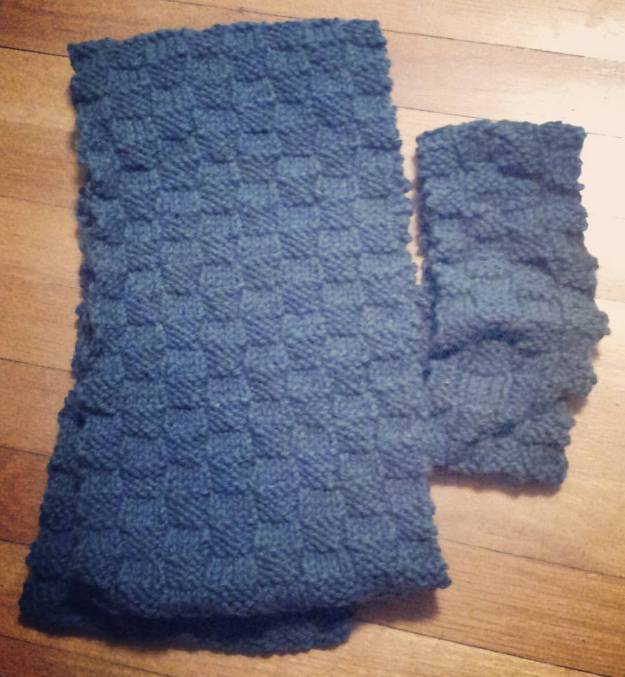
Here’s the blanket that I made for my cousin’s daughter. I’ll be using this pattern again. I think it is my best baby blanket to date.

Loops and Looms—Lavender

skein of Loops and Looms—Lavender Blues

I used four skeins of Loops and Threads: Country Loom – Lavender Blues. To start, cast on 73 stitches and knit five rows.  Then, to create the border, knit four (mark) add increase, then knit across for 63 stitches. Add another increase, (mark) and then knit the last four. In the next row, knit four (mark), add increase, and then alternate between decrease/slip, increase/knit stitch all the way across for for 63 stitches. At the end, add increase (mark), and then knit the last four stitches.

increase/decrease stitch border

increase/decrease stitch border

For the body of the blanket, continue to knit four (to the mark), increase, knit across (for 63), increase, then knit the last four. For the next row, knit four, then decrease, purl across, decrease again, and then knit the last four. Continue to alternate between knitting/increasing rows and purling/decreasing rows. Stitch to the desired length. I ended on knit stitch (with increases on each end before moving on to border).

At the very end, knit four, decrease/slip, increase/knit (for 63), then knit the last four stitches. That creates the last border edge. Then, knit the last five rows, and cast off.

finished and folded

finished and folded

Maybe Mad Max: Fury Road Is Not So Feminist After All

As I mentioned in the previous post, I’ve been absolutely blown away by the response to the new Mad Max: Fury Road film. The critics absolutely adore this film, and early on started claiming that the film is feminist. Social media has been blowing up with articles about the film. Mostly, I’ve been surprised and pleased that everyone else is noticing what, for a long time, felt like my own little secret.

Beyond that, I’ve been a little uncertain about the most pervasive argument. which is that the film is feminist. While there are many forms of feminism, and this film might encompass some of those interpretations, I’m not entirely convinced that this is a feminist film. In my view, simply adding female characters, and even a female lead, is not enough to make it feminist.

According to the Bechdel test, a movie has to have A) at least two women, who B) talk to each other, about C) something besides a man. Of course it’s shocking that so few films can pass the Bechdel test, but, in my opinion, just passing the Bechdel test is not enough to make it a feminist film. It’s just enough to make it not “problematic” and maybe not sexist. Sadly, however, with so few women represented in film, maybe this is all it takes to earn the “feminist” label. I, however, want a little more.

Yes, Fury Road has female characters, and yes they talked to each other, but did they ever talk about anything besides men—their captors who kept them in chains? Maybe a little bit. Not really. Their entire raison dêtre is a reaction to the men in power. The film is about reacting to a corrupt and toxic system of power, so maybe that could be construed as feminist, but a better reaction to the corrupt political system was never clearly defined (though perhaps implied here and there). We see women acting out of desperation. In my view, the film is mostly about a strong female lead with an action/reaction that may not be clearly feminist, but is (at least) not incredibly sexist.

Mad Max: Fury Road directed by George Miller

I saw Mad Max: Fury Road on opening night. I don’t watch many action movies, but I had to see this one. I had all kinds of weird memories like fever dreams about watching Mad Max: Road Warrior and Mad Max: Beyond Thunderdome with my brother when I was probably too young to be watching them. Through I hadn’t seen the films in decades, life often reminds me of Mad Max films. Frequently, when driving over Point of the Mountain, Utah, I feel like I am in a Mad Max film. Everyone increases their speed to about 80 miles per hour, semis barrel past me, shaking my little car, and motorcyclists with no helmets (and sometimes no shoes!) race past me in the fast lane. Once I saw a guy smoking a bong while driving. It’s just nuts out there, and it always reminds me of the apocalyptic lawless motifs of old Mad Max films.

I frequently reference Mad Max films, but don’t get a huge response from people. It had felt like I’m the only one for whom those films where impactful. In the weeks leading up to the release of Mad Max: Fury Road I rewatched both Mad Max: Road Warrior and Mad Max: Beyond Thunderdome to  prepare. The opening scene to Road Warrior is pretty great, but after that I began to doubt my ability to watch the old films. It seemed too much had changed, that they didn’t hold up over time. But, I persevered and found that, with some patience, both films do hold up in doing what they do best, which is to create a really specific and unique theme and motif that is carried through all of the Mad Max movies—and it’s a really weird motif that I absolutely love.

So, I went to see Fury Road on opening night and was blown away. I couldn’t’ve anticipated what it would be like, but I was delighted at every step of the way. Every image and moment is dedicated to building that same weird and delightful motif that George Miller creates in his other films—but even better this time. It looks like he took the time to add every layer and element that he wanted to add to the story, and it was so fun to see all of the references and connecting work throughout the piece. So, yes, I was already going to like this movie because I had a lot of nostalgia and positive bias, but even so, I still think the film is genius. It surpassed my expectations by a mile.

My Body Is a Book of Rules by Elissa Washuta

image from amazon.com

image from amazon.com

For those of you who miss the bygone days of the grad school creative writing workshop, My Body is a Book of Rules by Elissa Washuta is going to be your jam. It fostered in me nostalgia for those rapid cycling days of pushing myself to the psychological and intellectual limits to produce the wildest new thing imaginable only to discover it’d already been done, and better, and then I was back to the drawing board, and I did this on repeat for a couple of years until maybe (maayyybee) I really did create a few new things.

Washuta’s book has the messy feel of a creative writing workshop. In many of the sections, you can almost imagine the writing prompts to which she’s responding. Readers unfamiliar with this kind of (independent?) prose could very well be put off by this book. And to be fair, even as far as independent presses go, this book has some clunky, first effort moments. As a reader, I was okay with these moments because I was just so glad to be reading something new and different and good and incredibly personal and raw. Maybe too raw.

It’s difficult to write about one’s own mental illness without seeming off-puttingly self-indulgent, and Washuta is aware of this problem and bravely soldiers on. Her themes are so smart—a beautifully nuanced commentary on interactions between race, gender, government, and society. It’s weird. Life’s weird.

Interestingly, both Lena Dunham and Washuta published their books last year and both sometimes use a footnote method, where they break down a piece of text (such as their online dating profile or food journal) with footnotes. The footnotes are so great and so real. It feels very intimate. The only downside (and it’s a big one for me) is that you’ll get vertigo from going back and forth between the original text and the footnotes.

Here are some words I loved:

First, the title: My Body is  Book of Rules is genius.
Next, a chapter title that she should’ve saved for the title of her next novel: “Faster Than Your Heart Can Beat.”

Her descriptions of bipolar:

“…decreased social judgement” (12).

“…a window left open to let the murderers in” (13).

Commentary on Cosmo’s “sex tips”:

“…definitely don’t forget his sack” (18).

Her literary criticism:

She nails her analysis of Catcher in the Rye (a book with which I was previously enamored) like I’ve never seen before when she writes that it “Talks about what’s wrong when that’s not really what’s wrong” (63).

Her insights on life:

“Hope is the thing that comes before the very fucking scary thing” (135).

“do it because you want to, so badly, because you can’t not” (176).

“I am enough” (177).

“Nowadays, when someone else wants to reach me, they get a perpetual busy signal while I whisper sweet nothings to myself late into the night” (177).

“Perfection is hard to stomach” (183).

Outline: A Novel by Rachel Cusk

image from amazon.com

image from amazon.com

Outline by Rachel Cusk was something different. I haven’t read popular fiction in quite a long time, and I was worried when, in the beginning, the main character becomes engaged in a conversation with her “neighbor” on a flight to Athens. Through his line of questioning, we learn a little about the protagonist, which felt like a plot point contrived solely for the purpose of giving the reader information about the main character.

However, I liked the book and found the brilliance in that, as the protagonist meets several different characters, there are interesting and universal insights to be gained about human nature. For the most part, the characters themselves are very self-aware and analytical, sharing meaningful insights with the protagonist. Though, like all people, their assessment is not always accurate. Cusk presents these quirks and character flaws in entirely novel ways, but they resonate as true and important glimpses into the human psyche.

Interestingly, as the protagonist meets the various characters, Cusk’s voice or tone remains consistent throughout. So, there is little sense of the individuality of these characters. In many ways, the novel reads like an outline, a sketch, of the characters and ideas that Cusk is presenting.

The last character to enter the novel speaks about a troubling condition she’s gained, which she calls “summing up.” It prohibits her writing because just as she really gets in to writing a play, she finds the meaning creeping into her brain, words like “tension,” “mother-in-law,” or “meaninglessness.” Once she finds the significance of her work, she loses interest. In the summing up concept, the reader sees the ways in which Cusk has both avoided and indulged a summing up of the various characters and meanings in her own novel.

This section was also meaning to me because I’ve been stricken by the same sense of summing up since my early 20s. I was probably 21 when I realized, with a start, that every story is the same with few uninteresting variations. This is why I have a hard time with popular fiction. I have a longstanding joke, which is likely only amusing to me, that is called “I saw it the first time when it was called…,” wherein I liken every new book or movie to a book or movie that came before and grumpily deduce that it will offer nothing new.

Furthermore, I see the same patterns play out not just in movies, but in real people in real lives. I rarely think anyone is ever having a unique experience, and the result of that is, I suppose, a somewhat jaded view of the world. I’ve never known anyone else to sum things up quite like I do, and so to see it portrayed in a novel was strangely validating.

Here are a few ideas from the novel that I think render further discussion:

  • “The bump in the road hadn’t only upset his marriage; it caused him to veer off on to a different road altogether, a road that was but a long, directionless detour, a road he had no real business being on and that sometimes he still felt himself to be travelling even to this day” (15).
  • “The memory of suffering had no effect whatever on what they elected to do: on the contrary, it compelled them to repeat it” (18).
  • “We are all addicted to it, he said…the story of improvement, to the extent that it has commandeered our deepest sense of reality” (99).
  • “I had friends in Athens I could have called. But I didn’t call them: the feeling of invisibility was too powerful” (248).

What Happened, Miss Simone? directed by Liz Garbus

I heard rave reviews about What Happened, Miss Simone? at Sundance this year, but I didn’t get to see it at the time. As luck would have it, KRCL and the SLC Library brought it back for a free screening in Salt Lake. The producer, Amy Hobby, took questions from KRCL’s Eugenie Hero Jaffe. So, that was fun!

But, the film. The film. Nina Simone wasn’t on my radar until maybe five or six years ago, when someone posted a video of her performance of “I’ve Got Life” on Facebook. I watched it many times and got a few of her cds and now it’s a part of my life. I sing her songs with some frequency.

The film creates an arc and fall for her life, which was certainly messier and less clear in the living. She was dedicated to the piano at a young age. This dedication ran parallel to extreme oppression, where any wrong move could lead to abuse or even death by lynching. No wonder a small child would cling to something, anything—perfection. She was poised to be the first black concert pianist. She ended up paying the bills by performing in night clubs. One thing lead to another, and she became the preeminent jazz and blues singer of her era and beyond.

As the civil rights movement picked up, so too did her purpose. Her songs became more political. Her artistic passion and creativity flourished like never before, but her music was banned by many stations and venues that did not want to be political. The film outlines her tumultuous relationship with her husband, her relationship with her daughter. The film also reveals her struggle with bipolar disorder, which she dealt with at a time when very little was known about it (even less so than now).

I’m sure she was successful because most people feel the same way, but I really relate to Nina Simone. It’s not just that I’m practicing piano these days. There’s something about watching the slow steady rage building in her throughout this film that seems so very human, and so very understandable. When you have the luxury of not feeling rage, it can seem silly to outsiders. Once it begins to build within you, expressing it in any sort of effective way is nearly impossible.

The rage happens when you begin to feel less free. Like when suddenly, in very real ways, you are losing legal control over what happens to your body, and others lose control over what happens to their bodies, when you feel limited in your ability to move around in the world. Of course we limit our freedoms in various ways, which takes a lifetime to work through, but when others do the harm, that is hard to bear.

The rage happens when you are cracked open by love and that makes you capable of much deeper intensity than ever before. It’s all very thrilling and terrifying, and some people call it bipolar, and some people call it art, and they are not the same, but there is a shared relationship to control, creating, being, and doing things…differently.

Simone works, and works hard, to translate her rage into something useful, into art, into commentary relevant to the time period. She does this beautifully. Like good theory, the music and lyrics sometimes seem deceivingly simple, but build and grow in their complexity until you are moved to something completely new.

Leaving the film, I felt renewed. What might I do with my own moods, my own passions? How might I better express myself creatively? How might I create? I have some ideas. I do.

Yes Please by Amy Poehler

After reading books like Tina Fey’s Bossypants, Mindy Kaling’s Is Everyone Hanging Out Without Me?, and Chelsea Handler’s Are You There, Vodka? It’s Me, Chelsea, I was excited to read this latest one by a comedian. I’m a die hard fan of Saturday Night Live. I tend to love the work that comes from their alums–probably because they know all the good writers. Of her SNL bits, I mostly loved the ensemble skits she was in. Leslie Knope, the character she’s gone on to play in Parks and Recreation, is just great. When it comes to Amy Poehler, I like her, but I think she’s best in collaborative efforts.

Her book was not a favorite. If you’re a die hard fan and will read anything related to SNL, then read it. Otherwise, it’s okay to skip this one. There are funny moments, there are insightful moments, there’s biographical information, and there’s behind the scenes stuff from her work in comedy. But, there’s also a difficult self consciousness that doesn’t always work. Throughout, she complains about how hard and terrible it is to write a book, and those feelings begin to wear off on the reader. The book is repetitive in some ways that don’t seem intentional. The book’s organization is baffling. More importantly, the pages are thick and weird and glossy. What is probably supposed to be “good quality” comes off as too slick, and it makes the book too heavy. It will hurt your wrists while you are reading it in bed.

image from amazon.com

image from amazon.com

Here are a few lines for further discussion:

  • “Make sure he’s grateful to be with you” (202). This wisdom is via Poehler’s mother. It’s simple, but it resonated with me. I’ve had a few relationships for which I am (and was) very grateful. Like, look around at the sun shining and birds chirping and thank my lucky stars kind of grateful every day. With other people, not so much. Your level of gratitude for the other person says a lot.
  • “Hairspray was king, and the eighties silhouette…was big hair, giant shoulder pads, chunky earrings, thick belts, and form-fitting stretch pants. My silhouette was an upside-down triangle. Add in my round potato face and hearty eyebrows and you’ve got yourself a grade-A boner killer” (207-08). See, there were plenty of lolz! (Also, I want to reintroduce “grade-A boner killer” into more of my conversations.)
  • “And I count myself very lucky. That is what “very lucky” feels like. Oof” (235). These sentences ended a long paragraph on the various violences Poehler has endured–muggings, physical and sexual harassment, sexual violence–but never rape. She makes a powerful point here.
  • “‘Smile’ doesn’t really work either. Telling me to relax or smile when I’m angry is like bringing a birthday cake into an ape sanctuary. You’re just asking to get your nose and genitals bit off” (236). I like this for two reasons. One, being told to “smile” is a weird thing that men say to women. To be on the receiving end of this kind of command feels icky. Two, I love making jokes about ape violence despite the fact that it rarely draws laughs. I’m glad to see Poehler going for it here.
  • “[I]f you do start crying in an argument and someone asks why, you can always say, “I’m just crying because of how wrong you are” (237). This one made me laugh, and I hope I have the wherewithall to use it sometime.

**Edit: There’s also this place where she tells a story of having a casting director ask her to share her most embarrassing story. Poehler refused and didn’t get the job. Then, she told the reader that you don’t have to tell people your most embarrassing story when they ask. I liked that.